News and information that journalists need to serve the public and stay safe.
|
|
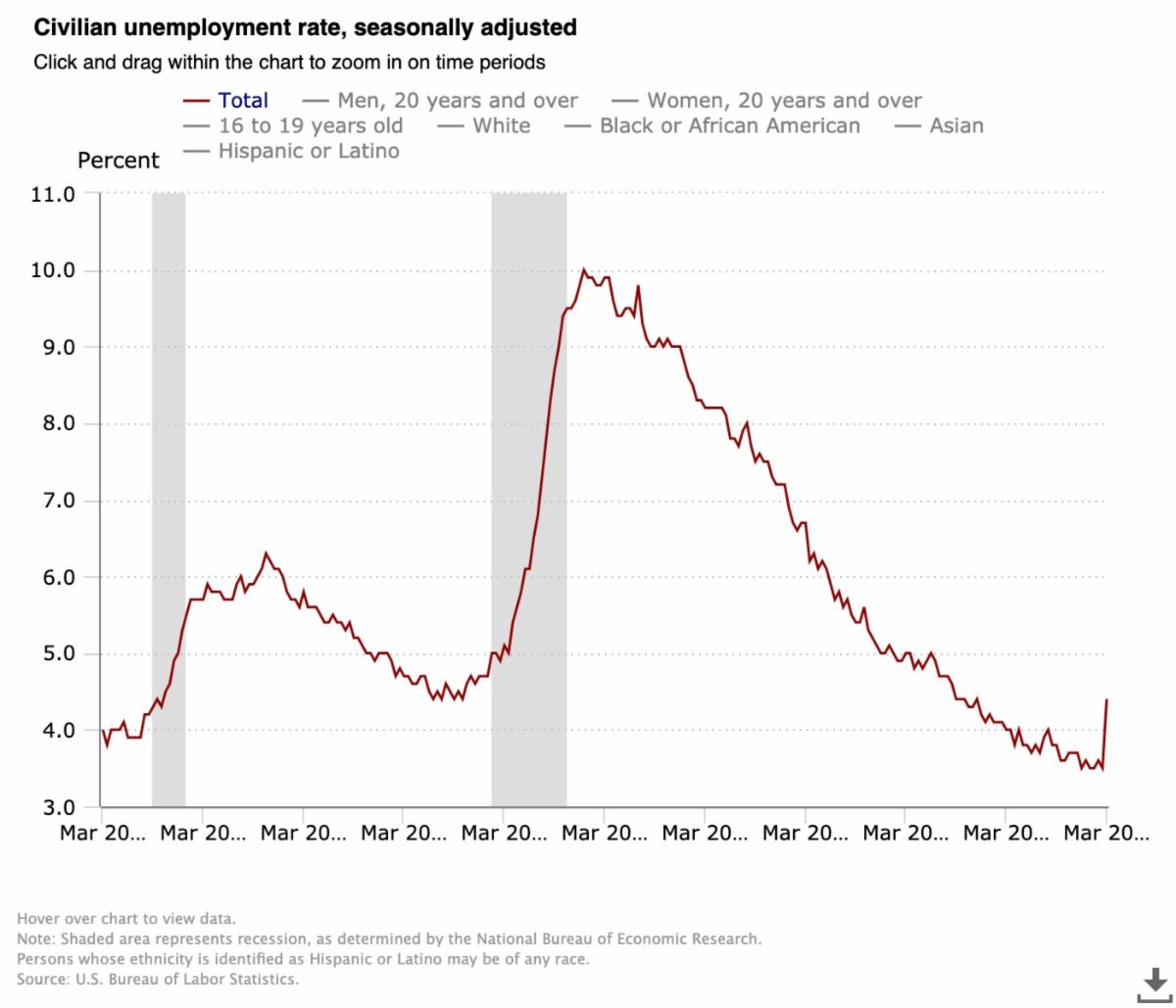
As a health story, the coronavirus is horrifying in its randomness, in its exposure of systemic flaws, in its tragic human toll. As an economic story, the pandemic is overwhelming in its scale and abruptness — the nation’s massive business and production engine at a sudden halt. How can journalists, particularly those at
smaller news organizations across the country, cover a macroeconomic story in Main Street terms?
Two friends of the newsletter,
Dave Skidmore
and
Mark Hamrick
, both veteran economic observers, shared their perspectives with us in email interviews. Some key takeaways from their responses:
- Be skeptical — gut-check your sources and information. The economic conditions the country faces now are unprecedented, and it’s impossible to determine when and how the economy will bounce back.
- Much of the economic data we see lags reality, which is unfolding much too quickly. But journalists will get a picture of regional economic conditions soon, when the Federal Reserve releases the Beige Book next week.
- Keep an eye on local and state governments — they have limited funds and will likely be forced to cut services or lay off workers.
- Every good story has a personal connection. Journalists should try explaining policies and how they affect people — and like Skidmore and Hamrick, you may reach different conclusions.
- With the combination of low interest rates and massive lending, look for unintended consequences and whether there is sufficient oversight.
“The best economic and business journalism I am reading now describes ordinary life in extraordinary times,” wrote Skidmore, who recently retired as assistant to the Board of Governors of the Federal Reserve and now is a consultant to the Brookings Institution’s Economic Studies program. “One great example is a
Washington Post piece
that described the pandemic's economic impact on a single block of Connecticut Avenue, about a five-minute walk from my house.”
Hamrick, the Washington Bureau Chief and Senior Economic Analyst for Bankrate.com, agreed: “
To learn about local issues, which may parallel national trends, speaking to sources in businesses, both large and small, will help generate good story leads and threads. Ultimately, all of this is about personal challenges and victories best told by the individuals involved themselves.”
Read on
for Skidmore and Hamrick’s insight on where to find good economic data, coverage mistakes to avoid, and what we can (and can’t expect).
|
|
L.A. Times journalist
Deborah Netburn
has been answering questions about the coronavirus for months, from
what it means for pet owners
to
how to explain it to kids
. But for the first time, she has added a caveat to her coverage: “One thing to keep in mind before we continue,” she wrote in her latest piece explaining
why some people are dying from COVID-19 and others don’t experience symptoms
. “It is possible that the information you read below will be contradicted in the coming weeks or that gaps in knowledge today will soon be filled as scientists continue to study the virus.” We asked Netburn, a science and features reporter, how the caveat came to be, what challenges she’s facing, and what she’s learning about explanatory journalism.
How did the caveat come about?
The caveat was inspired directly by something Dr. Edward Jones-Lopez of USC said to me early in our conversation. I asked him the very basic question — how does the virus make you sick — and about four words into his answer, he interrupted himself to say:
"I should start by saying the knowledge about the virus and the disease is changing almost by the hour. There is an explosion of information about this, and what I say right now may not be true tomorrow or some of the gaps I may refer to will no longer [be] gaps in a short period of time."
I wrote through the story and then added his caveat to the end of the introduction. I really wanted readers to understand that these guys are telling you what they know now, but this virus is so new to all of us, that even the experts are still learning about it.
What are you finding most challenging about covering this pandemic?
I feel a lot of internal pressure to rise to the occasion, be amazing, tell the most important stories, and demonstrate my dedication to the LA Times and journalism.
At the same time, I'm sad and scared and filled with anxiety, not so much about my own health, but about the devastating toll this pandemic is taking on so many people. I feel like a truly great and dedicated reporter would want to do nothing but work right now, but if I'm totally honest, I sometimes wish I could spend my days staring out the window, watching mindless television, baking and hanging out with my kids.
Being pulled in these two directions is very hard.
|
|
Bill Plante Chair in Leadership & Media Integrity, Loyola University Chicago
Freedom Forum Fellow in Women’s Leadership
I had a talk this weekend with an editor I respect. She’s leading ambitious and ever-expanding coverage of the coronavirus on multiple platforms. Her staff is serving the public’s insatiable appetite for trustworthy news.
But the editor worries that she’s letting her hard-working team down. She can’t keep up with the feedback they deserve.
On what once were her days off, she reviews great chunks of the week’s output. She wants to provide people worthwhile messages about their work; specifics, not generalities. But that commitment leaves her little time to recharge her own depleted batteries.
I know she’s not alone in dealing with these dueling goals — one that says “Lead the bigger picture for your team,” while another says “Deliver detailed feedback.”
It’s easier to juggle those goals when a crisis isn’t creating a tsunami of stories. It’s an ever- growing problem for managers today.
Let me offer two modest solutions:
- Grow the grapevine
- Go ahead and brag
The grapevine
consists of everyone — in all parts of the organization — who consume the product. So often, we read, watch or listen to something our colleagues have created and really enjoy it. We might even remember to compliment them on it, if we’re friends. But if we’re not close, we may keep our thoughts to ourselves. And it’s even less common that we’d respond to anyone’s good work by telling their bosses about it. That act is reserved for big problems.
Let’s change that.
Now is the time to “rat out” the good stuff to management. It doesn’t have to be an in-depth review, just a quick note with a nugget or two of detail that proves it’s for real. It doesn’t have to be for superstar performance. Darn good is sufficient. Just pass the message to management - or cc a manager in the note you send to your co-worker.
With this simple move, we can provide leaders a present they can shamelessly re-gift to staff.
What about the other solution?
Read on
.
|
|
|
Self-Care: Avoid chronic wrist pain
|
A key to your WFH comfort: Your
keyboard and mouse placement
. Dr. Karen Erickson, American Chiropractic Association spokesperson, advises placing a keyboard or keyboard tray at elbow height to keep wrists from flexing. Wrists should be straight, and wrist supports can help prevent flexing.
Dr. Erickson suggests the following gentle stretches to help prevent wrist pain:
- Hands in prayer position and open fingers apart, and gently push palms together, and heels of hands down.
- Shake your hands gently in different directions both when down by your sides, and again overhead.
- Place one arm in front of you with the elbow straight, palm down, and wrist flexed so fingers are pointing to the floor. Spread your fingers slightly and with the other hand gently press on the downward facing hand. Don't force here. Hold for about 20 seconds.
|
|
This newsletter is written & edited by the National Press Club Journalism Institute staff: Beth Francesco, Holly Butcher Grant, Jim Kuhnhenn, and Julie Moos.
Send us your questions and suggestions
for topics to cover.
|
|
The National Press Club Journalism Institute promotes an engaged global citizenry through an independent and free press, and equips journalists with skills and standards to inform the public in ways that inspire civic engagement. Support our important work with a tax-deductible contribution today.
|
|
|
|
|
|
|