News and information to help journalists serve the public and stay safe. |
|
As news organizations and the nation have responded to the coronavirus pandemic and the protests following the murder by police of George Floyd, journalists have increasingly confronted the need for newsroom equity and a truer relationship with the communities they serve.
The National Press Club Journalism Institute and PEN America will co-host a program on “Equity and community in local news: Lessons learned in 2020” to identify and share takeaways from pandemic and protest coverage and to look ahead toward election coverage.
|
|
For journalists who are parents, the stress may be about to get worse. Will schools open? Will children — again — have to learn remotely? Will the four walls of their house or apartment once again feel like they are closing in?
Journalists can be a resilient breed. They run to danger when others flee. They don’t cower in the face of authority. They persist when doors are shut.
How does that determination translate to parenting in a pandemic?
To what degree do journalists, considered first responders and essential workers in many respects, display resilient qualities? And how does that resilience translate to confronting the challenges presented by the coronavirus?
Duckworth: It’s in times like these where you're, ‘Wow, I'm being called.’ My cousin is a pulmonary emergency room doctor. And at the beginning of the pandemic, I asked her how she was managing. She was in the COVID unit and things were really terrible at that time. She said, ‘This is what I trained for.’
And I think that when you're really gritty it's often that you feel that way. I think maybe many journalists right now feel like, ‘This is what I trained for, right? Now's the time to be my best.’
And I’ve been very grateful to journalists throughout this crazy time for doing pretty heroic work.
How do you think children of people such as your cousin or of journalists perceive the work of their parents? Does that translate into a manifestation of grit with them?
Duckworth: It is a wonderful thing for a kid to wake up in the morning and they don't know exactly what's going to happen, but their parents seem to be purposeful and not completely overmatched.
If they don't have that, of course, it's not that either the child or the parent is necessarily to blame, right? I don't want to frame things that way. But I do think kids are always watching their parents. They are our first role models, and kids will try to figure out what the world is from how their parents are reacting to the world.
I'm a parent of a 17- and an 18-year-old, and, as I think they would agree, I'm not modeling perfection. I'm also not even modeling calm. They know that I'm more stressed than I’ve probably ever been. They know that I'm grinding my teeth at night. They know that I often have problems sleeping. And I don't think parents should feel the burden of being perfect role models or at least role models of perfection. But I do think trying to be role models that you're doing your best, I think that's what you're trying to model: ‘Mommy and daddy got up again and we made coffee and we’re doing our best, and we have some optimism that come what may — and we don't know what will come — we’ll be resourceful and as a family will manage.’
|
|
|
As racism and the treatment of people of color in and out of newsrooms has surged to the forefront of conversations, against the backdrop of a pandemic that disproportionately impacts people of color, journalists face many questions: When do ‘objectivity’ and ‘neutrality’ mask inequity? How do journalists move from covering protests to systemically telling stories that root out racist treatment in health care, education and other social spheres? And how can journalists practice antiracism in their everyday work?
|
|
“I don't have time to de-stress!” Sound familiar? Yes, Zoom meetings, interviews, deadlines eat up time like Pac-Man devouring blue ghosts. But groaning about it only compounds the strain.
So here are some short — fewer than 10 minutes — strategies and practices to reduce anxiety that don’t require a “temporarily away” notice on your Slack channel.
-
Breathing. Five minutes of slow, deep, meditative inhaling and exhaling will calm you and help clear your mind. You can use mindfulness apps, an online guide or simply breathe while mentally scanning your body from top to bottom.
-
Music. Even a few minutes of calming music can ease your anxieties. Or, if in a private space, find a favorite sing-along song and belt one out.
-
Freshen up or cool down. Take a break to brush teeth, wash your face, apply lotion. Or, you can try an extreme face plunge into ice water. They say it activates your diving response and resets you emotionally and physiologically.
-
Short yoga. You don’t need to take a class in the middle of the day to gain some benefit from yoga poses. Step away from your desk and try a child’s pose or downward-facing dog. You might even have time to stretch it into a plank before the phone rings again.
-
A short walk or a long stare. Step away from your desk and take a stroll through your house or apartment or into the backyard. If you’re worried about getting too far from your laptop, sit back and stare into the distance and take in your horizon. Throw in a deep breath or two.
|
|
Thanks, Jim Kuhnhenn, we’ll miss you! |
|
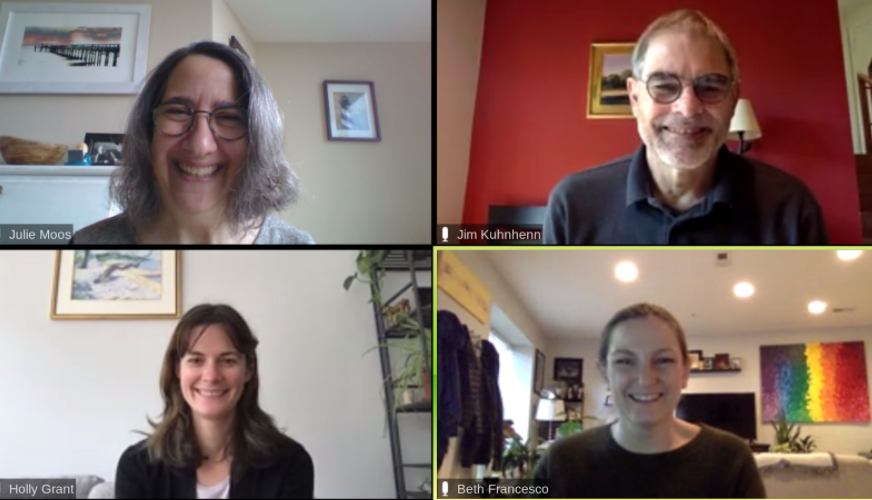
We couldn’t let today pass without saying a big public thank you to one of our core team members, Jim Kuhnhenn. Jim has been the Institute’s Press Freedom Fellow since June 2019 and is reaching the end of his fellowship today.
Jim’s steadfast commitment to removing barriers to press freedom in the U.S. and abroad has shaped meaningful action for the Institute and the National Press Club. He unpacks complicated First Amendment and FOIA matters with ease, has written at least a dozen press freedom statements, reported on many sensitive issues in this newsletter, produced programs with investigative journalists and with Terry Gross and Michael Barbaro, and so much more. Jim’s flexibility, creativity, and team spirit have been instrumental to the Institute’s success.
We’ll miss his talent and enthusiasm, his infectious grin, his incredible thoughtfulness, his devotion to our furry friends, and engrossing stories from his time on the Hill and off. He’s been a critical part of building the Institute’s foundation and future - and we wish him and the Kuhnhenn family our best as he embarks on his future without daily deadlines!
|
|
This newsletter is written & edited by the National Press Club Journalism Institute staff: Beth Francesco, Holly Butcher Grant, Jim Kuhnhenn, and Julie Moos. Send us your questions and suggestions for topics to cover.
|
|
|
|
|
|
|