|
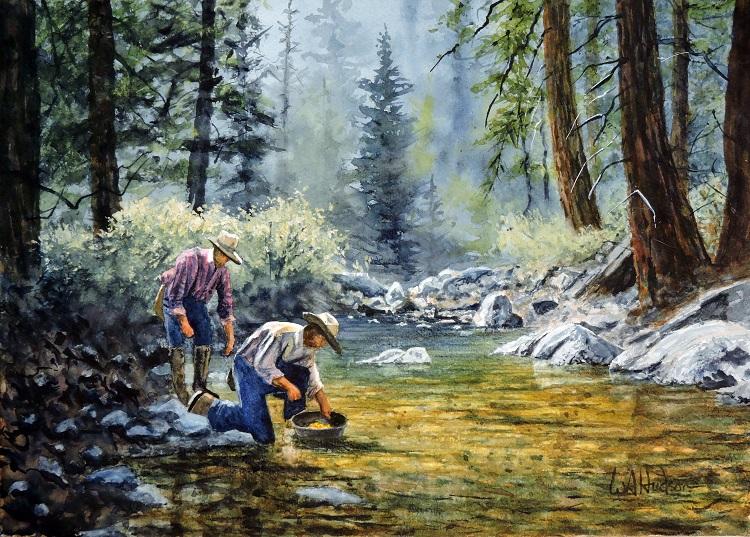
49ers
Watercolor, 14" x 10"
Original unframed ........... $600
| |  | |
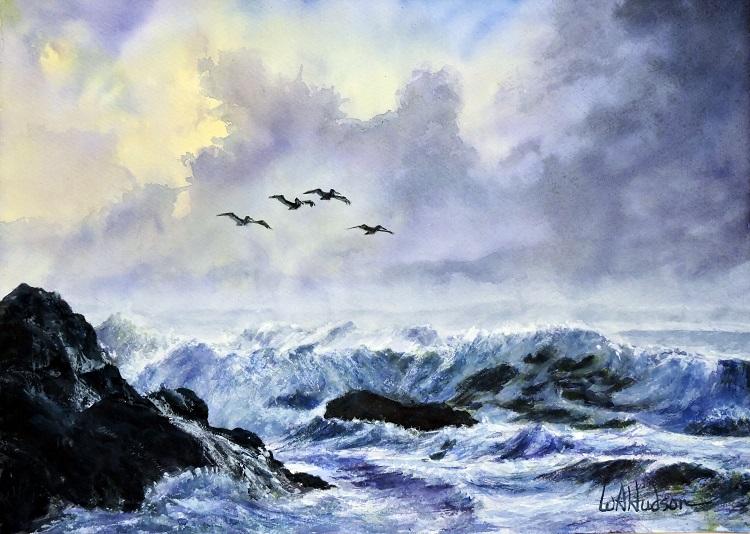
Pelicans
Watercolor, 14" x 10"
Original unframed .......... $600
| | | |
Every season I watch Gold Rush: White Water on the Discovery channel and marvel at how hard those guys work in dangerous, remote creeks of Alaska to pan, dredge, and sluice for gold dust, flakes, and occasional small nuggets. A full season may net 100 ounces, worth approximately $340,000, to be shared among 5 miners after the fixed costs (e.g. claim fees, fuel, equipment, travel, etc.) of each season are deducted.
And every year as we drive through northern California, I think of the geological events that led to the 1849 gold rush and discovery of huge nuggets in the mother lode… a few nuggets larger than 100 pounds worth over $5 million each if valued today at $3,380 per ounce.
Around 400 million years ago, California was under a large sea with active volcanoes erupting lava and minerals including gold onto the sea floor. About 200 million years ago, geological movements forced those volcanic islands eastward to collide with the North American Plate which was moving westward. The collision created huge pressure which melted the surface crust into magma that rose to eventually become the Sierra Nevada mountains. As the magma cooled, minerals with similar melting temperatures tended to concentrate together. Solidified minerals and rocks were raised to the surface and subjected to erosion and being carried downstream by water. Gold being extremely dense concentrated in pockets along rivers and streams.
* * * * * * *
| | |
Crabbin' In Oregon
...... by Bill Hudson.
| | |
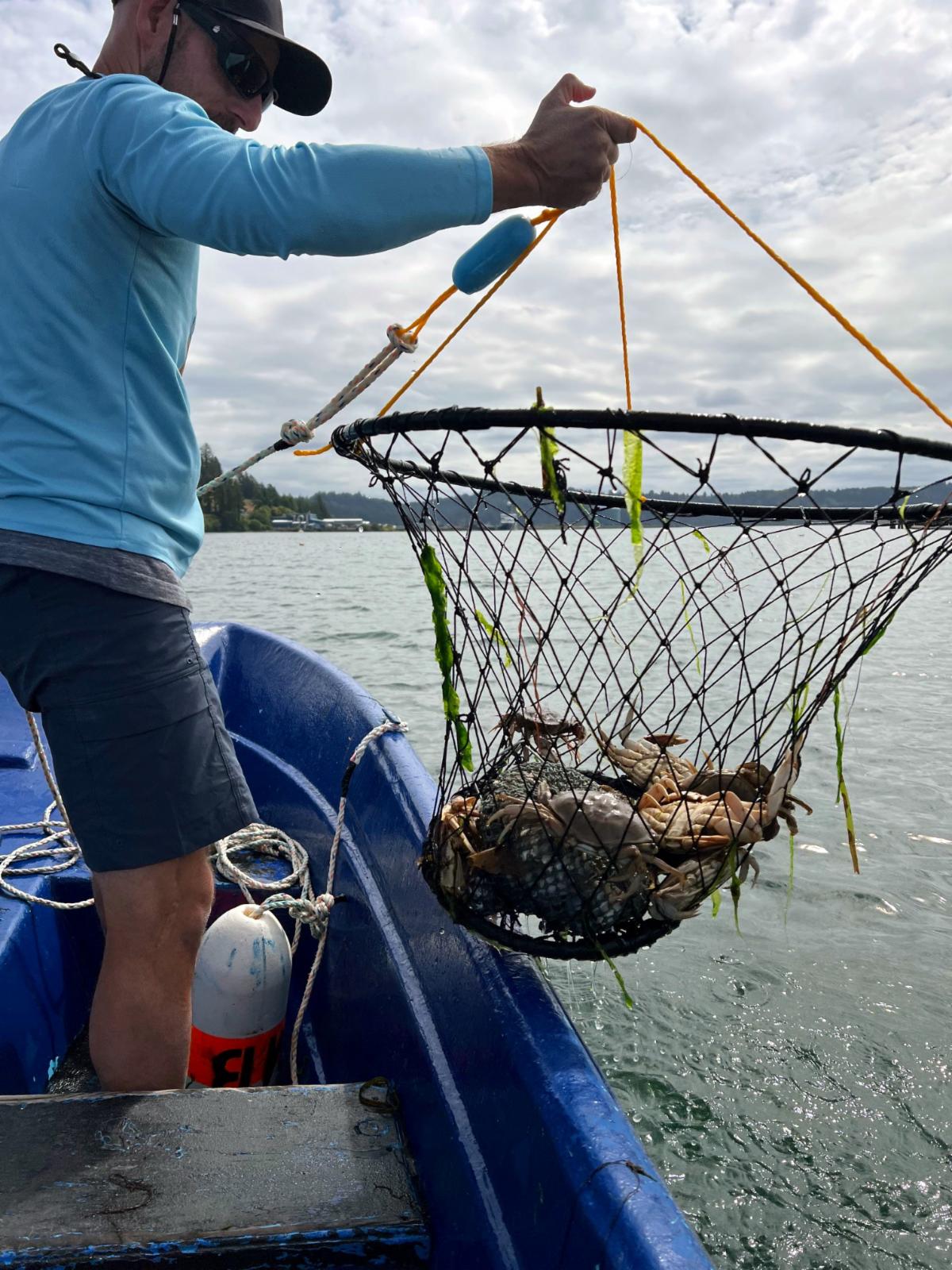
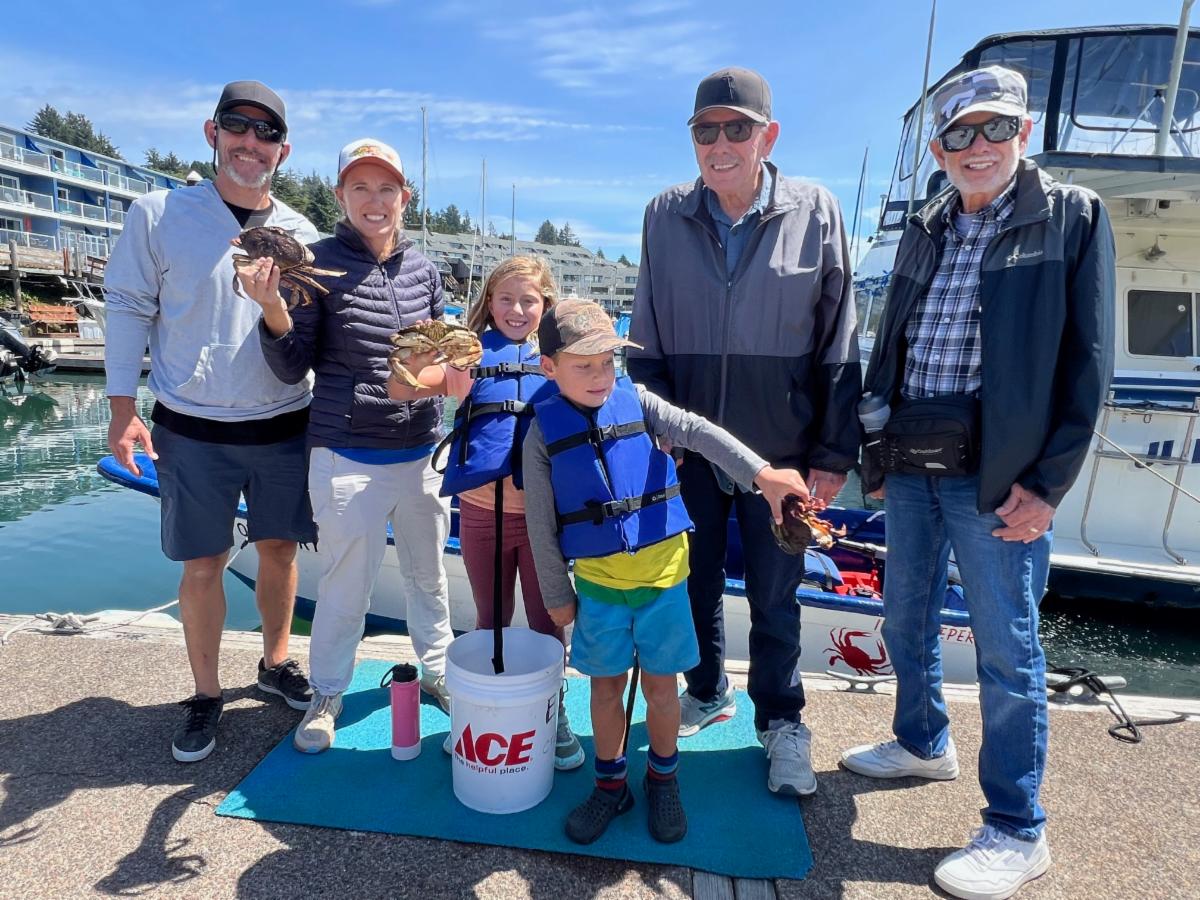
In 1999, my youngest son, Will, was recruited by Oregon State University to play shortstop for the Beavers baseball team in Corvallis. On my first campus visit, I took Will and several of his Southern California teammates 50 miles to the Oregon coast to do some recreational crabbing in Newport, OR. That trip, and that experience, cinched it for the entire Hudson family. Nearly every year since, I’ve driven up the Pacific coast stopping at harbor towns and spectacular northwest coastal areas capturing reference photographs for future paintings. The finale of each trip is spending a few days in Newport crabbing the Yaquina Bay with other family members … especially our grandkids. Catching, steaming (Maryland style), and eating crabs is a Hudson family tradition.
In Newport we rent a 4-man, motorized crab boat at the Embarcadero Resort Hotel in the harbor. Each boat is equipped with life jackets, three baited crab rings/traps and buoys, a day’s worth of gas, a long-handle hook to snag buoys, a storage bucket, and a plastic crab measuring device. In addition, each crabber, age 12 and over, must have a fishing license. Note: A Three-Day Nonresident Shellfish License is $19.
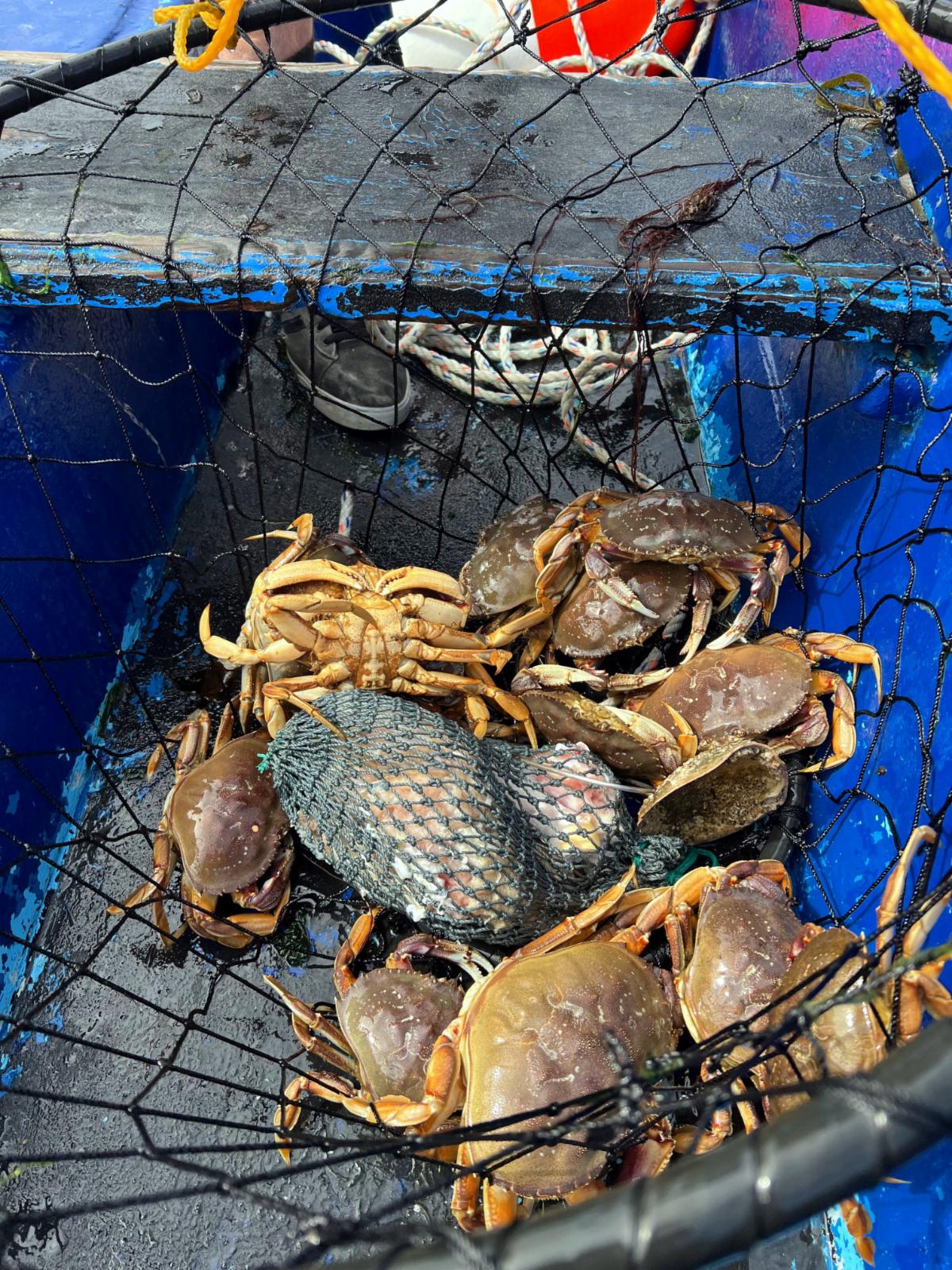
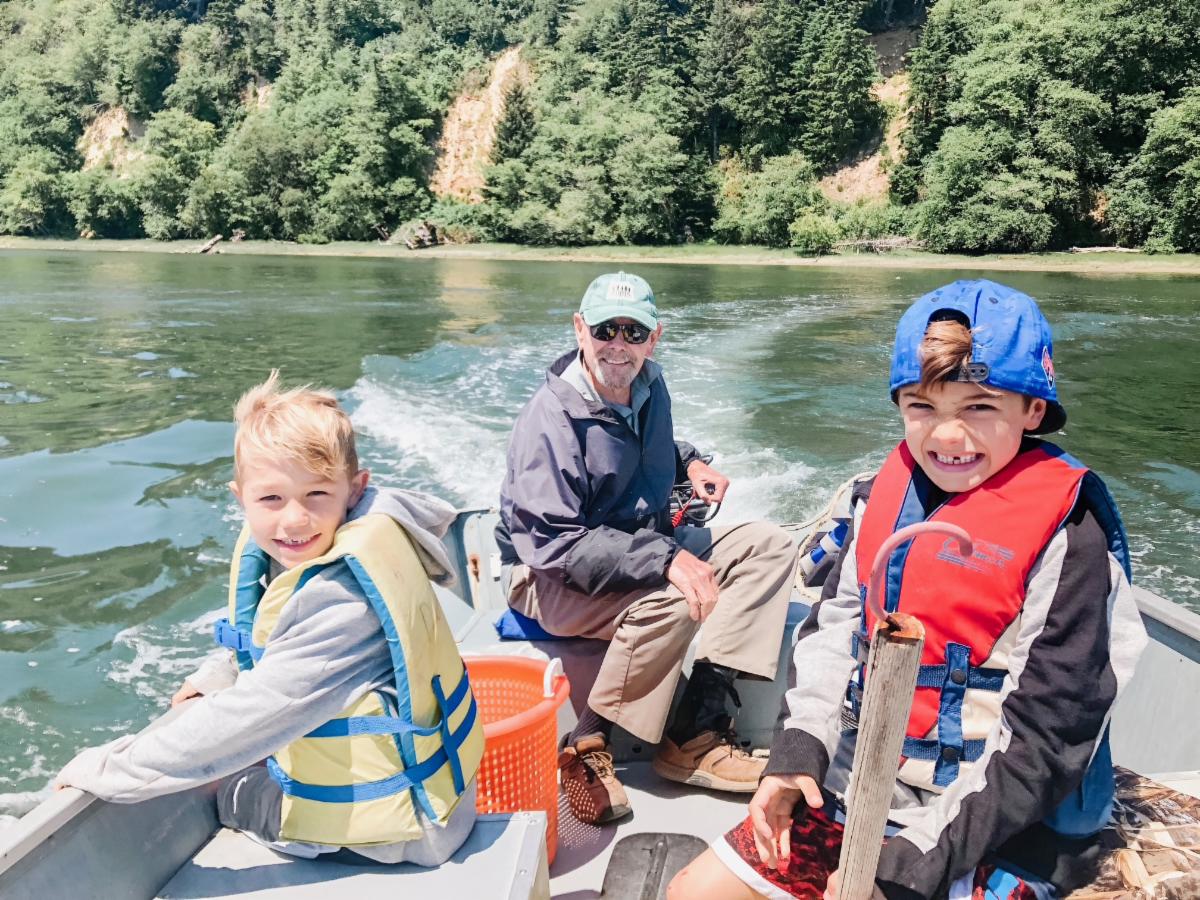
The beauty of recreational crabbing is the need for teamwork. Each person in that 4-man boat, regardless of age or gender, has a job. First the team decides where they want to set the rings. Usually they’re spaced 100 yards or so apart. Unlike large 3-dimensional crab pots that require an hour or so to attract crabs, crab rings lie flat on the bottom and need only 10-15 minutes to soak. So almost as soon as the three rings are dropped, they are ready for pickup and the team goes to work. Each mate is assigned one of these responsibilities:
Motor Man ….. He sits in the back of the boat with a hand on the motor. He steers the boat toward buoys, slows down upon approach, and throws it in neutral when the buoy has been snagged.
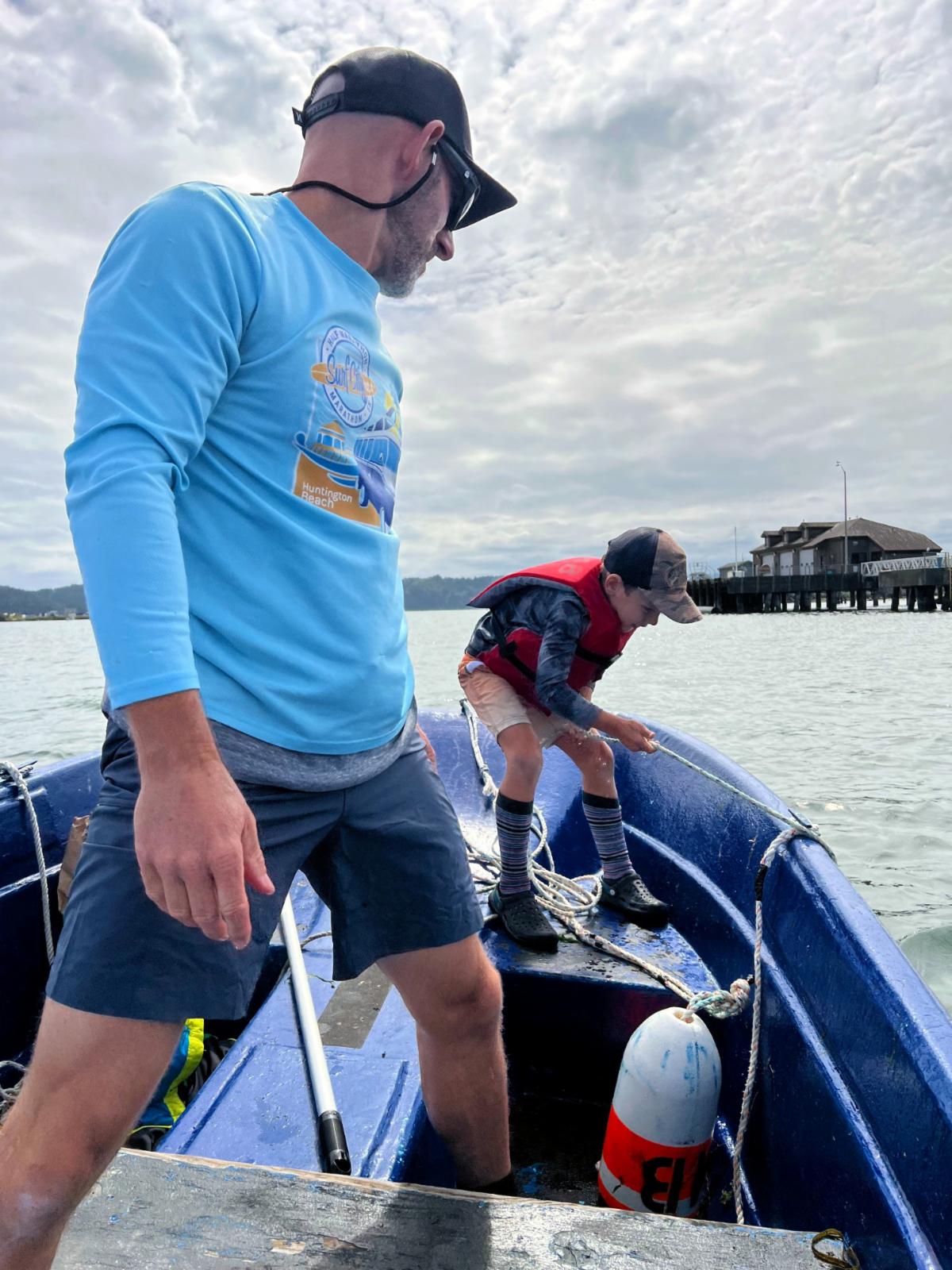
Buoy Man ……. He sits at the front of the boat with the long-handle hook. As the boat slowly approaches the buoy, he hooks the rope and brings the buoy aboard.
Power Man …… He grabs the rope and, at constant speed, pulls the ring into the boat. It’s important that he does this quickly at constant speed to help the ring set up in a basket shape and retain all the crabs.
Sorting Man …. When the ring, hopefully filled with crabs, is brought aboard, he decides which crabs are kept and which are thrown back in. He uses the plastic crab gauge to measure only male Dungeness crabs which must be at least 5 ¾ “ to be legal. All female Dungeness and all undersized male Dungeness are immediately released unharmed. In addition to Dungeness crab, each ring also catches red rock crabs for which any size of either sex are legal. The sorting man decides which red rocks are large enough to enjoy eating.
Imagine the excitement after each ring, filled with pissed-off crabs, is brought aboard. That’s the thrill that brings us back every year.
| | |
Buoy Man
Grandson, Stephen
| | | | | | | |
Motor Man ..... Grandpop (me)
Sorting Men .... Charlie & Tyler (Grandsons)
| | | |
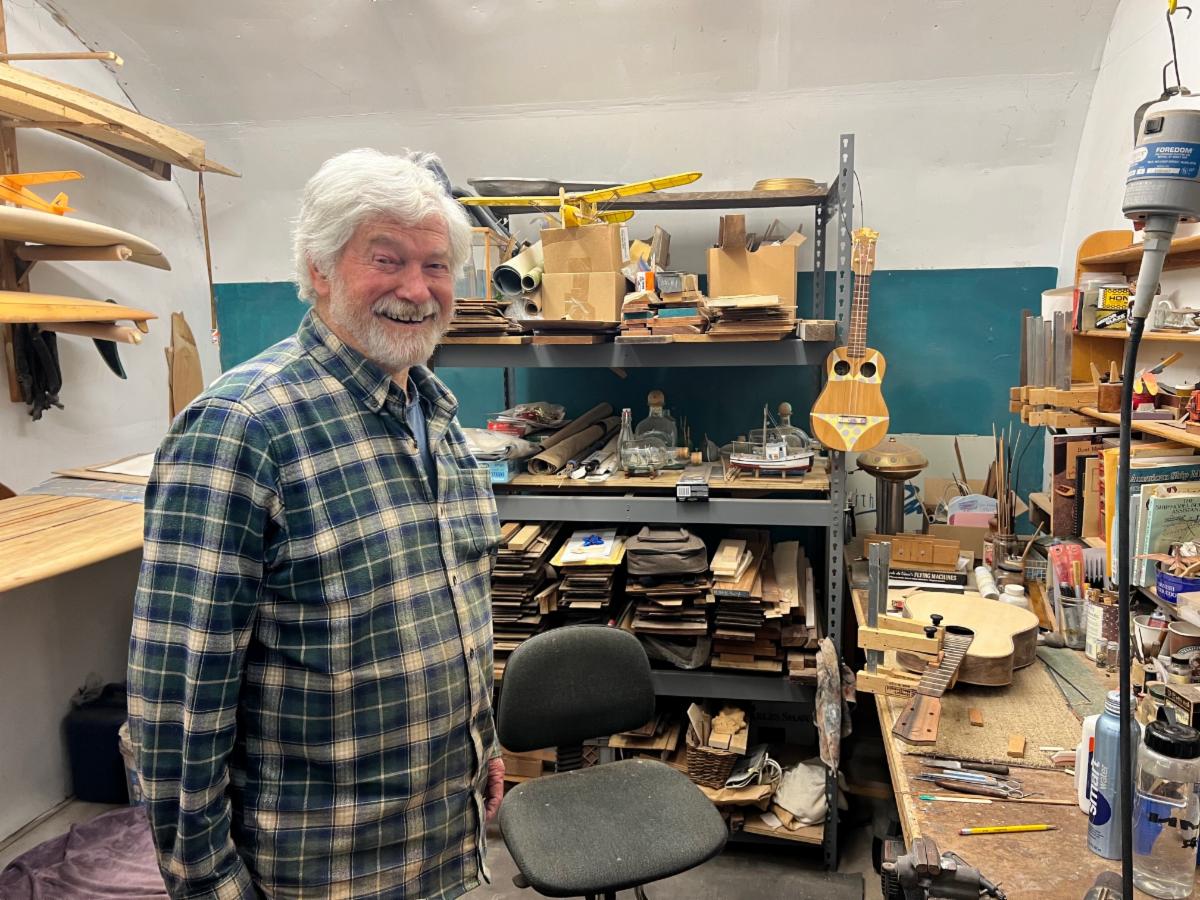
This year, Ellie and I drove up the coast first to Santa Cruz to visit my brother, then leisurely up Route 1 stopping briefly in small towns like Point Reyes Station, Inverness, Bodega Bay, Jenner, Point Arena, and Mendocino, to arrive and stay a night at Noyo Harbor in Fort Bragg, CA. In Fort Bragg we were eager to meet our friends, Paul and Stephanie Kraus. Both are true artists who show their work in Sportsman’s Park Gallery and Gifts on Harbor Drive near the end of Noyo Harbor. However, on this visit Paul & Stephanie invited us to their home, one they designed and built along with their large studio facility.
Paul is a retired Special Effects artist who worked for George Lucas making many films including “Star Trek,” “Indiana Jones,” etc. (ref Newsletter, September 2022…..”Owning A Monterey Clipper”). Paul is also a surf dude, painter, sculptor, and musician who makes beautiful stringed instruments (guitar, banjo, bass, etc.), and wood models of airplanes and boats. And that is precisely why we now stop each year in Fort Bragg ….so I can pick up my latest model vessel from Paul.
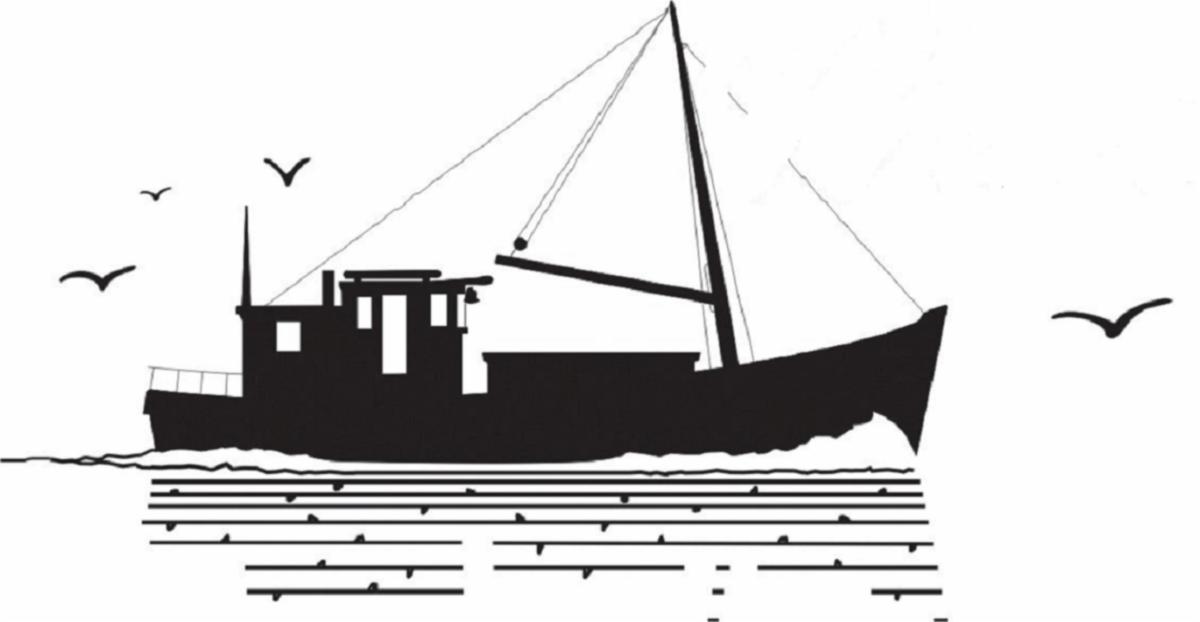
The Chesapeake Bay Skipjack
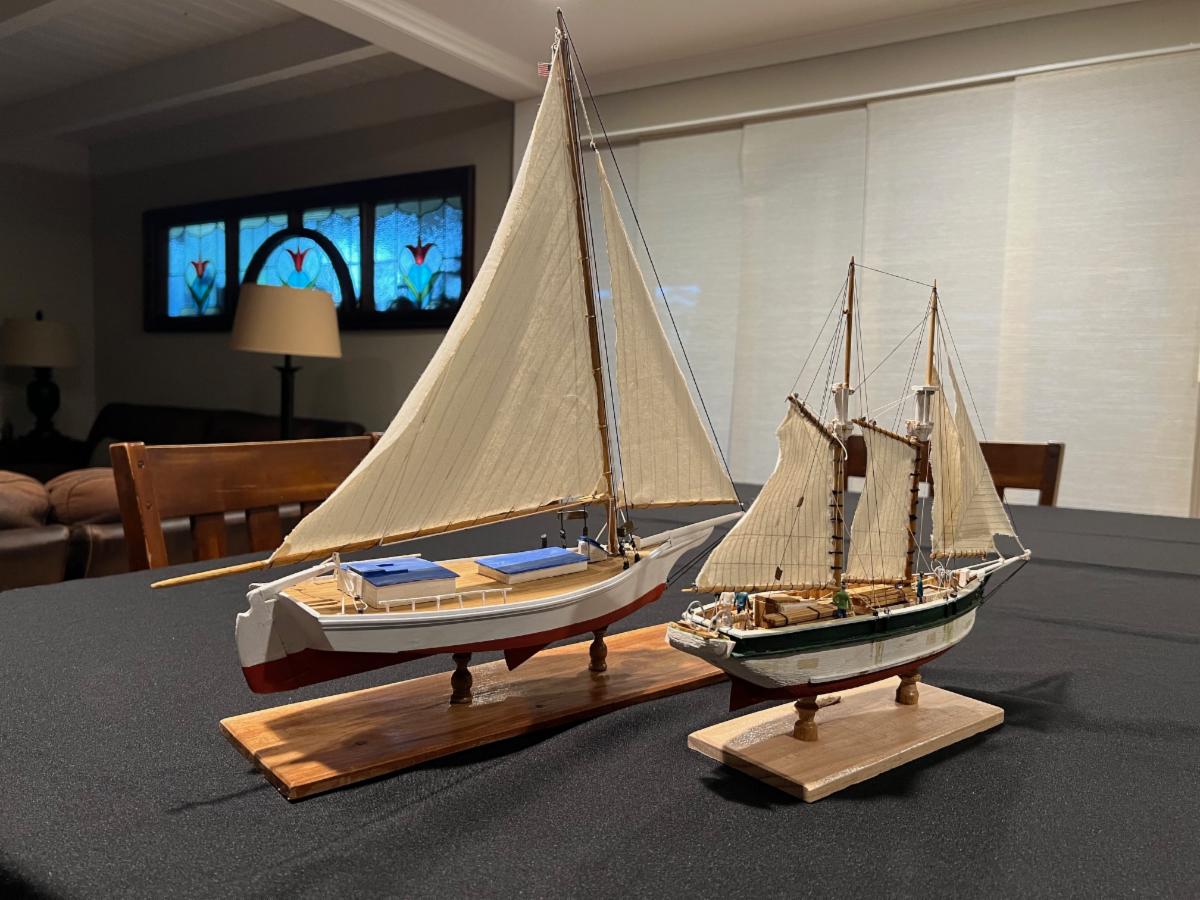
Last year I asked Paul to model a skipjack, a sailboat that is now recognized as the state boat of Maryland. Due to the alarming historic rate of oyster harvesting in Chesapeake Bay, dredging for Maryland oysters was completely prohibited in 1820. In 1865, it was again made legal but only permitted using sailboats. Coincidentally, Maryland’s peak oyster harvest was in 1884 at 15 million bushels.
The long-hull, 2-masted bugeye became the popular design. But as construction and manpower costs rose, the simpler, single-masted, low freeboard, wide beam, mounted centerboard, 40-to-50-foot length skipjack became popular by the end of the 19th century. More than 2,000 skipjacks were produced but only about 40 remain with less than 20 still fishing. In 1965, Maryland changed dredging laws to allow the use of motor power two days per week. The few remaining skipjacks were then modified with stern davits to hold a small pushboat for motorized travel as permitted.
The Bugeye
While touring all of Paul and Stephanie’s creations in their studio building, another ship model drew my attention. Paul explained it was “Arora” a 2-masted sailing scow. But it reminded me of the low freeboard, no chine, bugeye designed for 19th century, shallow water oyster dredging in the Chesapeake. I also bought the “Arora” before leaving Paul.
Recommendation
If you’re like me and are far happier owning models of past boats and reliving only joyful memories rather than having the burden of owning the real thing ….then I highly recommend you contact Paul Kraus. I send Paul photos and boat plans that I find online. His work and prices are great. Depending on size and complexity, I typically pay $200 to $300 for wooden boat models measuring about 9 to15 inches in length.
Paul Kraus …... Balsaboy2@gmail.com
Sportsman’s Park Gallery and Gifts
32094 North Harbor Drive
Fort Bragg, CA 95437
| | |
Studio Visits
My studio is an area within the business owned and operated by my son, Will. Will’s company Hudson Shuffleboards manufactures (entirely in the USA) and sells worldwide, custom crafted table shuffleboards of many designs and lengths from 7-feet to 22-feet. Will's and my location is:
3701 W. Carriage Drive
Santa Ana, CA 92704
I’m usually in my studio 3 days/week and welcome visitors. Stop in anytime. But to guarantee I’m there, call me at 714-795-0820 and make an appointment.
Thank You
Again, I thank each of you for your continued interest in this Newsletter. If you wish to make any art related announcements or comments that may benefit the readers, feel free to submit them for the next issue.
| |
SETTING LIFE'S COURSE
Discovering Value and Purpose
by Bill Hudson
www.Amazon.com
| | |
Past Newsletters
Past Newsletters are listed chronologically by title in the Newsletter section of my website www.BillHudsonArt.com/newsletter/
Events & Galleries
Fine Art America, is an online print-on-demand gallery which sells nearly all my images. These are available in a wide range of sizes on many substrates and objects including: coffee cups, shirts, towels, greeting cards, puzzles, phone cases, and tote bags.
| | | | |