|
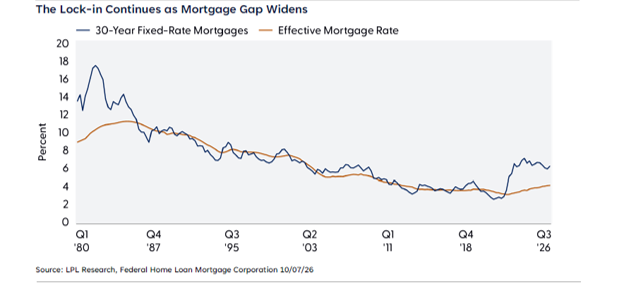
The result is a market that is stuck rather than collapsing. Softer demand has pushed down the median price of a new single-family home, though it remains well above pre-pandemic levels. The regional split is stark. Sales continue to weaken in the West and Northeast, while the South is on a firmer footing. Housing activity usually spills into furniture, appliances, and home improvement, as a result, that strength should support retail spending across the region.
For the broader economy, the math is simple. Residential investment is likely to subtract 0.3 percentage points from growth, and housing isn't poised to power the expansion anytime soon. That then puts more weight on business investment and consumer spending to keep the economy growing.
A Counterweight to the Crosscurrents
The economy faces no shortage of crosscurrents. Housing is hamstrung, labor demand is uneven, inflation pressures persist, and geopolitical shocks have made the path of monetary policy harder to read.
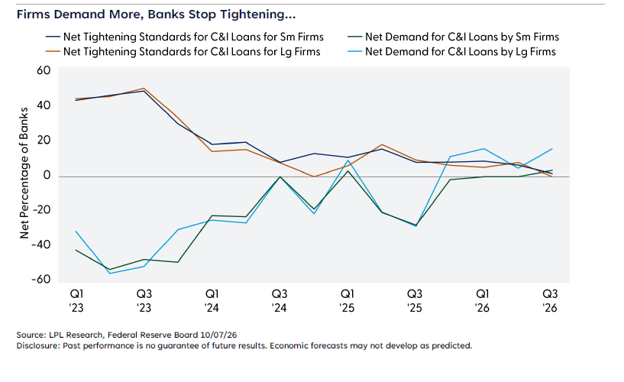
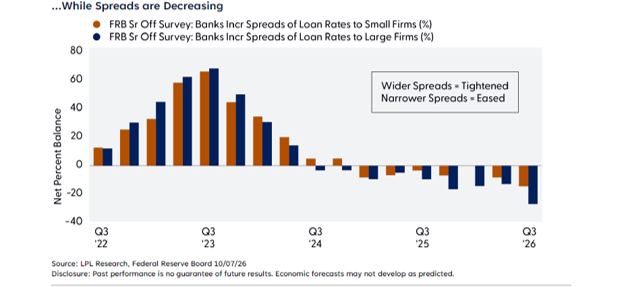
Credit is a counterweight. Companies don't typically ramp up borrowing when they expect activity to deteriorate sharply. Rising loan demand alongside steady or easier lending standards suggests businesses still see opportunities worth financing. That is notable in an economy where residential investment is a drag and capital spending has become a key source of growth.
Conclusion
The economy doesn't need every sector firing at once to keep expanding. Housing can stay stuck behind a wide gap between market mortgage rates and the rates homeowners already hold. Inflation can also remain uncomfortable, just as long as business investment picks up the slack. Attractive lending conditions make that scenario more plausible. Banks are still willing to lend, spreads are narrowing, and companies are asking for more credit despite elevated rates.
That mix should help sustain growth as businesses spend on equipment, technology, and capacity. Inflation and geopolitical risks could still cloud the outlook, but companies appear willing to look past some of the uncertainty when growth opportunities are good enough. For investors, the lending data offers a reassuring signal. Credit is available, businesses want it, and that gives capital spending a driver of growth, even with housing on the sidelines.
Asset Allocation Insights
LPL’s Strategic and Tactical Asset Allocation Committee (STAAC) maintains its recommendation for a tactical equity overweight and fixed income underweight. We believe prospects for the macro backdrop to improve and the AI-driven earnings boom will continue to support the broad equity market through 2026. The Committee favors the quality factor to express the tactical equity overweight.
On the fixed income side, we remain neutral relative to benchmark duration. In credit, we prefer to stay up in quality and resist the temptation to reach for spreads in a market where AI-related issuance is already filling the index with long, tight, single-name concentration. Securitized sectors (asset-backed securities and select collateralized mortgage-backed securities) remain attractive, while non-U.S. developed and emerging market debt increase income opportunities and offer diversification benefits.
|