|
The critical need for acoustic privacy in healthcare
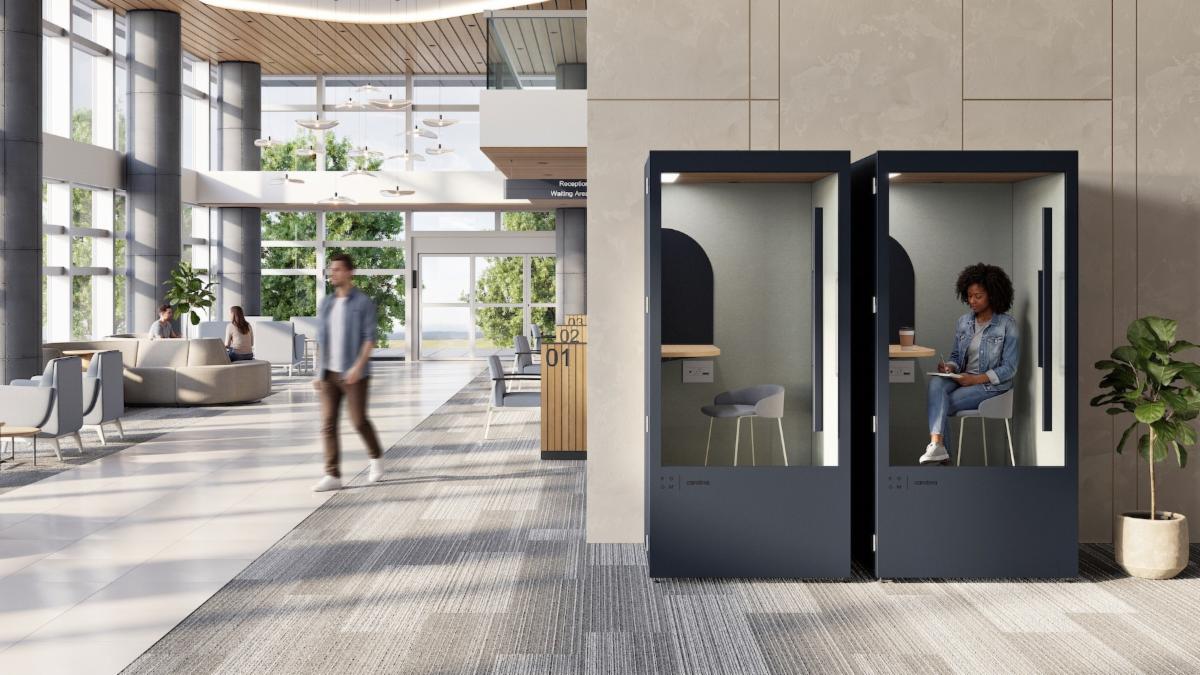
Carolina, an OFS company and provider of healthcare furniture solutions, and ROOM, a pioneer in modular privacy solutions, have announced the release of Sound Decisions: Why Acoustic Privacy Matters in Healthcare Environments. The new white paper examines the growing challenge of acoustic privacy in healthcare facilities, exploring how noise and limited access to private spaces can impact patient trust, caregiver well-being, and healthcare outcomes. The white paper provides research-backed insights for healthcare leaders, designers, architects and facility managers seeking practical solutions that support confidentiality, flexibility and operational efficiency.
Sound Decisions draws on industry expertise and is informed by research from the World Health Organization, the Facility Guidelines Institute and several peer-reviewed publications. The paper explores how healthcare organizations are challenged to balance patient privacy with the need for flexible, efficient spaces. For example, both WHO and FGI recommend sound levels of approximately 40 dBA in patient-care areas, yet studies have found many healthcare environments regularly operate between 50 and 70 dBA, while intensive care units and operating rooms often exceed 80 dBA.
|
| |
Bloomscape Collection, Best of NeoCon & Nightingale textiles winner, promotes environmental responsibility with biodegradable materials
Engineered for the demands of high-traffic healthcare interiors, every fabric in the Bloomscape Collection is bleach-solution cleanable and exceeds industry durability standards. CFStinson explains that all of the coated fabrics were thoroughly tested for compatibility with myriad cleaners and disinfectants. All non-woven products are HC-201 Certified, which allows end users, specifiers and designers to identify products designed specifically for healthcare.
Bloomscape also advances material innovation and sustainability for healthcare textiles. The five coated fabric patterns built on the Hyphyn platform deliver the performance of traditional vinyl while decomposing by 98% within two years in landfill conditions. Meanwhile, the Wildwood privacy curtain incorporates 54% post-consumer recycled polyester yarn, including 21% SEAQUAL YARN, making it SEAQUAL INITIATIVE Certified.
| | |
The perfect balance: Falcon’s Tufgrain chair collection is a game-changer for healthcare spaces
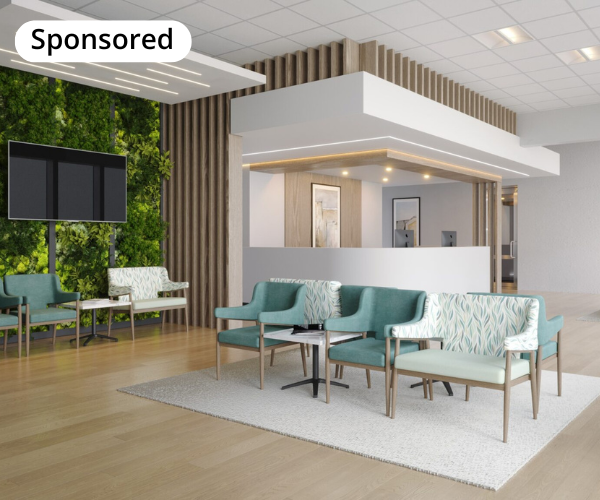
For years, healthcare designers and specifiers have faced the same frustrating compromise: how do you balance hospital-grade hygiene with a welcoming, patient-centered atmosphere? Facilities need furniture that can survive medical-grade cleaners, but patients and staff thrive in spaces that feel warm and hospitality-forward. Falcon’s Tufgrain chair collection is the perfect solution, pairing the cozy, natural look of wood with the heavy-duty durability of powder-coated aluminum.
At the heart of Tufgrain’s appeal is its incredible cleanability. Because the wood-grain finish is entirely non-porous, it handles hospital disinfectants with ease, offering the beauty of natural grain with none of the sanitary risks. On top of that, the aluminum chair frame is remarkably lightweight, making it easy for staff to quickly reconfigure waiting rooms or move seating during routine cleaning, significantly cutting down on back strain for environmental services teams.
| | | | |
ISSA launches Healthcare Environmental Hygiene Professional Certification to help hospitals consistently train EVS teams
ISSA, The Association for Cleaning and Facility Solutions, recently announced the launch of the ISSA Healthcare Environmental Hygiene Professional Certification (HEHP), a comprehensive, three-tier training program designed to build a consistent framework of environmental hygiene standards for in-house healthcare environmental services teams and any healthcare professionals who hold accountability for cleaning, disinfection, and patient care.
HAIs, re-emerging diseases and antimicrobial resistance remain the most pressing challenges facing hospitals and healthcare systems in the United States. According to the CDC, on any given day about 1 in 31 hospital patients has at least one healthcare-associated infection, driving billions of dollars each year in avoidable healthcare costs, longer stays, readmissions, reputational damage, and operational strain.
Developed collaboratively by environmental service (EVS) leaders, infection preventionists, nursing professionals, and healthcare industry thought leaders, HEHP is grounded in voice-of-customer input, current science, and evidence-based cleaning and disinfection standards to help address the real-world challenges healthcare organizations face every day, like mitigating the spread of HAIs.
| | |
Job Board’s healthcare posts are from Sarasota Memorial, Cushing Terrell, Nicklaus Children’s Health
Looking for a hospital facility management or healthcare project planner position? In June, hospitals added 9,000 jobs. Further, employment in healthcare continued its upward trend (+22,000), but at a slower pace than the average monthly gain of 38,000 over the prior 12 months, according the BLS report released on July 2.
Whenever there is a demand for healthcare practitioners, it can impact the facilities where they perform their jobs. This week’s healthcare positions on the FMLink Job Board include:
-
Healthcare FM for Indian Health Services, Bodwe Professional Services, Red Lake, MN
-
Equipment & Project Planner, Sarasota Memorial Healthcare System, Sarasota, FL
-
Healthcare Architect, Cushing Terrell, Seattle, WA
-
Facilities Office Coordinator, Nicklaus Children’s Health System, Miami, FL
-
Director of Facilities Management, HCA Healthcare, Horizon City, TX
| | |
CDC issues Ebola outbreak update and resources for healthcare facilities
The U.S. Centers for Disease Control and Prevention (CDC) issued the following Ebola Outbreak Response on July 8.
"The CDC is continuing to respond to an outbreak of Ebola disease affecting areas of the Democratic Republic of the Congo (DRC), South Sudan, and Uganda. To date, no cases of Ebola disease have been confirmed in the United States because of this outbreak.
"Early recognition is critical for healthcare worker and patient safety. While the risk of spread to the U.S. is considered low at this time, it is possible for travelers from affected areas to enter the U.S. As a precaution, CDC is working to raise awareness of this outbreak among public health departments, healthcare facilities, and healthcare providers in the U.S.
"Healthcare facilities and personnel should review Ebola resources now. Be prepared to assess patients for Ebola risk factors and symptoms."
| | |
KAI-designed Fort Worth clinic integrates primary care, imaging, lab, counseling services
National design and build firm KAI served as the Mechanical, Electrical, Plumbing and Fire Protection (MEP/FP) Engineer for the new JPS Health Network Medical Home Southwest Tarrant clinic serving the southwest Fort Worth Wedgewood neighborhood, a rapidly growing area experiencing increased demand for accessible healthcare services.
The clinic expands access to primary care and behavioral health services closer to home for residents, helping to prevent avoidable hospitalizations and meet increasing demand.
Designed to support integrated care, the new 39,000-sq.-ft. clinic brings behavioral health specialists and primary care physicians together in a shared space, allowing patients to access a full spectrum of services, including counseling, diagnostic imaging and laboratory services, medication management and primary care, all under one roof.
| | |
Oct. 17-20: IFHE World Congress session informs healthcare capital investment strategies
Capital constraints, rising construction costs, labor shortages, and increased patient volumes are reshaping how health systems approach and prioritize facility investments. For Rahul Tikekar, principal and SVP of Loring Consulting Engineers, the International Federation of Healthcare Engineering World Congress, co-located with the Healthcare Design Conference + Expo, enables systems to share strategies on how to effectively stretch capital funds.
Tikekar says it’s important for project teams to set priorities and follow three planning principles. First, standardize across the network and stop reinventing the wheel. Instead, build in flexibility where change is likely. Second, shift the focus from construction costs to lifecycle cost. Consider what the facility will cost to operate for 30 years. Third, design for adaptability and resilience from Day One to make space for the rapid changes shaping healthcare today. By aligning design, construction, and operations around these three principles, health systems can achieve better performance with less capital.
| | |
Marberry: Healthcare products seen at NeoCon & Design Days
There are plenty of healthcare products to check out at NeoCon and Design Days. My overall favorite product this year was not a healthcare product, but it could be some day.
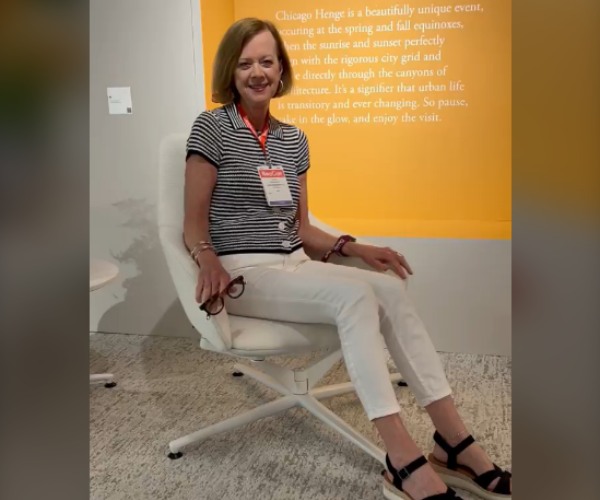
Just like putting wheels on suitcases revolutionized shlepping your bag through an airport, KI’s Cognetic Technology introduced a new way to support sitting that could revolutionize seating. Most office chairs have very little movement — height adjustment, maybe a forward and backward tilt. Cognetic Technology is unique in that it moves in multi-directional fashion — almost like a sitting Spirograph of random orbital motion that is very calming. Even better, early studies have shown a 30% reduction in anxiety and improved cognitive performance.
Cognetic received a well-deserved Best of Competition Award from the Best of NeoCon judges. Beyond office and lounge seating, there may be applications for this technology in clinical healthcare spaces, such as a maternity chair that improves upon the standard rocker. Or a chair for behavioral health.
| | FMLink, powered by The McMorrow Reports | | | | |