|
No matter your role, your day likely involves communicating with people above you, alongside you, and depending on you. When people talk about communicating up, across, or down, it’s usually explained in terms of hierarchy.
They're actually describing two things at once:
- the direction of influence
- the audience you’re speaking to
And different audiences listen for different things.
We often assume that if the work is clear, the communication will be too. In reality, doing clear work and communicating clearly are two different skills, and one does not automatically lead to the other.
Communicating UP
Result > Why it Matters > Recommendation
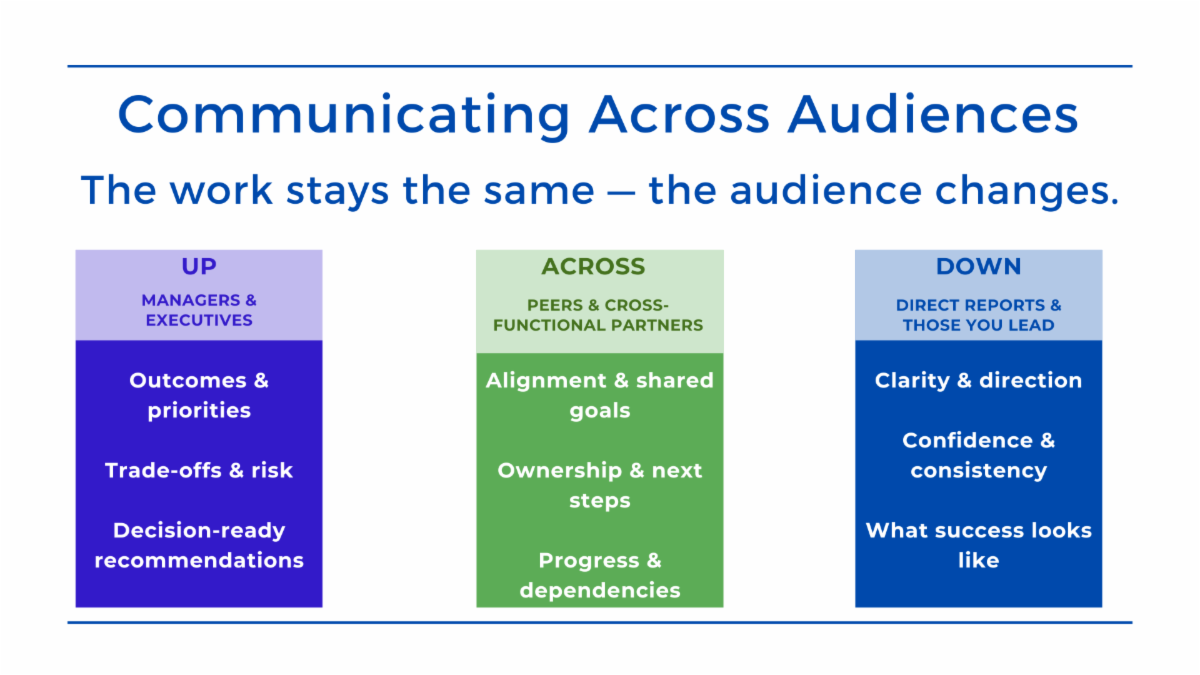
When you communicate up, people are listening for:
• Outcomes and priorities
• Trade-offs and risk
• Decision-ready recommendations
The common trap is that we explain the work instead of naming the result.
Campaign Performance Example
Instead of:
We ran a multi-channel campaign across LinkedIn and email, tested different messaging, built new landing pages, and worked with sales on follow-up to improve conversion.
Try:
The campaign generated 35% more enterprise demo requests. The main driver was the customer story campaign. We recommend repeating that approach next quarter.
Executives don’t need every step. They need to understand what changed, why it matters, and what decision is required.
Communicating ACROSS
Who will do what by when
(Peers & cross-functional partners)
Across communication is about:
• Alignment and shared goals
• Ownership and next steps
• Progress and dependencies
The trap here is subtle: assuming alignment without confirming it, or quietly taking on extra work to keep momentum moving.
Product Messaging & Positioning Example
Instead of:
We’re working on messaging for the new release and want to make sure it reflects what’s actually being built, so we should probably review everything together before it goes live…
Try:
Before the release, product will finalize positioning and engineering will confirm what will be in scope, so marketing messaging matches the actual release. Can we schedule a scope review this week?
Instead of:
I’ll just take care of that piece so we can move faster.
Try:
To move forward, we need two things: product will finalize the scope, and marketing will confirm the launch timeline.
Strong lateral communication makes ownership visible.
Communicating DOWN
What does success look like?
(Direct reports or those you guide)
When you communicate down, people look for:
• Clarity and direction
• Confidence and consistency
• What "done" looks like
The trap is softening direction in an effort to be supportive. Clarity is usually kinder than ambiguity.
Priority Example
Instead of:
There are a lot of things in motion right now, so just do what you can.
Try:
Your priority this week is finishing the client presentation. Everything else can wait.
Ownership Example
Instead of:
Maybe you could start looking into this.
Try:
I’d like you to take the lead on this and bring me an outline by Friday.
Decision-Making Example
Instead of:
Just use your judgment.
Try:
Use your judgment, and if the cost is over $5,000, check with me first.
Clarity reduces uncertainty.
Expectation Example
Instead of:
I just want this to go well.
Try:
Success here means the client understands the timeline, the budget, and the next steps.
When Someone is Struggling
Instead of:
Let me know if you need help.
Try:
Why don’t you draft the first version and we’ll review it together on Thursday.
The important thing to notice
None of this requires a formal title. Influence isn’t just about authority. It often comes from consistently giving people the context they need to move forward.
Many of the most effective professionals adjust how they communicate long before they’re given formal authority.
The work may stay the same.
What people need to hear depends on where they sit.
To Try
This week, notice where you’re communicating:
• Up
• Across
• Down
And ask yourself:
Am I giving this audience the information they actually listen for?
|