Missed the last issue of Currents? Click here to view it in your web browser! | |
*New* FCHEA Technical and Regulatory Working Group | |
|
In order to better serve the needs of our members, FCHEA has created a new Technical and Regulatory Working Group (TRWG) that will meet virtually via zoom on the 3rd Wednesday of every month. The first meeting will be Wednesday, February 19, at 2 pm.
This new TRWG will replace the different technology-focused working groups. This action was taken as many of the technical, regulatory, codes, and standards issues discussed in our meetings have significant overlap between different technology areas. In consolidating these activities under one umbrella Working Group, we hope to reduce redundancy and duplication for our members. We also hope this consolidation will allow broader collaboration and networking opportunities as participants will be able to take advantage of FCHEA’s diverse membership base.
Mhamed Samet, FCHEA’s Technical & Regulatory Affairs Coordinator, will run the meetings, and the agenda will include a variety of technical and regulatory topics including, but not limited to codes and standards, chemicals, emissions testing, lifecycle analysis, and other regulatory issues.
One of the benefits of this consolidation will be to discuss relevant topics as they come up. If you have suggestions for a timely topic to be covered during this meeting, or if you have any colleagues who would like to be added to the roster, please send them directly to msamet@fchea.org.
| |
Bloom Energy and Chart Industries Enter Carbon Capture Partnership | |
|
On February 13, Bloom Energy announced it has entered into a partnership with Chart Industries focused on developing a cost-effective path to decarbonization using natural gas, fuel cells, and carbon capture. The companies aim to offer a power solution that will yield a concentrated carbon dioxide (CO2) stream that can be utilized or sequestered.
Click here for the full press release from Bloom Energy
| Heraeus and Smoltek Hydrogen Enter into Strategic Collaboration on Advanced Iridium-based Catalyst Solutions | |
On February 13, Heraeus Precious Metals announced it had entered into a strategic collaboration with Smoltek Hydrogen, a subsidiary of Smoltek Nanotech Holding AB, on advanced iridium-based catalyst solutions for proton exchange membrane (PEM) electrolyzers. The partnership seeks to increase the functional efficiency of porous transport electrodes in PEM electrolyzers.
Click here for the full press release from Heraeus Precious Metals.
| Toyota Develops Third Generation Fuel Cell System | |
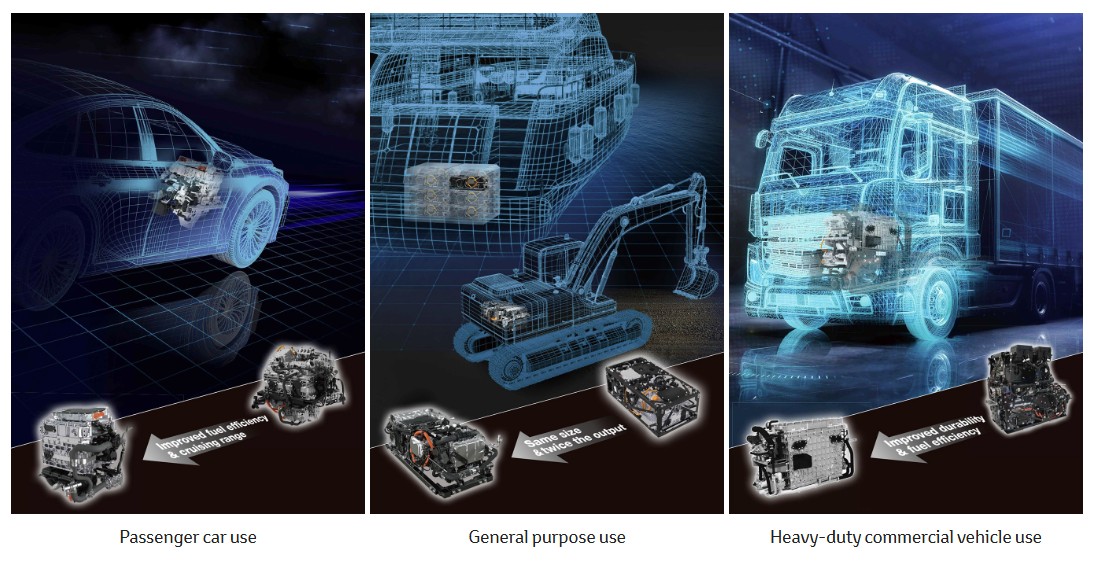
On February 14, Toyota Motor Corporation announced it has developed an all-new third-generation fuel cell system that features significant improvements in performance, fuel efficiency and costs compared to the prior version. In addition to passenger vehicles, this new fuel cell system will be expanded for use in heavy-duty commercial vehicles and is planned for introduction in markets mainly in Japan, Europe, North America, and China after 2026.
| |
|
Image source: Toyota
Click here for the full press release from Toyota.
| |
StormFisher Hydrogen Secures $50 million Commitment from Hy24 for North American Projects | |
|
On February 11, StormFisher Hydrogen announced it had secured a $50 million commitment from Hy24’s Clean Hydrogen Infrastructure Fund to accelerate the company’s pipeline of clean fuel production projects in North America. This includes facilities in Kansas, Minnesota, and Texas, and in Canada, that will have a total capacity to convert up to 1.8 gigawatts (GW) of renewable energy from solar and wind into renewable fuel of non-biological origin (RFBNO) eFuels, such as green hydrogen, e-Methanol, green ammonia, and e-Methane.
Click here for the full press release from StormFisher.
| |
PowerCell Group Attains Aviation AS9100D Certification | |
|
On February 12, PowerCell Group announced it has obtained AS9100D certification, a globally recognized aviation quality management standard, from LRQA. The AS9100D certification, which is technically equivalent to EN 9100:2018, JISQ 9100:2016, and KS Q 9100:2018, encompasses design, testing, qualification, manufacturing, and maintenance of fuel cell stacks, propulsion and auxiliary systems for hydrogen powertrains in aviation applications.
Click here for the full press release from PowerCell.
| |
Be sure to stay on top of state and DC-based events through FCHEA's This Week in Hydrogen and Fuel Cells email newsletter. If you are not already subscribed, please contact Connor Dolan at cdolan@fchea.org.
| |
5th Annual International Women’s Day Celebration | |
|
Women+ in Hydrogen is hosting its 5th annual International Women’s Day celebration! The in-person portion of this hybrid event will be hosted in Houston on March 13 and includes a site visit to Syzygy Plasmonics on March 12. As in years past, this year’s event will include all female panels on substantive topics in the hydrogen sector and lots of networking opportunities. Register today – in-person seating is limited and in-person registration confirmations will be sent out by February 14.
| |
Requests for Papers, Proposals, & Information | |
|
Los Alamos National Laboratory invites forward-thinking industry leaders to join the L’Innovator 2.0 Program. This initiative, in collaboration with the Department of Energy’s Hydrogen and Fuel Cell Technologies Office, is an opportunity to commercialize cutting-edge hydrogen and fuel cell innovations.
Los Alamos seeks experienced commercialization partners with:
- Expertise in hydrogen and fuel cell technology.
- U.S. manufacturing capabilities.
- Resources to co-invest in scaling transformative technologies.
Submit your Letter of Interest by February 15, 2025.
Click here for more information.
| |
Funding Available to Small Businesses for Clean Energy Research and Development | |
|
The U.S. Department of Energy (DOE) opened new funding to small businesses for innovative clean energy technologies as part of its Small Business Innovation Research and Small Business Technology Transfer (SBIR/STTR) programs. SBIR and STTR are competitive funding opportunities that encourage U.S.-based small businesses to engage in research and development to accelerate the commercialization of innovative technologies.
Through SBIR and STTR, the Office of Energy Efficiency and Renewable Energy (EERE) has enabled thousands of small businesses and entrepreneurs to develop cutting-edge technologies required to accelerate our transition to a clean energy future.
SBIR/STTR provides funding in two phases: Small businesses can receive up to $200,000 in Phase I to prove the feasibility of an idea; successful awardees can then receive up to $1 million in Phase II for further development including prototyping, validation, and testing.
The funding opportunity covers all EERE technology areas, including:
- Advanced materials and manufacturing
- Bioenergy
- Buildings
- Geothermal energy
- Hydrogen
- Industrial decarbonization
- Solar energy
- Vehicles
- Water power
- Wind energy
Mandatory letters of intent for this funding opportunity are due Wednesday, Feb. 26, 2025 by 11:59 p.m. ET.
Click here for more information.
| |
DOE/EIS-0570: California Hydrogen Hub | |
|
The U.S. Department of Energy (DOE) is preparing an Environmental Impact Statement (EIS) to assess the potential environmental impacts for the proposed action of providing financial assistance to the Alliance for Renewable Clean Hydrogen Energy Systems (also referred to as ARCHES) to facilitate the design, construction, operation and maintenance of the California Hydrogen Hub in the state of California.
The California Hydrogen Hub is proposed to consist of a suite of demonstration projects involving clean hydrogen production, transportation, and end uses located within California. ARCHES is the primary funding recipient and lead California Hydrogen Hub manager. As currently structured, the California Hydrogen Hub encompasses approximately 35 projects including clean hydrogen production facilities that could produce 450-500 metric tonnes per day of clean hydrogen from renewable electricity and biogenic sources, connective infrastructure including refueling stations and pipelines, and a range of end uses including fuel-cell electric trucks, fuel-cell electric buses, a marine vessel, cargo handling equipment, power generation via turbines, and stationary fuel cells.
DOE welcomes written comments on the scope of the EIS until March 3, 2025. Comments will be accepted and considered at any time during the EIS process. However, commenters should be aware that their comments should be timely for them to be fully considered.
To provide written comments through the www.regulations.gov web portal:
Navigate to www.regulations.gov, search for Docket No. DOE-HQ-2024-0087, and follow the instructions for submitting comments.
| |
DOE/EIS-0571: Pacific Northwest Hydrogen Hub | |
|
The U.S. Department of Energy (DOE) is preparing an Environmental Impact Statement (EIS) (DOE/EIS-0571) to assess the potential impacts to the human environment for the proposed action of providing financial assistance to the Pacific Northwest Hydrogen Association (also referred to as the PNWH2 Association). This action would facilitate the design, construction, operation and maintenance of the Pacific Northwest Regional Hydrogen Hub (Pacific Northwest Hub) including in the states of Washington, Oregon, and Montana. The Pacific Northwest Hub would demonstrate the production of clean hydrogen from renewable energy resources and would consist of a suite of demonstration projects involving clean hydrogen production, transportation, and end uses located within the Pacific Northwest.
As currently proposed, the Hub would encompass approximately 10 projects, including clean hydrogen production facilities that could produce 300-400 metric tons per day of clean hydrogen, hydrogen liquefiers, connective infrastructure including refueling stations and pipelines, and a range of end uses including fuel cell electric trucks, fuel cell electric buses, cargo handling equipment, and stationary fuel cells.
DOE welcomes written comments on the scope of the EIS until March 3, 2025. Comments will be accepted and considered at any time during the EIS process. However, commenters should be aware that their comments should be timely for them to be fully considered.
To provide written comments through the www.regulations.gov web portal:
Navigate to www.regulations.gov, search for Docket No. DOE-HQ-2024-0094, and follow the instructions for submitting comments.
| |
DOE/EIS-0569: Appalachian Hydrogen Hub | |
|
The U.S. Department of Energy (DOE) is preparing an environmental impact statement (EIS) to assess the potential environmental impacts for the proposed action of providing financial assistance to the Battelle Memorial Institute (Battelle) to facilitate the design, construction, operation, and maintenance of the Appalachian Hydrogen Hub (also referred to as the Appalachian Regional Clean Hydrogen Hub or ARCH2) in the Appalachian Region including Ohio, Pennsylvania, and West Virginia. The Appalachian Hydrogen Hub is proposed to consist of a suite of demonstration projects involving clean hydrogen production, transportation, and end uses located within the Appalachian Region that includes Ohio, Pennsylvania, and West Virginia. Battelle is the primary funding recipient and lead Appalachian Hydrogen Hub manager.
As currently proposed, the Appalachian Hydrogen Hub would encompass 12 proposed projects, including hydrogen production facilities that could produce at least 1,700 metric tons per day of clean hydrogen (autothermal reformation facilities with carbon capture, biomass pyrolysis facilities, electrolysis facilities, and facilities for recovering hydrogen from waste gases), hydrogen liquefiers, and a range of end uses including residential fuel cells, materials handling equipment, mobility, and industrial uses, including production of ammonia, urea, and low-carbon aviation fuel.
DOE welcomes written comments on the scope of the EIS until March 3, 2025. Comments will be accepted and considered to the extent practicable throughout the EIS process. However, commenters should be aware that their comments should be timely for them to be fully considered.
To provide written comments through the www.regulations.gov web portal:
Navigate to www.regulations.gov, search for Docket No. DOE-HQ-2024-0082, and follow the instructions for submitting comments.
| |
Intercity Transit Announces RFP | |
|
Intercity Transit, the public transportation provider in Thurston County, Washington, anticipates that it will soon seek proposals from qualified firms interested in providing a Hydrogen Refueling Station at its location in Olympia, Washington.
The solicitation documents for this project will be available online through Washington’s Electronic Business Solution (WEBS). If your firm may be interested in this opportunity, please register in WEBS so that you may download the solicitation documents once they have been posted.
The WEBS registration process can be started by visiting the website provided above and clicking “register now”. If you require assistance with the WEBS registration process, please contact WEBS customer service at (360) 902-7400.
| |
DOE Issues Notice of Intent for Funding to Advance Hydrogen and Fuel Cell Technologies to Drive National Decarbonization | |
|
On September 10, the U.S. Department of Energy announced a notice of intent for potential funding to accelerate the research, development, and demonstration (RD&D) of affordable clean-hydrogen and fuel cell technologies to drive national decarbonization. The potential funding will focus on advancing technologies for hydrogen production, hydrogen infrastructure, and fuel cells, as well as demonstrating hydrogen and fuel cells in new, high-impact applications.
Potential topic areas include:
- Photoelectrochemical (PEC) Water Splitting Device Scale Up will develop and demonstrate PEC water splitting devices using low-cost, scalable synthesis and fabrication techniques.
- High-Performance Materials for Hydrogen Service, Including Cryogenic and/or High-Pressure Conditions will develop advanced materials for use in high-pressure hydrogen storage tanks, cryogenic service conditions, and fiber reinforced polymer hydrogen pipelines.
- Sustainable High-Temperature Proton Exchange Membranes and Ionomers for Heavy-Duty Transportation Applications will develop membranes and ionomers (key components of fuel cells) suitable for high temperature operation (up to 120°C) in heavy-duty fuel cell applications, without the use of perfluorosulfonic acid.
- Domestic Hydrogen Fuel Cell Electric Motorcoach Bus Development and Demonstration will develop and demonstrate domestically produced fuel cell electric motorcoach buses suitable for long-haul service.
For all topic areas, HFTO envisions awarding financial assistance awards in the form of cooperative agreements with periods of performance ranging from approximately two to four years.
Click here for more information from DOE.
| |
OCED Announces Plans to Fund up to $400 Million for Clean Energy Projects in Rural and Remote Areas | |
|
On August 22, the U.S. Department of Energy’s (DOE) Office of Clean Energy Demonstrations (OCED) issued a Notice of Intent (NOI) for up to $400 million to spur innovative, community-focused clean energy solutions in rural and remote areas across the United States. This funding will support the deployment of a variety of commercially available, clean energy technologies, demonstrating their viability and benefits to rural and remote residents, and ultimately encouraging widespread adoption.
The anticipated new funding plans to support the demonstration of energy technologies that provide clean, resilient, reliable, affordable power, while also aiming to increase local energy independence and economic development. Eligible projects must address at least one of the following: improving overall cost-effectiveness of energy generation, transmission, or distribution systems; siting or upgrading transmission and distribution lines; reducing greenhouse gas emissions from energy generation in rural or remote areas; providing or modernizing electric generation facilities; developing microgrids; or increasing energy efficiency.
Click here for more information.
| |
|
The Namibian green hydrogen initiative is centered around three key hydrogen valleys: the Southern Region, the Central Region, and the Northern Region. These valleys are designed with integrated infrastructure and production on facilities es powered by abundant solar and wind energy resources. The comprehensive plan includes the development of necessary transportation on infrastructure to facilitate efficient distribution on and export. The objective of this initiative is to achieve an output of 10-12 million metric tons per annum by 2050. This ambitious target underscores Namibia’s commitment to becoming a leading producer and exporter of green hydrogen and its derivatives.
The Namibian government, via the Namibian Hydrogen Fund are conducting a market sounding process to identify interested promoters for the Southern Corridor Green Valorisation and the Central Valley Common User Infrastructure (CUI) Development projects. RfPs will be shared with those participants that have indicated their interest at this stage.
For more information, contact CTEN@CrossBoundary.com.
| |
Drayage Truck Funding from Ports of Los Angeles and Long Beach Available to Stack with HVIP | |
|
Starting Tuesday, November 14, 2023, the Clean Truck and Bus Voucher Incentive Project (HVIP) will make $60 million provided by the Ports available for voucher requests for zero-emission Class 8 tractors performing drayage operations at the Ports of Los Angeles and Long Beach.
Voucher enhancements funded by the Ports are $100,000 per truck for fleets size 10 and smaller and $75,000 for fleets larger than 10, additional to the HVIP drayage voucher amount of $150,000 per truck and any other applicable HVIP voucher enhancements listed on www.californiahvip.org/funding. Purchaser qualifications are as defined in the HVIP Implementation Manual.
Funding is made available through the Ports’ Clean Truck Funds and administered by CALSTART on a first-come, first-served basis through the existing HVIP voucher request process and online Voucher Processing Center. Voucher requests will follow HVIP requirements, including the eligible trucks and dealers listed at www.californiahvip.org.
Additionally, all existing eligible unredeemed HVIP drayage truck vouchers that meet the Ports’ requirements will receive the same additional funds of $75,000 or $100,000 added to their HVIP voucher. Outreach to individual dealers and purchasers is already underway regarding this increase as additional actions are required to apply Port Clean Truck Funds to existing vouchers.
Click here for more information.
| |
Zero-Emission Freight and Marine Statewide Grant Funding in California | |
|
On August 22, the California Air Resources Board announced up to $20 million in funding is now available Statewide through the VW Zero-Emission Freight and Marine (ZEFM) program. This VW ZEFM solicitation incorporates the modifications to California's Beneficiary Mitigation Plan that were recently approved by the California Air Resources Board and has the following new features:
- Allows stacking with Clean Off-Road Equipment Voucher Incentive Project (CORE) and other state programs that don’t claim NOx emissions reductions
- Removed static funding caps for all project categories, including the funding cap for Airport Ground Support Equipment
- Includes a higher cost-effectiveness threshold (increased from $280,000 to $466,000 per ton of NOx reduced) that will be used as the primary factor in determining maximum funding
- Requires CARB’s pre-approval for projects with proposed award over $1 million
Funding is available for the following project categories:
- Heavy-lift forklifts (8,000 lb. lift capacity or greater) scrap and replace
- Airport ground support equipment scrap and replace
- Port cargo handling equipment (including terminal tractors) scrap and replace
- Ferries, tugboats, towboats repower, and
- Shore power system installation for ocean-going vessels not required or not yet required to use shore power while at berth.
Applications are being accepted and reviewed on a first-come, first-served basis until funding is exhausted.
Click here for more information.
| |
Statewide Funding for California Zero-Emission Class 8 Freight and Port Drayage Trucks |
Funding is now available from the California Volkswagen Environmental Mitigation Trust for the Zero-Emission Class 8 Freight and Port Drayage Trucks category. This program will provide incentive funds on a first-come, first-served basis to truck owners operating in the state of California to replace Class 8 freight trucks, including drayage trucks, waste haulers, dump trucks, and concrete mixers, with zero-emission technologies approved by the California Air Resources Board and available for commercial use.
Click here for more information on the program.
| |
Incentives for Off-Road Zero-Emission Equipment | |
The California Air Resources Board announced $125 million in funding incentives for its Clean Off-Road Equipment Voucher Incentive Project (CORE). CORE helps offset the higher cost of zero-emission technology with a point-of-sale discount. There is no scrappage requirement, and additional funding is available for charging and fueling infrastructure and for equipment deployed in disadvantaged communities.
Click here for more information on the program.
| |
|
Upcoming FCHEA Meeting Calendar
For more information on any of FCHEA's working groups, committees, or to be added to any working group rosters, please contact Connor Dolan at cdolan@fchea.org.
| |
FCHEA Technical and Regulatory Working Group (TRWG) Meeting
A virtual meeting will be held Wednesday, February 19 at 2:00 PM EST.
FCHEA Government Affairs Committee (GAC) Meeting
A virtual meeting will be held Thursday, February 20 at 2:00 PM EST.
| |
1025 Connecticut Avenue NW, Suite 1000, Washington D.C. 20036 | 202-355-9463 | | | | |