November 20, 2026 - Issue 210 | | Last week, two very different failures reminded us how much of daily life rests on systems we rarely think about. On Thursday, November 12, email and calendars stopped working for millions of Microsoft 365 users. The next afternoon, the FAA halted departures at airports across the country. Neither event was a cyberattack, and the two were not related. Both showed what happens when a small problem in a connected system spreads far beyond where it started. | | This Week's Cybersecurity All-Stars | | |
This week's issue brings the return of recognizing our weekly "Cybersecurity All-Stars". I had stopped doing this for some reason. So, beginning this week that error will be corrected.
An engaged and empowered staff to join the fight against cybercrime is a major part of protecting any organization.
Week of November 2 - November 15, 2026
- Kris Hines
- Michele Wholey
- Maria Kullman
- Theresa Eadie
Well done. Stop by the IT Department to claim your All-Star merch and show off your cybersecurity skills to your work mates.
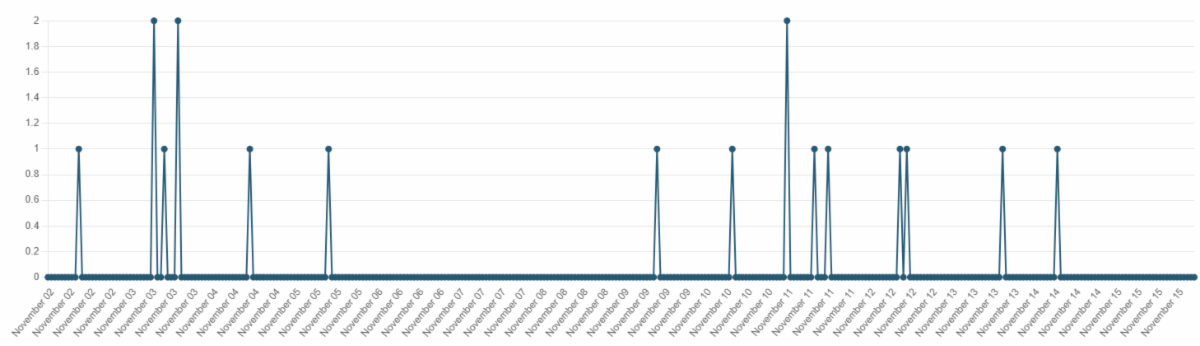
Incidents Reported by Staff (November 2 - November 15, 2026)
| | Latest Vulnerabilities Report | |
As a Chief Information Security Officer, I receive regular reports from the Center for Internet Security (CIS). I am not sure why I haven't thought of this sooner, but "Cybersecurity Friday" is a great place to share these important security alerts. Beginning with this issue, I will share the alerts I have received.
Take the time to review them and if they apply to you, take action and as always, feel free to reach out to me with any questions.
| | |
The Microsoft problem began on November 12 with users unable to reach Exchange Online mailboxes. It quickly spread to other services that depend on email, including Teams calendars and Copilot. Microsoft said it had no evidence of malicious activity and traced the problem to a process that sets up secure connections becoming overwhelmed, following a recent network configuration change. Recovery came region by region over roughly a day and a half. Microsoft says more than 430 million people use Microsoft 365, and reports of disruption came from businesses, hospitals and government offices around the world.
On Friday, November 13, at about 4 p.m. Eastern, the FAA ordered a nationwide ground stop that lasted more than four hours. The FAA said its legacy network became unstable when data flooded it at a rate of 1,000 connection attempts every 4 to 5 seconds. Officials pointed to a new router installed during a switch from copper wiring to fiber at a site in El Dorado, Arkansas. Instability reached 17 of the FAA’s 22 en route control centers. Roughly 3,500 aircraft were in the air and all landed safely. Reporting put cancellations above 14,000 across Friday and Saturday, and airlines said it would take until Sunday night to restore full schedules. The FAA says it has no indication of a cyberattack, and the root cause is still under investigation.
| | Looking for Commonality in the Ouatages | | |
The most important lesson is that neither outage needed an attacker. An ordinary change, an upgrade or a configuration update, was enough. Modern systems are tightly linked, so a fault in one place can travel a long way. A single email service affected calendars, meetings, AI assistants and the tools that other companies build on top of it. A router problem at one remote site disrupted air traffic facilities across the country.
The second lesson is that the damage lasts longer than the outage. Mailboxes came back, but delayed messages and backlogs had to clear. The ground stop ended Friday night, but aircraft, crews and gates were out of position, and travelers felt it through the weekend. Recovery is a process, not a moment.
The third lesson is that these systems are mostly invisible until they stop. We do not think about the network behind a flight or the email service behind a hospital appointment. Hidden dependencies, like the vendor behind your vendor, are often the ones that surprise us.
| | |
You cannot prevent a provider’s outage, but you can lessen its effect on you. Keep copies of important documents, contact numbers and travel details somewhere you can reach without a single account or app. Know a second way to reach your family, co-workers and bank. If a flight is canceled, use the airline’s official app or known phone number, keep receipts, and ask what the airline will cover. If you are traveling, build in extra time and carry a charged battery pack and a paper copy of key information.
Outages also create openings for scammers. Messages about refunds, rebooking, “restored access” or password resets often follow a real disruption and look believable because people are expecting news. Do not click links in unexpected messages. Go to the official app or website yourself.
| | What Can Organizations Do | | |
Plan for the day when email, chat or a key system is not available. Decide in advance how you will reach staff, customers and leaders, and keep that plan somewhere that does not depend on the failed service. Identify the services your critical work depends on, including third parties, and decide what a manual or paper fallback looks like. Practice it, because a plan no one has tried tends to fail when it is needed.
Treat changes as a source of risk. Staged rollouts, tested rollback plans and limits on how far one change can spread help keep a small mistake small. After any outage, hold a blameless review, find the root cause, and fix the design weakness, not just the symptom. Communicate clearly during an incident and separate what is confirmed from what is still being investigated. Both Microsoft and the FAA have said their investigations continue, and it is worth waiting for those findings before drawing firm conclusions.
| |
-
Have a second channel. Know how to reach key people if email or chat is down.
-
Keep essentials accessible. Store critical contacts, procedures and travel details where one outage cannot lock you out.
-
Map your dependencies. Include vendors and the services they rely on.
-
Write and practice a fallback. Manual procedures only help if people have used them.
-
Control change. Roll out in stages and know how to roll back.
-
Verify before you click. Expect scams that exploit the confusion.
-
Learn afterward. Review what happened and fix what the outage exposed.
| | Connected services make life faster and more convenient, and we are not going to unplug them. But convenience depends on things working, and sooner or later something will not. The goal is not to avoid every outage. It is to be ready for one: know what you depend on, have another way to do the essential work, stay calm, and watch out for those who would take advantage of the confusion. | | Next week we look at Passkeys. If you understand how passkeys work you life will be just a little bit easier. | | |
William Mann, CGCIO | Borough of West Chester | | | | | |