Weekly update from the National Housing Conference | |
News from Washington | By Brittany Webb
| |
|
Veteran homelessness reaches a record low
Veteran homelessness has reached its lowest level on record, according to a joint announcement from the U.S. Interagency Council on Homelessness (USICH), HUD, and U.S. Department of Veterans Affairs (VA). Data from the 2024 Point-in-Time Count, which estimates the number of people experiencing homelessness nationwide, revealed a 7.5% decrease from 2023, an 11.7% decline since 2020, and a 55.6% drop since 2010. Further, there was a 10.7% decrease in unsheltered Veteran homelessness nationwide in the last year. Detailed tracking of veteran homelessness began in 2009.
“The 2024 PIT Count data reflecting a 10% reduction in unsheltered veteran homelessness nationwide is positive news. After a brief spike, communities have been revitalizing local efforts. The return to decreases in veteran homelessness reflects the power of community work, the impact of housing-focused interventions, and the tenacity we see every day from organizations on the front lines of responding to this emergency,” said Kathryn Monet, CEO of the National Coalition for Homeless Veterans. “These results remind us that when we come together with the intent to create systemic change, we can improve access to housing for veterans.”
The news comes one month after the Administration celebrated permanently housing nearly 48,000 homeless Veterans in 2024. The success is credited to interagency collaboration and evidence-based Housing First models, which prioritize stable housing and wraparound services such as healthcare and job support, as vital to making such progress.
“No Veteran should experience homelessness in this country they swore to defend,” said VA Secretary Denis McDonough. “This year’s PIT Count shows that VA and the entire Biden-Harris Administration are making real progress in the fight to end Veteran homelessness. We still have a long way to go, but we will not stop until every Veteran has a safe, stable place to call home.”
“This data show that with the right investments in housing and health care, and with strong leadership and coordination across government, homelessness is solvable,” said USICH Director Jeff Olivet. “The challenge now is to end Veteran homelessness and use the lessons we learn to help all people without a home.”
| | |
|
Act fast - limited in-person seating available!
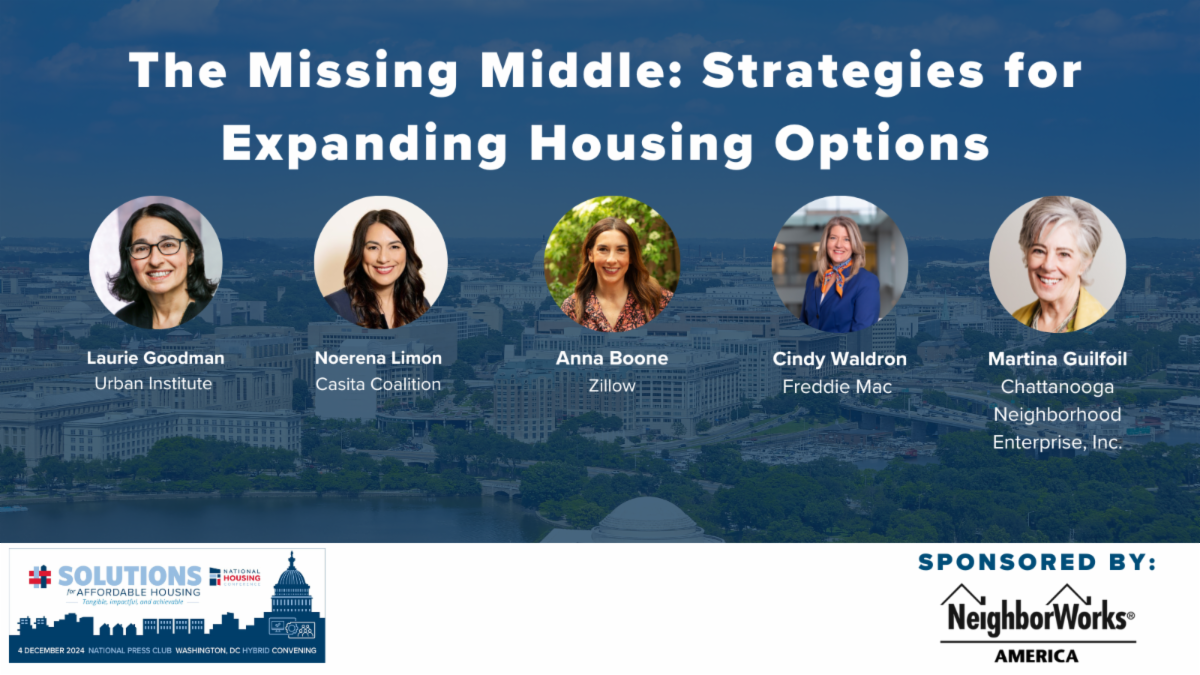
On Dec. 4, the National Housing Conference will host its Solutions for Affordable Housing convening at the National Press Club in Washington, DC. Join Congresswoman Debbie Dingell (D-Mich.) and affordable housing stakeholders as they discuss today’s most pressing housing issues and focus on solutions that are tangible, impactful, and achievable.
NHC members can take advantage of excusive member rates by using the following discount codes.
| |
|
In-Person Tickets
$175
Use Code: Member2024
| |  |
|
Virtual Tickets
$125
Use Code: MemberVirtual2024
| |
|
NAREB’s 2024 SHIBA report calls for comprehensive reform
The National Association of Real Estate Brokers (NAREB) released its 2024 State of Housing in Black America (SHIBA) report, highlighting significant challenges for Black homeownership despite broader economic stability. Persistent racial disparities continue to affect homeownership rates, with Black households at 45.7% compared to 74.3% for White households. Despite a 3.3% GDP in 2023, the housing market continues to struggle with declining mortgage originations and affordability. Key demographics, such as Black female-headed households and millennials, saw drops in mortgage applications and approvals over the past year. The report calls for urgent housing finance reforms to address systemic inequities and enhance access to homeownership for Black Americans.
The SHIBA report outlines the various headwinds Black Americans face when pursuing homeownership, despite a low Black unemployment rate of 5.5%. Median wages for Black workers stand at $56,490, significantly lower than the $89,050 median for White workers, and nearly 25% of Black households have zero or negative wealth. Additionally, appraisal bias results in a 30% median undervaluation of homes in Black neighborhoods. Investor activity has further impacted Black communities, with Redfin estimating that investors purchased 16% of homes sold in the second quarter of 2024, focusing on lower-priced properties. This trend limits affordable housing options, hindering Black homeownership opportunities. Additionally, climate change adds another layer of risk to Black communities, which are often located in areas vulnerable to natural disasters and face insufficient infrastructure and limited resources for recovery. Rising insurance premiums and the withdrawal of insurers from high-risk areas are making it difficult for Black homeowners to secure mortgages and build equity.
The broader housing market presents additional challenges, with mortgage rates fluctuating between 6% and 7% in 2024, and home prices still 47% higher than pre-pandemic levels. Only 14.5% of renter households can afford a median-priced home, a problem exacerbated by the 4.5 million housing unit shortage reported by Zillow. Other persistent challenges include higher mortgage denial rates for Black applicants, an increase in high-cost loans, and a persistent racial wealth gap – where the average net worth for White households is $1,415,470 compared to $332,390 for Black households.
NAREB is calling for comprehensive reforms to address these disparities. Key proposals include restructuring the housing finance system, expanding FHA loan programs, addressing appraisal bias, and creating special purpose credit programs. National priorities include establishing a National Homeownership Tax Credit Program to support affordable homeownership, expanding the U.S. Department of Housing and Urban Development's (HUD) Section 184 program to include Black borrowers, eliminating loan-level price adjustments, and providing relief for student loan debt. Additionally, NAREB's partnership initiatives, such as the Black Developers Academy and the Building Black Wealth Tour, aim to equip Black families with the knowledge and tools needed to achieve homeownership.
The report underscores that incremental wage increases are insufficient to close the racial wealth gap. Instead, it states systemic changes in housing policies and financial systems are essential to create equitable opportunities for Black homeownership and wealth building.
| | |
|
Biden Administration unveils new climate initiatives
The Biden Administration announced a series of new climate investments aimed at reducing emissions and reducing home energy costs, with a strong emphasis on boosting energy efficiency in the housing sector. These initiatives focus on making homes more affordable and energy-efficient by upgrading heating and cooling systems, improving insulation, and installing energy-efficient appliances in residential buildings nationwide.
The investments include $18 million allocated through the U.S. Department of Energy’s Energy Efficiency and Conservation Block Grant program (EECBG), authorized under the Bipartisan Infrastructure Law. Grantees will use the funds to develop net-zero building roadmaps, bolster recycling programs, launch residential energy efficiency rebate programs in disadvantaged communities, and more.
“The success of America’s clean energy transition will be found at the state and local level which is why President Biden and Vice President Harris have helped transform local clean energy plans into real, lasting actions,” said U.S. Secretary of Energy Jennifer Granholm. “The EECBG Program recognizes that climate solutions are not one-size fits all and provides localities with the tools needed to increase access to clean energy and boost energy resilience through community-led initiatives.”
| | |
|
Mortgage applications surge in rural communities
Rural areas are continuing to adjust to higher housing demand as a result of the COVID-19 pandemic, according to new research from Fannie Mae. The analysis shows a surge in rural mortgage applications of 80% above pre-pandemic levels, a trend that has continued into 2024. In urban areas, applications slowed due to high interest rates. Out-of-region buyers appear to be driving this trend, with second-home and investment purchasers initially leading the charge, followed by primary residence seekers. The shift is attributed to several factors, including increased remote work opportunities, a desire for more space, and changing lifestyle preferences. The trend could potentially help reverse population decline in rural areas, where over half of non-metropolitan counties experienced population loss in the decade before the pandemic.
| | |
|
LIHTC analysis tool shows allocation impacts
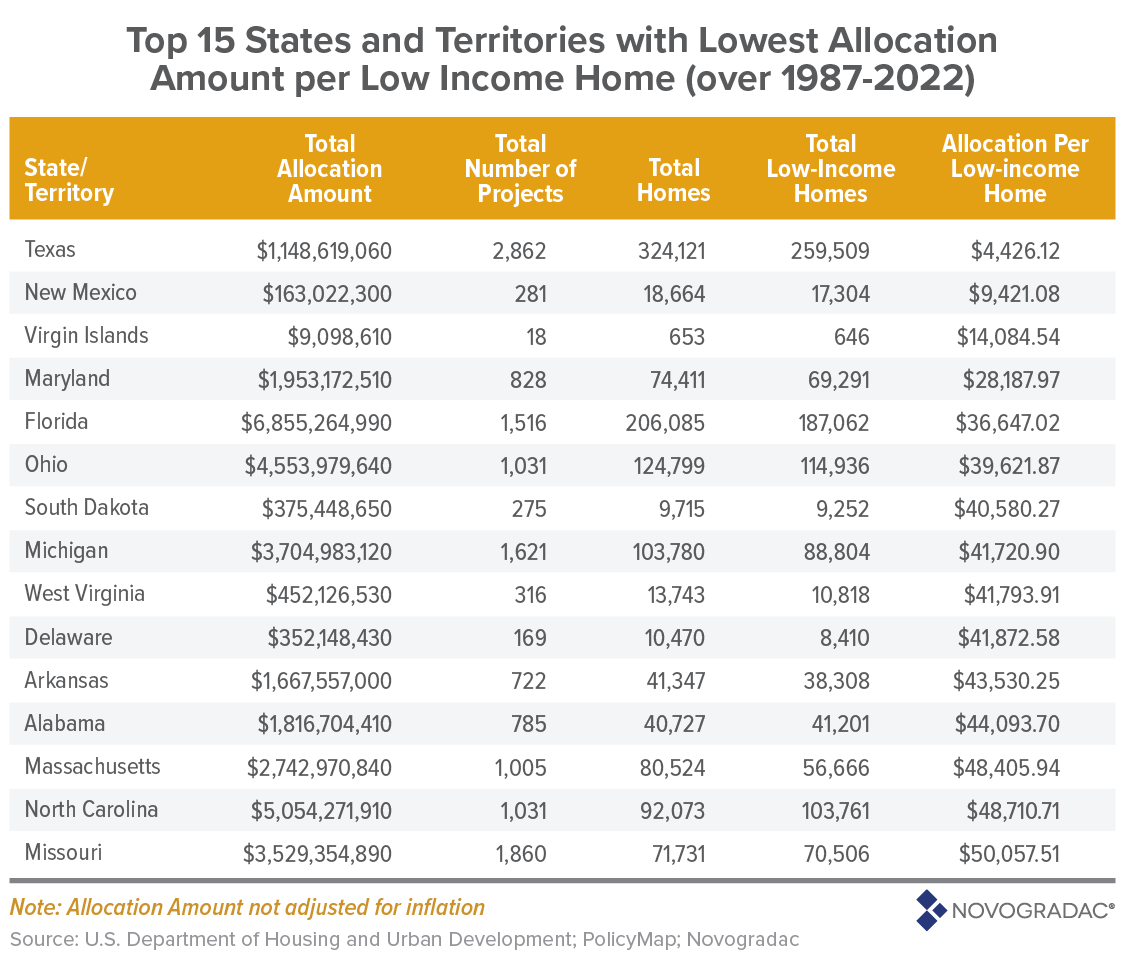
A recent analysis from Novogradac examines details of Low-Income Housing Tax Credit (LIHTC) properties across the country through its LIHTC mapping tool, showing the top Congressional Districts by allocation, number of properties, and allocation in relation to low-income homes. Texas tops the list having the lowest total allocation amount per low-income home at $4,426 across a total number of 2,862 projects. The data reveals a mismatch between highest allocations not aligning with highest number of properties. However, this is likely explained by varying construction costs and amount of gap financing available, among other things.
| |
Your go-to resource for housing policy | |
|
A new report from the Congressional Research Service offers an overview of the HOME Investment Partnership Program (HOME), an important federal block grant that provides flexible financing for affordable housing. The report includes an analysis of HOME grants to states in FY2024 and cumulative HOME funds spent on various activities, with rental new construction as the top category. It notes that in May, HUD proposed an updated HOME rule that would make significant and awaited regulatory updates to the program that would enhance efficiency of the program.
The Huffington Post reports that Senator Elizabeth Warren (D-Mass.), newly appointed as the top-ranking Democrat on the Senate Banking Committee, will focus her attention on housing supply and private equity in her new role. Warren plans to address the shortage of affordable housing and scrutinize the impact of private equity firms on the housing market. She aims to increase housing production and affordability while also examining the role of corporate landlords in the greater rental landscape.
The Congressional Budget Office (CBO) released a report on the housing goals of Fannie Mae and Freddie Mac (the Enterprises). The report frames the fees for mortgages that meet goal requirements as a subsidy and tax policy. For fiscal year 2025, the CBO estimates that nearly 750,000 households meeting these goals will receive an average implicit subsidy of $2,300, while approximately 1.4 million households not meeting the requirements will pay an implicit tax. The most affected households among those not meeting the goals will pay around $8,000, with others paying about $160 on average. As a result of this policy, the Enterprises are expected to purchase 37,000 more mortgages meeting the goals and 29,000 fewer mortgages that do not meet the requirement that they otherwise would.
An article from Newsweek discusses the potential impact of Donald Trump's presidency on the U.S. housing market. Experts suggest that President Trump's policies may not provide significant relief for Americans struggling with high home prices, low supply, and potentially elevated mortgage rates. While President Trump has proposed reducing regulations and offering tax incentives to increase housing supply, his plans for higher tariffs and stricter immigration policies could potentially increase homebuilding costs.
| |
Renew your NHC membership today! | |
Watch this video to learn more about how NHC represents diverse leaders across the housing spectrum, including lenders, homebuilders, affordable housing advocates, real estate professionals, housing development corporations, housing finance agencies, and more, to address today's pressing housing issues. | |
|
Your involvement is essential to addressing today’s housing challenges, and NHC relies on active members to maximize our impact and remain a leader in tackling today’s housing issues.
NHC membership offers exclusive networking opportunities, access to our weekly Member Brief, and other key housing resources such as our Housing Resource Center, Paycheck to Paycheck database, and Employer Assisted Housing Toolkit. We look forward to working with you to address America's housing challenges.
| |
|
Monday, November 18
Using AI to Predict and Prevent Homelessness | Joint Center for Housing Studies, 1 PM ET
AHF Live. November 18-20
Tuesday, November 19
2024 Homeownership Policy Symposium | NCST, 8:30-6 PM ET
Utah Strategies To Address Homelessness & Housing | NCRC, 9-10 AM ET
Farewell reception for U.S. Rep. Patrick McHenry, R-NC | Women in Housing and Finance, 5-7 PM ET
Wednesday, November 20
Post-Election Discussion: Navigating Homelessness Policy and FY25 Appropriations | National Alliance to End Homelessness, 3-4 PM ET
2024 New York Gala | Enterprise, 6 PM ET
13th Annual Housing Center Conference | American Enterprise Institute - AEI, November 20-21
Thursday, November 21
Post-Election Webinar | Affordable Housing Tax Credit Coalition, 3-4 PM ET
Emerging Leaders Program Presents: Unlock Insights on the 2025 Multifamily CRE Market | NMHC
| |
The National Housing Conference is a diverse continuum of affordable housing stakeholders that convene and collaborate through dialogue, advocacy, research, and education, to develop equitable solutions that serve our common interest. | |
Defending Our American Home since 1931 | |
Copyright © 2024. All Rights Reserved. | | | | |