|
October is ADHD Awareness Month
ADHD Resources
October is Bullying Prevention Month
Bullying & Cyberbullying Prevention Resources
In the News: Delaware Rural Health Transformation Funding
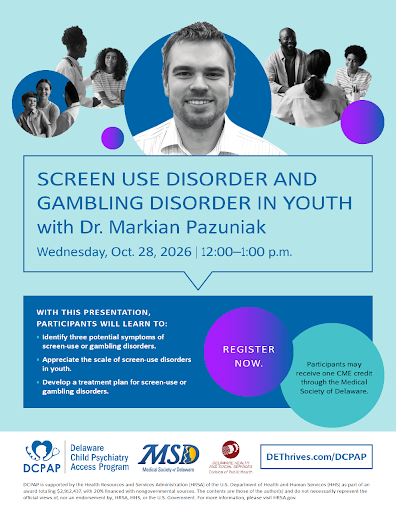
DCPAP Training: Screen Use Disorder & Gambling Disorder in Youth
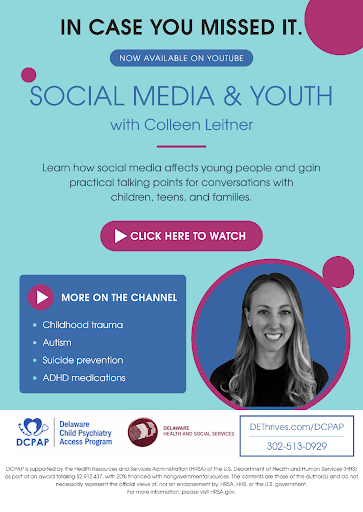
DCPAP YouTube Viewing
DCPAP Fall Outreach
DCPAP at the Delaware Healthcare Forum
DCPAP Office Hours M – TH
Community Resources & More!
| | October is ADHD Awareness Month | | |
ADHD Awareness Month helps increase awareness and understanding by sharing reliable ADHD information and strengthening community support.
As providers, we do our part to support the children and families with screening, diagnosis and treatment of ADHD across the lifespan.
The American Academy of Pediatrics (AAP) provides clinical guidance and
other resources to assist with the diagnosis and treatment of children and adolescents with Attention Deficit Hyperactivity Disorder (ADHD). Tools are provided for pediatricians, patients, families and teachers to ensure a comprehensive assessment of the patients functioning and behaviors leading to a proper diagnosis and successful treatment plan. Updated 10/3/2026
| | Resource Spotlight: Delaware CHADD | | |
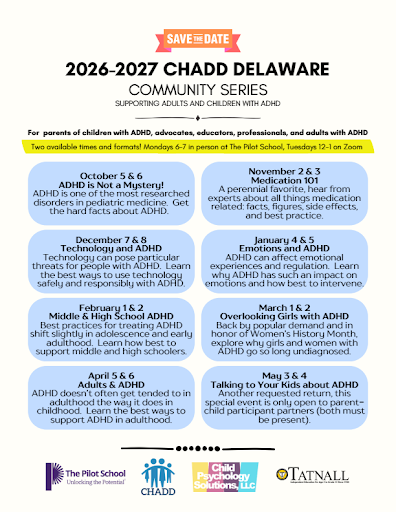
The Delaware CHADD chapter was co-founded 4 years ago by Dr. Cami Cami Winkelspecht, Ph.D. | Child Clinical Psychologist with Child Psychology Solutions, LLC and the Head of School at Tatnall, Dr. Alli Williams (former head of school at Pilot). They offer free in-person meetings and zoom webinars each month of the school year from October-May aimed at increasing evidence-based education for parents, caregivers, teachers, professionals (and kids/teens too at times) with ADHD. These events are all free and now posted on our website (with links for the first three zooms).
| | October is Bullying Prevention Month | | October as National Bullying Awareness Month. It is an opportunity to encourage the nation to take action at the local level to create safe and supportive organizations. When bullying is considered unacceptable and is not tolerated, encouraging kindness and inclusion will help to irradicate bullying. | | The National Child Traumatic Stress Network (NCTSN) recognizes that bullying has devastating effects on children and families such as school avoidance, loss of self-esteem, increased anxiety, and depression. Bullying can occur in multiple ways. It can be verbal, physical, through social exclusion, or via digital sources like email, texts, or social media.] [Being bullied can severely affect the person’s self-image, social interactions, and school performance and can lead to mental health problems such as depression, anxiety, and substance use, and even suicidal thoughts and behaviors. The NCTSN links to trauma resources related to the affects of bullying. | | |
The U.S. Centers for Disease Control and Prevention (CDC) defines bullying as any unwanted, repeated aggressive behavior by a youth or group of youths (not siblings or current dating partners) involving a real or perceived power imbalance that causes physical,
psychological, social, or educational harm.
CDC Definition and Key Statistics
- Definition: Involves physical, verbal, relational/social (e.g., spreading rumors), or property damage, occurring in-person or electronically (cyberbullying).
- High School Statistics: About 1 in 5 high school students report being bullied on school property, and over 1 in 6 report being bullied electronically.
- Outcomes: Associated with physical injury, emotional distress, anxiety, depression, lower academic achievement, substance use risks, self-harm, and increased risk of suicide or mortality.
CDC Prevention Strategies
The CDC outlines evidence-based approaches to stop youth violence and bullying through its technical packages and resources like StopBullying.gov:
- Promote Family Environments: Support healthy child and youth development through positive parenting and consistent communication.
- Teach Social-Emotional Skills: Implement universal school-based programs that build empathy, communication, conflict management, and problem-solving skills.
- Connect Youth to Adults and Activities: Foster strong bonds with caring adults, mentors, and safe after-school programs.
- Enhance Bystander Intervention: Train students and staff to become upstanders who safely intervene or report aggressive behavior.
- Create Safe Environments: Establish clear behavioral expectations, positive school climates, and community-level protections.
| | Check Out DCPAP Bullying & Cyberbullying Training | | Bullying & Cyberbullying Prevention Resources | | In the News: Delaware Rural Health Transformation Funding | |
The Delaware Department of Health and Social Services (DHSS) announced funding Wednesday through Delaware’s Rural Health Transformation Program to help recruit and retain physicians serving rural communities in Kent and Sussex counties.
The funding supports two programs: one providing educational awards to eligible medical students and another providing housing and relocation assistance to eligible physicians in residency training. In return, recipients will commit to five years of practice in rural Delaware.
| | |
The DCPAP YouTube training channel has recorded
a variety of training sessions for enduring viewing.
Can’t attend an upcoming session?
We will post new trainings post live presentation.
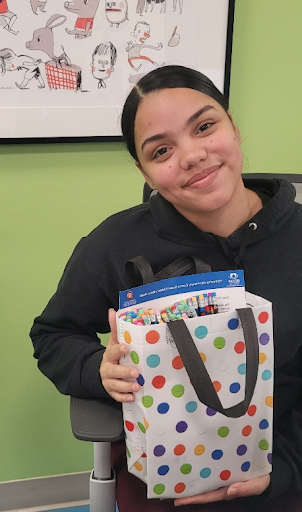
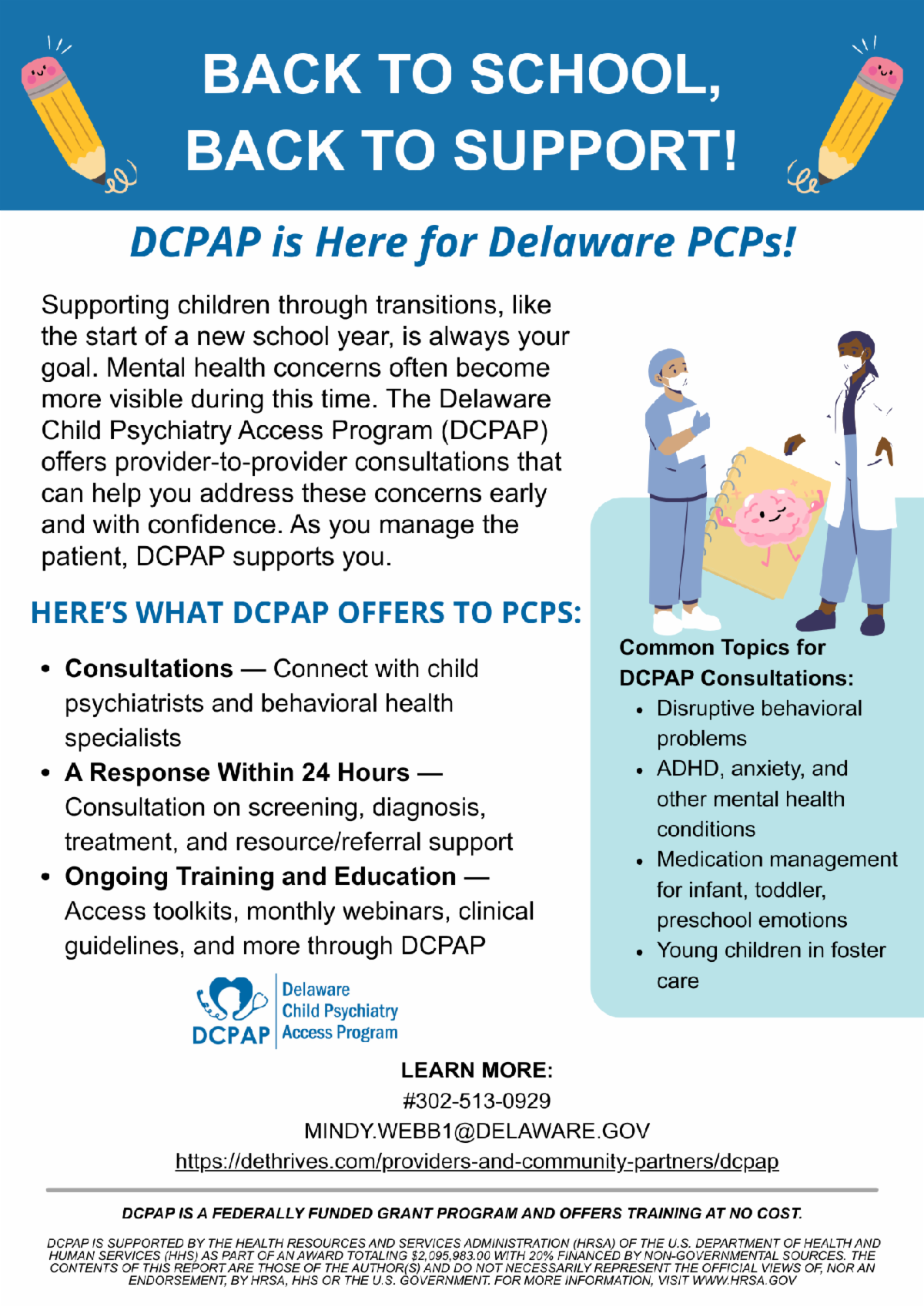
| | The DCPAP team is visiting each of the practices across the state who are registered with our program. We are sharing a Back to School message. along with prosocial message pencils for the primary care providers to share with their patients. Thanks to all providers for their hard work in addressing the health and mental health needs of their patients. And a special thanks to the support staff who welcomed us into their offices. Have you gotten yours yet? | | | DCPAP at the DE Healthcare Forum - Stop By! | DCPAP will host a table at the 30th Delaware Healthcare Forum on Thursday, October 29, 2026, 8:00 AM to 4:00 PM at Bally’s Dover Casino Resort, Rollins Center in Dover. The Healthcare Forum will bring together over 500 healthcare leaders from provider organizations across Delaware for a one-day conference focused on education, collaboration, and networking. Stop by to see us! | DCPAP Office Hours Offers PCPs Access to Psychiatrists Online 4 Days Each Week | | |
Office Hours for PCPs every Monday thru Thursday
from 12 – 2 PM, allowing DCPAP to offer live psychiatric consultation to PCPs 4 days per week.
PCPs - Need the link for Office Hours?
Email mindy.webb1@delaware.gov
PCPs can ask DCPAP for assessment, treatment
and support resources for specific patients anytime
via email, phone, text or website.
Check for additional resources below.
| | Community Resources & More | | |
DCPAP Hosts Office Hours 4 Days Each Week, Monday-Thursday.
PCPs can Speak with Consulting Psychiatrists Live Online.
Join us Monday thru Thursday between 12 – 2 PM!
DCPAP Consultation Line 302-513-0929
Monday - Friday 8 a.m. - 5 p.m.
Check Out Our Web Page on DE Thrives!
DCPAP on DE Thrives
| | Easy Access Through the QR Code Below.
Make DCPAP a FAVORITE on your Computer. | | Connecting with Child & Adolescent Psychiatrists made simple. | | Register, Request & Review program information in one place. | | |
About DCPAP
The Delaware Child Psychiatry Access Program is supported by the Health Resources and Services Administration (HRSA) of the U.S. Department of Health and Human Services (HHS), as part of a financial-assistance award totaling $2.09M, with an additional 20% funded by nongovernment source(s). The contents are those of the author(s) and do not necessarily represent the official views, nor are an endorsement, of HRSA/HHS or the U.S. government.
| | |
DCPAP Disclaimer Details:
Requests to DCPAP result in the sharing of clinical concerns and considerations based on information presented during professional-to-professional psychiatric consultation. It does not infer a direct patient contact by the consulting psychiatrist nor a direct psychiatric evaluation of a specific patient. Clinical assessment may not be complete and may require further direct patient and record assessment by the treating clinician, or referral of the patient for direct assessment by a psychiatrist or appropriate mental health professional.
| |
| | |
Funding for DCPAP through a grant to DPH from
U.S. Department of Health and Human Services (HHS)
Health Resources and Services Administration (HRSA)
| | | | | | |