House APP Committee Shares Budget Decisions:

Significant Restorations Made for FY26

Today, the House Appropriations Committee released their budget decisions for FY26. These decisions restore significant amounts of the DDA budget previously targeted for cuts and cost containment measures. Below outlines today’s decisions as well as other actions that have been taken throughout the session, to restore funding to the Developmental Disabilities Administration (DDA) to provide you with a fuller picture. Below, see the decisions announced today, followed by a recap of the decisions we previously shared, that happened earlier in the session.


It is important to note that the budget deliberations are not over. Now it is time to offer our profuse and sincere thanks to members of the House Appropriations Committee. The Senate decisions come next and then the full budget must be reconciled and then voted on by the General Assembly. Based on what we heard today, we believe the Senate decisions on the DDA budget will be in a very similar posture.


Thank you for your unrelenting advocacy these past two months. This would not have been possible without the thousands of you who spoke up! As we move through these final weeks of session, please also note this is not over.

Decisions Announced by House APP Committee Include:

When we first received the proposed budget in January, it was proposed that there be a cut to DDA funding of $457 million total funds.


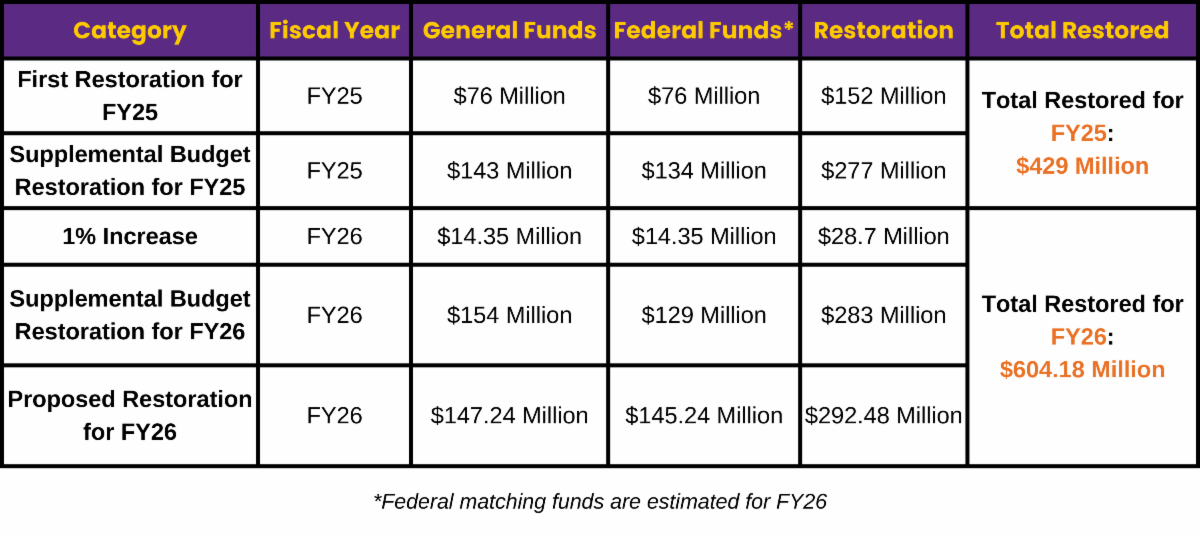
The House Appropriation Committee announced that they will be restoring $292.48 million of that amount (total funds).

  • For community providers, the geographic differential rates will not be eliminated (as proposed). Instead the intent is that these rates will be capped at 10% above the rest of the state rates. * there is some technical language we will need to get clarified in the Senate.
  • The Dedicated Hour Rate for Community Living Group Home and for Supported Living, will be decreased from 87% to 86% of the fully loaded brick. Budget language states that DDA may not consider the availability of shared hours in a home when approving dedicated hours to support the medical, behavioral, or day-time residential support needs of an individual. This provision will be effective for a minimum of 1 year.
  • For Self-Directed Services participants, the Reasonable and Customary rates are preserved at the current level.


  • For Self-Directed Services participants, Wage Exceptions will not be eliminated (as proposed) but will be allowed up to 15% above the maximum reasonable and customary service rate, and 10% above the standard maximum wage for the Geographic Differential maximum wage.


  • For Self-Directed Services participants, the Committee asks DDA to remove the day-to-day administrator category of services from Individual and Family Directed Goods and Services (IFDGS) and instead place this category on a separate service line.  
  • For State-Funded individuals, the Committee added budget language to direct the DDA to ensure people who receive services from the DDA apply for Medicaid to capture federal funds for those eligible for the Medicaid Waiver. Further, the committee directed that a certain number of individuals may still need to be supported by DDA with state-only funds.


  • For Low-Intensity Support Services (LISS), the Committee rejected the proposal to eliminate LISS, and added a FY26 funding appropriation for $2 million dollars, with a directive to cap individual grants from this fund at $500.

To support growth, the Appropriations Committee rejected the recommended cut of the 1% rate increase for DDA community providers. This funding represents a total of $28.7 million total funds. This increase is consistent with other Medicaid long-term care provider groups, including behavioral health and aging services.


DDA reports there is funding for expansion of approximately 600 Transitioning Youth entering services in FY26, Crisis Placements and DSS Youth Aging Out.

The DDA is also mandated to report quarterly on spending for the Community Services Program, providing detailed data on enrollment, service utilization, and cost estimates. The first report is due by August 15, 2025. These reporting requirements are designed to enhance transparency and accountability, ensuring that funds are used effectively to meet the needs of our community.


It also included that the DDA will NOT establish a policy that would require transitioning youth to enter into the traditional model for their first year of service.

BRFA Updates

In the Budget Reconciliation and Financing Act (BRFA), the decisions were that the DDA can put a cap on Individual and Family Directed Goods and Services (IFDGS).


The DDA will also be allowed to use Waiting List Equity Funds (WLEF) for FY26 for deficiency spending.


The effort to remove LISS from statute was rejected. LISS will remain in statute and "may" be funded annually depending on availability of state funds.

Recap of Previously Shared Budget Decisions:

FY25


The Governor’s FY26 budget initially included a proposed cut of $194 million, to take place during the last quarter of fiscal year 25. Budget leaders from both the House and Senate successfully restored $152 million of this cut by reallocating funds in partnership with the Governor's administration.


Governor Moore’s supplemental budget addressed additional deficit spending by the Developmental Disabilities Administration (DDA) that was not anticipated when the budget was initially proposed. A total of $277 million will be allocated for FY25, with $143 million sourced from the General Fund and $134 million from federal funds.


Additionally, the Governor had reinstated $5.5 million for the Low-Intensity Support Services (LISS) program for FY25.

FY26


For FY26, the allocation for additional deficit spending increases to $283 million, comprising $154 million from the General Fund and $129 million from federal funds. This funding is intended to cover ongoing operational costs that were unknown at the time that the FY26 budget was introduced.

We encourage you to review the information carefully to understand how these changes may impact our community. Should you have any questions or require further clarification, please do not hesitate to reach out.

See what's happening on our social sites:
Facebook  Twitter  Linkedin