WELCOME TO THE INAUGURAL ISSUE OF THE MERCY DEI DIGEST! |
|
Hello Mercy Community,
It’s fall, one of my most favorite seasons; here comes cool weather, Halloween, and Thanksgiving. I love the beautiful Michigan foliage, cute fall boots, cider mills, and celebrations. This is the time where I will also begin my regular communication on DEI at Mercy.
In each DEI Digest, I will share diverse holidays that we can celebrate as a community. I will also include best teaching practices for an inclusive classroom community, key DEI initiatives of the Sisters of Mercy, and important information for students and their families.
I am so honored to work at Mercy to create an anti-racist and anti-biased learning environment for all students. I have received so much support from all levels of the Mercy community, board members, alumnae, administrators, faculty, staff, and students. This work cannot be done in isolation so the support and encouragement are so appreciated. I am committed to making a “Just Mercy” for all students.
In Mercy,
Mercy High School Director of Diversity, Equity & Inclusion
|
|
SISTERS OF MERCY'S COMMITMENT TO SOCIAL JUSTICE & ANTI-RACISM |
|
According to the Sisters of Mercy, “Racism in all its forms contradicts Catholic Social Teaching, which calls for respect for the human dignity of every person. The Sisters of Mercy oppose racism and are actively working to develop an intercultural perspective within our Institute as well as within the communities we live and serve.”
For those who are interested, check out the resources on ways to take action and learn more about the anti-racism and social justice advocacy from the Sisters of Mercy.
|
|
DEI ACTION PLAN UPDATE AT MERCY HIGH SCHOOL
September - November 2020
|
|
STUDENTS
The launch of the 1st chapter of the Pretty Brown Girls Club, meetings will start in November
- Founded by 2017 Mercy Distinguished Alumna Sheri Johnson Crawley
The Student Diversity Union Club was founded in October
- This club is an umbrella for BASE, HRC, GSA, etc...
- It is for everyone
Addition of The Hate U Give to the English 9 curriculum
- DEI class facilitation of final reflection
- A curriculum review process for English Literature
One-on-one meetings with students who need coaching/directions dealing with DEI issues
Restorative meetings have been instituted
- The goal is to help forge trust, understanding and even change mindsets during a conflict
- Help students deal with conflict more effectively, specifically as it relates to DEI issues
STAFF
The Mercy DEI Book Club launched
-
So You Want to Talk About Race by Ijeoma Oluo
- We meet 2x month and discuss connections, lessons learned, and how to apply it in our lives and at Mercy
- 1 group meets in person and another on Zoom
- Teachers can earn SCHECHs for recertification
DEI training held with Calvin Terrell
- All staff in August
- Board of Trustees in September
- Another training is being planned for early 2021
- ERACCE is scheduled for August 2021
One-on-coaching with staff
Election resources
- Working with administrators, to create a supportive environment for students during the 2020 presidential election
Advising and using a DEI lens on the school marketing materials and bulletin boards
- Updating policies for review of internal and external images and messaging
|
|
The diversity calendar is a way for us to celebrate our differences as a Mercy community.
November
Native American Heritage Month
Black Catholic History Month
10/31 – 11/2: Day of the Dead (Día de Los Muertos)
11/3: Saint Martin de Porres’ Feast Day
11/13: St. Augustine’s Birthday - He was the first “Doctor” of the church from North Africa.
11/16: Dutch American Heritage Day
11/30: Birthday of Shirley Chisholm - In 1968, she became the first Black woman elected to the United States Congress. She represented New York’s 12th congressional district. In 1972, she was the first Black candidate for a majority party’s nomination for the president of the United States, as well as the first woman to run for the Democratic Party’s presidential nomination.
|
|
NOVEMBER IS BLACK CATHOLIC HISTORY MONTH |
|
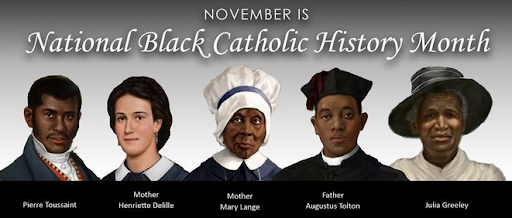
There is a cause for celebration of Black people in the Catholic church! According to the U.S. Conference of Catholic Bishops, there are over 3 million Black Catholics in the US. and 798 predominantly African American parishes. “While many [B]lack people are Baptist, the second-largest religious group that [B]lack people belong to in the U.S. is the Catholic Church. There are 250 African American priests, 437 deacons, 75 men of African descent in seminary formation, 400 African American religious sisters, and 50 religious brothers. These numbers do not include missionaries from Africa who now serve in various ministries throughout the United States” (Catholic Extension).
Another reason to celebrate is the 5 Black men and women who are being considered for canonization for their inspiring lives:
- Venerable Pierre Toussaint (1766-1853), the former slave and philanthropist who is buried in New York’s Saint Patrick’s Cathedral
- Venerable Henriette Delille (1813-1862), from New Orleans, a descendant of slaves who founded the Sisters of the Holy Family
- Venerable Augustus Tolton (1854-1897), who was born in slavery and eventually attended seminary in Rome because no American seminary would accept him, and who was a pastor in Chicago
- Servant of God Mother Mary Elizabeth Lange (ca. 1794-1882), the Haitian refugee who had a passion for educating children and who founded the Oblate Sisters of Providence
- Servant of God Julia Greeley (c. 1833-1918), the former slave who was Denver’s “Angel of Mercy,” now buried in Denver’s cathedral
Check out these resources to learn more about Black Catholics and the Church:
|
|
CREATING & MAINTAINING INCLUSIVE CLASSROOMS: INCLUDING NATIVE AMERICANS IN OUR CURRICULUM |
|
As we approach Thanksgiving and Native American Heritage History month, consider including Native American materials in your lesson planning. I have included some resources and best practices to do so. See the resources below and consider utilizing them this month and beyond.
Thanksgiving Mourning - In this activity, students will explore the perspectives of two Native American authors about the meaning of the Thanksgiving holiday and then write journal entries.
Pre-Columbian Native Peoples and Technology - The purpose of this lesson is for students to grapple with three separate definitions: primitive, civilized (civilization), and technology. Students examine or re-examine their definitions of these words and how these words define what they understand about Pre-Columbian native culture. The objective is to help students determine their point of view.
Stereotypes and Tonto - This lesson revolves around Sherman Alexie’s poignant yet humorous and accessible essay, “I Hated Tonto (Still Do).” It explores the negative impact that stereotypes have on the self-worth of individuals and the damage that these stereotypes inflict on pride in one’s heritage. The reading is supported by a short video montage of clips from Western films. The clips offer students the opportunity to evaluate primary sources for bias and bigotry, as well as providing context for the protagonists’ experiences in the essay.
|
|
NORMS FOR HAVING DIFFICULT CONVERSATIONS |
|
Consider these norms from other Sisters of Mercy schools as you have conversations around DEI issues.
From Mount St. Mary Academy-Watchung, NJ:
- Speak from the “I” perspective
- Be fully present
- Be self-responsible and self-challenging
- Listen to understand
- Accept respectful conflict as a necessary catalyst for change
- Suspend judgment
- Be comfortable with silence
- Make mistakes and let go
- Lean into discomfort
- Respect confidentiality-Respect candidness of others as a gift
From Mercy High School Baltimore’s civil discourse norms:
- Maintain engagement
- Activate intentional listening skills
- Inquire further when confronted with misunderstandings or disagreements
- Cultivate an open mind
|
|
MRS. SMITH'S RECOMMENDATIONS FOR GREAT DEI READS |
|
So You Want to Talk About Race by Ijeoma Oluo - our staff book club pick!
White Fragility by Robin Diangelo
Cultivating Genius: An Equity Framework for Culturally and Historically Responsive Literacy by Gholdy Muhammad
The History of Black Catholics by Cyprian Davis
|
|
NATIONAL BLACK CATHOLIC CONGRESS RECOMMENDED BOOKS |
|
The Fire Next Time by James Baldwin
The Cross and the Lynching Tree by James H. Cone
How To Be An Antiracist by Ibram X. Kendi
What Truth Sounds Like by Michael Eric Dyson
So You Want to Talk About Race by Ijeoma Oluo
Racial Justice and the Catholic Church by Bryan N. Massingale
I am Still Here: Black Dignity in a World Made for Whiteness by Austin Channing Brown
Caste: The Origins of Our Discontent by Isabel Wilkerson
|
|
|
|
|
|
|