Weekly update from the National Housing Conference | |
News from Washington | By Brittany Webb
| | |
FHA updates loss mitigation framework, ending pandemic-era waterfall
The Federal Housing Administration (FHA) has formally retired its COVID-19 Recovery Loss Mitigation waterfall, a temporary suite of tools that assisted over two million homeowners during the pandemic. The transition is outlined in a new Mortgagee Letter, which keeps the current options in place through September 30 before replacing them with a streamlined, permanent framework. The announcement also indicates scrutiny of the Payment Supplement Program and a need for the Department of Housing and Urban Development (HUD) to determine if the program should remain a part of the loss mitigation program. Additionally, FHA will limit borrowers to one permanent loss mitigation solution every 24 months, up from 18, citing alleged misuse of COVID-era tools and rising default rates.
HUD said the changes reflect a return to prudent management of the Mutual Mortgage Insurance Fund (MMIF) and incorporate lessons from the pandemic to create a more flexible, long-term approach. The MMIF has a current capital ratio of 11.47%, well above its statutory minimum of 2%.
Reaction to the policy shift has been mixed. Industry leaders noted that the action recognizes that pandemic-era practices are no longer applicable to market realities, while some are concerned of potential gaps in support for struggling homeowners amid a high rate environment and a hastened timeline for servicers to sunset programs.
“The issue is less what they rescinded as it is what they instituted,” said NHC's president and CEO David Dworkin in an interview with HousingWire. “What they’ve instituted is a responsible and fair way of addressing the needs of people who are in trouble with their mortgage and can work it out. That’s good for them, for the lender and for the taxpayer.”
“Specifically, we appreciate FHA’s efforts to reinstate a cap on the number of times a borrower can utilize a home-retention program and require the successful completion of trial payments to demonstrate long-term affordability,” said Bob Broeksmit, president and CEO of the Mortgage Bankers Association. “Together, these safeguards will improve sustainability, protect the FHA insurance fund, preserve borrower equity, and further align FHA with the GSEs.”
| | | |
Nearly a quarter of HUD staff rumored to resign, HUD for sale
Approximately 2,300 HUD employees have reportedly accepted the agency’s latest “Fork in the Road” offer to resign from their positions. The most recent resignation offer, extended to HUD’s estimated 10,000 employees, closed on April 11. If estimates are correct, the Department responsible for expanding affordable housing and creating strong and sustainable communities for all Americans faces the loss of one-quarter of its workforce.
Rumors of mass layoffs have plagued HUD for weeks as the Trump administration continues its efforts to massively downsize the footprint of the federal government through its Department of Government Efficiency (DOGE). Housing advocates have questioned how the Department will maintain its functionality with drastic reductions in force, expressing deep concerns for continuation of services such as rental assistance, FHA mortgages, and fair housing.
"The Deferred Resignation Program carries out President Trump’s commitment to efficiency in the federal government by providing a pathway for employees who wish to seek new opportunities while also affording the agency an opportunity to streamline our operations,” stated HUD Secretary Scott Turner.
The HUD headquarters was subsequently once again listed for sale shortly after the resignation rumors became public, appearing on a list of federal properties that the General Services Administration (GSA) has designated for “accelerated disposal.” It had been listed for sale by GSA last month, but was removed for the administration to “understand the nuances of the assets listed.” HUD announced a formal partnership with GSA to relocate the HUD headquarters on Thursday.
“HUD’s focus is on creating a workplace that reflects the values of efficiency, accountability, and purpose,” said Secretary Turner. “We’re committed to rightsizing government operations and ensuring our facilities support a culture of optimal performance and exceptional service as we collaborate with our partners at GSA to deliver results for the American people.”
| | | |
Partnering with NHC’s Housing Visionary Awards Gala and its distinguished honorees elevates your organization’s visibility, deepens engagement, and opens the door to valuable networking with over 500 influential housing leaders and stakeholders.
We offer sponsorship levels tailored to fit every organization’s needs – starting at $3,500 up to $50,000. Depending on your sponsorship level, benefits could include:
- Additional Gala tickets.
- A Gala Tribute Book ad.
- Listing in the Gala Tribute Book.
- Listing in printed and electronic marketing materials.
- Acknowledgement in opening and closing media presentations.
- Prominent listing of company logo, name, and website link on the event website.
- Recognition in Gala opening remarks.
- Recognition as a Networking Reception sponsor or as a Dessert Reception sponsor.
Tribute Book ads are available from $750 for a quarter-page to $2,500 for a full-page placement. Tickets are $1,000, but NHC members at or above the Full membership level receive half-price tickets.
For more information, please contact NHC's COO Amanda Mitchell at amitchell@nhc.org.
| | | |  | | |
CFPB layoffs begin and end within hours
The Consumer Financial Protection Bureau (CFPB) initiated mass layoffs that were quickly halted by a federal judge, affecting an estimated 1,500 of CFPB’s 1,700 employees.
"I am deeply concerned given the scope and speed of the agency's action...about whether the agency is now in compliance with the preliminary injunction," U.S. District Judge Amy Berman Jackson said during a hearing regarding the dismissals. Jackson ordered that Thursday's mass layoffs be suspended pending a decision on whether the government is in violation of her order.
Acting CFPB Director Russ Vought stated that the reductions were necessary to realign the Bureau's operations with its revised mission and priorities. The layoffs proceeded under a partial stay of a federal court injunction that had previously blocked such actions without individualized assessments.
The agency plans to shift its focus away from enforcement activities that can be managed by states. This move has drawn criticism from consumer advocates and lawmakers, including Sen. Elizabeth Warren (D-Mass.), who condemned the layoffs as a serious threat to consumer protection and democracy.
Legal challenges are ongoing, with the CFPB's employee union filing motions questioning the legality of the mass terminations and arguing that the cuts undermine the bureau's statutory functions. Despite the controversy, the administration maintains that the CFPB will continue to operate in a more streamlined form.
| | | |
New effective dates for HOME final rule
HUD has published updated effective dates for its final rule modernizing the HOME Investment Partnerships Program (HOME), following a regulatory review by the Trump administration. Originally set to take effect on February 5, the rule will now be phased in through multiple dates beginning on April 20 and extending into October.
Almost all provisions will take effect on April 20. However, updates related to tenant protections have been delayed until October 30. HUD cited the need for additional public input as the reason for postponing those specific changes. Grantees may voluntarily adopt the new rule’s provisions before the effective dates and are encouraged to begin planning for implementation.
The HOME rule is the program’s first major regulatory overhaul in more than a decade and reflects long-standing industry recommendations to simplify administration and improve program outcomes. Meanwhile, members of Congress are also collecting public feedback on the program’s future as part of a potential legislative reauthorization.
| | | |
Celebrating Fair Housing Month amid challenges to equal opportunity
HUD Secretary Scott Turner kicked off Fair Housing Month by unveiling the 2025 theme: “Faith, Freedom, and Fair Housing.” In his remarks, Secretary Turner reaffirmed HUD’s responsibility to uphold the Fair Housing Act and its ongoing commitment to a free and fair housing market. He described the period as the “Golden age of American homeownership,” encouraging Americans to report any instances of discrimination and highlighting HUD’s role in ensuring equal opportunity for all.
While HUD’s leadership celebrates this month, the National Fair Housing Alliance (NFHA) and other civil rights advocates are raising alarms about what they describe as a “national assault on fair housing.” Lisa Rice, NFHA President and CEO, issued a statement warning that recent federal actions threaten to undermine decades of progress.
“The fight for fair housing was born from decades-long efforts by civil rights icons and modern-day patriots. Their work helped unleash unparalleled opportunities for hundreds of millions of people from the Atlantic to the Pacific. The Fair Housing Act established three promises for the people of this nation—the elimination of discrimination in our housing and lending markets, the opportunity for everyone to live in an affordable home in a well-resourced, resilient, healthy neighborhood; and fair housing as the national policy of the United States. While these promises are not yet fulfilled, we have made great strides towards achieving them”
Rice emphasized that without robust federal enforcement, individuals facing housing discrimination will have fewer avenues for justice, and the risk of predatory and exclusionary practices will rise.
| | | |
HUD releases FY 2025 income limits for housing programs
HUD has released the 2025 income limits that determine eligibility for a wide range of federal housing programs, including the Low-Income Housing Tax Credit (LIHTC), Section 8 Housing Choice Vouchers, Public Housing, and HOME. The limits guide rent-setting and tenant income eligibility for thousands of affordable housing developments nationwide. The 2025 limits incorporate 2022 American Community Survey data and mark a significant shift by applying a new trend factor based on Congressional Budget Office projections, rather than the traditional Consumer Price Index for All Urban Consumers (CPI-U). This change aligns with HUD’s pre-pandemic methodology and is expected to produce more stable and predictable income limit growth over time. According to Novogradac, income limits increased across the almost 2,500 areas by around 6.2%. The 2025 limits are effective as of April 15.
| | | |
FHFA launches mortgage fraud tip line
The Federal Housing Finance Agency (FHFA) has launched a public tip line for reporting suspected mortgage fraud involving Fannie Mae, Freddie Mac, or the Federal Home Loan Banks. The new resource allows individuals to submit tips anonymously online, by email at fraudtips@fhfa.gov, or by phone at 1-800-793-7724.
The move was first announced by FHFA Director Bill Pulte via a post on X (formerly Twitter). Reportable issues include falsified loan documents, fraudulent appraisals, or misuse of mortgage relief programs. FHFA says all credible tips will be reviewed by its Office of Inspector General and may be referred to law enforcement.
| | | |
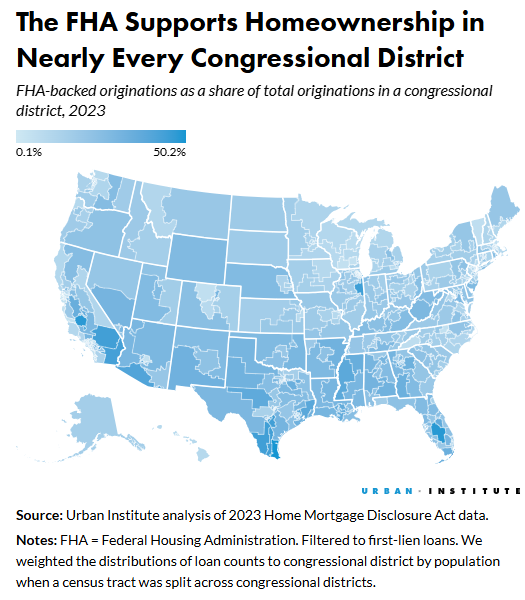
FHA lending supports nearly every district
New research from the Urban Institute highlights the vital role that FHA mortgages play in districts across the country, finding that FHA supports homeownership in nearly every district. Topping the list of highest shares of FHA loans is Florida’s 18th District at 46.8%, followed by California’s 22nd at 45.8%, Illinois 2nd District at 43.5%, Texas’ 34th District at 41.7%, and California’s 23rd District at 41.3%.
| | |
The Affordable Housing Credit Improvement Act has been reintroduced in the U.S. House of Representatives with record-breaking bipartisan support—over 100 original cosponsors from nearly 40 states—signaling a powerful push to address the nation’s affordable housing crisis. This landmark bill would finance up to 1.6 million additional affordable homes over the next decade, making it easier to build in underserved communities. With a Senate companion bill expected soon, advocates are rallying to turn this momentum into real action and secure a long-overdue win for millions of cost-burdened individuals nationwide.
In a speech at the Economic Club of Chicago, Fed Chair Jerome Powell indicated that the U.S. economy is in a broadly solid position with a strong labor market, though new concerns of tension for the Fed’s dual mandate have arisen. With inflation still above the Federal Reserve's 2% goal and heightened uncertainty particularly due to the Trump administration's significantly larger-than-anticipated tariff increases, Powell notes that inflationary effects could be more persistent.
The NYU Furman Center’s Stoop blog examines the structural “charter defects” of Fannie Mae and Freddie Mac that hinder meaningful reform of the government-sponsored enterprises (GSEs). The so-called “big three” defects include a too low and inadequately risk sensitive minimum regulatory capital, the implied guarantee as a bad system of government support, and the ease of abusing borrowings through the ability to carry an unlimited discretionary investment portfolio. The piece argues that without resolving these tensions, housing finance reforms will remain limited.
| | Renew your NHC membership today! | | Watch this video to learn more about how NHC represents diverse leaders across the housing spectrum, including lenders, homebuilders, affordable housing advocates, real estate professionals, housing development corporations, housing finance agencies, and more, to address today's pressing housing issues. | | |
Your involvement is essential to addressing today’s housing challenges, and NHC relies on active members to maximize our impact and remain a leader in tackling today’s housing issues.
NHC membership offers exclusive networking opportunities, access to our weekly Member Brief, and other key housing resources such as our Housing Resource Center, Paycheck to Paycheck database, and Employer Assisted Housing Toolkit. We look forward to working with you to address America's housing challenges.
| | The National Housing Conference is a diverse continuum of affordable housing stakeholders that convene and collaborate through dialogue, advocacy, research, and education, to develop equitable solutions that serve our common interest. | | Defending Our American Home since 1931 | | Copyright © 2024. All Rights Reserved. | | | | |