|
Dear Colleagues,
This month’s newsletter shares updates relating to the complex and rapidly changing federal funding landscape. We want both to acknowledge the continued uncertainty and ongoing threats, as dramatized by recent suspensions of funding to UCLA, and to highlight some progress, as we begin to see evidence of increases in NIH award notices. We also want to share resources that are intended to help those seeking new federal and non-federal funding.
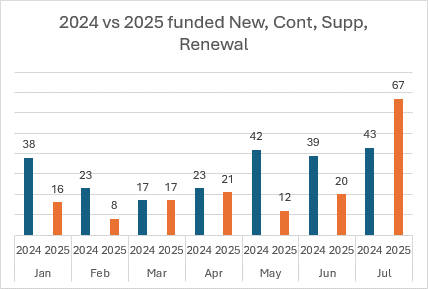
Notices of awards (NOAs). We know many DOM researchers are experiencing very frustrating delays in the receipt of NOAs. However, there has been positive movement over the past month with an increase of NOAs received (see Figure). The months of July, August, and September represent the last quarter of the federal fiscal year and are typically the most active for award notices, so we are closely monitoring award notices, and we will continue to update you.
| | |
Foreign subawards. As of mid-July, UCSF has 142 active foreign subawards impacted by the May NIH notice halting all awards with foreign subawards (NOT-OD-25-104). The guidance was for researchers to remove the foreign sub-component, or restructure and resubmit their research awards for full scientific review under a new administrative process to be developed by late summer or fall 2025. NIH is not currently accepting new applications that propose foreign subawards and there has not been any updated guidance for new applications. The NIH recently issued a second notice (NOT-OD-25-130) providing an expedited process for the restructuring of existing awards with foreign subawards involving human subjects. This is a welcome development, as most of UCSF’s impacted awards involve human subjects. We are seeing some grants coming through with this new mechanism.
Funding strategies discussion for ZSFG faculty and fellows. Peter Hunt (ZSFG DOM Associate Chief of Research) hosted a very successful first session discussing grant terminations and research portfolio diversification. The sessions, intended for faculty and fellows affected by changes in federal funding and NIH foreign subcontract policies will feature anchor faculty Neeta Thakur, Annie Luetkemeyer and Gabe Chamie. If you were unable to join the first session, there is a second session scheduled on Monday, August 25, from 2 PM-3 PM in PRIDE Hall, Room 1940. Sign up here.
Research Resilience Initiative. The Office of Research is excited to launch the Research Resilience Initiative (RRI). Led by the office of the Associate Vice Chancellor for Research Inclusion, Diversity, Equity, and Anti-Discrimination (AVCR-IDEA), RRI aims to assist researchers affected by federal policy changes in obtaining new funding through monthly seminars for early-career researchers, seminars on obtaining grants from non-NIH and non-federal funders, grant writing and consultation services, and a mini-grant program to help at-risk, early-career researchers prepare new grant proposals.
NIH support of animal research. The NIH recently announced that it will no longer issue NOFOs exclusively for studies with animal models. NIH will continue to support grants that use laboratory animal models if scientifically appropriate, justifiable, and with animal welfare oversight. If laboratory animals are proposed, scientists must continue to clearly explain why they are necessary for their research, that the minimal number needed to ensure rigorous and reproducible studies will be used, and why the study cannot be done using another model or approach.
New policies affecting NIH proposals. The NIH is limiting PIs to six new, renewal, resubmission, or revision applications per calendar year (excluding T activity codes and R13 conference grants) to ensure fairness and maintain review quality (NOT-OD-25-132). While limited use of AI tools may be appropriate for limited aspects, applications that are either substantially developed by AI, or contain sections substantially developed by AI, will not be considered to be original ideas of applicants and may be subject to misconduct investigation and enforcement actions.
NIH has revised its inclusion policy, replacing the term “sex/gender” with “sex” and updating race/ethnicity categories to match federal data standards (NOT-OD-25-131). The inclusion of women and members of racial and/or ethnic minority groups in all NIH-funded clinical research is required, unless a strong scientific or health-related justification is provided. Effective August 18.
Although we are pleased to be able to report some progress in the federal funding situation, we acknowledge the challenges presented by ongoing uncertainties and will continue to work with you as things evolve. We devote the remainder of this newsletter to celebrating your accomplishments and providing information about funding opportunities, programs, and events.
We know how hard members of our community are working to sustain our research enterprise, and we hope these resources are useful to you.
Best,
| | |
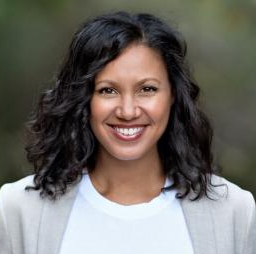
Congratulations to Marilyn Thomas, PhD, MPH, assistant professor in the Division of General Internal Medicine at UCSF Health, who received the 2025 Irene Perstein-Mt. Zion Award! The Irene Perstein Award is awarded annually by the UCSF School of Medicine to an outstanding, newly recruited junior faculty scientist.
| | First Time R01 or Equivalent Award | | Please let Ilona Paredes know if we inadvertently missed your K award, first R01, or equivalent award in this issue of the newsletter. We will make sure to feature your award in our next issue. | | Promoting our Faculty for National Recognition | | |
As part of our commitment to faculty success and advancement, we encourage those interested in membership in national societies such as ASCI, AAP, or NAM to notify their Division Chiefs. To support you in this process, Rita Redberg, MD, MS, and the DOM Awards Committee are available to assist with nominations. The committee’s goal is to identify outstanding colleagues whose work deserves national recognition and, together with Division Chiefs, guide and support nominees through the process. These prestigious societies not only honor individual accomplishments, but they also offer career benefits, including the possibility of a one-year acceleration.
Below are key nomination details for several major national societies. Proposers must be society members, and at least one should be outside of UCSF. We encourage faculty to review these carefully and reach out early to their Division Chiefs if interested in being nominated.
American Society for Clinical Investigation (ASCI)
The ASCI elects new members each year to recognize physician-scientists with significant research accomplishments. It serves as a benchmark of excellence in medical research, celebrating advances in medicine, and aims to bridge basic and translational research.
- Candidates must be age 50 or younger as of January 1 in the year of induction.
- Nominees are allowed three total attempts at election.
- Requires a proposer and seconder, both of whom must be active ASCI members, ideally from outside the nominee’s institution.
- Up to three general supporters (optional) may provide additional context on the nominee’s contributions.
- The proposer's general statement should address the quality, originality, and impact of the nominee's scientific work and the overall importance and consistency of the nominee's research theme.
Nomination Deadline: Wednesday, September 10, 2025. For questions, please contact Suneil Koliwad, MD, PhD, professor in the Division of Endocrinology and Metabolism, or staff@the-asci.org. For nomination instructions, click here.
Association of American Physicians (AAP)
The AAP seeks to inspire the full breadth of physician-led research across all fields of science related to medicine and health, and to build a community of physician scientists in support of the principle that objective science and evidence are essential foundations for improving patient care and the health of Americans.
- No age limit. Nominees are allowed four total attempts (three consecutive years with one gap year).
- Requires two nominators, both of whom are current AAP members, ideally from outside the nominee’s institution.
- Accepts a broad range of physician-scientists, including clinical and translational researchers.
- Open to a broad range of physician-scientists, including those engaged in clinical, translational, disease-oriented, patient-oriented, and epidemiological research.
- Emphasis is placed on innovation, impact, and enduring contributions across scientific domains.
Nomination Deadline: Friday, October 10, 2025. For questions, please contact admin@aap-online.org. For nomination instructions, click here.
National Academy of Medicine (NAM)
The NAM is one of the highest honors in health and medicine, recognizing individuals who have demonstrated outstanding professional achievement and commitment to service. Faculty in the Department of Medicine may be nominated under any of NAM’s twelve sections.
- Nominations are highly competitive and involve multiple stages including a preliminary ballot, evaluations by a nominating committee, and a final ranked ballot that includes more candidates than will ultimately be elected.
- Nominations from outside the nominee's institution are strongly encouraged.
- The application requires a four-page nomination packet including a list of the nominee's ten most significant publications.
To become a member of the National Academy of Medicine (NAM), one must be nominated by current members, followed by an election by the existing membership. The NAM does not have a direct application process for general membership. Read more here.
| | Research Support Programs | | |
PRE-Proposal Application REview (PREPARE) Program
Get expert NIH-style peer reviews for your R, K, and U proposals through the PREPARE program—led by Judy Hahn and Joanne Engel. Reviews are rigorous, structured, and have been highly valuable to investigators at all career stages.
| | |
ARCHES: Support During Challenging Times
In this climate of federal grant terminations and delays, we know that many of you are navigating serious challenges while caring for yourself and supporting your staff. For up-to-date information and resources on topics including grant writing support, finding alternative funding sources, and staff support, please visit the ARCHES website. It is available to all, and it will be updated monthly.
| | |
August Writing and Focused Work Café
Friday, August 15
The UCSF CAPS Developmental Core will be hosting a Writing and Focused Work Café. The CAPS Writing Café is open to all researchers, regardless of their area of focus, and is not limited to those conducting research related to AIDS.
Faculty, trainees, and staff from any university are invited to join on Friday, August 15, 2025, from 12 PM-3 PM. A Zoom link will be provided to those who RSVP.
Please bring a work-related project you need to complete. We will briefly share what our goals are for this time and then follow the Pomodoro technique to keep us focused by working in intervals for a total of three hours with short and small breaks in between.
Please RSVP to Mireya Avila if you would like to attend.
| | |
William T. Grant Foundation
Monday, September 15
The William T. Grant Foundation is accepting applications for the Institutional Challenge Grants program. Interested applicants should email Liz Catalano to announce their intent to apply.
The Foundation is most interested in supporting existing research-practice partnerships that will use the grant to continue learning and growing, and are not yet so established that the grant adds little value to what is currently in place.
The award will provide $650,000 over three years, which includes: up to $60,000 for up to nine months of joint planning activities, funding for two years of a full-time equivalent fellowship, and up to three years of support for the research partnership. In addition, universities must fund one additional year of a full-time equivalent fellowship. Because of the institutional commitment required, applicants must obtain approval from their Chair or Dean before applying. The application deadline is Monday, September 15, 2025. Apply here.
| | |
A.P. Giannini Foundation
Thursday, November 6
The A.P. Giannini Foundation invites physician-scientists with 3 to 36 months of total postdoctoral experience to apply to the 2026 Postdoctoral Research Fellowship & Leadership Award. The Fellowship program supports innovative research in the basic sciences and applied fields and trains fellows to become established investigators. Research projects should advance the translation of biomedical science into preventions, treatments, and cures for human diseases.
Applicants must be United States citizens or permanent alien residents. They must hold or complete an MD/PhD, PhD, or equivalent degree before they activate the fellowship.
Applicants must arrange their research training before applying to the 2026 program. The research training program must be sponsored by an accredited California medical school and performed under the mentorship of a principal investigator who holds a full-time faculty or primary appointment at the sponsoring medical school.
To Apply:
-
Applications are submitted through an online portal on the Foundation’s website.
-
The application deadline is Thursday, November 6, 2025.
| | |
NIH Loan Repayment Programs (LRP) Applications Cycle
The NIH will begin accepting applications for the Extramural Loan Repayment Program (LRP) on Monday, September 1, 2025. Awardees can receive up to $100,000 in qualified educational debt repayment with a two-year award.
To learn more about eligibility requirements, application dates, and the benefits of receiving an LRP award, be sure to visit the LRP website, check out our overview video, and attend one of our upcoming events:
- October 7 – LRP Technical Assistance Webinar
- November 6 – LRP Ask Me Anything Session
-
The application deadline is Thursday, November 20, 2025.
| | Additional NIH Announcements | | |
Closeout Enforcement During Appeals Process
If a grant or cooperative agreement has been terminated due to misalignment with NIH’s mission or priorities, and the recipient has submitted a timely appeal, NIH will not proceed with unilateral closeout actions while the appeal is under review.
-
NIH has started to issue Type 4 Extension multi-year funded (MYF) awards for Noncompeting Continuation grants. Recipients of Type 4 MYF awards, please contact OSR with questions.
| | |
Flexibilities for Registration and Results Reporting of Prospective Basic Experimental Studies with Human Participants
NIH is indefinitely extending flexibility for registration and results reporting requirements for Basic Experimental Studies with Humans (BESH) submitted to designated BESH funding opportunities (NOT-OD-25-134).
| | |
Survey on the Impacts of Federal Executive Orders on Faculty
The Academic Senate committee developed this survey to gather concrete data on the impacts of federal actions on UCSF faculty, beyond what has been available via existing administrative reporting systems. They are also interested in understanding how UCSF faculty feel about the institutional response thus far, and would love as wide participation as possible to inform the Senate, faculty community, and UCSF leadership about faculty experience at this unprecedented and challenging moment, and to help direct response and advocacy.
| | |
Navigating NIH’s Revised Public Access Policy
This presentation will provide an overview of the requirements for authors who publish peer-reviewed articles resulting from NIH-funded research. Starting July 1, 2025, the full text of these articles must be made available without an embargo (delay) period. We'll discuss how to navigate the publishing options, rights, and licenses, and other changes authors will see when depositing funded manuscripts to PubMed Central via the NIH Manuscript Submission System (NIHMS).
To join this event on Wednesday, August 13, 2025, 11 AM - 12 PM, please register via the link below. The event URL will be sent via registration email. Registrants will receive a link to a recording of the session.
| | |
Finding Alternatives to NIH Funding: Success In Industry Partnerships Webinar
Hosted by the UCSF Research Development Office, this virtual session will will explore what makes academic-industry collaborations successful. Hear from leaders with deep experience in translational research and cross-sector collaboration, including Pamela Munster, MD, Sabine Mueller, MD, PhD, MAS, Jim Kiriakis, and Amy Gryshuck, PhD.
The webinar will take place on Wednesday, August 27, 2025, 11 AM - 12 PM via Zoom.
| | |
UCSF Clinical & Translational Science Institute
The Clinical & Translational Science Institute (CTSI), SFBayCRN, and IMPACT programs are hosting their annual conference on Tuesday, September 9, 2025, from 9 AM - 4 PM.
Talking points will include federal, state, and local perspectives as they relate to the current research environment. See flyer here.
| | |
UCSF Institute for Human Genetics (IHG) Genotech Symposium
The Genotech Symposium will take place on Monday, September 22, 2025, from 9 AM - 6 PM at the Genentech Hall Atrium and Auditorium (600 16th Street, San Francisco).
Join UCSF faculty and industry leaders for presentations and networking focused on genetics and genomics. Registration is free and open to all.
For questions, please contact Tiffany Lai.
| | If you'd like to contribute to future newsletters, please send your items to Ilona Paredes. | | Informational Resources for the Research Community | | |
Copyright © 2025, University of California, San Francisco, All rights reserved.
Please send comments, suggestions, and questions to:
diane.havlir@ucsf.edu and david.erle@ucsf.edu
| | | | |