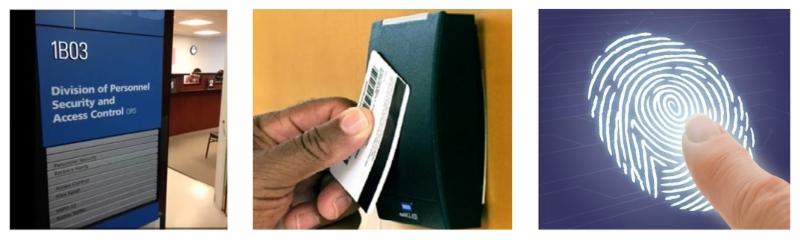
Highlights of DPSAC News articles published over the past year are presented here in abridged form. Each publication date, printed in bold, is a link to the DPSAC News issue published on that date.
DPSAC - Safeguarding the NIH Workforce One Case at a Time
On a daily basis, DPSAC staff is attending to the details to make sure that every one of the approximately 35,000 employees and contractors entering NIH facilities has undergone strict identity proofing and has been determined suitable for a specific position classification. The PIV card (HHS ID Badge) is the tangible result of the many behind-the-scenes efforts to safeguard the NIH workforce.
News Briefs
DPSAC recently revised the Badging Authority by Classification Chart to reflect a policy change regarding the issuance of NIH Legacy badges to Extended Visitors. Footnote 8 on the chart states that "To be eligible for an NIH Legacy badge, the individual must visit the NIH Campus three or more times a week, as attested by an Administrative Officer."
The Badging Authority chart can be viewed from the NIH network. On the DPSAC website (
www.idbadge.nih.gov
), click on "Applying for a Badge" and then on the link: NIH Badging Authority by Classification Table .
In the Event of an Operating Status Change
DPSAC follows the Office of Personnel Management (OPM) operating status. In the event of any potential operating status change, individuals should consult OPM's website (
http://www.opm.gov/status
) for indications of whether the Division of Personal Security and Access Control (DPSAC) will be open for business.
PIV Card Visual Aids
On October 30, 2017, the NED team released version 4.1 that included support for changes to HHS and NIH badge policy affecting the following groups:
- Foreign nationals living in the U.S. for three or more years now receive PIV badges with a blue stripe rather than RLA badges.
- NIH FTE - Special Government Employees (SGEs) who require both logical and physical access receive RLA badges rather than NIH ID "legacy" badges.
- Non-FDA Tenants and Volunteers (other than Special Volunteer) will receive RLA badges rather than NIH ID "legacy" badges.
- NIH will no longer issue ID badges to FDA tenants.
Now that these revised policies have been in effect for several months, the number of ID badges with the new color codes (and combinations of color codes) are growing across NIH. DPSAC News has prepared visual aids to help NIH'ers recognize these new badges and better understand who qualifies for the different ID credentials and why.
The NIH Restricted Local Access (RLA) Badge
Starting in July 2014, NIH began issuing a new type of personal identity verification (PIV) card, the Restricted Local Access (RLA) Badge. The RLA Badge serves the same purpose as the HHS ID Badge, providing both physical access to NIH facilities and logical access to NIH information systems.
NIH worked with HHS to develop the RLA badge in order to meet HSPD-12 security guidelines for individuals who do not qualify for an HHS ID Badge.
Individuals who qualify for the RLA badge
- Foreign nationals who have lived in the US for less than 3 years
- Short-term staff (at NIH less than 6 months)
- Summer students
The life cycles of the RLA Badge
An RLA badge issued to a foreign national is valid for 3 years.
- RLA Badges issued to short-term staff are valid for a maximum
- of 6 months
- RLA Badges issued to summer students are valid through
- September 30 of the year issued
Note: Prior to July 14, 2014, badge requests for foreign nationals defaulted to a 5-year HHS ID Badge. Since July 14, 2014, all badge requests for foreign nationals living in the US less than three years default to a 3-year RLA Badge.
Safety Corner - Help Us Help You! - Know How to Spot Common Fire Safety Hazards in the Workplace
The following fire safety awareness article was prepared by the Division of the Fire Marshal, ORS
Even though all facilities on the NIH Bethesda and Poolesville campuses are surveyed by the Division of the Fire Marshal (DFM) on a regular basis, fire safety hazards in the workplace can still pop up.
Peer responsibility plays a large part in keeping NIH facilities fire safe. Therefore, it is extremely important for the NIH community to be able to spot and correct the more common workplace fire safety hazards before a fire incident occurs.
Below are the top 10 fire safety hazards that are frequently encountered in NIH facilities that can be easily spotted, corrected, and … prevented.
1. Blocked or locked exit doors
2. Storage in stairwells
3. Fire doors propped open
4. Improper use of extension cords
5. Material/equipment in corridors that impede egress
6. The use of portable space-heating devices in laboratories and health care areas
7. Flammable or combustible liquids and compressed gas cylinders in corridors
8. Tampering with fire protection equipment
9. Missing ceiling tiles
10. Use of equipment with damaged or exposed electrical wiring
News Briefs - Badge Clearance for Foreign Nationals
DIS encourages the administrative community and other stakeholders to visit this updated site and to refer customers to it as well!
Helpful Tips
Do not lend your ID badge to anyone! -- lending out your ID badge is prohibited. The issuance of ID badges is based on strict identity proofing and the determination of one's suitability for a specific position classification. To do so is a criminal offense!
ALT cards -- should be returned to the IC ALT card coordinator- NOT to the Division of Personnel Security and Access Control (DPSAC).
Administrative Officers (AOs) who wish to obtain sponsor authority --must complete the sponsor training (see:http://www.ors.od.nih.gov/ser/dpsac/Training/Pages/administrators.aspx) and e-mail a copy of your signed certificate to Alex Salah at salaha@ors.od.nih.gov. Upon receipt of the certificate, Mr. Salah will authorize the AO as a Sponsor.
Note: ONLY individuals with an Administrative Officer role in NED are eligible to be HHS ID Badge/PIV Card Sponsors.
Temporary Lifting of Security Freezes on Credit Information Required for Some Background Investigations
DPSAC wants to remind individuals who will occupy positions of public trust or higher to temporarily lift security freezes on their credit report in order for the Office of Personnel Management (OPM)-National Background Investigations Bureau (NBIB) to conduct and complete background investigations.
The OPM-NBIB has experienced an increase in the number of national credit bureau reports that are unobtainable due to individuals placing a security freeze on their credit reports.
When OPM-NBIB is unable to obtain a tri-bureau credit report due to one, two, or all three bureaus having a security freeze, the overall effect is an incomplete investigation.
In order to ensure the quality of OPM's investigative products, individuals who have a security freeze in place must lift the freeze temporarily prior to submission of the e-QIP to the DPSAC office. This requirement applies to national credit bureau checks which are conducted as extra coverage for positions of 'public trust' or higher.
What is a security freeze?
A security freeze is designed to prevent credit, loans and services from being approved in your name without your consent, but may also delay or interfere with or prohibit the timely approval of any subsequent requests or application you make regarding new credit, loans or services.
Credit bureaus, also called credit reporting agencies, are companies that collect and maintain consumer credit information then resell it to other businesses in the form of a credit report.
Contact Information for the Three Credit Bureaus
Equifax - www.equifax.com
P.O. Box 740241 , Atlanta, GA 30374-0241
1-800-685-1111
P.O. Box 2104, Allen, TX 75013-0949
1-888-EXPERIAN (397-3742)
P.O. Box 1000, Chester, PA 19022
1-800-916-8800
Equifax Waives its Fees to Place, Temporarily Lift or Permanently Remove a Security Freeze through June 30, 2018
Equifax recently announced that it is waiving any fee to Place, Temporary Lift or Permanently Remove a Security Freeze through June 30, 2018. Any freeze activities after June 30, 2018 may be subject to the fees provided by your state of residence.
According to Equifax, "If you are the victim of ID theft and have a police report or other appropriate document as required by your state, please submit your request to Equifax in writing and provide Equifax with such police report or appropriate document so you will be eligible for any benefits associated with ID theft victims."
Important: Once you place a security freeze on your Equifax credit file, a PIN will be displayed on a one-time PDF that you can view and print.
Y
our PIN will not be e-mailed, so please be sure to refer to the
How do I get my PIN
box for system requirement information.
FAQs (regarding credit reporting freezes)
Q
. What does it mean to put a freeze on your credit?
A.
A security freeze is an effective tool in preventing the most costly and difficult-to-detect form of identity theft - false new accounts opened in your name. New account fraud occurs when a thief uses the victim's personal information to open up one or more new accounts for credit or services in the victim's name.
Q.
How do I put a freeze on my credit?
A.
Once you put a credit freeze on your files, you have to lift it when you want to use your credit and then reestablish the freeze afterward. To put a credit freeze in place, you must contact each of the three credit reporting agencies separately.
Q.
How Long Does it Take to Lift a Security Freeze?
A.
Credit bureaus can usually comply with an online or telephone request to lift a security freeze within 15 minutes. Credit bureaus have up to three business days to comply with a written request to lift a security freeze after they receive the request by mail.
Safety Corner - Protect Yourself Against IRS Scams As Tax Season Approaches
The following material is provided by the Internal Revenue Service (IRS) and is especially timely given that tax season is here!
The IRS continues to warn consumers to guard against scam phone calls from thieves intent on stealing their money or their identity. Criminals pose as the IRS to trick victims out of their money or personal information.
Here are several tips to help you avoid being a victim of these scams:
Scammers make unsolicited calls
Thieves call taxpayers claiming to be IRS officials. They demand that the victim pay a bogus tax bill. The thieves con the victim into sending cash, usually through a prepaid debit card or wire transfer. The scammers may also leave "urgent" callback requests through phone "robo-calls," or via "phishing" e-mail.
Callers try to scare their victims
Many phone scams use threats to intimidate and bully a victim into paying. The callers may even threaten to arrest, deport or revoke the license of their victim if they don't get the money.
Scams use caller ID 'spoofing'
Scammers often alter caller ID to make it look like the IRS or another agency is calling. The callers use IRS titles and fake badge numbers to appear legitimate. They may use the victim's name, address and other personal information to make the call sound official.
Cons try new tricks all the time
Some schemes provide an actual IRS address where they tell the victim to mail a receipt for the payment they make. Others use e-mails that contain a fake IRS document with a phone number or an e-mail address for a reply. These scams often use official IRS letterhead in e-mails or regular mail that they send to their victims.
The IRS will NOT:
• Call you to demand immediate payment. The IRS will not call you if you owe taxes without first sending you a bill in the mail.
• Demand that you pay taxes and not allow you to question or appeal the amount you owe.
• Require that you pay your taxes a certain way. For instance, require that you pay with a prepaid debit card.
• Ask for your credit or debit card numbers over the phone.
• Threaten to bring in police or other agencies to arrest you for not paying.
When It's Necessary to Replace Your HHS ID (or NIH RLA) Badge
ID Badge Re-Issuance Procedures Quick Reference Guide
There are occasions when it's necessary to replace your HHS ID or NIH RLA Badge. Some reasons are obvious, as when ID badges get broken or lost or stop working for one reason or another. Other reasons requiring a badge replacement include classification changes, badge renewals or a name change.
The Division of Personnel Security and Access Control (DPSAC) has prepared a useful guide, in pdf format, "ID Badge Re-issuance Procedures" to help the administrative community quickly determine how to proceed with the badge re-issuance process for each of these situations.
All Special Government Employees (SGEs) to Temporarily Receive NIH ID "Legacy" Badges
Until further notice, all SGEs registered in the NIH Enterprise Directory (NED) who require NIH physical access will receive an NIH ID "legacy" badge following a name check (NCIC) by the NIH Police.
DPSAC had intended to start issuing Restricted Local Access (RLA) badges in November 2017 to the small number of NIH Government Employees (SGEs) requiring both physical and logical access. DPSAC now expects to begin issuing RLA badges to SGEs requiring both physical and logical access sometime later this spring.
New Supplemental Form to Help Expedite the Background Investigations for Some SF-85P Public Trust Applicants
In an effort to trim its backlog, the Office of Personnel Management (OPM) National Background Investigations Bureau (NBIB) is streamlining several of it's background investigation procedures.
As part of these efforts, the 'Standard Form (SF)-85P Questionnaire for Public Trust positions' is being updated to include additional expanding questions for Public Trust Moderate Risk positions.
OPM, as the Suitability Executive Agent, has authorized the use of interim data collection techniques to obtain the new information that is not currently captured on the SF-85P questionnaire in e-QIP. Beginning in March 2018, DPSAC will start requiring any individuals in Moderate Risk Public Trust positions to complete the NBIB-provided supplemental form along with their SF-85P questionnaire.
The supplemental form will allow DPSAC to assist NBIB with identifying public trust applicants that can be streamlined and expedited through the Tier 2 investigation (formerly known as the MBI investigation).
Dear DPSAC News Subscriber:
It gives me great pleasure to introduce DPSAC's newly redesigned DPSAC News e-newsletter to our subscribers. Our new look comes after a successful 11 year run of our text-based (some might say 'text heavy') version.
DPSAC News will continue to provide the NIH administrative community, DPSAC staff and other stakeholders with useful and actionable information to help them stay current with personnel security and access control policies and procedures. …
Sincerely,
T'Nae Brown, Director, DPSAC
Background Investigation 'Tiers' to Replace Current Naming Conventions in NED
DPSAC reported in the
July 5, 2017 DPSAC News
on the Office of Personnel Management (OPM), modifying the naming conventions for standard background investigations to a 5-Tiered Background Investigation Model and naming convention.
As OPM transitioned to using the ‘Tiers,’ DPSAC also adopted the revised naming convention in its operations and now uses the ‘Tiers’ exclusively.
Each position at NIH is assigned a risk and sensitivity designation used to determine the kind of background investigation required for a position. In the upcoming months the NED team will be updating the terminology currently displayed in the NED Portal in order to align with the required standard OPM naming conventions (Tiers).
Updating the NIH 2866
Currently, AO’s complete the NIH 2866 ‘Position Sensitivity Worksheet’ that was developed by the NIH Personnel Security Subcommittee and later integrated directly into the NED Portal. The NIH 2866 was intended to help AOs/ATs entering position information to determine a “minimum” background investigation for a selected positions at NIH.
Please be aware that the Badging Authority by Classification Chart (Rev. 11-16-2017) reflects a policy change regarding the issuance of NIH Legacy badges to Extended Visitors
.
Footnote 8 on the chart states that "To be eligible for an NIH Legacy badge, the individual must visit the NIH Campus three or more times a week, as attested by an Administrative Officer." To view the Badging Authority chart, go to the DPSAC website ( www. idbadge.nih.gov), click on "Applying for a Badge" and then on the link:
NIH Badging Authority by Classification Table
(posted under the "Extended Visitor Badge Program at NIH").
DPSAC Posts Revised Guidelines to Request Badge Services at Remote Locations
For individuals who need NIH badge services but will not be working on an NIH campus or visiting an NIH campus, remote enrollment and issuance services may be the only option.
DPSAC can help to coordinate non-routine enrollments (photo/fingerprints), badge issuance, and badge maintenance services with other HHS Operating Divisions for employees who reside in areas that are far removed from NIH campus locations.
HHS has Program Support Center (PSC) offices that offer badge services in the following cities: Boston, New York City, Philadelphia, Atlanta, Chicago, Dallas, Kansas City (MO), Denver, San Francisco, Seattle, Miami, Cleveland, Salt Lake City, and Irvine (CA ).
Additional locations may also be available on a case by case basis through other HHS Operating Divisions.
DPSAC recently revised its instructions for applying for remote badge services on its website at: https://www.ors.od.nih.gov/SER/DPSAC/BADGE/Pages/badgingremote.aspx. When these services are needed, Administrative Officers (AOs) should complete the “Request for Remote Badging Services Form" provided on that site and submit it to DPSAC so that the coordination/approval process can be initiated.
FY 2020 Initial Estimated Pricing and Budget Guidance for Background Investigations
The Office of Personnel Management (OPM) and the National Background Investigations Bureau (NBIB) have published their Initial Estimated Pricing and Customer Agency Budget Guidance to help customer agencies include NBIB services in their FY 2020 budget requests.
Please note all FY 2020 prices in the 'Notice' are initial estimates only. NBIB plans to publish final FY 2020 prices by June 30, 2018. Click on Federal Investigations Notice No.18-01 to view all FY 2020 initial estimated billing rates.
Remove “Freeze” on Your Credit to Avoid Background Investigation Delays
Because consumers are concerned with shielding and protecting access to their credit report from unwanted intrusion, many individuals have “frozen” their credit report.
As a result, a growing number of investigations submitted to the National Background Investigation Bureau (NBIB) have frozen credit reports.
Unfortunately, NBIB will find out that the person’s credit is frozen only after the Bureau’s initial request for a credit report is returned from the credit vendor as ‘frozen,’ resulting in delays and unnecessary costs.
NBIB has changed its internal process for handling frozen credit discovered during the investigative process. Should the Bureau discover that the person’s credit report is frozen at the time they conduct the credit check, it will give the agency submitting the investigation request (DPSAC/NIH) 10 days to notify NBIB that the credit report has been un frozen. If NBIB is not notified within the 10-day period, the investigation will be discontinued.
When can someone re-freeze his/her credit report?
NBIB prefers that the individual’s credit report remains unfrozen until the investigation is closed since there are situations when a second report may be required.
If the individual opts to re-freeze his/her credit report before the investigation closes, NBIB offers the following caveat: Following the initial credit check, if NBIB has to ask the agency to un-freeze a person's credit, it could take up to 30 days to re-run the credit report.
Note: When NBIB is unable to obtain a tri-bureau credit report due to one, two, or all three bureaus having a security freeze, the overall effect is an incomplete investigation.
If an individual has a security freeze in place, it must be temporarily lifted prior to submission of the e-QIP to the DPSAC office. This requirement applies to national credit bureau checks which are conducted as extra coverage for positions of 'public trust' or higher.
How to Contact the Credit Bureaus
Credit bureaus, also called credit reporting agencies, are companies that collect and maintain consumer credit information then resell it to other businesses in the form of a credit report.
There are many credit bureaus in the United States, but most people are familiar with the big three: Equifax, Experian and TransUnion. These bureaus are all publicly-traded, for-profit companies not owned by the government.
Contact Information for the Three Credit Bureaus:
Equifax - www.equifax.com
P.O. Box 740241
Atlanta, GA 30374-0241
1-800-685-1111
Experian - www.experian.com
P.O. Box 2104
Allen, TX 75013-0949
1-888-EXPERIAN (397-3742)
TransUnion - www.transunion.com
P.O. Box 1000
Chester, PA 19022
1-800-916-8800
New Fed Employees, Contractors Should Complete e-QIP Supplemental Forms with the Same Care as e-QIP
Individuals entering federal service (including contractors) must complete a background investigation for their position at NIH. Part of this background investigation involves filling out a questionnaire through the National Background Investigation Bureau (NBIB) online system: Electronic Questionnaires for Investigations Processing (e-QIP).
The applicant is also required to complete several mandatory forms for the background investigation. These supplemental forms are sent along with the initial e-QIP invitation email as attachments.
Despite the title of these forms, they are not optional – they are REQUIRED for the background investigation. Without them, OPM will not initiate the background investigation.
These forms include the “ Declaration of Federal Employment (OF-306),” the “Optional Application for Federal Employment (OF-612)” the “ HHS Credit Release,” and for those in public trust positions, the “ Additional Questions for Moderate Risk Public Trust Positions.”
Additionally, individuals who are required to work with or around children at NIH will be required to complete the “OFI 86C Special Agreement Check” form in addition to supplemental documentation required for their Child Care Investigation (per the Crime Control Act of 1990).
Badging Delays Traced to Errors and Omissions on Supplemental Forms
Approximately 70% of e-QIP or Supplemental Forms reviewed by DPSAC case reviewers prior to releasing to OPM are either incomplete, filled out improperly or contain erroneous information.
When DPSAC case reviewers discover incomplete or faulty entries on the e-QIP or Supplemental Form submissions, they must send the e-QIP package back to the applicant for correction. Many of these issues can be avoided if the applicant follows the detailed instructions included on the forms
Unfortunately, a returned questionnaire can cause delays in the badging process and can result in the badge being disabled and confiscated at the perimeter gate when the person attempts to enter the NIH campus.
In instances when the individual’s badge is confiscated, the badge holder will need to contact Personnel Security [orspersonnelsecurity@mail.nih.gov; 301-402-9755] to re-initiate his/her background investigation. Submitting the background investigation to NBIB is a Homeland Security Presidential Directive 12 (HSPD-12) requirement before an applicant can be issued a PIV badge at NIH.
Only after DPSAC has successfully completed its review of the applicant’s e-QIP and Additional Forms will it submit the e-QIP package to NBIB for the appropriate background investigation.
When "Optional" is NOT Optional
Even though the OF-306 and OF-612 forms contain the word ‘Optional’ in their titles, completing these forms is NOT optional. According to DPSAC case reviewers, this may be one reason that applicants take the supplemental forms less seriously. As with the e-QIP questionnaire, responses in the supplemental forms must adhere to NBIB guidelines or they will be rejected.
Helpful Tip
Volunteers and Tenants are now issued Restricted Local Access (RLA) badges instead of NIH Legacy badges. Rather than fill out an Extended Visitor request form issued by the NIH Police, Volunteers and Tenants are now sponsored by their Administrative Officer and undergo a background investigation or fingerprint check.
National Background Investigations Bureau (NBIB) to Launch Design Update to Electronic Questionnaires for Investigations Processing (e-QIP)
On June 24, 2018, the NBIB plans to launch their redesigned e-QIP platform that will improve navigation and functionality for individuals entering their security form data.*
The changes will present users with a more modern website and intuitive layout allowing applicants to easily identify where they are in each section and to track their progress as they proceed.
A new left navigation panel will also display the applicant’s progress with symbols to identify complete and incomplete sections. …
New Process Lets LWS Operators Renew ALT Card Certs Without Recycling the Card First
Previously, ALT Cards with expired certificates had to be recycled and re-sponsored before the Lifecycle Work Station (LWS) operator could renew the ALT certificates. Now, ALT cards with expired certificates can be renewed without recycling the ALT card first.
DPSAC is advising LWS Operators to pay close attention to and follow the LWS system prompts when they are renewing an ALT card. The system will indicate whether the ALT card should be recycled. LWS operators should NOT simply recycle the ALT Card because that’s what they have always done.
Please direct your questions regarding the LWS and its operation to the DPSAC Helpdesk: 301-451-4766 or facilityaccesscontrol@mail.nih.gov . For questions about requesting and/or processing ALT requests, please contact CIT IAM Smart Card at: CITIAMSmartCard@mail.nih.gov or submit a service desk ticket.
Additional information regarding ALT cards, including submitting ServiceNow tickets, can be found in the Knowledge Base (KB) article about ALT cards at:https://myitsm.nih.gov/kb_view_customer.do?sysparm_article=KB0012403
DPSAC: Expediting the PIV & Badging Processes While Helping to Safeguard the NIH Workforce
Over the next few weeks DPSAC News will look more closely at each of these key steps and the roles that the applicant and each DPSAC department [viz., Customer Service, Enrollment, Case Review, Access Control and Adjudication] plays in the Personal Identity Verification [PIV] process.
DPSAC is responsible for verifying personal identity, validating suitability, adjudicating background investigations, authorizing facility access and issuing ID badges for NIH employees, contractors and affiliates. It also handles a steady stream of inquiries at its customer service desk and telephone help lines.
Everyone at NIH who requires a background investigation for their position, or who applies for a new or replacement HHS ID Badge or NIH RLA Badge will need to be processed through DPSAC. DPSAC coordinates its efforts with each individual entering the NIH workforce to help him/her complete the PIV process successfully so that s/he may be found suitable for employment within NIH.
National Background Investigations Bureau (NBIB) Deploys its Redesigned Electronic Questionnaires for Investigations Processing (e-QIP)
NBIB recently launched its redesigned e-QIP platform to improve navigation and functionality for individuals entering their security form data.
The changes present users with a more modern website and intuitive layout allowing applicants to easily identify where they are in each section and to track their progress as they proceed.
A new left navigation panel displays the applicant’s progress with symbols to identify complete and incomplete sections. Using this panel, the applicant can quickly track his/her progress at a glance. The new design will also include help links, auto-fill fields and new status menus that illustrate the applicants’ progression throughout the form.
NED Adopts OPM/NBIB 5-Tier Background Investigation Standards and Naming System
The deployment of NED Maintenance Release 4.2.2 incorporates the OPM/NBIB Tier nomenclature and values system into the NED portal and marks the final step in NIH’s changeover to the Tier system.
As
DPSAC News
readers know, an individual’s background investigation requires him or her to complete either the Standard Form (SF) 85, the SF85P or the SF-86 as well as other supplemental forms. The position the individual is hired to fill will correspond to one of five Tier levels that reflect the level of risk and sensitivity associated with that position.
A full description of the five tiers and their corresponding background investigations can be found on the DPSAC website at:
https://go.usa.gov/xQKgR
. You may want to bookmark this URL for future reference.
U.S. Army at Fort Detrick to Require New Access Cards for NIH-issued PIV Card Holders Working at or Visiting the Base
The U.S. Army Garrison at Fort Detrick is changing entry procedures beginning this fall with the Army implementing an automated installation entry system at all gates. Once these procedures become operational, Army guards will scan identification cards before they allow entry to Fort Detrick.
The changes are required to meet Executive Order HSPD-12 mandatory requirements for entry into federal facilities.
Since NIH-issued PIV cards are not compatible with the Army’s entry system, all NIH workers stationed at Fort Detrick (as well as NIH employees, contractors or affiliates with a PIV Card who require access to Fort Detrick) will need to obtain an Army-issued access card. NCI staff working on site or who are regular visitors are being advised to obtain their Army-issued card prior to system implementation.
Return Your Government-Issued ID Badge When Leaving NIH
From time to time DPSAC News runs an article reminding NIHers that if they plan to end their affiliation with NIH, whether as an employee, contractor or affiliate, they must turn in their HHS ID Badge or RLA Badge to their Administrative Officer (AO).
The AO can then deactivate the badge in NED and turn in the deactivated badge to the badging office.
NOT returning your ID badge can have security and financial consequences
If a worker ends his or her affiliation with NIH and fails to return his/her ID badge, the AO may not know to deactivate the person in NED, leaving NIH and its workforce vulnerable.
While it is unlikely that a former employee or contractor would want to cause harm or mischief, collecting the person’s badge when they end their service with NIH is the best way to ensure the safety of the workforce and NIH facilities….
Visitors to the DPSAC Enrollment and Badging Center in Building 31, Room 1B03 will see a new wall plaque honoring Richie Taffet, former Program Manager of the HSPD-12 Program Office, who retired from the NIH at the end of 2017 after 49 years of exceptional service.
The plaque states in part that Richie was "instrumental in developing and implementing NIH's program to issue "smart card" badges to employees, contractors and affiliates.... Throughout his career, as attested to by his numerous significant accomplishments, Richie epitomized the best qualities of a dedicated public servant."
NIH Enterprise Directory--Creating a NED Record: The Need to Provide Accurate and Complete Information (Part 2)
DPSAC to NED Sponsors: "Remove any Doubt...Check it Out!"
The August 15, 2018 DPSAC News kicked off a multi-part series on the importance of providing complete and accurate information in NED to avoid the negative impact that incorrect, incomplete or missing data can have on individuals during the badging process and on IC’s throughout the background investigation process.
Personal Information
DPSAC must rely on the Administrative Teams who sponsor the NED account to ensure the information they are attesting to has been validated .
It is imperative that administrators enter/verify that the correct citizenship or legal status is entered, as incorrect entries cause the record to bypass the NIH Division of International Services’ (DIS) validation, thus, creating a security vulnerability in NIH’s vetted workforce.
Since spring 2018, over 90 discrepancies have occurred, many of which were related to citizenship and/or legal status data fields in NED. These discrepancies required the NED team, the AO, and DPSAC to terminate transactions, update records, and/or re-enroll staff.
Many of these discrepancies are easily fixable at the time of entry; however, once the NED record is created and sponsored, it’s a more lengthy process to correct. Information entered into NED feeds into several other information systems related to the badging and background investigation process, making corrections a difficult task.
NED Adopts OPM’s 5-Tier
Background Investigation Standards and Naming System
With the deployment of NED Maintenance Release v4.3.2 on September 9, 2018, NED portal users now see a change in background investigation naming conventions and values that align with current OPM/NBIB “Tier” terminology.
As DPSAC News readers know, an individual’s background investigation requires him or her to complete either the Standard Form (SF) 85, the SF85P or the SF-86 as well as other supplemental forms.
The position the individual is hired to fill will correspond to one of five Tier levels that reflect the level of risk and sensitivity associated with that position. In FY 2017 OPM and NBIB completed the transition to its Tiers background investigation terminology and values system, By the summer of 2017, DPSAC also adopted the Tiers system into its operations and has been using the Tiers exclusively since then.
A full description of the five tiers and their corresponding background investigations can be found on the DPSAC website at:
https://go.usa.gov/xQKgR
.
Creating a NED Record: The Need to Provide Accurate and Complete Information (Part 4)
In this fourth and final installment on “Creating Accurate and Complete NED Records,” DPSAC explores how best to validate an individual’s Personal, Work or Position Information when creating NED records and offers helpful tips for NED portal users.
NED administrators are urged to “Review, Correct, Validate” an individual's Personal and/or Position data in NED before completing a NED registration.
This installment looks at three important validation fields: “Legal Name,” “Social Security Number (SSN)” and “Date and Place (City, State, Country) of Birth.”
1. Legal Name
The legal name entered must match the full legal name on both official documents used for enrollment. Nicknames (e.g., "Marjie," "Nick,") should not be used in place of the full legal name.
2. Social Security Number (SSN)
It is critical to enter an applicant’s correct SSN as reflected on their government-issued SSN card.
3. Date and Place (City, State, Country) of Birth
Entering or validating an individual’s month and date of birth correctly is critical. AO sponsors should be aware that foreign passports often use the "Day/Month/Year” format. For example, a United Kingdom passport would indicate 9 April 1986 as the date of birth. Be on alert.
IMPORTANT: An individual’s “State of Birth” field in NED should be left BLANK if he or she was born in a foreign country.
NBIB Announces FY 2019 Pricing Increase Deferment
According to Federal Investigations Notice No. 18-06, September 24, 2018, the National Background Investigations Bureau (NBIB), will maintain its current FY 2018 prices at least through the first quarter of FY 2019.
Throughout FY 2019, NBIB will continue to reassess its financial standing quarterly to determine if previously published FY 2019 prices should be implemented. If so, advanced notice will be provided.
NED to Enforce System Access Requirements for NED Portal Users with the AO Role
According to an October 12, 2018 e-mail from the NED Team to the AO and AT community, NED will be enforcing the below system access requirements for NED portal users with the AO role.
System Access Requirement
An individual's current Position Designation Type in NED must be designated to a Moderate Risk Public Trust position requiring a Tier 2 (or higher) background investigation, and the background investigation must, at a minimum, have been initiated by the Office of Personnel Management (OPM)/National Background Investigation Bureau (NBIB).
For any questions related to this requirement, please contact the NED Team at: nedteam@mail.nih.gov .
Safety Corner - Play It Safe When Using
Space Heaters
in NIH Buildings
Each year at this time, questions arise concerning the use of space heaters at NIH- owned facilities. The guidelines that follow below do not pertain to NIH leased facilities.
Please be aware that if you work in a leased facility, there may be more stringent requirements from the building owner and/or the local fire-safety "Authority Having Jurisdiction."
Please check with your Office of Research Facilities (ORF) Facility Manager (https://orfapps.od.nih.gov /BuildingsandFacilityManagers.asp) before purchasing or using a space heater in any NIH leased facility.
Before a space heater can be considered for an NIH owned facility, any difficulties in regulating or maintaining a comfortable temperature must first be directed to ORF to have a building engineer attempt to make mechanical adjustments to the heating system.
If it is determined by ORF that an area cannot be adequately heated, written approval will be provided by the ORF Facility Manager assigned to the building to support the purchase and use of a space heater in designated areas only. Space heaters are not permitted, under any circumstances, in laboratories, patient care units, or clinics.
AOs Urged Not to Ignore ‘DEUS’ Third Anniversary Update Task for Foreign Nationals in NED
Failure to Take Action Will Result in the Revocation of the Foreign National’s ID Badge
The Division of International Services reports that several foreign nationals who have reached their DEUS (Date Entered the United States) three-year anniversary are having their RLA badges revoked because Administrative Officers (AOs) sometimes fail to submit “DEUS Third Anniversary” tasks the NED Portal generates 42-days prior to a foreign national’s DEUS.
The NED Portal generates a “DEUS Three Year Anniversary” task 42 days prior to a foreign national’s (non-US citizen) third year anniversary of having been in the US. NED also sends e-mails to both the FN Restricted Local Access (RLA) badge holder and the servicing AO advising them to update the badge holder’s record and submit the task.
Any NED Portal user with the AO role whose primary SAC coverage includes the FN’s SAC can see and claim the task from their NED Portal Inbox. Once the AO claims the task, they are also instructed to update the FN’s NED record and submit the task.
Once the AO submits this task, a notification will be sent to the Division of Personnel Security and Access Control (DPSAC) allowing them to initiate the FN’s new HSPD-12 Personal Identity Verification (PIV)-compliant background investigation. This will allow the FN to be issued the replacement PIV badge.
The consequences of not acting
If an AO hasn’t submitted the task by 10 days prior to the RLA badge holder’s third year anniversary of having entered the US, NED sends both the badge holder and their servicing AO the same e-mail NED sent at 42 days prior to the badge holder’s DEUS three-year anniversary.
If an AO fails to submit the task by the three-year anniversary of the RLA badge holder being in the US, NED revokes the badge and sends the “badge revocation” e-mail to both the RLA badge holder and the servicing AO.
Guidelines to Request Badge Services at Remote Locations
For individuals who need NIH badge services but will not be working on an NIH campus or visiting an NIH campus, remote enrollment and issuance services may be the only option.
The Division of Personnel Security and Access Control (DPSAC) can help to coordinate non-routine enrollments (photo/fingerprints), badge issuance, and badge maintenance services with other HHS Operating Divisions for employees who reside in areas that are far removed from NIH campus locations.
HHS has Program Support Center (PSC) offices that offer badge services in the following cities: Boston, New York City, Philadelphia, Atlanta, Chicago, Dallas, Kansas City (MO), Denver, San Francisco, Seattle, Miami, Cleveland, Salt Lake City, and Irvine (CA ).
When these services are needed, Administrative Officers (AOs) should complete the “Request for Remote Badging Services Form" provided on that site and submit it to DPSAC so that the coordination/approval process can be initiated.
Is Your PIV Card (HHS ID Badge) Provisional or Final?
Did you know that until your background investigation has been successfully adjudicated and you have been found suitable to work at NIH, your PIV Card (HHS ID Badge) is considered provisional?
Many new employees and contractors mistakenly believe that the badge they are issued at the time of enrollment is their final or permanent badge. In fact, a badge issued at enrollment is deemed interim until the individual’s background investigation is concluded and the Division of Personnel Security and Access Control (DPSAC) has successfully completed adjudicating the person’s background investigation.
How do I know when I’ve been found suitable and my badge is permanent?
Once the person’s background investigation is complete and DPSAC has successfully adjudicated the case, the badge holder will receive an e-mail from the NIH Personnel Security Office with the subject line:
" DPSAC BACKGROUND INVESTIGATION COMPLETE FOR [person’s name]"
The e-mail will notify the person the s/he has been found suitable to occupy a Tier 'x' position as of a certain date.
Applicants who occupy a non-sensitive T-1 position (most positions at NIH fall into this Tier) can typically expect to receive their approval e-mail within six weeks. Background investigations for individuals who occupy positions carrying greater responsibility (e.g., Public Trust positions [Tier 2 and 4] or National Security positions [Tier 3 and 5] will take longer. In certain cases, the investigation can take as long as a year or greater.
NBIB Website Offers Resources to Help e-QIP First Time Users
New or current NIH employees, contractors and affiliates who need help completing the Electronic Questionnaires for Investigations Processing ( e-QIP) can log onto the National Background Investigations Bureau website [
https://nbib.opm.gov/e-qip-background-investigations/
] where they will find useful guides and resources for filling out their Standard Form (e-QIP questionnaire).
Because the e-QIP questionnaire may take several hours to complete, DPSAC recommends that the individual set aside ample time. DPSAC also advises individuals to not wait until the last minute to complete the questionnaire since DPSAC cannot authorize issuance of a PIV Badge and/or authorization for Entry on Duty until the e-QIP is complete and all required materials are received by the deadline referenced in the e-mail.
The individual must complete the final step in the e-QIP questionnaire -- "Select 'Release Request/Transmit to Agency'" -- to ensure that OPM receives the e-QIP forms. DPSAC will contact the individual if additional or clarifying information is needed.
Individuals are encouraged to print their e-QIP archival copy for their own records.