DPSAC News
A bi-weekly newsletter from the Division of Personnel Security and Access Control
|
Providing timely information to help keep NIH safe and secure.
|
|
May 22, 2019 Issue of DPSAC News
In this issue:
- DPSAC Alerts Customers to Processing and Service Delays
- Fellows Planning Clinical Rotations at Walter Reed Should Plan on 3 Months for Security Processing and Authorized Access
- Software Glitch Causing Hundreds of PIV Card Holders to Lose Access to the NIH Network
- DPSAC Prescreening for New Hires and Classification Changes - Guidance for Administrators
- FAQs: More on Converting Non-FTEs to FTEs
- Helpful Tips -- Reducing Processing Time for New Hires
|
|
DPSAC Alerts Customers to Processing and Service Delays
|
|
As reported in the May 8, 2019
DPSAC News
, these delays are attributed to a number of factors, including a spike in requests for badges due to security enhancement for network accounts, a surge in badge renewals, and influx in NIH hiring, as well as DPSAC internal processing changes relating to the prescreening of new hires. Plus, this past week, DPSAC was alerted to a software glitch affecting hundreds of PIV Badge ho
lders. (see related story below: '
Software Glitch Causing Hundreds of PIV Card Holders to Lose Access to the NIH Network
').
DPSAC is doing its best to reduce wait times and accommodate customers as it deals with this substantial increase in workload.
DPSAC is advising new hires that the time to
complete enrollment and be issued a PIV badge is currently averaging 6 weeks.
In addition, DPSAC has outlined on its website homepage additional information that customers can use to help expedite the various enrollment and badge-related tasks. For more information, please visit
www.idbadge.nih.gov
.
|
|
Fellows Planning Clinical Rotations at Walter Reed Should Plan on 3 Months for Security Processing and Authorized Access
|
|
The Division of Personnel Security and Access Control (DPSAC) advises that Clinical Fellows or Program Coordinators planning a clinical rotation at Walter Reed National Military Medical Center (WRNMMC) should give themselves at least 3 months in advance of the date they need access to Walter Reed to coordinate with their WRNMMC Graduate Medical Education Sponsor and the NIH Sponsor to be processed and approved for access to Walter Reed.
Once our office is notified, DPSAC will send an email to the clinical fellow planning a clinical rotation at WRNMMC, their Administrative Officer (AO) and supervisor. The email will contain detailed instructions on the steps needed and the required forms for access.
Program Coordinators or Fellows planning rotations at WRNMMC will need to work closely with his/her NIH sponsor and the clinical program sponsor at WRNMMC to coordinate submission of the required forms.
|
|
Software Glitch Causing Hundreds of PIV Card Holders to Lose Access to the NIH Network
Affected Individuals Must Complete the Badge Renewal Process ASAP
|
|
In a May 14, 2019 email to the NIH community, the Division of Personnel Security and Access Control (DPSAC) announced that the Department of Health and Human Services (HHS) recently identified an issue affecting certain individuals who are in-process for a PIV badge renewal but whose badge certificate expiration may predate the physical badge expiration date.
In these instances, logical access (i.e., access to the NIH network), which is normally provided via the badge, will be disabled, thus preventing these individuals from accessing the NIH network until they complete the badge-renewal process. According to DPSAC, the current badge will still allow for physical access to NIH campus and facilities until the badge expiration date is reached.
DPSAC is advising individuals who are affected by this anomaly
to visit an NIH Enrollment/Badging office to complete enrollment for their badge renewal as soon as permissible.
Upon receipt of the enrollment fingerprint results, typically 24-48 hours, the new PIV badge, with updated certificates, can be issued.
If you are in this group, DPSAC recommends you request a username and password exemption from your IC ISSO to bridge the one-to-two-day gap before a PIV badge can be issued.
DPSAC strongly encourages applicants to schedule their enrollment/badging appointments as soon as they receive their badge-renewal email notification in order to limit the likelihood of this scenario.
|
|
DPSAC Prescreening for New Hires and Classification Changes -- Guidance for Administrators
|
|
This article first appeared in the May 8, 2019 DPSAC News
The NIH Division of Personnel Security and Access Control (DPSAC)’s core mission is to ensure the NIH workforce is comprised of
suitable
federal employees, contractors and affiliates, per governing federal authorities and directives
.
In order to carry out its mission, DPSAC manages tasks that are essential to ensuring the security of the NIH workforce, as well as the integrity and efficiency of the NIH.
Included in those tasks, DPSAC is charged with prescreening employment applications, submitting background investigation requests, authorizing and issuing Personal Identity Verification (PIV) and Restricted Local Access (RLA) credentials, and adjudicating background investigations in order to make suitability determinations for much of the NIH workforce.
Please click
here
to read more about the DPSAC prescreening process.
|
|
Q.
When
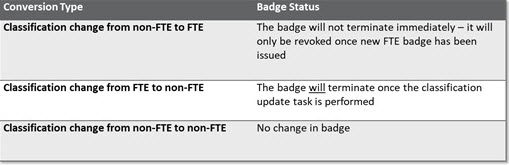
entering an 'update' task to change an employee classification, does changing IC, Position Sensitivity Level (PSL) or other data affect whether the badge will remain active until the new FTE badge is issued?
A.
Changing IC, PSL, etc. will not disable the current non-FTE badge. The current non-FTE badge will remain active until the new FTE badge is issued.
|
|
Reducing Processing Time for New Hires
______________________________
Processing times are often delayed due to reasons outside of DPSAC control, which include, but are not limited to:
- Incomplete or not submitted OF-306
- Candidate response time
- Issues requiring clarification by the candidate
- Untimely submission of initial e-QIP or corrected e-QIP
How the AO and HR communities can assist:
- By ensuring all required documents have been uploaded into onboarding prior to establishing a NED account
- By entering candidates as early as possible but no later than 6 weeks prior to their Entry on Duty (EOD) date
- By working with DPSAC to ensure candidates respond in a timely manner to inquiries.
|
|
Administrative Officers (AOs) who wish to obtain sponsor authority
must complete the sponsor training. To access the training module, click on:
Sponsor
.
Upon completion, the AO should sign and e-mail a copy of the certificate found at the end of the training module to Alex Salah at:
salaha@ors.od.nih.gov
. Upon receipt of the certificate, Mr. Salah will authorize the AO as a Sponsor.
Note: ONLY individuals with an Administrative Officer role in NED are eligible to be HHS ID Badge/PIV Card Sponsors.
|
|
A biweekly e-newsletter from the National Institutes of Health, Office of Research Services, Division of Personnel Security and Access Control (ORS/DPSAC) to keep its readers informed of personnel security and access control policies and practices designed to safeguard the NIH and its workforce. DPSAC is responsible for verifying personal identity, validating suitability, reviewing background checks, authorizing facility access and issuing ID badges for NIH personnel.
Department of Health and Human Services
National Institutes of Health
Office of Management
Office of Research Services
Division of Personnel Security and Access Control
|
|
Keep up with the latest NIH updates
|
|
|
|
|
|
|