|
|

|
|
Daily Transportation News
Monday, October 5, 2026
|
|
|
Editorial and legal note: This briefing is provided for general information and professional awareness. It summarizes publicly available materials from government agencies, legislatures, transportation providers, companies, research organizations, and news organizations. Inclusion does not constitute IATR endorsement, legal advice, a finding of fact, or a recommendation that any regulator adopt a particular policy. Readers should consult the original source and applicable law before relying on any item for regulatory, procurement, enforcement, or operational decisions.
|
|
|
|
|
NEW YORK CITY | FOR-HIRE DRIVERS, BENEFITS & WORKFORCE PROTECTION
The Black Car Fund Expands No-Cost Benefits for New York’s For-Hire Vehicle Drivers
For more than 25 years, The Black Car Fund has provided workers’ compensation coverage to independent, for-hire vehicle drivers across New York. Founded as the New York Black Car Operators’ Injury Compensation Fund under state legislation signed in 1999, the nonprofit’s original mission was to provide workers’ compensation coverage and related benefits for black-car operators.
Under Executive Director Ira Goldstein, who has led the Fund since 2010, the organization has expanded that mandate to include health and income-protection benefits, driver-safety courses, dental cleanings, vision coverage, and other services supported through a passenger surcharge. The Fund recently expanded its no-cost Drivers Benefits program—now serving more than 68,000 drivers—to include hospital-indemnity insurance and a health-navigation service, while also increasing payments through its Earn While You Learn program.
“For more than 25 years, The Black Car Fund has continued to evolve to meet the changing needs of New York’s for-hire vehicle drivers. While providing workers’ compensation coverage remains at the core of our mission, I am particularly proud of how we have expanded that mission to provide drivers with meaningful benefits, education and resources that can make a real difference in their lives and the lives of their families. Reaching more than 68,000 drivers through our Drivers Benefits program is an important milestone, but we are always looking at what more we can do. The drivers we serve keep New York moving, and we believe they deserve an organization that continues to move forward for them.”
Ira Goldstein | Executive Director | The Black Car Fund
|
Recognition
|
|
New York State Federation Taxi Driver (NYSFTD) to Name Ira Goldstein Among This Year’s Honorees
The New York State Federation of Taxi Drivers will recognize Ira Goldstein on October 8, 2026, as part of a celebration honoring New Yorkers whose commitment and service help keep the city strong, safe, and moving forward. The event recognizes key figures in New York City’s transportation and labor sectors.
|
WHY IT MATTERS TO REGULATORS:
The Black Car Fund demonstrates an industry-specific model that links FHV passenger activity with worker protections. As regulators manage change in taxi, limousine, and TNC markets, the model raises practical questions about benefit portability, income stability, safety education, surcharge administration, and the treatment of independent drivers in regulated passenger-service systems.
Source:
City & State New York — 2026 City & State Hall of Fame
|
|

|
|
NEW YORK CITY | FHV ACCESSIBILITY, DRIVER PROTECTIONS & PLATFORM OVERSIGHT
NYC TLC Reports New Accessibility Benchmarks and Driver-Pay Protections for High-Volume FHV Platforms
New York City’s Taxi and Limousine Commission reported that it has strengthened the City’s minimum-pay framework for drivers on high-volume for-hire vehicle platforms, including measures intended to protect drivers from company “lockouts.” The Commission’s FY2026 performance reporting also identifies an accessible-trip service standard requiring drivers to complete 90 percent of accessible FHV trip requests within 10 minutes or less.
The report further states that more than half of the active medallion-taxi fleet is now accessible, with 5,911 accessible taxis on the road through October 2026. Beginning in FY2026, TLC also required licensed e-hail applications to provide customers with a call-center option for requesting a wheelchair-accessible taxi.
WHY IT MATTERS TO REGULATORS:
The NYC model ties platform regulation to measurable passenger-service and driver-protection outcomes. It demonstrates tools for establishing and monitoring minimum driver compensation, anti-lockout protections, wheelchair-accessible service response times, e-hail requirements, accessible-fleet availability, and platform accountability.
Source:
New York City Mayor’s Management Report — Taxi and Limousine Commission
|
|
|
NEW YORK | ROADWAY SAFETY, STATE ACCOUNTABILITY & HIGH-VOLUME PASSENGER-SERVICE CORRIDOR
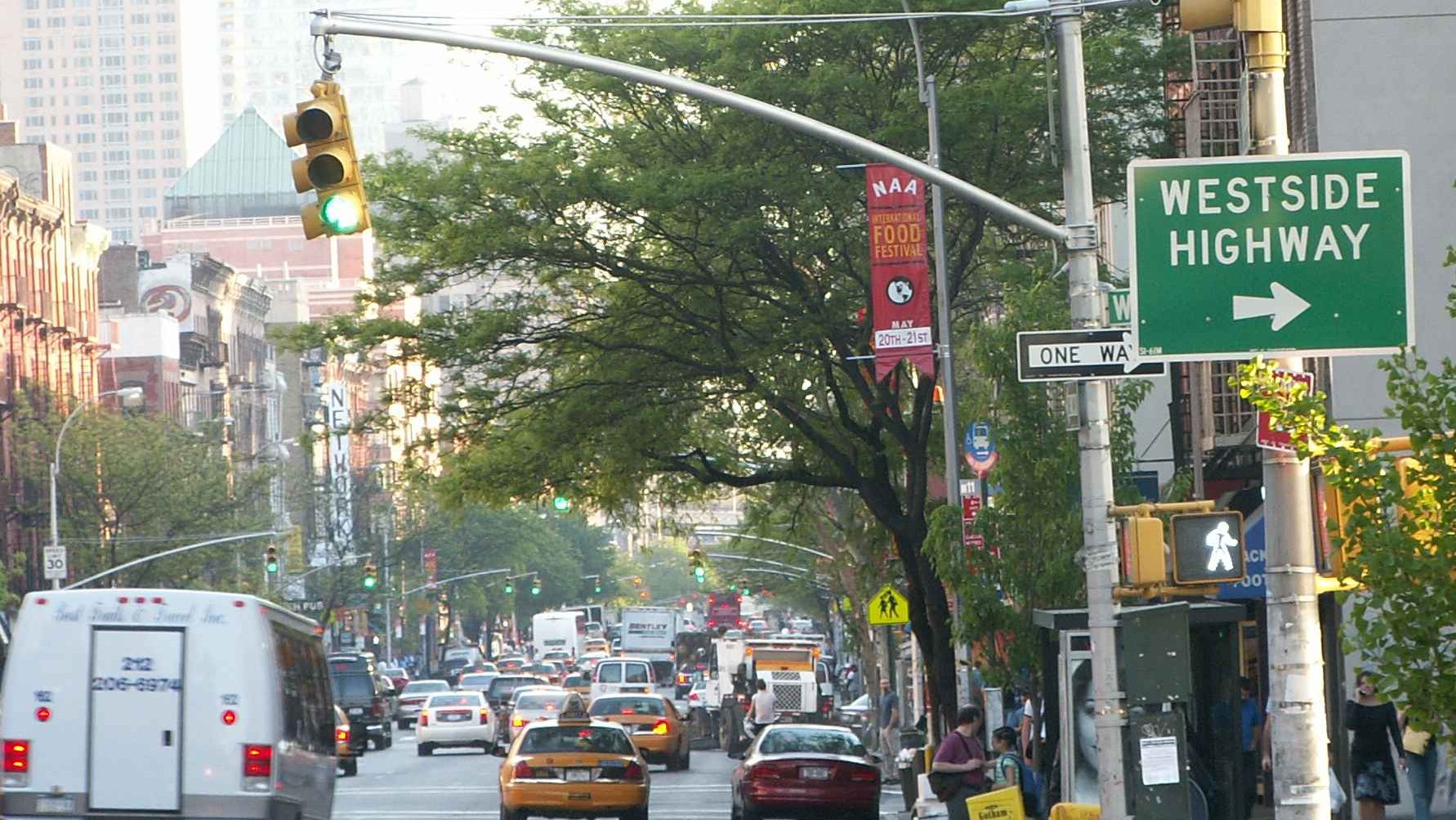
NYSDOT’s West Side Highway Safety Study Now Projected for 2027, Streetsblog Reports
|
|
Image: Streetsblog NYC.
|
New York State’s Department of Transportation is now projecting that it will release recommendations for the future of mobility on Manhattan’s West Side Highway corridor by the end of the first quarter of 2027, according to Streetsblog. The publication reports that this would place the agency about 17 months behind the roughly 18-month study timeline announced in 2024, and approximately three years after the agency first announced the work.
The Route 9A study area spans West Street and Twelfth Avenue between the Battery and West 59th Street. Streetsblog reported that city records showed 495 reported crashes from the study’s September 2024 start through June 15, 2026, resulting in 236 injuries and one death. NYSDOT said it was still reviewing public feedback and expects to issue concept recommendations by March 31, 2027.
WHY IT MATTERS TO REGULATORS:
The West Side Highway is a major operating corridor for taxis, FHVs, ride-hail vehicles, commercial deliveries, pedestrians, cyclists, and emergency services. The delay highlights the importance of transparent safety-study timelines, public crash-data reporting, accountable implementation milestones, and coordination between roadway agencies and passenger-service regulators where street design affects driver behavior, pick-up/drop-off activity, congestion, and vulnerable-road-user safety.
Source:
Streetsblog NYC
|
|
|
TEXAS | COMMERCIAL ROBOTAXIS, VEHICLE AUTHORIZATION & FEDERAL SAFETY SCRUTINY
Tesla’s Austin Cybercab Expansion Faces Operational and Federal-Safety Questions
CNBC reported October 3 that Tesla’s Cybercab service in Austin completed its first month amid pressure to expand. Texas Department of Motor Vehicles public records cited by CNBC showed the number of Cybercabs authorized for commercial use rising from 45 at launch to 169 by October 3.
The report also said the National Highway Traffic Safety Administration opened an audit query after the launch to assess compliance with federal safety standards. Tesla reportedly received more time to respond to the agency’s questions. Austin’s early commercial deployment illustrates how fleet growth, service operations, and federal safety review can advance simultaneously.
WHY IT MATTERS TO REGULATORS:
Commercial authorization counts do not resolve all local passenger-service questions. Regulators may seek visibility into service areas, fleet changes, remote-support procedures, incident reporting, accessibility, complaint channels, insurance, and coordination between local, state, and federal authorities.
Source:
CNBC
|
|

|
|
KINGSTON, ONTARIO | TAXI LICENSING, MUNICIPAL OVERSIGHT & ENFORCEMENT
Kingston Takes Over Taxi Licensing and Regulation
Effective October 1, 2026, the City of Kingston assumed responsibility for administering, licensing, and enforcing passenger transportation services within the municipality. The transition replaces the Kingston Area Taxi Commission’s regulatory role and establishes a municipal passenger-transportation program intended to support public safety, accessibility, customer service, and regulatory compliance.
Kingston’s framework covers taxicab-driver licensing, broker licensing, taxi-plate and vehicle registration, annual renewals, document management, compliance monitoring, complaints, and enforcement. The City says taxicab services are regulated under its Passenger Transportation Services By-Law, while transportation network companies remain regulated under a separate TNC By-Law.
WHY IT MATTERS TO REGULATORS:
Kingston provides a current example of a jurisdiction restructuring local taxi regulation and consolidating licensing, vehicle registration, broker oversight, compliance, complaints, and enforcement within municipal government. The transition also highlights the value of clear division between taxi and TNC regulatory frameworks.
Source:
City of Kingston — Passenger Transportation Services
|
|
|
ONTARIO | REGIONAL RIDESHARE PILOT, PLATFORM APPROVAL & TAXI-STAND PROTECTIONS
Ontario’s Northlander Rideshare Pilot Preserves Municipal Taxi Authority
Ontario Regulation 136/26 establishes a time-limited pilot framework for rideshare services along the Northlander corridor. The regulation requires rideshare-operator approval by the Registrar and addresses operating requirements including driver training and restrictions on street hails and taxi-stand solicitation by rideshare drivers.
The framework expressly preserves municipal authority to license and regulate taxicabs and limousines, as well as their drivers, owners, dispatchers, and brokerages. The pilot remains in force through May 19, 2027.
WHY IT MATTERS TO REGULATORS:
The pilot provides a model for a province to establish regional TNC standards while preserving local taxi and limousine authority. It separates platform approval from municipal authority over conventional passenger service while using training, registration, operating restrictions, and station-area protections.
Source:
Government of Ontario — O. Reg. 136/26
|
|
|
TORONTO | TAXICABS, LIMOUSINES, UBER/LYFT & MUNICIPAL SERVICE STANDARDS
Toronto’s Vehicle-for-Hire Bylaw Remains the Core Municipal Framework for Taxi and PTC Oversight
Toronto’s Vehicle-for-Hire Bylaw regulates taxicabs, limousines, and private transportation companies, including Uber and Lyft. The City identifies vehicle condition, driver conduct, short-fare refusal, mobile-phone use, routes, fares, driver identification, and vehicle identifiers among the matters addressed through the framework.
The framework demonstrates the practical tools through which cities can set customer-service expectations and enforce core safety and consumer-protection rules across conventional taxi and app-based passenger services.
WHY IT MATTERS TO REGULATORS:
Existing vehicle-for-hire authority is often the baseline for rules involving complaints, accessible service, curb operations, pricing disclosures, driver and vehicle identification, data reporting, and enforcement. Any future driverless passenger service must be reconciled with these local protections.
Source:
City of Toronto — Vehicle-for-Hire Bylaw
|
|

|
|
EUROPE | CROSS-BORDER AUTONOMOUS-VEHICLE TESTING & HARMONIZED PRE-DEPLOYMENT
EU Expands Cross-Border Autonomous-Vehicle Testbed Initiative to 22 Countries
Portugal, Slovakia, and Norway joined the European Commission’s cross-border autonomous-vehicle testbed initiative on September 29, bringing participation to 22 countries. The countries signed a Joint Declaration of Intent on large-scale cross-border testbeds during Connecting Europe Days in Brussels.
The initiative was launched under the European Automotive Action Plan and is intended to support harmonized commercial pre-deployment of autonomous vehicles across Europe. It brings together EU Member States, non-EU countries, regional and local authorities, industry stakeholders, transport operators, and other relevant institutions.
WHY IT MATTERS TO REGULATORS:
Cross-border testing offers a model for coordinating vehicle authorization, safety expectations, data governance, operating conditions, and pre-deployment oversight across multiple jurisdictions rather than creating isolated national AV programs.
Source:
European Commission — Directorate-General for Mobility and Transport
|
|
|
UNITED KINGDOM | TAXI WORKFORCE TRANSITION, AUTONOMOUS SERVICES & OPERATOR FEES
U.K. Taxi Union Calls for Transition Fund as Driverless Services Approach
The GMB union is calling for a government-backed transition fund for taxi and private-hire drivers whose work could be affected by autonomous vehicles. The proposal would be supported through a levy on technology companies deploying driverless vehicles, according to reporting by The Times.
The proposal is a union policy position—not a government decision or announced funding program. It nevertheless reflects a widening debate over the workforce implications of commercial driverless passenger service and the respective regulatory roles of national government, Transport for London, local licensing authorities, and AV operators.
WHY IT MATTERS TO REGULATORS:
AV regulation increasingly extends beyond technical safety to workforce transition, economic impacts, operator fees or levies, licensing structures, and support for drivers and related service workers. Regulators may need to consider how commercial authorizations affect existing taxi and private-hire markets.
Source:
The Times
— reported union proposal; not a government policy announcement.
|
|
|
EUROPE | ADVANCED DRIVER ASSISTANCE, TYPE APPROVAL & SPEED-ASSISTANCE SAFETY
European Safety Council Challenges Tesla Full Self-Driving Approval
The European Transport Safety Council has urged European regulators to reject approval of Tesla’s Full Self-Driving system over concerns regarding its speed-offset functionality, according to Reuters reporting. The issue has generated differing positions among European regulators as the company seeks broader deployment of the system.
The report said broader European approval had been delayed until December. The reported discussion concerns advanced driver-assistance technology and regulatory approval; it does not constitute an authorization for driverless taxi or other commercial passenger service.
WHY IT MATTERS TO REGULATORS:
The dispute illustrates the challenge of regulating advanced driver-assistance systems when manufacturers seek deployment across jurisdictions with varying interpretations of international vehicle rules, speed-related safety requirements, and approval exemptions. Regulators should distinguish driver-assistance approval from automated passenger-service authorization.
Sources:
Reuters
|
European Transport Safety Council
|
|

|
|
FRANCE | AUTONOMOUS DELIVERY VEHICLES, LOCAL OPERATING AREAS & REMOTE SUPERVISION
France Authorizes Driverless Electric Delivery Vans on Public Roads

|
|
Image: The Connexion France.
|
France has established a framework allowing compact, driverless electric delivery vehicles to operate on public roads. Reporting on the transport ministry order says the vehicles may be up to four meters long, two meters wide, and 2.5 meters high, with payload capacity of up to 1,000 kilograms. They are intended for short-distance logistics, are remotely monitored, and use onboard sensors to identify obstacles and operating conditions.
The framework distinguishes between pedestrian areas and road environments, with reported maximum operating speeds ranging from 6 km/h in pedestrian areas to 25 km/h on streets with a 30 km/h limit and up to 45 km/h in other specified road settings. Local and regional authorities are expected to play a role in determining where the vehicles may operate.
WHY IT MATTERS TO REGULATORS:
France’s approach illustrates how a national authorization can be paired with local control over operating areas, speed, street access, land use, delivery handoff, remote supervision, pedestrian safety, incident response, and public-space impacts. It is a useful reference for regulators considering autonomous delivery beyond sidewalk robots.
Source:
The Connexion France
|
|
|
GLOBAL | DRONE OPERATIONS, CROSS-BORDER COMPLIANCE & REGULATORY INTELLIGENCE
Drone Regulatory-Intelligence Platform Expands Coverage to Seven Additional Countries
UAS traffic-management reporting on October 3 said Flyby Guys expanded its Drone Assistant regulatory-intelligence platform to seven additional countries. The company describes the platform as a tool intended to help drone operators identify operational rules applicable to particular locations and flights.
The development is a private-sector compliance-product announcement, not a government rule or proof that a particular drone operation is authorized. Its relevance lies in the growing need for operators to translate differing national and local requirements into real-time operational decisions as drone delivery, inspection, public-safety, and logistics activity expands internationally.
WHY IT MATTERS TO REGULATORS:
Cross-border drone operations depend on accessible, accurate, and current rules governing airspace permissions, geographic restrictions, operator certification, remote identification, privacy, noise, local launch sites, insurance, and incident reporting. Regulators may wish to consider how official data and local restrictions are made available in machine-readable, reliable formats.
Source:
Unmanned Airspace
— industry compliance-platform development; not a government regulatory action.
|
|
|
GLOBAL | UNECE, AUTOMATED-DRIVING SYSTEMS, SAFETY CASES & DATA GOVERNANCE
Global AV Policy Work Emphasizes Shared Learning on Safety Cases and Data Governance
A 2026 World Economic Forum report on autonomous-vehicle regulation highlights the challenge of moving from diverse national and local frameworks toward shared learning. The report identifies international harmonization work through the United Nations Economic Commission for Europe’s Global Technical Regulation on Automated Driving Systems, including work on safety cases and data governance.
The report does not replace local licensing powers or commercial passenger-service rules. Rather, it frames global standards as a foundation that can help regulators assess how an automated-driving system demonstrates safety, manages risk, monitors performance, and handles operational data.
WHY IT MATTERS TO REGULATORS:
As robotaxis, automated shuttles, and delivery vehicles move across jurisdictions, regulators need compatible approaches to safety-case review, reporting thresholds, software changes, cybersecurity, data access, privacy, incident investigation, and post-deployment monitoring. Global technical work can inform local decisions without displacing local operating-permit authority.
Source:
World Economic Forum — Autonomous Vehicles: From Regulatory Diversity to Shared Learning
|
|
Featured Research / Study
|
|
|
UNITED STATES | AUTONOMOUS VEHICLES, PEDESTRIANS, CYCLISTS & COMMUNITY SAFETY
New Research Examines AV Safety Around Pedestrians and Cyclists
UC Berkeley Safe Transportation Research and Education Center (SafeTREC) published a September 14 research brief examining autonomous vehicles and vulnerable-road-user safety. The brief reviews pedestrian and cyclist perceptions and interactions with AVs, available AV crash data, AV use as a ride-hailing service, and relevant AV technology and design issues.
The researchers identify technology, infrastructure, and data trends that can help communities understand how to walk and bike safely alongside AVs. The brief also notes that its findings may assist policymakers developing legislation, communities assessing local safety needs, and manufacturers addressing technical concerns.
WHY IT MATTERS TO REGULATORS:
Vulnerable-road-user interaction is becoming one of the most important practical questions as robotaxis expand. The research provides an evidence base for considering street design, crosswalk and curb conditions, AV data collection, crash reporting, operating domains, pedestrian and cyclist interactions, and local safety requirements.
Source:
UC Berkeley SafeTREC — Autonomous Vehicles and Vulnerable Road User Safety
|
|
|
|
|
Kingston taxi transition:
Monitor the City’s implementation of its new Passenger Transportation Services By-Law, including online licensing, taxicab driver and broker approvals, vehicle registration, complaint handling, compliance monitoring, and coordination with the separate TNC framework.
NYC TLC accessibility and driver protections:
Follow implementation and enforcement of high-volume FHV driver-pay and anti-lockout requirements, the accessible-trip response standard, e-hail call-center requirements, and continued expansion of wheelchair-accessible taxi service.
West Side Highway safety study:
Monitor NYSDOT’s promised concept recommendations, now expected by March 31, 2027, and whether the process includes measurable safety interventions and transparent progress reporting for a high-volume taxi, FHV, ride-hail, delivery, pedestrian, and cycling corridor.
European AV testbeds:
Watch how the 22-country initiative turns its Joint Declaration into interoperable processes for cross-border testing, data sharing, safety review, local-authority participation, and eventual commercial pre-deployment.
AV workforce transition:
Follow the U.K. discussion on whether prospective driverless-service operators should contribute to workforce-transition funds or other economic-support mechanisms for taxi and private-hire drivers.
France autonomous delivery:
Watch for French guidance defining the role of local and regional authorities in designating authorized operating areas for small driverless delivery vehicles, including speed, route, remote supervision, and pedestrian-safety requirements.
Vulnerable-road-user safety:
As robotaxis and other AVs expand, regulators may wish to ensure that testing and operating permits address pedestrian and cyclist interactions, infrastructure conditions, accessible street design, data access, crash reporting, safety performance, and the authority to modify or pause operations where risks emerge.
|
|
A Message From the IATR President

At the International Association of Transportation Regulators (IATR), our regulators are at the forefront of addressing both the challenges and opportunities facing the mobility paradigm. Our IATR members, partner organizations, and regulated industries will continue on our shared quest to fulfill the mission of our non-profit educational organization—to bring about Multi-Modal Mobility Innovation for All!
This mission can best be accomplished through information sharing, collaboration, identifying and promoting best practices, and educating our membership. These educational updates and electronic media clips are affectionately known as “IATR snips” and endeavor to cover all aspects of mobility around the globe—especially news and developments involving safety, technology innovation, multi-modal integration, automation, sustainability, electrification, accessibility, regulatory modernization, and equity.
If you would like more information about the IATR, please visit
www.iatr.global.
Current members can renew their memberships by logging in through the IATR portal at the top right-hand side of the website. If you forgot your membership password, please email
info@iatr.global.
|
|
International Association of Transportation Regulators
Advancing safe, equitable, innovative, and effective transportation regulation worldwide.
Visit IATR.Global
|
|
|
|
|