| View as Webpage | ||

|
||
|
Daily Transportation News Tuesday, October 6, 2026 |
||
| Editorial and legal note: This briefing is provided for general information and professional awareness. It summarizes publicly available materials from government agencies, legislatures, transportation providers, companies, research organizations, and news organizations. Inclusion does not constitute IATR endorsement, legal advice, a finding of fact, or a recommendation that any regulator adopt a particular policy. Readers should consult the original source and applicable law before relying on any item for regulatory, procurement, enforcement, or operational decisions. Image credits identify sources and do not constitute permission to reproduce images. | ||
Top Highlight |
||
New York City | Road Safety & Micromobility
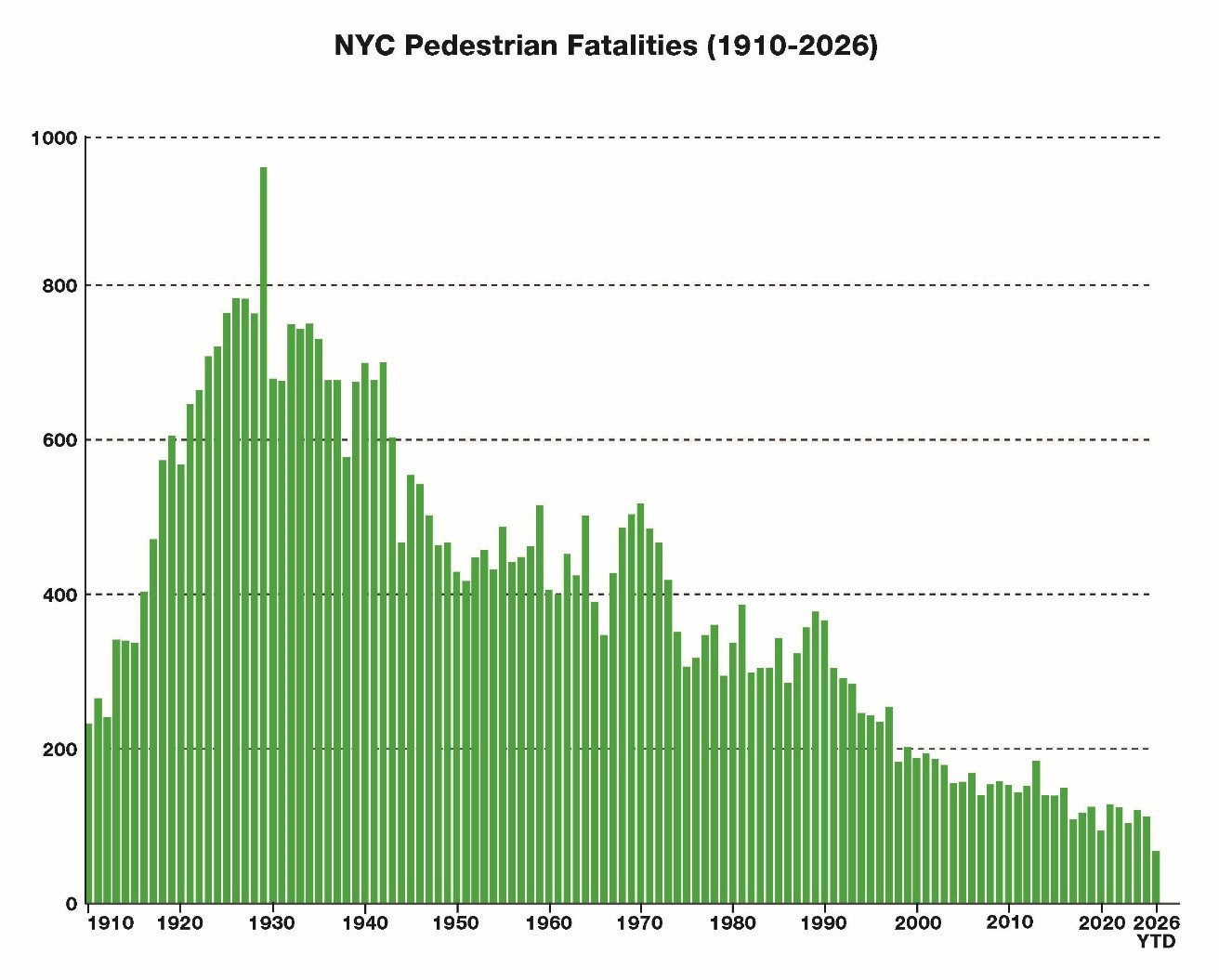
NYC Reports Lower Pedestrian Fatalities as City Advances Vision Zero Reimagined
New York City reported 67 pedestrian deaths through September 30, a 15 percent decrease from the same period in 2025. In an October 2 announcement, officials described pedestrian fatalities as the lowest recorded for the first nine months of a year, excluding the unusual 2020 pandemic period. Overall traffic fatalities were also at their second-lowest level for the same period. The city announced a 10-year Vision Zero Reimagined action plan intended to continue and expand its road-safety work. The results were not uniformly positive: fatalities among e-bike and stand-up scooter users increased. The update therefore highlights both progress in pedestrian safety and the need to examine changing risks across different road-user groups. For taxi, FHV and other passenger-service regulators, the findings provide a current reference for considering how driver practices, street conditions and interactions with vulnerable road users fit within broader transportation-safety programmes. Aggregate fatality changes alone do not establish which individual intervention caused an improvement.
WHY IT MATTERS TO REGULATORS:
Road-safety reporting is most useful when
it distinguishes outcomes by road-user group
and places trends in context. Regulators can
examine how safety data inform driver education,
enforcement priorities and coordination with
street-management agencies, while monitoring
whether gains extend to emerging mobility modes.
|
||

|
||
California | Robotaxis & Event Operations
San Francisco Plans Fleet Week Robotaxi Geofences Along Northern WaterfrontSan Francisco's Municipal Transportation Agency says autonomous rideshare services will have designated service boundaries during Fleet Week, October 9–11, from 10 a.m. to 6 p.m. The geofences cover northern waterfront areas and additional corridors, and autonomous rideshare service will not be available anywhere within the Presidio. SFMTA identifies congestion and pedestrian safety as the reasons for the boundaries. Traditional Uber, Lyft and taxi services will remain available without those geofence restrictions. The arrangement is event-specific, not a permanent citywide robotaxi ban.
WHY IT MATTERS TO REGULATORS:
Temporary operating boundaries raise practical
questions about operator coordination, passenger
notice, pickup activity near boundary edges
and accessible alternatives. The published map
provides a useful example of communicating
service-specific restrictions during major events.
Sources: SFMTA — Fleet Week Advisory and Map | CBS San Francisco — October 5 |
||
Washington, D.C. | For-Hire Regulatory Modernization
D.C. Proposal Would Broaden For-Hire Passenger-Service OversightCouncilmember Brianne Nadeau introduced the For-Hire Passenger Service Reform Act of 2026, B26-0818, on October 1. The proposal would broaden coverage of for-hire activity, including services providing some or all of a trip without a direct charge, and strengthen tools addressing unlicensed operations. The proposed overhaul also addresses accessible service, fare transparency, driver compensation, insurance, vehicle inspections and emerging service models, including autonomous vehicles. It is proposed legislation, not an enacted regulatory framework.
WHY IT MATTERS TO REGULATORS:
Service definitions and licensing categories
must keep pace with changing pricing and
operating models. The proposal provides a
reference for evaluating consistent passenger
protections across conventional and emerging
for-hire services.
|
||
United States | Emergency Relief & Compliance
FMCSA Extends Automatic Regional Emergency Relief From 14 to 30 DaysThe Federal Motor Carrier Safety Administration announced a final rule extending automatic regulatory relief following regional emergency declarations from 14 days to 30 days. The change took effect October 5. Qualifying declarations may be issued by a governor, an authorized representative or FMCSA. Operators should consult the rule's applicability and conditions; emergency relief should not be treated as a blanket suspension of all motor-carrier safety obligations.
WHY IT MATTERS TO REGULATORS:
Emergency flexibility requires clear boundaries.
The change highlights the importance of
documenting covered operations, communicating
exemption limits and maintaining coordination
between emergency management and transportation
enforcement.
Source: FMCSA — October 5, 2026 |
||

|
||
Vancouver | E-Scooter Safety & Enforcement
Vancouver Police Report More Than 1,275 E-Scooter Warnings and TicketsVancouver Police reported more than 1,275 warnings and tickets in an October 2 update on an electric kick-scooter enforcement campaign running September 4–October 4. Helmet-related interactions accounted for 753 warnings and 167 tickets. Other targeted conduct included sidewalk riding, carrying passengers and underage operation. The figures were an interim campaign update, not verified final totals.
WHY IT MATTERS TO REGULATORS:
Enforcement data can identify rules requiring
clearer communication and targeted education.
Distinguishing warnings from penalties helps
agencies explain how education and enforcement
work together.
|
||
Winnipeg | Rideshare Safety & Investigation
Winnipeg Police Announce Charge Following Alleged Rideshare Passenger AssaultWinnipeg police reported that a 27-year-old man was charged with sexual assault following an alleged incident involving a rideshare passenger on September 27. According to October 5 reporting, police arrested the suspect the following day and released him on an undertaking. The charge is an allegation, not a finding of guilt. Reporting did not identify the rideshare platform.
WHY IT MATTERS TO REGULATORS:
Passenger-safety investigations highlight the
importance of accessible complaint channels,
preservation of trip records and coordination
among police, platforms and licensing authorities.
Any licensing response should follow applicable
law and procedural safeguards.
Sources: The Canadian Press via CTV News | CityNews — October 5, 2026 |
||
Cornwall, Ontario | Vehicle-for-Hire Policy Watch
Cornwall Defers Vehicle-for-Hire Bylaw Work Until After Municipal ElectionsCornwall City Council voted to receive a vehicle-for-hire report for information rather than proceed immediately with proposed changes, according to September 30 reporting by Taxi News & Road Warrior News. Staff presented the report September 28. Further consideration was deferred until after municipal elections, with the timing of Ontario's regional rideshare pilot also raised during the discussion. The action was a deferral, not adoption of a new bylaw.
WHY IT MATTERS TO REGULATORS:
Local licensing reviews can intersect with
provincial pilots and municipal governance
transitions. Clear reporting of what remains
proposed helps operators and passengers
understand the rules currently in force.
|
||

|
||
Belgium | Taxi Electrification & Accessibility
Brussels Extends Taxi Vehicle Age Limits While Keeping Zero-Emission Deadline
Brussels has agreed to extend the maximum operating age of existing combustion-engine taxis from seven to nine years, while increasing the limit for electric, hydrogen and wheelchair-accessible taxis from eight to ten years. The government is retaining January 1, 2027 as the deadline after which newly registered taxi vehicles must be zero-emission. The announced package also provides an exemption for wheelchair-accessible taxis intended to protect service availability.
WHY IT MATTERS TO REGULATORS:
Brussels separates the standard for newly
registered vehicles from the operating life
of existing taxis. The approach offers a
reference for balancing electrification,
replacement costs and accessible-service
continuity.
Sources: BRUZZ — October 4, 2026 | RTBF — October 2, 2026 |
||
European Union | AI Governance & Enforcement
European Commission Updates AI Act Enforcement OverviewThe European Commission updated its AI Act enforcement overview on October 6, explaining the responsibilities of the Commission's AI Office, national competent authorities and the European Data Protection Supervisor. Enforcement powers began applying August 2, 2026 for provisions already applicable. The overview lists December 2, 2027 for Annex III high-risk AI rules and August 2, 2028 for high-risk AI embedded in regulated products. Applicability must be assessed for the particular system and use, rather than assumed for every transportation algorithm or automated vehicle.
WHY IT MATTERS TO REGULATORS:
The framework provides a reference for
allocating AI oversight responsibilities,
requesting information and monitoring compliance.
Agencies evaluating AI-enabled services should
distinguish system-specific obligations from
general technology policy.
|
||
European Union | Vehicle-Access Policy Watch
European Vehicle-Access Rules Highlight Cross-Border Compliance ChallengesThe European Commission identifies urban vehicle-access regulations, including low- and zero-emission zones, congestion charging and limited-traffic zones, as tools for addressing emissions, congestion and safety. Its policy overview highlights difficulties communicating and enforcing requirements for vehicles registered elsewhere, including foreign zero-emission vehicles. European initiatives address standardized access-rule data, clearer driver information and improved access to information needed for enforcement. The overview is a policy reference, not an announcement of a new October 6 restriction.
WHY IT MATTERS TO REGULATORS:
Taxi, FHV and commercial fleets crossing
municipal boundaries need understandable
eligibility and registration rules.
Digital information and interoperable
enforcement processes are important alongside
the emissions standards themselves.
Source: European Commission — Urban Vehicle Access Regulations |
||

|
||
South Africa | Taxi & E-Hailing Representation
Western Cape Opens Participation in E-Hailing and Metered Taxi Council Elections
Registration and nominations for the Western Cape's E-Hailing and Metered Taxi Council remain open until October 14. The initiative provides a representative structure for licensed operators, facilitated by the provincial government. Elections are scheduled for November 17–18, with a final constitution planned for March 2027. The council is an industry representation mechanism, not a replacement for government licensing or enforcement authority.
WHY IT MATTERS TO REGULATORS:
Structured stakeholder engagement can support
dialogue on safety, compliance and market
development. Clear membership, election and
governance rules help distinguish industry
representation from public regulatory powers.
Source: Western Cape Government — Council Registration and Elections |
||
India | Airport Taxis & Ground Access
Navi Mumbai Airport Adds Taxi and Prepaid Ground-Transport OptionsNavi Mumbai International Airport announced expanded ground-transport arrangements ahead of its winter flight schedule, according to October 5 reporting. Bharat Taxi is scheduled to begin operations October 10 with a dedicated fleet of up to 40 vehicles. The announced package also includes prepaid taxi and autorickshaw services and additional app-based ride options. Scheduled additions should be distinguished from services already operating.
WHY IT MATTERS TO REGULATORS:
Airport ground-access programmes bring together
operator permissions, passenger information,
pickup arrangements and multiple fare models.
Transparent service identification and clearly
communicated prepaid options are useful
considerations for airport and for-hire
regulators.
Sources: Financial Express | The Tribune / ANI — October 5, 2026 |
||
New Zealand | Vehicle-Inspection Implementation Watch
New Zealand Prepares Phased Vehicle-Inspection Changes for NovemberNew Zealand's announced light-vehicle inspection reforms begin taking effect November 1, 2026. Two-year Warrant of Fitness intervals are phased: the eligible cohort first registered on or after November 1, 2019 enters this November, with the older eligible cohort following in November 2027. Inspection changes also address malfunction indicators for automatic emergency braking and lane-keep assistance. These checks should not be characterized as comprehensive certification of automated-driving performance. Operators must check the requirements applicable to their vehicle and service class.
WHY IT MATTERS TO REGULATORS:
Inspection modernization requires clear
eligibility dates and careful treatment of
electronic safety systems. Private-vehicle
inspection intervals should not automatically
be applied to commercial passenger-service
vehicles.
Source: NZ Transport Agency — November 1 Implementation Guidance |
||
Featured Research / Study |
||
Shared Mobility | Regulatory Design & Costs
Urbanism Next Examines Shared-Mobility Regulation and Operating CostsA 2026 Urbanism Next report examines regulation of e-bike and scooter sharing, transportation network companies, microtransit and shared autonomous vehicles. It compares how rules are established, the levels of government involved and the costs and benefits for different stakeholders. The report identifies liability, data sharing and fees among common regulatory requirements. It observes that higher-level regulation tends to produce greater uniformity, while local regulation produces more variation. Those observations should be considered alongside local policy objectives and operating conditions.
WHY IT MATTERS TO REGULATORS:
The report offers a framework for comparing
regulatory authority, compliance costs and
public-interest goals. It can inform reviews
of licensing, data obligations and coordination
across jurisdictions without prescribing a
single model for every mobility service.
Source: Urbanism Next — Shared Mobility Regulations: Balancing Policy Goals With Operating Costs |
||
A Message From the IATR President
At the International Association of Transportation Regulators (IATR), our regulators are at the forefront of addressing both the challenges and opportunities facing the mobility paradigm. Our IATR members, partner organizations, and regulated industries will continue on our shared quest to fulfill the mission of our non-profit educational organization—to bring about Multi-Modal Mobility Innovation for All! This mission can best be accomplished through information sharing, collaboration, identifying and promoting best practices, and educating our membership. These educational updates and electronic media clips are affectionately known as “IATR snips” and endeavor to cover all aspects of mobility around the globe— especially news and developments involving safety, technology innovation, multi-modal integration, automation, sustainability, electrification, accessibility, regulatory modernization, and equity. If you would like more information about the IATR, please visit www.iatr.global. Current members can renew their memberships by logging in through the IATR portal at the top right-hand side of the website. If you forgot your membership password, please email info@iatr.global. |
||
International Association of Transportation RegulatorsAdvancing safe, equitable, innovative, and effective transportation regulation worldwide. |
||
|
International Association of Transportation Regulators |