|
Daily Transportation News
Monday, September 14, 2026
|
|
Editorial and legal note: This briefing is provided for general information and professional awareness. It summarizes publicly available materials from government agencies, legislatures, transportation providers, companies, and news organizations. Inclusion does not constitute IATR endorsement, legal advice, a finding of fact, or a recommendation that any regulator adopt a particular policy. Readers should consult the original source and applicable law before relying on any item for regulatory, procurement, enforcement, or operational decisions. Image credits and source links are provided where photographs are embedded; confirm image-use rights before publication.
|
|
FOR-HIRE INSURANCE & RATE REGULATION
New York DFS Seeks Comment on Proposed Auto-Insurance Rate Rules Affecting Personal and For-Hire Vehicle Policies
The New York State Department of Financial Services has published a proposed second amendment to 11 NYCRR 163, Insurance Regulation 153. The proposal was filed on August 21 and published in the State Register on September 9, with public comments due by November 9, 2026.
The Times Union reports that the proposal would prohibit insurers from increasing rates for personal and for-hire vehicle policies by more than 5% without prior DFS approval. The proposal is part of a wider New York effort focused on insurance affordability, fraud reduction, and premium pressures.
WHY IT MATTERS TO REGULATORS: Commercial for-hire insurance availability and affordability directly affect taxis, FHVs, black cars, limousines, NEMT providers, and other regulated passenger-transportation operators. Regulators should review the proposed text, the scope of covered policies, the approval standard for increases above 5%, insurer comments, and potential effects on both premium growth and carrier participation in the for-hire market.
Sources:
New York Department of Financial Services — Regulatory Activity
|
Times Union — State unveils new regulations for auto insurers
|

|
|
TAXI, RIDESHARE & VEHICLE RECALL COMPLIANCE
CARFAX Finds More Than One in Four Taxis and Rideshare Vehicles in Major U.S. Cities Have an Unfixed Recall
CARFAX reported that about 27% of taxi and rideshare vehicles analyzed across 16 major U.S. cities had at least one open, unfixed recall, compared with roughly one in five vehicles nationwide. The company said it analyzed nearly 438,000 vehicle identification numbers obtained from state and city officials through public-records requests or open-data portals and checked them against its Vehicle Research Search Service.
The analysis found higher reported open-recall rates in some cities, including 38.6% for New York City medallion taxis and 37.5% for vehicles in Seattle. CARFAX noted that recall severity varies, from software updates and labeling corrections to more significant mechanical issues.
WHY IT MATTERS TO REGULATORS: For-hire vehicle regulators have a direct opportunity to reduce preventable safety risk by linking vehicle licensing, inspection, renewal, and fleet-audit processes to authoritative recall-status checks. The findings also raise practical questions about licensee notification, repair access, downtime support, and compliance deadlines after safety recalls are issued.
Source:
CARFAX — Recall analysis of taxis and rideshare vehicles
|
|
ADVANCED AIR MOBILITY & PILOT GOVERNANCE
Texas Launches Federal Advanced Air Mobility Pilot Demonstrations
The U.S. Department of Transportation announced that Texas has become the sixth location to begin activity under the Advanced Air Mobility Integration Pilot Program. The Texas initiative, known as Project Nexus, includes the Texas Department of Transportation, BETA Technologies, Joby Aviation, and other public- and private-sector partners.
USDOT said initial demonstrations include next-generation aircraft operations and planned test flights between Perot Field Fort Worth Alliance Airport and Dallas Fort Worth International Airport. The Department said data from pilot projects will support the Federal Aviation Administration’s development of regulations for safe integration of next-generation aircraft.
WHY IT MATTERS TO REGULATORS: Advanced air mobility raises issues beyond aircraft certification. Transportation and local-government regulators may need to address airport and vertiport access, land use, curbside operations, surface connections, emergency planning, noise, equity, accessibility, passenger protections, data sharing, and coordination among state, municipal, airport, and aviation authorities.
Source:
U.S. Department of Transportation — Federal eVTOL Pilot Program in Texas
|
TRANSIT ACCESS & FEDERAL FUNDING
FTA Continues to Accept Applications for Accessible and Coordinated Mobility Pilot Funding
The Federal Transit Administration is accepting applications for up to $4.2 million through its Innovative Coordinated Access and Mobility Pilot Program. The program supports demonstration projects that improve coordination among transportation providers and human-services agencies to expand transportation access for older adults, people with disabilities, and individuals with low incomes.
Eligible applicants include public transportation providers, state and local governments, federally recognized tribes, nonprofit organizations, and private operators. Applications are due October 14, 2026, through Grants.gov.
WHY IT MATTERS TO REGULATORS: Coordinated mobility pilots can help agencies improve first- and last-mile service, integrate paratransit and NEMT resources, reduce duplication among providers, and address transportation barriers faced by older adults, people with disabilities, and low-income riders.
Source:
Federal Transit Administration — Innovative Coordinated Access and Mobility Pilot Program
|

|
TRANSIT RELIABILITY & PARATRANSIT ACCESS
Ottawa Reviews Fall Transit Improvements, O-Train Expansion, and Para Transpo Access
Ottawa’s Transit Committee received OC Transpo’s fall service-improvements update, covering bus-route changes, customer feedback, and progress on the Stage 2 O-Train expansion. OC Transpo reported that 30 bus routes serving approximately half of its riders received more reliable schedules beginning August 20.
The agency also reported improved O-Train Line 1 frequency, earlier Line 2 service, a new Kanata-to-Orléans express route, and expected pre-trial running on the east extension beginning in early October. OC Transpo announced fare-free travel for OC Transpo and Para Transpo riders on September 26 and 27.
WHY IT MATTERS TO REGULATORS: The update links schedule reliability, capital-project accountability, customer feedback, and accessible transportation. It offers a practical example of public transit governance that pairs immediate operational changes with transparent reporting on longer-term rail expansion and paratransit access.
Source:
CityNews Ottawa — OC Transpo fall improvements update
|
|
TRANSIT OPERATOR SAFETY
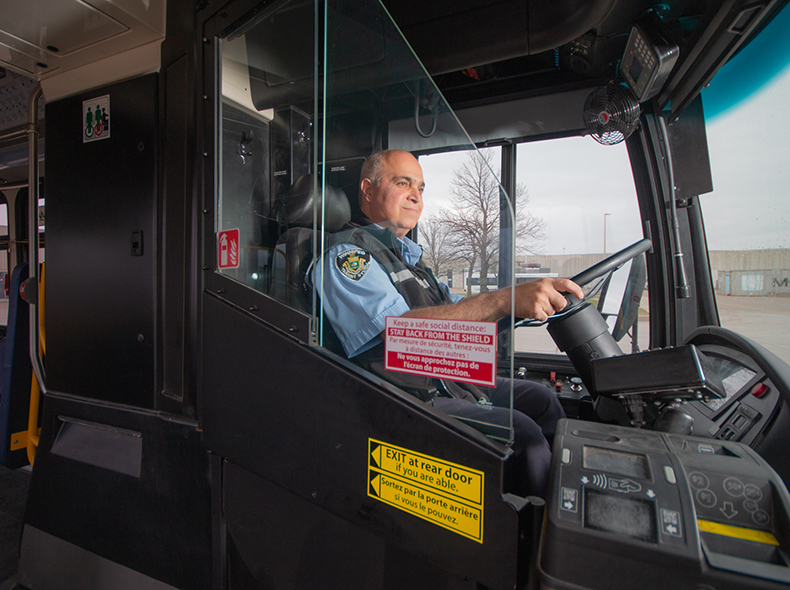
Winnipeg Moves Toward Full Safety Shields for Transit Operators
|
|
Photo: City of Winnipeg. Winnipeg Transit operator safety shield. Confirm reuse terms before external redistribution.
|
Winnipeg city councillors have backed spending to install full safety shields on transit buses, according to the Winnipeg Free Press. The action follows continuing concern about attacks on transit operators and has been welcomed by the union representing transit workers.
WHY IT MATTERS TO REGULATORS: Physical operator-protection measures should be assessed alongside incident reporting, de-escalation training, emergency response, fare-enforcement practices, vehicle design, and accessibility impacts. Winnipeg adds to growing North American experience with full operator barriers as an element of transit workforce safety.
Source:
Winnipeg Free Press — Safety shield report
|
FUEL POLICY & EMISSIONS ACCOUNTING
Canada Updates Transportation Fuel Life-Cycle Assessment Model
Environment and Climate Change Canada published updated guidance to its Fuel Life Cycle Assessment Model, incorporating proposed changes to how transportation fuels’ carbon intensity is calculated. The model supports life-cycle emissions analysis used in low-carbon fuel policy and related compliance approaches.
WHY IT MATTERS TO REGULATORS: Life-cycle carbon accounting affects how governments and fleets assess the environmental performance of electric vehicles, renewable fuels, hydrogen, and conventional fuels. Clear and current methodology is important for fleet procurement, emissions-reduction policy, compliance planning, and public reporting.
Source:
Environment and Climate Change Canada — September 2026 model changes
|

|
|
AIRPORT MOBILITY & AUTOMATED SHUTTLES
Zürich Airport Deploys Level 4 Electric Shuttle Buses With Remote Monitoring

|
|
Photo: Flughafen Zürich, via Electrive. Confirm image-use terms before external redistribution.
|
Zürich Airport has deployed two fully automated electric shuttle buses without an onboard human safety monitor, according to reporting on a project developed with WeRide. The initial Level 4 trips will operate without passengers, followed by expected employee use after a testing period. The shuttles operate on a defined airport route that does not cross aircraft taxiways or runways.
The vehicles are remotely monitored, with teleoperation available as needed. Swissport and Krummen Kerzers are participating in the employee-shuttle program and each provides a remote-operations monitor.
WHY IT MATTERS TO REGULATORS: Airport campuses offer a controlled but complex environment for automated passenger operations. Regulators should consider operational-design limits, remote intervention, worker and passenger protections, accessibility, charging, cybersecurity, data-sharing, emergency response, and coordination among airport, aviation, police, transit, and municipal authorities.
Source:
Electrive — Zürich Airport tests autonomous electric shuttles
|
TAXI & VTC LICENSING DATA
Spain’s VTC and Taxi Authorization Data Highlight the Need for Clear Licensing Records
Spanish reporting based on Ministry of Transport registry data states that VTC—vehicle-with-driver—authorizations rose from 24,259 at the end of 2025 to 27,107 on September 1, 2026. The same reporting indicates that taxi authorizations recorded in the registry declined from 63,474 at year-end 2025 to 60,469 by early July.
The report cautions that a mandatory 2026 administrative visa process may temporarily affect the recorded validity of authorizations that are later rehabilitated. The figures should therefore not be interpreted automatically as a permanent loss of active taxi licenses.
WHY IT MATTERS TO REGULATORS: Licensing data should clearly differentiate permanently surrendered licenses from active records, inactive authorizations, temporary administrative lapses, pending renewals, and restored permissions. Accurate classifications are essential for market-supply analysis, taxi/TNC policy, accessibility requirements, enforcement planning, and public trust in regulatory data.
Source:
Demócrata reporting on Spanish Ministry of Transport registry data
|
TAXI LICENSING & ACCESSIBILITY
Finland Implements New Taxi Regulatory Requirements
Finland’s updated taxi regulations took effect September 1, introducing changes involving driver and entrepreneur training, fare information, licensing, vehicle registration, and professional qualifications. Under the revised framework, vehicles used in taxi transport must be linked to a valid transport licence, while additional requirements—including taxi plates and taximeters—are scheduled to take effect in stages.
WHY IT MATTERS TO REGULATORS: Finland offers a current example of a taxi framework that combines professional standards, vehicle identification, licensing controls, fare transparency, and consumer protection. The phased implementation approach may be useful to agencies modernizing taxi and private-hire rules while allowing operators time to comply.
Source:
Finnish Transport and Communications Agency — Taxi regulation changes
|

|
|
AUTOMATED FREIGHT & CROSS-BORDER RULES
Pony.ai Unveils Level 4 Electric Robotruck and Pursues European Road Tests

|
|
Pony.ai and GAC Commercial Vehicle Gen-4 Level 4 autonomous electric heavy-duty truck, unveiled at IAA Transportation 2026. Photo: Pony.ai / GAC Commercial Vehicle; use subject to confirmed company image-use terms.
|
Pony.ai unveiled a Level 4 autonomous heavy-goods vehicle at the IAA Transportation trade fair in Hanover, Germany, and said it is talking with European governments and potential customers about road tests. Reuters reports that the full-electric truck was jointly developed with Chinese state-owned automaker GAC and is planned for volume production later this year.
Pony.ai said it operates several hundred Level 4 trucks in China, including vehicles operating fully driverless and others with human safety drivers. The company has not announced a specific European testing authorization.
WHY IT MATTERS TO REGULATORS: Automated freight presents many of the same governance questions as robotaxis—operating design domains, remote support, incident reporting, insurance, data access, and cybersecurity—but with additional risks related to vehicle mass, freight corridors, loading operations, and vulnerable road users. Clear test-permitting pathways are important before commercial deployment can be assessed.
Sources:
Reuters
|
Pony.ai / GAC Commercial Vehicle release
|
|
FREIGHT RAIL & MULTIMODAL LOGISTICS
India Completes Its 2,843-Kilometer Dedicated Freight Corridor Network
India has completed its 2,843-kilometer Dedicated Freight Corridor network following the inauguration of the final three sections of the Western Dedicated Freight Corridor on September 8. The newly commissioned Western sections total 326 kilometers and complete the 1,506-kilometer route linking Dadri in Uttar Pradesh with Jawaharlal Nehru Port near Mumbai.
Together with the 1,337-kilometer Eastern Dedicated Freight Corridor, the system creates a continuous high-capacity rail-freight backbone across major economic corridors. The corridors are intended to shift freight traffic from mixed-use rail routes, reduce congestion on passenger lines, improve freight reliability, and strengthen links among industrial areas, logistics hubs, and ports.
WHY IT MATTERS TO REGULATORS: Separating high-volume freight from passenger rail traffic can improve capacity, reliability, safety, and service planning across an entire rail network. India’s completed corridor system offers a large-scale example for agencies examining freight-rail investment, port connectivity, multimodal logistics planning, land use around logistics hubs, and passenger-service benefits when freight bottlenecks are reduced.
Sources:
The Hindu — Dedicated Freight Corridors
|
NBM&CW — Western DFC completion
|
PUBLIC TRANSIT ELECTRIFICATION & REGIONAL ACCESS
Punjab, Pakistan Approves Expansion of Electric-Bus Service to 91 Tehsils

|
|
Photo: The Express Tribune. Image from the source article; confirm reuse terms before external redistribution.
|
Pakistan's Punjab’s government has approved an expansion of electric-bus service to 91 tehsils, with deployment of 1,500 buses planned from January 2027, according to reporting by The Express Tribune. The program is intended to extend public transportation access beyond major metropolitan areas while supporting electrification objectives.
WHY IT MATTERS TO REGULATORS: Scaling electric-bus operations beyond large cities requires more than vehicle procurement. Regulators and public agencies must plan for charging infrastructure, electricity supply, depot operations, maintenance capacity, route scheduling, workforce training, procurement safeguards, fare affordability, and service standards in lower-density communities.
Source:
The Express Tribune — Punjab electric-bus expansion
|
|
New York For-Hire Insurance: Review the proposed amendment to Insurance Regulation 153, monitor comments through November 9, and watch for DFS action on covered policies, rate-review standards, fraud-reduction measures, and commercial-market implications.
Open Vehicle Recalls: Consider whether vehicle inspections, licensing renewals, fleet audits, and licensee notices can better incorporate reliable recall-status information for taxis, rideshares, NEMT, and other regulated passenger vehicles.
Texas Advanced Air Mobility: Follow FAA rulemaking, pilot data, airport and vertiport planning, and the framework for passenger, cargo, emergency-response, and autonomous-flight demonstrations.
Ottawa Transit: Monitor schedule-reliability changes, O-Train east-extension testing, and Para Transpo service initiatives.
Zürich Airport Automation: Watch for employee-service expansion, published safety data, remote-intervention requirements, and accessibility commitments.
Autonomous Freight: Track national and EU-level policy developments governing testing and commercial use of Level 4 heavy-duty vehicles.
India Freight Corridors: Watch for changes in freight mode share, passenger-rail reliability, port connectivity, logistics-hub development, and safety outcomes as the completed network enters full operation.
|
Message from IATR President

At the International Association of Transportation Regulators (IATR), our regulators are at the forefront of addressing both the challenges and opportunities facing the mobility paradigm. Our IATR members, partner organizations, and regulated industries will continue on our shared quest to fulfill the mission of our non-profit educational organization—to bring about Multi-Modal Mobility Innovation for All! This mission can best be accomplished through information sharing, collaboration, identifying and promoting best practices, and educating our membership. These educational updates and electronic media clips are affectionately known as “IATR snips” and endeavor to cover all aspects of mobility around the globe—especially news and developments involving safety, technology innovation, multi-modal integration, automation, sustainability, electrification, accessibility, regulatory modernization, and equity.
If you would like more information about IATR, visit www.iatr.global. Current members can renew their memberships through the IATR website, or contact info@iatr.global for assistance.
|
Renew Your Membership for 2026
Weekly news snippets • Membership database access • Conference videos and files • Discounted conference rates
Renew your membership or email info@iatr.global.
|
|
INTERNATIONAL ASSOCIATION OF TRANSPORTATION REGULATORS
Dedicated to promoting positive regulatory outcomes through education and collaboration.
Website: www.iatr.global
|
Contact: info@iatr.global
© 2026 International Association of Transportation Regulators. All rights reserved.
Unsubscribe
|
Privacy Policy
|
|
|
