|
|
|
|
|
Daily Transportation News
Friday, September 25, 2026
|
|
|
Editorial and legal note: Source links were checked against the linked publication, agency, or organization before this version was prepared. This briefing is provided for general information and professional awareness. It summarizes publicly available materials from government agencies, legislatures, transportation providers, companies, research organizations, and news organizations. Inclusion does not constitute IATR endorsement, legal advice, a finding of fact, or a recommendation that any regulator adopt a particular policy. Readers should consult the original source and applicable law before relying on any item for regulatory, procurement, enforcement, or operational decisions.
|
|
|
|
|
TRANSIT SAFETY, WORKER PROTECTION & FEDERAL OVERSIGHT
FTA Orders Immediate NYCT Track-Worker Safety Changes After Fatal Flagger Strike
The Federal Transit Administration has ordered New York City Transit to take immediate action following the September 3 death of a flagger who was struck by a southbound D train. FTA said its action follows continuing concerns about rail-worker protection and the need for immediate operational safeguards after the fatal incident.
FTA's September 14 Immediate Action Letter restricts roadway-track access unless NYCT demonstrates compliance with specified protections. The action addresses positive confirmation that tracks are protected, restrictions on workers fouling track to place or retrieve warning devices, 10-mph work-zone operating restrictions, retraining and recertification, revised roadway-worker-protection procedures, and expedited near-miss reporting to FTA and New York's state safety oversight agency.
WHY IT MATTERS TO REGULATORS: This action demonstrates how federal transit safety oversight can use immediate operational safeguards, together with corrective requirements, to strengthen worker protection. It also illustrates the role that track-access controls, work-zone rules, retraining, control-center procedures, near-miss data, and safety-management-system accountability can play in supporting continuous safety improvement.
Sources:
Federal Transit Administration
|
Immediate Action Letter (PDF)
|
|

|
|
WORK-ZONE SAFETY & AUTOMATED ENFORCEMENT
MTA Begins Issuing Fines Through Automated Work-Zone Speed Enforcement

Image source: NY1 / Spectrum News.
|
Drivers recorded traveling more than 10 mph above the posted limit in active MTA Bridges and Tunnels work zones are now receiving civil penalties after an initial warning period. The enforcement program uses cameras mounted on unmarked vehicles during work hours; first-time violations carry a $50 fine, with higher penalties for repeat violations.
WHY IT MATTERS TO REGULATORS: The program demonstrates a transition from warning-based automated enforcement to monetary penalties. It raises practical questions about signage, evidence standards, notice, repeat-offender treatment, adjudication, privacy, and due process.
Source:
NY1
|
|
|
CONGESTION PRICING, URBAN FREIGHT & CURB MANAGEMENT
NYC Uses $5 Million in Congestion-Pricing Revenue to Shift Deliveries to Off-Hours
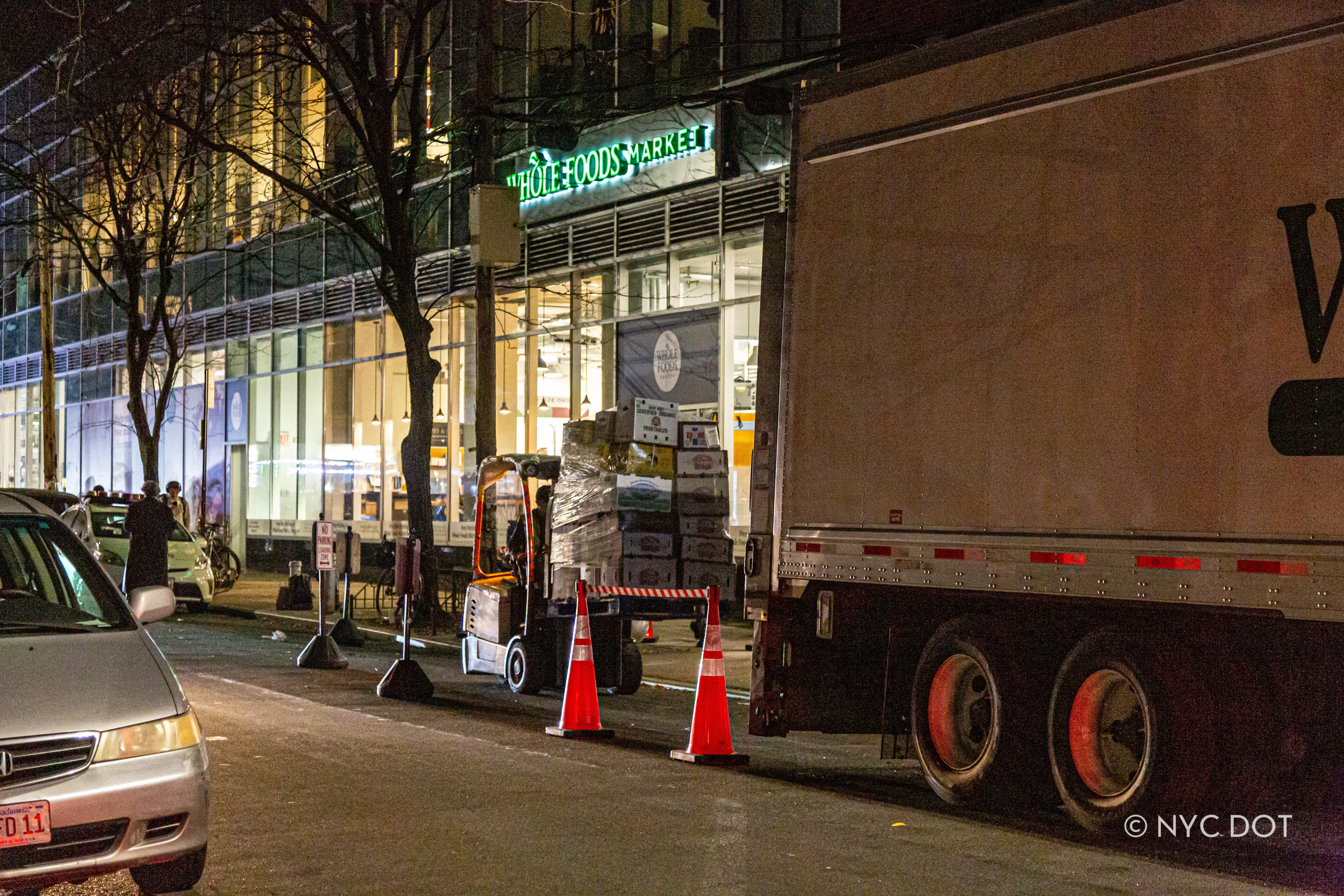
Photo: New York City Department of Transportation.
|
New York City DOT has announced a $5 million incentive program to help businesses shift deliveries from peak daytime periods to 7 p.m.–6 a.m. The first phase is expected to support operational changes including low-noise delivery equipment, building-security improvements for unattended deliveries, and other adjustments that make off-hour receiving practical.
NYC DOT says the initiative supports a longer-term goal of establishing 5,000 off-hour-delivery locations by 2040 and shifting an estimated 62,000 daily truck trips out of peak periods. The agency links the program to congestion reduction, curb management, safety, bus operations, emissions reduction, electric trucks, cargo bikes, and microhub development.
WHY IT MATTERS TO REGULATORS: The initiative shows how congestion-pricing revenue can be used to influence freight and delivery behavior while advancing safety, curb-management, and sustainability objectives. It offers a practical model for pairing road pricing with business-facing operational incentives.
Source:
New York City Department of Transportation
|
|
|
AUTONOMOUS FREIGHT & COMMERCIAL VEHICLE OVERSIGHT
California Permit Supports Autonomous Long-Haul Truck Deliveries
Kodiak AI and DTL Transport announced autonomous trucking deliveries on California's I-5 and CA-99 corridors following Kodiak's August approval for a California Department of Motor Vehicles heavy-duty autonomous-vehicle testing permit. The companies describe the operations as freight movements conducted under California's AV testing framework.
WHY IT MATTERS TO REGULATORS: Freight deployment adds a different operating context to autonomous-vehicle oversight. Regulators will need to consider remote assistance, safety reporting, vehicle requirements, roadway interactions, emergency response, insurance, enforcement, and coordination with freight operators.
Source:
Kodiak AI
|
|

|
|
RAIL SAFETY & CONDITION-MONITORING DATA
Canada Safety Board Calls for Enhanced Wheel-Impact Analytics After Alberta Derailment
Following its investigation into an 18-car CN freight derailment near Uncas, Alberta, the Transportation Safety Board of Canada called on Transport Canada and the rail industry to develop enhanced analytics for wheel-impact-load-detector data. The investigation found that a shattered wheel rim progressively deteriorated and contributed to rail fractures and the derailment.
WHY IT MATTERS TO REGULATORS: The recommendation illustrates how safety oversight can move beyond collecting equipment-condition data toward more sophisticated, potentially real-time analytics to identify elevated risk before failure.
Source:
Transportation Safety Board of Canada
|
|
|
RAIL TRESPASS PREVENTION & GEOFENCING
Canada Funds Rail Trespass-Prevention and Crossing-Safety Projects
Transport Canada announced more than $4.5 million for 12 education and awareness projects through the Rail Safety Improvement Program. The projects include targeted outreach at high-risk locations, community and school education, research, and technology-supported safety campaigns.
One project will use location data, privacy-friendly geofencing, and digital advertising at 10 high-risk locations to reach people who have recently entered railway property without permission. Other projects include work on national guidance for safety, navigation, and trespass-prevention signs in transit and passenger-rail settings.
WHY IT MATTERS TO REGULATORS: The initiative combines safety education with data and geofencing tools, providing a model for how privacy-conscious technology can complement conventional rail-safety enforcement and physical protections.
Source:
Transport Canada
|
|
|
PASSENGER PROTECTION & ADMINISTRATIVE ENFORCEMENT
Canadian Transportation Agency Issues $80,000 Administrative Monetary Penalty Under Passenger Protection Rules
The Canadian Transportation Agency issued an $80,000 administrative monetary penalty to JetBlue following findings involving 40 violations of Canada's Air Passenger Protection Regulations. The agency said the matters involved failures to provide affected passengers with confirmed alternative travel arrangements after cancellations within the carrier's control.
WHY IT MATTERS TO REGULATORS: The action is a current example of administrative enforcement supporting passenger-protection compliance. It demonstrates the value of clear operational duties, documented carrier processes, proportionate monetary penalties, and accessible review mechanisms.
Source:
Canadian Transportation Agency
|
|

|
|
AUTONOMOUS SHUTTLES & OPERATING-AREA APPROVALS
German Consortium Seeks Standardized Approval Process for Driverless Public-Transport Shuttles

Image source: Sustainable Bus / HOLON.
|
A consortium led by Deutsche Bahn is preparing a standardized process intended to help authorities evaluate and approve defined operating areas for autonomous public-transport vehicles. The project is expected to begin in October and use real operating areas in Hesse and Bavaria, together with the HOLON automated shuttle, to reproduce the full authorization process.
The work will develop common application documentation, review procedures, and methods for matching a vehicle's operational design domain with real-world infrastructure conditions such as road widths, curve radii, and road-surface characteristics.
WHY IT MATTERS TO REGULATORS: Autonomous-shuttle deployment requires more than vehicle approval. Authorities must decide whether a specific road network is appropriate for driverless operation. This project offers a practical model for a repeatable, documented, and auditable operating-area authorization process.
Source:
Sustainable Bus
|
|
|
CITY AV TESTBEDS & PUBLIC-PRIVATE COORDINATION
European Commission Extends ADACities Call Focused on Autonomous-Mobility Testbeds
The European Commission has extended the deadline for expressions of interest in ADACities, an initiative intended to support city and public-authority engagement in autonomous-driving test environments. Discussions have focused on eligible vehicles and use cases, financing, city and public-authority roles, cross-border testbeds, and consortium formation.
WHY IT MATTERS TO REGULATORS: The initiative emphasizes the important role of cities and public authorities in establishing practical autonomous-mobility environments. It is relevant to agencies examining permitting, public-space management, operating conditions, data sharing, accessibility, and cross-jurisdictional coordination.
Source:
European Commission
|
|
|
AI DRIVING SYSTEMS & SERIES PRODUCTION
Mercedes-Benz and Wayve Sign Agreement for AI Driving-System Integration
Mercedes-Benz and UK-based Wayve have announced an agreement to integrate Wayve's AI Driver technology into future Mercedes-Benz vehicles. The companies describe the initial application as advanced urban and highway point-to-point driving assistance, with integration expected to begin within the next two years.
WHY IT MATTERS TO REGULATORS: The agreement illustrates how AI-based driving systems are moving from pilots toward production integration. Regulators will need to distinguish advanced driver assistance from higher automation and assess documentation of software updates, system boundaries, driver responsibility, safety validation, and lifecycle performance.
Sources:
Reuters
|
Wayve
|
|

|
|
RIDE-HAILING & PLATFORM ACCOUNTABILITY
Thailand Plans Tighter Ride-Hailing Enforcement and Platform Scorecards

Image source: The Nation Thailand.
|
Thailand's Ministry of Transport has announced plans for stricter enforcement of app-based ride-hailing rules beginning October 1. The reported “App Report Card” system would track specified compliance issues involving licensed public drivers and registered vehicles.
The reported approach would extend oversight beyond individual drivers and vehicles to the platforms that facilitate dispatch and market access. Details on the scorecard's performance measures, publication process, and implementation arrangements should be monitored as the initiative proceeds.
WHY IT MATTERS TO REGULATORS: Thailand's planned approach is a notable example of platform accountability alongside traditional driver and vehicle oversight. It raises practical questions about platform data access, compliance standards, consumer transparency, fair procedures, and proportionate regulatory remedies.
Source:
The Nation Thailand
|
|
|
AUTONOMOUS VEHICLES & COMMERCIAL OPERATIONS
Hong Kong Plans Commercial Autonomous-Vehicle Applications Later This Year

Image source: Hong Kong Transport and Logistics Bureau.
|
Hong Kong's Transport and Logistics Bureau has said it expects to begin accepting applications from autonomous-vehicle operators for commercial operations later in 2026. The government also outlined plans to expand autonomous-driving activity along the Hong Kong section of the Hong Kong–Zhuhai–Macao Bridge in 2027.
WHY IT MATTERS TO REGULATORS: Hong Kong is moving from trials toward a formal commercial-operations application process. It provides a jurisdiction to watch for operating approvals, safety cases, fleet monitoring, public reporting, emergency response, cross-boundary deployment, and public-sector oversight of AV services.
Source:
Hong Kong Transport and Logistics Bureau
|
|
|
INDIA | TNC LICENSING, DRIVER VERIFICATION & PLATFORM COMPLIANCE
Maharashtra Tightens Driver-Information Requirements for App-Based Taxi Aggregators
Maharashtra has directed app-based taxi aggregators to submit complete, verified driver information within 90 days under the state's Aggregator Policy 2026. The reported requirements include verified driver profiles, residence and domicile information, Marathi-language requirements, and recurring driver-verification reporting for platforms operating in the state.
The policy places responsibility for maintaining current, verified driver records on the platforms themselves, rather than relying only on individual driver compliance.
WHY IT MATTERS TO REGULATORS: The measure illustrates a platform-centered compliance approach for the ride-hail sector. It is relevant to agencies evaluating driver eligibility, verification, operator audit authority, recurring data submissions, local licensing conditions, record accuracy, and accountability for digital intermediaries.
Source:
Report on Maharashtra aggregator requirements
|
|
Featured Research / Study
|
|
|
TRANSPORTATION DATA & PERFORMANCE MONITORING
BTS Updates Preliminary Transportation Estimates Program
The U.S. Bureau of Transportation Statistics has updated its preliminary-estimates program, which uses statistical models to provide earlier estimates for aviation enplanements, transit ridership, Amtrak ridership, transborder freight, and vehicle miles traveled. BTS says the estimates can be available about three to 12 months before final audited or official counts.
The program uses available source data including TSA screening data, Federal Transit Administration National Transit Database data, freight and trade data, and Federal Highway Administration traffic trends. BTS notes that the outputs are preliminary modeled estimates and may change as final data become available.
REGULATOR USE: Timelier preliminary indicators can help agencies monitor changes in demand, service, freight activity, and travel behavior while final audited datasets are pending. They should be used as early decision-support signals, with appropriate recognition of uncertainty and revisions.
Source:
U.S. Bureau of Transportation Statistics
|
|
|
|
|
Worker safety: Monitor FTA's NYCT action and related efforts to strengthen roadway-worker protection, including track-access controls, training, work-zone procedures, and near-miss reporting.
Automated enforcement: Follow implementation of MTA work-zone speed enforcement for lessons on public communication, warning periods, evidence standards, notice, repeat-offender treatment, and due-process procedures.
Platform accountability: Watch Thailand's planned ride-hail scorecards and Maharashtra's driver-information requirements for approaches to platform reporting, verification, data access, audit authority, and compliance support.
Autonomous mobility: Monitor Germany's operating-area approval work, Hong Kong's anticipated commercial-AV application process, and California automated-freight operations for developing approaches to operating conditions, safety, data, insurance, and accountability.
Curb and freight policy: Track NYC's off-hour-delivery program for participation, delivery-shift outcomes, congestion effects, safety impacts, and potential lessons for reinvesting road-pricing revenue.
|
|
 Message from IATR President
At the International Association of Transportation Regulators (IATR), our regulators are at the forefront of addressing both the challenges and opportunities facing the mobility paradigm. Our IATR members, partner organizations, and regulated industries will continue on our shared quest to fulfill the mission of our non-profit educational organization—to bring about Multi-Modal Mobility Innovation for All! This mission can best be accomplished through information sharing, collaboration, identifying and promoting best practices, and educating our membership. These educational updates and electronic media clips are affectionately known as “IATR snips” and endeavor to cover all aspects of mobility around the globe—especially news and developments involving safety, technology innovation, multi-modal integration, automation, sustainability, electrification, accessibility, regulatory modernization, and equity.
If you would like more information about IATR, visit www.iatr.global. Current members can renew their memberships through the IATR website, or contact info@iatr.global for assistance.
|
|
Renew Your Membership for 2026
Weekly news snippets • Membership database access • Conference videos and files • Discounted conference rates
Renew your membership
or email
info@iatr.global.
|
|
|
INTERNATIONAL ASSOCIATION OF TRANSPORTATION REGULATORS
Dedicated to promoting positive regulatory outcomes through education and collaboration.
Website:
www.iatr.global
|
|
|
