|
|
|
|
|
Daily Transportation News
Monday, September 28, 2026
|
|
|
Editorial and legal note: This briefing is provided for general information and professional awareness. It summarizes publicly available materials from government agencies, legislatures, transportation providers, companies, research organizations, and news organizations. Inclusion does not constitute IATR endorsement, legal advice, a finding of fact, or a recommendation that any regulator adopt a particular policy. Readers should consult the original source and applicable law before relying on any item for regulatory, procurement, enforcement, or operational decisions.
|
|
|
|
|
NEW YORK CITY | TAXI WORKFORCE, DRIVER WELLNESS & BENEFITS
After Taxi Driver Deaths, NYTWA Urges City to Advance Health-Benefits Fund
The New York Taxi Workers Alliance is pressing Mayor Zohran Mamdani and New York City officials to advance a long-discussed fund that would provide health-related benefits for taxi drivers. The renewed request follows the deaths of three taxi drivers who were found in their vehicles this summer, bringing attention to the health, economic, and social pressures facing drivers in the yellow-taxi industry.
According to The New York Times, the proposed fund could support medical screenings, disability insurance, and other health benefits for drivers. The Alliance represents approximately 28,000 New York City taxi drivers and is seeking action on a benefit model intended to reach a workforce that is largely independent and does not generally receive traditional employer-sponsored coverage.
City officials told the Times that they are considering ways to bring health and wellness services directly to drivers. The proposal remains under discussion, and its funding structure, eligibility rules, governance, and administrative responsibilities would need to be defined before any program could move forward.
WHY IT MATTERS TO REGULATORS: The development highlights how driver wellness, economic security, and public safety can intersect in a regulated taxi and for-hire transportation system. It offers regulators a constructive opportunity to consider whether existing licensing, fare, surcharge, airport-facility, and driver-support mechanisms can help address workforce health needs. Any proposed benefit fund would require transparent decisions on statutory authority, stable funding, eligibility, privacy, program governance, financial accountability, and coordination among city agencies, drivers, industry stakeholders, and state partners.
Sources:
The New York Times
|
|
|
|
|
INTERNATIONAL RESEARCH SURVEY
Share Your Perspective: International Transport Infrastructure Asset Management Survey
IATR is sharing an international research survey for professionals with direct responsibility for, involvement in, or substantial knowledge of transport infrastructure asset management. The study examines how organizations across countries and sectors prioritize maintenance and renewal investments when budgets are limited.
The research explores how organizations define assets and asset management; the criteria, key performance indicators, risk measures, and lifecycle considerations used in investment decisions; and the maturity and consistency of current practices. Its goal is to identify common ground and key differences across the industry, including whether a more unified approach to transport asset management may be achievable.
WHO SHOULD PARTICIPATE: Asset management directors, managers, and specialists; highway and infrastructure maintenance engineers and managers; pavement, bridge, and structural-asset engineers; condition-assessment and performance-monitoring specialists; infrastructure risk-management professionals; capital-program and investment planners; transport asset-management consultants; and staff of public road authorities, agencies, state-owned transport enterprises, private concessionaires, contractors, and relevant regulatory bodies.
The survey is intended for professionals who can speak knowledgeably about how their organization assesses infrastructure condition, manages risk, plans maintenance and renewal, monitors performance, and prioritizes investment. It is not intended for transport professionals whose work is unrelated to infrastructure asset condition, maintenance, lifecycle planning, or capital-investment decisions.
Responses are collected anonymously and will be reported only in aggregated form; no individual or organization will be identifiable in resulting analysis or publication. The survey can be saved and completed later, so respondents do not need to finish it in one sitting.
IATR is sharing this external research opportunity for the professional awareness of members and readers. Participation is voluntary. Inclusion does not constitute IATR endorsement of the study, its methodology, its sponsors, or any resulting findings.
|
|

|
|
NEW YORK CITY | URBAN FREIGHT, CURB MANAGEMENT & CONGESTION
NYC Launches $5 Million Incentive Program to Expand Off-Hour Deliveries
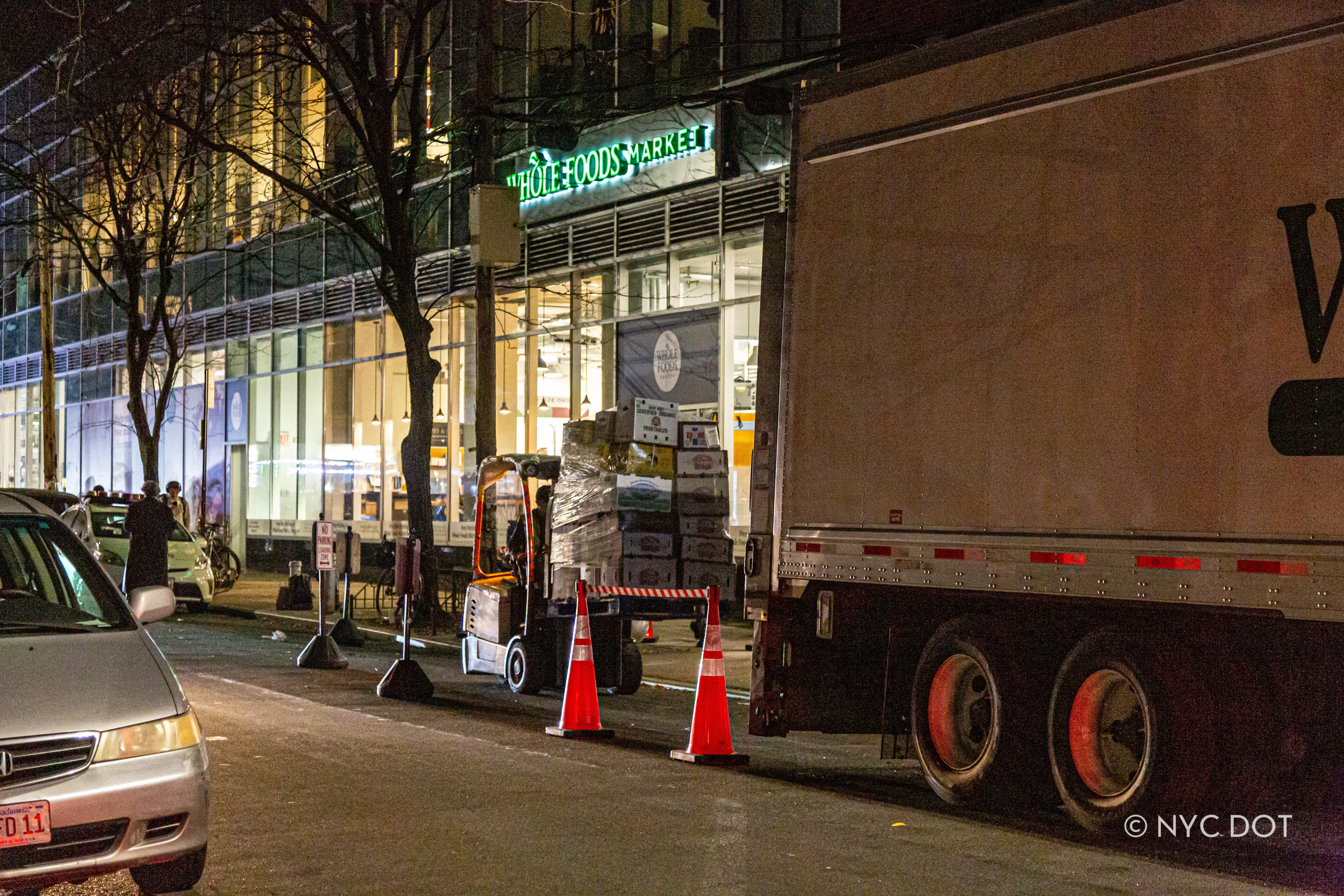
Photo: New York City Department of Transportation.
|
New York City DOT has launched a $5 million incentive program to help businesses shift commercial deliveries from congested daytime periods to off-hour windows between 7 p.m. and 6 a.m. The program is funded through the Metropolitan Transportation Authority’s Central Business District Tolling Program mitigation funding.
In the first phase, up to 14 businesses will receive more than $500,000 in incentives. Funding can support low-noise delivery equipment, building-security modifications that enable unattended deliveries, and related safety equipment. NYC DOT says applications are open on a rolling basis for a second phase that will distribute the remaining funds.
NYC DOT estimates that roughly 90% of goods moving through the city travel by truck. The agency’s Delivering Green plan sets a goal of 5,000 off-hour-delivery locations by 2040, which it estimates could shift approximately 62,000 truck trips from peak periods.
WHY IT MATTERS TO REGULATORS: The program demonstrates how road-pricing revenue can be reinvested in practical freight-management incentives. It offers a positive model for connecting congestion management with freight efficiency, Vision Zero, bus operations, emissions reduction, curb management, and small-business support.
Source:
New York City Department of Transportation
|
|
|
VEHICLE STANDARDS, FLEET PLANNING & ELECTRIFICATION
U.S. DOT Finalizes New Fuel-Economy Standards Through SAFE Vehicles Rule III
The U.S. Department of Transportation announced a final rule resetting the National Highway Traffic Safety Administration’s Corporate Average Fuel Economy standards. The department calls the action the Safer Affordable Fuel Efficient Vehicles Rule III, or SAFE Vehicles Rule III, and says it applies to passenger cars and light trucks for model years 2022 through 2031.
According to DOT, the rule projects a fleet-average fuel economy of 34.9 miles per gallon by model year 2031, compared with 30.1 mpg for model year 2024. DOT also states that the rule will change vehicle-classification criteria beginning in model year 2030 and end the CAFE credit-trading program beginning in model year 2028.
WHY IT MATTERS TO REGULATORS: Federal vehicle standards influence the vehicles available to taxi, FHV, paratransit, public-transit, NEMT, and municipal fleets. State and local regulators may wish to monitor potential implications for vehicle purchase prices, fleet electrification plans, charging investments, emissions targets, accessible-vehicle procurement, and the operating economics of licensed transportation providers.
Source:
U.S. Department of Transportation
|
|
|
TRANSIT SERVICE, REGIONAL COORDINATION & HEAT RESILIENCE
Washington-Area Planning Board Adopts Regional Bus-Service Guidelines
The Metropolitan Washington Council of Governments’ Transportation Planning Board has adopted regional service guidelines under its DMVMoves initiative. The guidelines are intended to support coordinated planning by Metrobus and local transit providers, including Ride On and Fairfax Connector, around common expectations for service hours and frequency.
The board is also working with regional partners on travel-time reliability measures and an extreme-heat resilience toolkit to support transit decision-making.
WHY IT MATTERS TO REGULATORS: Riders experience a regional network, even when service is delivered by separate agencies. Common service and reliability measures can help transit agencies identify network gaps, compare performance, establish shared expectations, and align investment decisions while preserving each operator’s individual responsibilities.
Source:
Metropolitan Washington Council of Governments
|
|
|
TRANSIT FLEET SAFETY & SERVICE RESTORATION
SFMTA Restores Full 37 Corbett Bus Service After Fleet Safety Work
The San Francisco Municipal Transportation Agency restored regular 30-foot bus service on the 37 Corbett route on September 28, returning the route to its original inbound alignment and restoring direct access to all inbound stops through Buena Vista. The 30-foot fleet had undergone safety inspections after a vehicle issue was identified in June.
SFMTA states that reinforced and redesigned manufacturer-supplied parts have been installed across the fleet. The agency also implemented an accelerated inspection cycle every 2,000 miles—approximately once per month—to help maintain the fleet’s condition in service.
WHY IT MATTERS TO REGULATORS: The restoration provides a practical example of a transit agency pairing corrective maintenance, fleetwide component replacement, a more frequent inspection program, and transparent rider communication. It illustrates how service can return after a safety concern while enhanced preventive-maintenance controls remain in place.
Source:
San Francisco Municipal Transportation Agency
|
|

|
|
ACCESSIBLE TRANSIT & CUSTOMER-LED IMPROVEMENT
TransLink Details Accessibility Improvements Across Metro Vancouver
TransLink released its 2026 Accessibility Plan after gathering feedback from approximately 3,700 customers and disability advocates. The plan identifies actions to remove and prevent barriers across the transit journey, including bus-stop accessibility, station elevators and escalators, accessible washrooms, pedestrian connections, vehicle design, passenger information, and HandyDART service.
TransLink reports that more than 86% of bus stops were accessible as of 2025. Since 2023, the agency has invested almost $20 million with local governments in sidewalks, curb ramps, and pedestrian crossings near transit.
WHY IT MATTERS TO REGULATORS: The plan offers an example of treating accessibility as a continuing operational, infrastructure, information, and customer-service responsibility. Its feedback process and measurable actions can inform regulator expectations for accessibility planning, public reporting, first- and last-mile access, and meaningful consultation with disabled riders.
Source:
TransLink
|
|
|
RIDESHARE, PASSENGER RAIL & RURAL MOBILITY
Ontario Northlander Rideshare Program Links App-Based Service With Intercity Rail
Ontario’s Northlander-phase provincial rideshare framework is operating as a one-year program to support app-based rideshare service in designated communities along the Northlander train corridor between Gravenhurst and Cochrane, as well as Greater Sudbury. The program began May 19, 2026, and is intended to help connect riders to passenger rail.
Rideshare operators must apply for approval and meet requirements on drivers, vehicles, safety, and insurance. Approved operators must submit quarterly reports, and the province may seek additional information for administration, enforcement, road-safety analysis, accessibility and service-availability monitoring, transportation planning, congestion management, and evaluation of corridor connectivity.
WHY IT MATTERS TO REGULATORS: The program provides a concrete model for integrating TNC-style service with public transportation while retaining safety and insurance requirements, operator approval, data reporting, audit authority, and program evaluation.
Source:
Government of Ontario
|
|
|
PASSENGER ACCESSIBILITY & CONTINUOUS COMPLIANCE
Canada Continues to Advance Accessible Transportation Planning and Reporting
Canada’s accessibility regime requires federally regulated transportation organizations to develop accessibility plans, feedback processes, and progress reports. The framework works alongside transportation accessibility rules that address passenger-facing practices, including communications, training, assistance, mobility aids, and other service requirements.
The continuing emphasis is on identifying and removing barriers through ongoing planning and reporting rather than treating accessibility as a one-time construction or vehicle-procurement issue.
WHY IT MATTERS TO REGULATORS: Planning and reporting obligations can make accessibility performance more visible and accountable across transportation modes. Regulators considering similar requirements may find the model useful in connecting consultation, measurable action, organizational responsibility, and public transparency.
Sources:
Accessible Transportation Planning and Reporting Regulations
|
Accessibility Standards Canada
|
|

|
|
FINLAND | DIGITAL RAIL, COMMUNICATIONS & SAFETY OVERSIGHT
EU Derogation Supports Finland’s Digirail Communications Deployment
The European Commission has granted Finland a derogation allowing commercial mobile networks to be used in implementing a new railway communications solution supporting the Digirail project and deployment of the European Rail Traffic Management System. The derogation remains valid through December 31, 2035.
Finland is replacing railway traffic-management and train-control systems, with train-to-control communication expected to rely on radio connections. The decision requires Finland to apply national rules governing pre-FRMCS data-radio communication and to notify the European Commission if compliance with the derogation could jeopardize railway-system safety.
WHY IT MATTERS TO REGULATORS: The decision offers a practical example of how a regulator can authorize new communications technology under clearly defined safety conditions. It raises important questions about resilience, cybersecurity, continuity of service, safety assurance, and use of commercial networks in safety-critical transportation systems.
Source:
Finnish Transport and Communications Agency Traficom
|
|
|
GERMANY | AUTONOMOUS VEHICLES & COMMERCIAL DEPLOYMENT
Germany’s Autonomous-Driving Legal Pathway Supports Deployment Beyond Testing

Image: German Federal Ministry for Digital and Transport.
|
Germany’s autonomous-driving legislation provides a national pathway for vehicles with autonomous driving functions, including technical requirements, approval processes, operational responsibilities, and data-processing considerations. The framework is designed to enable uses such as automated people movers, hub-to-hub services, and demand-responsive transportation as deployment evolves beyond limited testing environments.
WHY IT MATTERS TO REGULATORS: Germany’s approach addresses the transition from pilots to authorized operations. It provides a useful reference point for regulators considering how vehicle approval, operating responsibility, data governance, remote supervision, service-area limitations, and public-road safety obligations can work together in a commercial autonomous-mobility environment.
Source:
German Federal Ministry for Digital and Transport
|
|
|
EUROPEAN UNION | AUTONOMOUS MOBILITY & CROSS-BORDER TESTING
European Commission Places Cross-Border AV Testbeds on This Week’s Agenda
The European Commission’s Connecting Europe Days program includes a September 29 session on autonomous vehicles and cross-border testing. The session is expected to address the role of testbeds and regulatory frameworks in supporting deployment, with Portugal, Slovakia, and Norway anticipated to sign a joint declaration of intent on large-scale cross-border autonomous-vehicle testbeds.
WHY IT MATTERS TO REGULATORS: Cross-border AV operations make consistency in safety requirements, operating domains, communications, data governance, incident reporting, insurance, and responsibility especially important. Coordinated testing can help governments identify regulatory gaps before broader commercial deployment.
Source:
European Commission
|
|
|
|
|
HONG KONG | AUTONOMOUS VEHICLES & COMMERCIALIZATION
Hong Kong Opens Pathway for Commercial Driverless-Vehicle Applications
Hong Kong’s Transport Department will begin accepting applications from autonomous-vehicle operators for commercial operation of individual projects later this year. The announcement follows driverless AV trials on Airport Island and at the Hong Kong-Zhuhai-Macao Bridge Hong Kong Port automated carpark.
The department is also advancing the Airportcity Link autonomous transport system connecting the bridge port and SKYCITY. Separately, MTR Corporation and the Airport Authority are developing an Air-Rail Intermodal Service using AVs to connect the Express Rail Link at Hong Kong West Kowloon Station with Airport Express service at Kowloon Station.
WHY IT MATTERS TO REGULATORS: Hong Kong is moving from controlled trials toward project-specific commercial authorization while linking AV planning to airport and rail passenger transfers. The staged approach is relevant to regulators assessing how to define authorization conditions, evaluate operating areas, establish safety and incident-reporting expectations, and integrate autonomous service into broader public transportation networks.
Source:
Government of Hong Kong
|
|
|
KENYA | PUBLIC-SERVICE VEHICLES, COMPLIANCE & ROAD SAFETY
Kenya’s NTSA Issues Fresh Compliance Directive to Public-Service-Vehicle Operators
Kenya’s National Transport and Safety Authority has directed public-service-vehicle operators to ensure that their vehicles, crew, businesses, and routes comply with applicable safety and regulatory requirements. The directive emphasizes qualified and verified crew, properly licensed and maintained vehicles, regular safety checks, clear responsibility within operator management systems, use of authorized routes and lawful stopping locations, and documented compliance records.
The compliance action follows NTSA’s nationwide capacity-building program for more than 4,000 PSV drivers, SACCO managers, operators, and supervisors. The agency has also highlighted requirements concerning safe, fair passenger service and ongoing vehicle roadworthiness.
WHY IT MATTERS TO REGULATORS: The directive demonstrates a practical, whole-operator approach to public-service-vehicle oversight. Rather than focusing only on individual driver conduct, it links licensing, inspection, maintenance, route compliance, enterprise governance, training, recordkeeping, and passenger service.
Source:
Kenyans.co.ke, reporting on NTSA directive
|
|
|
GHANA | FARE REGULATION, ENFORCEMENT & PASSENGER PROTECTION
Kumasi Authorities Step Up Enforcement Against Unapproved Commercial-Transport Fares
The Kumasi Metropolitan Assembly has warned commercial transport operators against charging fares outside approved rates and said it will pursue tougher sanctions, including prosecution and public naming of offenders. The Assembly engaged 24 transport unions and directed operators that increased fares before the authorized adjustment to return to approved fare levels.
The Assembly stated that the approved 8% fare adjustment must be calculated from the existing lawful fare, rather than from a previously increased and unapproved amount.
WHY IT MATTERS TO REGULATORS: The action is a current example of fare oversight focused on consumer protection and operator compliance. It highlights the practical importance of communicating approved rates clearly, engaging operator associations, defining enforcement consequences, and ensuring that fare adjustments are applied transparently and consistently.
Source:
MyJoyOnline, reporting on Kumasi Metropolitan Assembly action
|
|
Featured Research / Study
|
|
|
UNITED STATES | AUTOMATED VEHICLES & FEDERAL RESEARCH
NHTSA Releases September 2026 Reports to Congress on Automated-Vehicle Research
NHTSA’s September 2026 Reports to Congress include an update on federal research and rulemaking involving vehicles equipped with automated driving systems. The material provides a current reference point for regulators monitoring the evolving federal safety agenda around automated vehicles.
WHY IT MATTERS TO REGULATORS: State and local regulators continue to play a central role in passenger-service oversight, commercial operations, curb access, licensing, insurance, accessibility, enforcement coordination, and emergency response. NHTSA’s research and rulemaking updates can help jurisdictions distinguish federal vehicle-safety responsibilities from local operational questions as AV services move toward deployment.
Source:
National Highway Traffic Safety Administration
|
|
|
|
|
Driver health and safety: New York’s renewed taxi-driver health-benefits discussion provides an opportunity to examine benefits access, health resources, airport facilities, driver-income stability, and the potential role of passenger-surcharge or other industrywide funding mechanisms.
Freight and curb management: New York City’s new off-hour delivery incentive program shows how congestion-pricing revenue can support small-business operational changes, reduce daytime truck activity, and advance freight efficiency, street safety, cleaner deliveries, and more reliable transit operations.
Accessibility in practice: TransLink’s accessibility plan demonstrates how agencies can connect infrastructure, passenger information, feedback, service design, and measurable goals to create a more inclusive transit system.
Digital and autonomous mobility: Finland’s Digirail authorization, Germany’s autonomous-driving pathway, and Hong Kong’s commercial-application process show how public authorities are moving technology from controlled trials toward clearly conditioned deployment and operating oversight.
Whole-operator safety oversight: Kenya’s PSV compliance directive highlights the value of connecting driver eligibility, roadworthiness, enterprise governance, route compliance, maintenance, training, and documented records in commercial passenger-service regulation.
Affordability and passenger protection: Kumasi’s action on unapproved fares shows how transparent fare-setting, active engagement with operator associations, and proportionate enforcement can support public confidence and regulatory compliance.
|
|
A Message From the IATR President

Transportation regulators continue to play a central role in shaping how public transportation, taxi and for-hire service, accessibility initiatives, workforce policies, and emerging mobility technologies develop.
Today’s developments offer practical examples of how jurisdictions are using targeted programs, maintenance actions, passenger-focused design, data and reporting requirements, and cross-sector collaboration to support safer, more accessible, and more adaptable transportation systems.
|
|
International Association of Transportation Regulators
Advancing safe, equitable, innovative, and effective transportation regulation worldwide.
Visit IATR.Global
|
|
|
|
|