|
Welcome Back!
We hope you had a restful and enjoyable Labor Day weekend. The Daily Transportation News resumes today with the latest regulatory developments, accessibility milestones, and autonomous vehicle policy shifts from around the world.
|
|
Daily Transportation News
Tuesday, September 8, 2026
Daily developments in taxis, mobility, public transportation, autonomous vehicles, regulation and transportation technology
|
|
Editorial Note:
This briefing summarizes publicly available materials from government agencies, legislatures, transportation providers, and news organizations for professional awareness.
|
|
ACCESSIBILITY & EQUITY
NYC's Accessible Taxi and FHV Fleet Surpasses 13,000 Vehicles

|
|
Image: A wheelchair-accessible Nissan NV200 taxi in New York City. Photo via Wikimedia Commons.
|
New York City's accessible for-hire transportation network continues to expand, with more than 13,000 wheelchair-accessible vehicles now operating across the city's yellow taxi, green taxi and FHV fleets. More than half of the active medallion taxi fleet is now wheelchair accessible, including 5,911 accessible taxis. TLC has also expanded access to accessible taxi service by requiring licensed taxi e-hail providers to offer a telephone option for requesting a wheelchair-accessible vehicle.
TLC's accessibility framework also requires licensed FHV bases to provide equivalent service to passengers requesting wheelchair-accessible vehicles, either through trip-mandate requirements or an approved accessible-vehicle dispatch arrangement.
REGULATORY RELEVANCE:
NYC provides a practical example of how regulators can use fleet requirements, licensing conditions, accessible dispatch, driver training and technology to expand equitable transportation access. The model is particularly relevant as jurisdictions consider how accessibility requirements should apply to taxis, FHVs and app-based mobility platforms.
Source:
New York City Taxi and Limousine Commission (TLC)
|

|
AVs & ROBOTAXIS | SAFETY
1. NHTSA Opens Investigation Into Tesla Cybercab Self-Certification
The National Highway Traffic Safety Administration opened an Audit Query into Tesla's certification that its new Cybercab complies with applicable Federal Motor Vehicle Safety Standards following the vehicle's commercial deployment in Austin, Texas. The investigation focuses on Tesla's self-certification of a vehicle that lacks conventional steering wheels, pedals and mirrors.
REGULATORY RELEVANCE:
The investigation could become an important test of how existing federal vehicle-safety requirements apply to purpose-built autonomous vehicles and where traditional vehicle standards may need to evolve.
Source:
National Highway Traffic Safety Administration (NHTSA)
|
MARKET STRUCTURE & LICENSING
2. Uber and Driver Groups Push for a Managed Human-to-AV Transition
Uber has aligned with driver organizations in supporting policies that would maintain a mix of human-driven and autonomous vehicles as robotaxis expand. The company has backed proposals in jurisdictions including New Jersey and Washington, D.C., reflecting a growing debate over how regulators should manage the transition to autonomous transportation while addressing employment and market-structure concerns.
REGULATORY RELEVANCE:
The development highlights a major emerging regulatory question: whether AV deployment should be governed solely by safety and vehicle standards or also by market structure, workforce impacts, licensing and competitive-access rules.
Source:
Uber Newsroom / Industry Reports
|
NEW FRONTIER REGULATION | DRONES
3. TSA Moves Toward Security Framework for Commercial BVLOS Drone Operations
The Transportation Security Administration is developing security requirements for unmanned aircraft operating beyond visual line of sight. The federal effort includes engagement with industry and other stakeholders around security programs that could support broader commercial BVLOS operations.
REGULATORY RELEVANCE:
As drones move toward routine commercial use, regulators will need to address operator accountability, identification, security, data sharing, airspace coordination and emergency response. The issue is increasingly relevant to transportation regulators beyond traditional aviation authorities.
Source:
Transportation Security Administration (TSA)
|

|
DRIVER ELIGIBILITY & BACKGROUND CHECKS
4. British Columbia Tightens Passenger-Transportation Driver Screening
British Columbia's amended Passenger Transportation Regulation took effect September 1, requiring drivers of passenger-directed vehicles to maintain both a police information check with vulnerable-sector screening and a driving-record check. New record-check certificates expire every two years and must be supported by recent screening documentation.
REGULATORY RELEVANCE:
The changes strengthen continuing oversight of driver eligibility rather than treating background screening as a one-time licensing exercise. The approach has implications for taxis, FHVs and transportation network services.
Source:
Government of British Columbia
|
PUBLIC TRANSIT & FARE POLICY
5. TTC's Monthly Fare Capping Takes Effect
Toronto's TTC implemented monthly fare capping on September 1. Riders using the same PRESTO, debit, credit or mobile-wallet payment method travel free after 47 paid trips in a calendar month. Traditional adult, youth, senior and Fair Pass monthly passes were discontinued as part of the transition.
REGULATORY RELEVANCE:
Fare capping demonstrates how digital payment systems and mobility data can be used to improve affordability without requiring passengers to purchase a monthly pass upfront. It also raises questions about payment interoperability, customer data and equitable access to digital fare systems.
Source:
Toronto Transit Commission
|
CONGESTION MITIGATION & MULTIMODAL
6. Ontario Begins Restoring Vehicle Lanes on Major Toronto Corridors
Ontario has begun restoring motor-vehicle lanes on several major Toronto streets following a Court of Appeal ruling. The province has issued an RFP covering Bloor Street, Yonge Street, University Avenue, Queen's Park, Queen's Park Crescent and Avenue Road, with work beginning on Bloor Street West.
REGULATORY RELEVANCE:
The decision puts roadway allocation and multimodal governance back at the center of Toronto's transportation debate. It illustrates the regulatory tension among congestion mitigation, transit priority, cycling, pedestrian safety and private-vehicle mobility.
Source:
Government of Ontario
|

|
MAJOR EVENT REGULATORY PREPAREDNESS
7. Madrid Deploys Dedicated Transportation Plan for First F1 Grand Prix
Madrid is preparing for the September 11-13 Formula 1 Grand Prix with a dedicated mobility plan covering Metro, commuter rail, buses, special shuttle services, taxis and VTCs. The city has established specific taxi and VTC pickup areas and restrictions requiring VTC passengers to have a pre-booked service. Madrid's municipal transport operator will also operate five free special bus services during the event.
REGULATORY RELEVANCE:
The event provides a timely example of major-event transportation regulation, including temporary curb allocation, multimodal coordination, taxi/VTC management, traffic restrictions and inter-agency planning.
Source:
Madrid City Council / Municipal Transport Operator
|
CROSS-BORDER REGULATION & SAFETY
8. EU Land-Transport Regulators Advance Cross-Border Safety Rules
The European Council's Working Party on Land Transport is meeting September 8 with work concerning EU positions on amendments to the international agreements governing the carriage of dangerous goods by road and inland waterways. The agenda also reflects continuing EU-level coordination on international land-transport regulation.
REGULATORY RELEVANCE:
The work demonstrates the continuing importance of harmonized safety requirements and cross-border regulatory coordination, particularly where transportation operators move across multiple jurisdictions.
Source:
European Council
|
DIGITAL REGULATION & INTERMODAL
9. EU Entry/Exit System Moves Beyond Temporary Flexibility
The European Union's temporary flexibility period for implementation of the Entry/Exit System ended September 6. Border points continue to face technical and operational challenges, particularly around biometric processing at major transport gateways including Eurostar, Eurotunnel and the Port of Dover.
REGULATORY RELEVANCE:
The experience illustrates how new digital regulatory requirements can affect passenger processing, infrastructure readiness and multimodal transportation operations. It also highlights the importance of contingency planning when technology becomes part of a mandatory regulatory process.
Source:
European Commission / Home Affairs
|

|
AVs | MICROMOBILITY & EVs
10. Singapore Introduces Broad Land-Transport Regulatory Package
Singapore introduced the Land Transport and Related Matters (No. 2) Bill on September 8. The legislation proposes changes covering active mobility, EV charging, road traffic, small motorized vehicles and autonomous vehicles. It would extend the existing AV regulatory sandbox for road deployments and establish a new sandbox for AV deployments on public paths. The package also strengthens enforcement against deregistered vehicles and addresses EV-charging safety and regulatory processes.
REGULATORY RELEVANCE:
Singapore continues to demonstrate an integrated approach in which AVs, EV infrastructure, micromobility, road safety and enforcement are addressed within a coordinated regulatory framework.
Source:
Ministry of Transport, Singapore
|
AVs & ROBOTAXIS | LICENSING
11. UAE Establishes Federal Framework for Autonomous Vehicles
The UAE Cabinet approved a resolution regulating autonomous vehicles, including mechanisms for inspection, registration, licensing and license renewal, as well as procedures for testing new vehicle technologies. The framework also defines responsibilities among vehicle agents, operators and passengers and establishes roles for federal and local authorities.
REGULATORY RELEVANCE:
The UAE approach is notable for explicitly addressing vehicle approval, operational testing, licensing, stakeholder responsibilities and federal/local regulatory authority within one framework.
Source:
UAE Government Media Office
|
VEHICLE LICENSING CAPS & ELECTRIFICATION
12. Philippines Opens 8,750 New TNVS Slots, With Strong EV Requirement
The Philippines' Land Transportation Franchising and Regulatory Board has approved 8,750 new Transport Network Vehicle Service slots in Metro Manila, the Ilocos Region and Bicol. The largest allocation, 7,500 slots in Metro Manila, is restricted to battery-electric and plug-in hybrid vehicles. Half of the new Bicol and Ilocos allocations are also reserved for electric vehicles. The LTFRB said the additional capacity was based on studies indicating insufficient TNVS allocation to meet growing passenger demand.
REGULATORY RELEVANCE:
The decision combines two fundamental regulatory questions: how much transportation supply the market should have and what types of vehicles should be permitted to provide that service. It also demonstrates how licensing policy can be used to accelerate fleet electrification.
Source:
Land Transportation Franchising and Regulatory Board (LTFRB)
|
REGULATORY WATCH
Issues regulators may want to monitor as these developments evolve:
Accessibility: NYC's accessible-fleet progress provides a useful benchmark for regulators considering equivalent accessibility requirements across taxis, FHVs and app-based services.
NEMT: Watch for new procurement, Medicaid and transportation-accessibility developments that could affect NEMT eligibility, service standards, fraud controls and coordination with public transit and paratransit.
Licensing & Market Structure: The Philippines' expansion of TNVS capacity is a useful counterpoint to jurisdictions that maintain quantitative limits on taxi and TNC supply.
Driver Eligibility: British Columbia's new recurring record-check framework reinforces the move toward continuous driver compliance monitoring.
Soft Meters & Upfront Pricing: Continue watching the shift from traditional taximeters toward GPS-based software meters, upfront fares and differentiated pricing, particularly as regulators balance transparency with increasingly dynamic pricing models.
AV Safety & Liability: NHTSA's Cybercab investigation puts self-certification, vehicle design standards and federal oversight directly into the spotlight.
Mobility Data: Toronto's fare-capping system and Europe's EES rollout both illustrate the increasing regulatory importance of payment, identity and mobility data.
Insurance & Liability: As AV deployment expands, regulators will increasingly face questions surrounding responsibility among manufacturers, technology providers, fleet operators, platforms, safety drivers and passengers.
Congestion & Street Management: Toronto's roadway changes and NYC's congestion-pricing experience demonstrate two very different approaches to allocating scarce urban road space. NYC's first-year evaluation found that air quality remained stable or improved slightly and that environmental-justice communities did not experience increased pollution attributable to congestion pricing.
Electrification: The Philippines is using transportation licensing itself as an electrification tool by restricting new Metro Manila TNVS slots to BEVs and PHEVs.
Digital Advertising: Continue monitoring emerging rules governing digital advertising inside and outside taxis, FHVs and other regulated vehicles, particularly where advertising intersects with passenger privacy, driver distraction and consumer protection.
Major Events: Madrid's Formula 1 mobility plan is a strong current example of how cities can coordinate taxis, VTCs, public transit, curb space and traffic restrictions around high-demand events.
New Mobility: Singapore's proposed regulatory sandboxes for AVs on roads and public paths illustrate the growing need for regulators to create controlled pathways for delivery robots, autonomous vehicles, micromobility and other emerging modes.
|
🚘 IATR 39TH ANNUAL CONFERENCE
AV City: Autonomous Mobility
September 14-17, 2026 | Las Vegas, Nevada
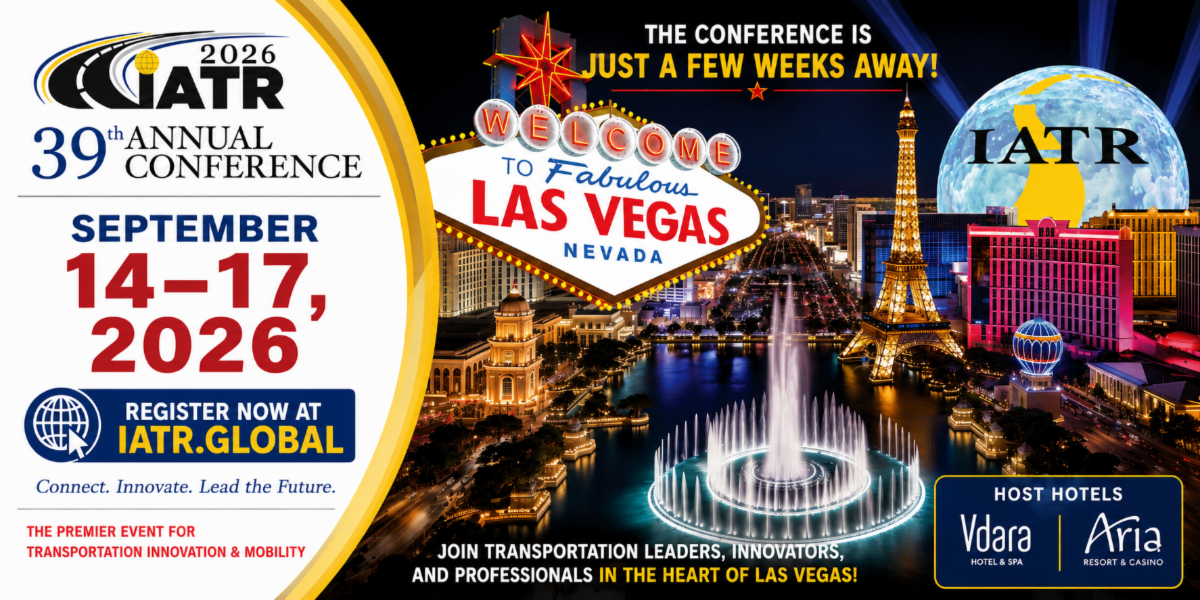
The IATR 39th Annual Conference begins next week at the Vdara Hotel in Las Vegas. This year's theme, "AV City: Autonomous Mobility," brings together transportation regulators, government leaders, industry and researchers to examine how regulation is evolving across automated, connected and electrified transportation.
Updated Conference Links:
Why this week's news matters for IATR
From NYC's accessibility requirements and British Columbia's driver screening rules to Singapore's AV regulatory sandbox and the UAE's autonomous-vehicle framework, this week's developments reinforce a central theme for transportation regulators:
The next generation of mobility will require regulators to connect accessibility, licensing, safety, data, liability, sustainability and market structure rather than regulating each technology in isolation.
|
|
EDITORIAL & LEGAL DISCLAIMER
This publication is provided by IATR for informational and professional discussion purposes only. It summarizes publicly available transportation, regulatory, legislative and industry developments and does not constitute legal advice, regulatory advice, or an endorsement by IATR of any company, technology, product, policy or position described.
Where legislation or regulatory proposals are discussed, the language is intended to distinguish proposed measures from enacted requirements. Readers should consult the relevant government agency, legislation, regulation or official proceeding for authoritative information.
IATR recommends independent legal or regulatory review before relying on information concerning active enforcement matters, litigation, procurement, licensing requirements or legal interpretations.
|
Message from IATR President

At the International Association of Transportation Regulators (IATR), our regulators are at the forefront of addressing both the challenges and opportunities facing the mobility paradigm. Our IATR members, partner organizations, and regulated industries will continue on our shared quest to fulfill the mission of our non-profit educational organization — to bring about Multi-Modal Mobility Innovation for All!
This mission can best be accomplished through information sharing, collaboration, identifying and promoting best practices, and educating our membership. These educational updates and electronic media clips are affectionately known as “IATR snips” and endeavor to cover all aspects of mobility around the globe — especially news and developments involving safety, technology innovation, multi-modal integration, automation, sustainability, electrification, accessibility, regulatory modernization, and equity.
If you would like more information about IATR, visit
www.iatr.global.
Current members can renew their memberships by logging in to the IATR portal or
clicking here.
For membership assistance, contact
info@iatr.global.
|
RENEW YOUR IATR MEMBERSHIP
- Weekly transportation and regulatory news snippets
- Access to the IATR membership database
- Conference videos, materials and resources
- Discounted rates for IATR conferences and programs
Renew your membership at
www.iatr.global
or email
info@iatr.global
with questions.
|
|
INTERNATIONAL ASSOCIATION OF TRANSPORTATION REGULATORS
|
|
|

.jpg)