|
Daily Transportation News
September 9, 2026
|

|
|
TNC REGULATION & DRIVER WORKFORCE
California Rideshare Driver Union Nears Certification as 30-Day Waiting Period Concludes
|
|
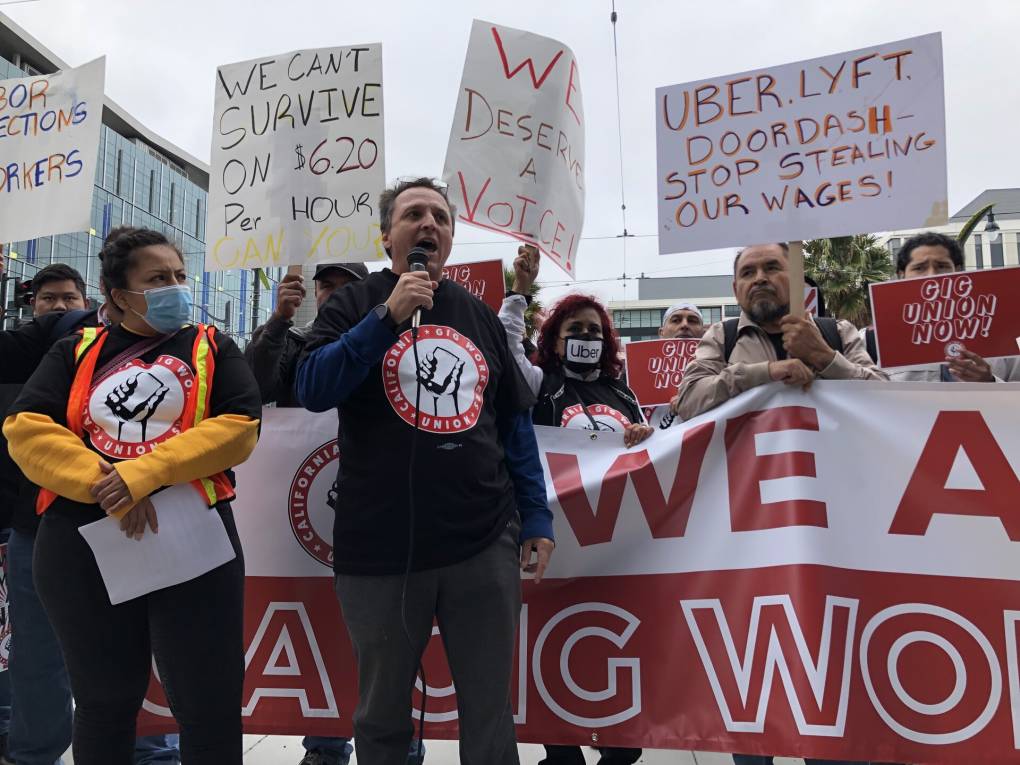
Uber and Lyft drivers in California have organized for collective bargaining rights. (Photo: KQED)
|
The California Gig Workers Union is nearing certification as the exclusive bargaining representative for roughly 800,000 Uber and Lyft drivers across California, with the statutory 30-day waiting period that began August 7 concluding this week. The California Public Employment Relations Board verified in August that the union, backed by SEIU, had secured support from at least 30 percent of active rideshare drivers statewide — the threshold required under Assembly Bill 1340, the 2025 law that gave California app-based rideshare drivers the right to unionize and bargain collectively.
Under AB 1340, drivers remain independent contractors. Rideshare companies would be required to negotiate in good faith with the certified union over pay, benefits and working conditions, and organizers have said they hope bargaining can begin by the end of the year. Uber dropped its opposition to the framework after a separate bill produced major insurance-requirement reforms, and Governor Gavin Newsom's office has celebrated the outcome as creating the world's largest union of gig drivers.
Certification could follow once the waiting period ends, unless another qualifying organization emerges — and no such challenge has been reported. Final certification had not been formally announced as of this report.
WHY IT MATTERS TO REGULATORS: California has created the first functioning collective-bargaining framework for TNC drivers in the United States without reclassifying them as employees. If bargaining produces negotiated pay, insurance and working-condition standards, those standards could increasingly substitute for rules that taxi and TNC regulators set themselves — reshaping driver-pay regulation, insurance requirements and enforcement in every jurisdiction where similar proposals are pending, including Massachusetts and Illinois.
Source: Los Angeles Times | Governor of California
Read the Los Angeles Times report on driver-union certification
Read the Governor's office statement on the gig-drivers union
|

|
AV OVERSIGHT & CURB DATA
Washington, D.C. Will Independently Monitor Robotaxis After Selecting Winner of AV Observation Zone Challenge

|
|
D.C. will pilot roadside cameras to independently observe how autonomous vehicles use its streets. (Photo: POPVILLE)
|
The District Department of Transportation, working with US Ignite and the Southwest Business Improvement District, has selected AIWaysion as the winner of the city's Autonomous Vehicle Observation (AVO) Zone Challenge. AIWaysion will deploy a roadside computer-vision platform to detect and track autonomous vehicles in Washington, giving policymakers independent analysis of AVs' drop-off locations, curb usage and traffic behaviors. The winner was selected for a $50,000 pilot contract, with deployment expected to begin in early 2027.
WHY IT MATTERS TO REGULATORS: As robotaxi fleets grow, regulators increasingly depend on operators' own data to know what the vehicles are doing. D.C. is building independent, city-owned observation instead — curb-level evidence on pick-ups, drop-offs and traffic behavior that can inform curb management, permit conditions and enforcement. For any jurisdiction weighing MDS-style data requirements, this is a working model of third-party AV monitoring.
Source: US Ignite | POPVILLE | Read the announcement on the AV Observation Zone Challenge winner | POPVILLE report
|
NEMT & MEDICAID TRANSPORTATION
Colorado NEMT Provider Shuts Down Over Medicaid Reimbursement Rates, Leaving Patients Scrambling

|
|
Transit-to-Care stopped providing rides after Medicaid reimbursement reductions. (Photo: KKTV 11 News)
|
Transit-to-Care, a non-emergency medical transportation provider serving the Pikes Peak region, ceased operations after state Medicaid reimbursement rate reductions left the company unable to cover its operating costs. All future rides were cancelled, forcing patients who depend on the service to find new transportation to medical appointments. Colorado's Department of Health Care Policy and Financing said more than 20 other NEMT providers serve El Paso County and expressed confidence in provider coverage.
WHY IT MATTERS TO REGULATORS: NEMT reliability is a healthcare-access issue as much as a transportation issue. Reimbursement levels set by healthcare agencies directly determine NEMT supply, and sudden provider exits fall hardest on patients with no alternatives. Regulators overseeing NEMT standards, brokerage arrangements and continuity-of-service requirements should watch how rate policy and transportation capacity interact.
Source: KKTV 11 News | Read the KKTV report on the NEMT shutdown
|
TRANSIT FUNDING & FEDERAL POLICY
Surface Transportation Extension Averts Shutdown but Leaves Transit Funding Gap
A continuing resolution signed September 2 — H.R. 6500, the Continuing Appropriations and Extensions Act, 2027 — extends federal surface transportation programs through December 11, 2026, averting a shutdown. But the stopgap lacks advance appropriations — according to Mass Transit Magazine's analysis, that leaves public transit funding about 20 percent below current levels and passenger rail funding 81 percent lower during the extension, with no guaranteed funding for passenger rail. House Speaker Mike Johnson has pledged to "wrap up" the five-year BUILD America 250 surface transportation reauthorization (H.R. 8870) by the end of the year.
WHY IT MATTERS TO REGULATORS: Transit agencies, paratransit operators and FTA-funded mobility programs plan capital projects around predictable federal funding. Short-term extensions without advance appropriations complicate fleet purchases, accessibility upgrades and state-of-good-repair work, and the December deadline sets up a compressed end-of-year negotiation that every transit regulator should be tracking.
Source: Mass Transit Magazine | Read the Mass Transit report on the surface transportation extension
|

|
PARATRANSIT & ACCESSIBILITY
Ottawa's Para Transpo Launches Late-Night Weekend Pilot

|
|
Para Transpo is extending weekend service until 2 a.m. under a one-year pilot. (Photo: CBC News)
|
Ottawa's Para Transpo, the city's door-to-door paratransit service for riders with disabilities, began a one-year pilot September 4 extending weekend service until 2 a.m. Saturdays and Sundays, with rural trips ending at 1:30 a.m. Late-night trips must currently be booked by phone the previous day, and the transit agency is working to add online booking. The extension responds to years of advocacy from Para Transpo users.
WHY IT MATTERS TO REGULATORS: Paratransit services are often bound by service-hour rules that leave riders excluded from evening employment, social and cultural life. Ottawa's pilot is a concrete example of how accessibility obligations can be expanded incrementally — with measurable ridership data — and raises recurring questions for regulators: booking lead times, digital access to reservations, and how paratransit hours compare with the fixed-route network.
Source: CBC News | Read the CBC report on the Para Transpo pilot
|
AIRPORT TAXI FARES
Charlottetown Airport Updates Taxi Fare Schedule for First Time in Over Four Years
The Charlottetown Airport Authority has published an updated taxi fare schedule for service to and from Charlottetown airport (YYG), effective November 1, 2026 — the first fare update in about four and a half years. The airport sets zone-based flat rates for taxi trips between the airport and destinations such as Charlottetown, Stratford and Cornwall, alongside per-kilometre rates for other destinations.
WHY IT MATTERS TO REGULATORS: Airport ground transportation pricing sits at the intersection of municipal fare regulation and airport authority control. The Charlottetown update is a reminder that many airports administer their own fare and access regimes for taxis — raising familiar questions for regulators about who sets airport fares, how increases are justified, and how airport taxi pricing stays coordinated with city-regulated taxi meters.
Source: Charlottetown Airport (YYG) | Read the YYG public notice on updated taxi fares
|
REGIONAL TRANSIT SERVICE
GO Transit Service Changes Take Effect as Metrolinx Cites Training and Recovery Needs
GO Transit, the Greater Toronto and Hamilton Area's regional rail and bus network, began reducing weekday service September 8 on the Lakeshore West, Barrie and Stouffville lines, with weekend changes following September 12. Metrolinx describes the adjustments as interim measures supporting crew training and certification, recovery from record ridership during the FIFA World Cup, and preparation for future service needs, and expects them to remain in place until spring 2027. Some cancelled trains will be supported by additional GO bus service.
WHY IT MATTERS TO REGULATORS: Service reductions on regional transit ripple directly into for-hire transportation demand — airport trips, first/last-mile connections and peak-period taxi and rideshare volumes all shift when rail frequency drops. The episode also illustrates how major events, workforce training pipelines and long-term service planning now interact in regional mobility decisions.
Source: now Toronto | Read the report on GO Transit service changes
|

|
AUTOMATED DRIVING & EU APPROVAL
Slovenia Clears Tesla's Supervised FSD, Becoming Sixth EU Country to Approve the System
Slovenia has authorized use of Tesla's FSD (Supervised) driver-assistance system on its roads, becoming the sixth EU member state to clear the camera-based system, with rollout to begin soon. The national approval comes ahead of an October 6 EU-level vote on the system's wider authorization, and reporting suggests a dispute over speed-assistance requirements could still determine the outcome of that vote.
WHY IT MATTERS TO REGULATORS: Slovenia illustrates the two-track structure of automated-driving oversight in Europe: individual member states can permit supervised systems nationally while EU-level type-approval decides whether the technology becomes standard across the single market. For taxi and for-hire regulators, broader FSD availability raises near-term questions about driver-attention requirements, licensing distinctions between assisted and automated driving, and how supervised systems are monitored.
Source: Reuters | Read the Reuters report on Slovenia's FSD approval
|
TAXI & PRIVATE-HIRE LICENSING
TfL Updates London Taxi and Private Hire Driver Policy, Targeting Repeat Non-Payers
Transport for London's updated Taxi and Private Hire Driver Policy (version 6.0, effective September 1) introduces dedicated provisions covering money owed to TfL by both licence applicants and existing licence holders. Under the new policy, unpaid debts to TfL are taken directly into account in licensing decisions, and a licence can be refused, suspended or revoked over money owed, with repeat non-payers specifically identified.
WHY IT MATTERS TO REGULATORS: TfL is linking regulatory compliance to financial obligations owed to the regulator itself — an approach other licensing authorities may consider. The update shows how licensing policies are being used as broader accountability tools, and raises practical questions about proportionality, appeal rights and how financial-compliance provisions interact with driver livelihoods.
Source: Transport for London | Read the TfL Taxi and PHV Driver Policy
|
MAAS & MULTIMODAL BOOKING
EU Rail Ticketing and Multimodal Booking Package Advances in Parliament
The European Commission defended its passenger package before the European Parliament's transport committee this month. The three proposed regulations — on multimodal booking, on rail ticketing for international journeys, and on passenger rights for single-ticket trips — would let travellers book cross-border journeys with one ticket, compare transport modes on a single platform, and know who is responsible when a journey fails. The largest booking platforms would face new fairness and neutral-ranking rules, and the Irish Presidency wants the Council to reach a general approach by the end of the year.
WHY IT MATTERS TO REGULATORS: If adopted, the package would create the first EU-wide framework for multimodal digital booking — the regulatory backbone of MaaS. Platform fairness rules, neutral ranking and single-ticket liability will matter to any jurisdiction regulating mobility apps, aggregators or integrated fare products, and the EU approach is likely to become a reference point internationally.
Source: European Commission | Read the European Commission announcement
|

|
RIDE-HAILING LICENSING
Hong Kong Opens Ride-Hailing Licence Applications with Strict Scale and Financial Requirements

|
|
Hong Kong's Transport Department is accepting ride-hailing platform licence applications through October 30. (Photo: HKSAR Government)
|
Hong Kong's Transport Department has invited platform companies to apply for ride-hailing service licences under the city's new regulatory regime, with applications open until noon on October 30. Licences run up to five years with an annual fee of HK$1.2 million, and applicants must be Hong Kong-registered companies with local offices, must have lawfully operated in a city of at least 7.5 million people, must have processed at least 100,000 daily orders in each of at least two cities, and must demonstrate substantial paid-up capital, bank deposits and credit facilities backed by three years of audited financial reports.
WHY IT MATTERS TO REGULATORS: Hong Kong has moved from prohibition to licensing in under a year, and its eligibility rules are effectively market-structure regulation: the scale, capital and operating-history thresholds will determine which platforms can compete at all. The regime is a detailed reference model for regulators designing platform licensing, financial-responsibility and enforcement frameworks — and for how taxi industries are compensated alongside ride-hailing liberalization.
Source: HKSAR Government | Read the Hong Kong government announcement on licence applications
|
FUEL PRICES & DRIVER ECONOMICS
Oil Above $100 a Barrel Puts Fuel Costs Back at the Center of Fare and Driver-Income Debates
Brent crude settled above $101 a barrel on September 9 — its highest close since May — after a sharp escalation of attacks on vessels near the Strait of Hormuz severely disrupted maritime traffic through the critical oil transit point. U.S. gasoline prices are now averaging about $4.22 per gallon, and diesel prices have reached record levels approaching $6 per gallon, intensifying cost pressure across taxi, livery, NEMT and delivery fleets.
WHY IT MATTERS TO REGULATORS: Fuel spikes flow directly into driver take-home pay and fare adequacy. Jurisdictions with fuel-surcharge mechanisms tied to pump prices should review whether their triggers apply, and regulators everywhere face renewed calls for fare reviews, temporary surcharges or lease-cap adjustments. Record diesel prices also raise operating costs for transit, paratransit and NEMT contractors — tightening the same service-continuity pressures highlighted across this edition.
Source: Yahoo Finance / Reuters | Read the report on Brent crude surpassing $100
|
AIRPORT GROUND TRANSPORT REFORM
Researchers Warn Lagos Airport Transport Reforms Could Raise Fares and Exclude Drivers
A new policy brief warns that efforts to modernize ground transportation at Lagos's Murtala Muhammed International Airport — including the airport authority's digital Airport Car Hire Rank Management System and vehicle-age requirements — could raise fares, squeeze traditional operators and threaten driver livelihoods unless regulators design a realistic transition pathway. The researchers acknowledge the reforms aim to improve safety, accountability and service quality, but caution that higher standards without affordable compliance routes shift costs onto drivers and eventually passengers.
WHY IT MATTERS TO REGULATORS: Airport ground transportation modernization — digital rank and dispatch systems, vehicle standards, platform exclusions — is a global trend, and Lagos is a cautionary case study in transition management. The brief's core warning applies anywhere: reforms that raise standards without a pathway for incumbent drivers risk converting a safety and quality agenda into an affordability and livelihood crisis.
Source: Guardian Nigeria | Read the Guardian Nigeria report on airport transport reforms
|
|
Tesla / NHTSA: Watch for next steps in NHTSA's audit query into Tesla's self-certification of Cybercab vehicles deployed in Austin — a defining test of AV self-certification.
EU Automated Driving: The October 6 EU-level vote on Tesla's FSD (Supervised) follows Slovenia's approval; a dispute over speed-assistance requirements could decide the outcome.
TNC Labor: Once California certifies the Gig Workers Union, watch the first bargaining sessions over driver pay, benefits and insurance — and similar frameworks advancing in Massachusetts and Illinois.
NYC TLC: Public hearings are upcoming September 17 on the proposed taxi improvement surcharge payment process and September 18 on proposed Vision Zero rules.
Hong Kong: Ride-hailing platform licence applications close October 30; watch which platforms meet the scale and financial thresholds.
UK: Right-to-work guidance changes take effect October 1; private hire operators and licensing authorities should review compliance obligations for subcontractor and gig-worker arrangements.
Singapore: The Land Transport and Related Matters (No. 2) Bill — covering AVs, point-to-point enforcement, EV charging and active mobility — moves to its next parliamentary stage in October.
|
Message from IATR President

At the International Association of Transportation Regulators (IATR), our regulators are at the forefront of addressing both the challenges and opportunities facing the mobility paradigm. Our IATR members, partner organizations, and regulated industries will continue on our shared quest to fulfill the mission of our non-profit educational organization - to bring about Multi-Modal Mobility Innovation for All! This mission can best be accomplished through information sharing, collaboration, identifying and promoting best practices, and educating our membership. These educational updates and electronic media clips are affectionately known as "IATR snips" and endeavor to cover all aspects of mobility around the globe - especially news and developments involving safety, technology innovation, multi-modal integration, automation, sustainability, electrification, accessibility, regulatory modernization, and equity.
If you would like more information about the IATR, you can visit our website at www.iatr.global. Current members can renew their memberships when you log in to your IATR portal on the top right-hand side of our website, or click here. If you forgot your membership password, please email us at info@iatr.global.
|
RENEW YOUR MEMBERSHIP FOR 2026
- Weekly news snippets
- Access to the membership database
- Videos and files from recent conferences
- Discounted rates for future conferences, and more!
Renew your membership at www.iatr.global or email info@iatr.global for any questions!
|
|
INTERNATIONAL ASSOCIATION OF TRANSPORTATION REGULATORS
|
|
|
