|
Back to the 16th century… Holland.
The originals were red, purple, black, yellow and white.
In medieval Europe they were used as sweeteners. In 1814, the celebrity chef of his day, Antoine Beauvilliers included ‘Gâteau de Carottes’ in his French cookbook, L'art du Cuisinier.
Yes, the good-old carrot.
HMG promoted carrots during World War II, with a bit of palaver about improving eyesight… you never see a rabbit wearing glasses… leading to a resurgence in carrot cake as a cheap, sweet treat…
… today no coffee shop is without a slice for six quid, and…
… the very English idiom… ‘not worth a carrot’…
… which neatly encapsulates what’s happening, now, with NHS leadership. The numbers of experienced managers bailing out is very worrying.
The job's not worth a carrot.
There's a recognised management and psychological phenomenon, that appears as a cluster of overlapping effects, all of which are amplified in big systems like the NHS, under intense political and operational stress.
There isn’t one canonical label but it aligns closely with what we can all see happening and with well-established concepts.
Role overload is often misunderstood. It’s not just ‘too much to do’, it’s too much to do without sufficient authority and time.
Role ambiguity, is the fog of the day-to-day. Unclear priorities, shifting goals, contradictory instructions.
Over time these create ‘learned uncertainty’.
People genuinely do not know what good looks like anymore… especially toxic in command-and-control systems like the NHS, where success is ill-defined and failure is punished, leading to…
Fear of Failure and a Blame Culture
This is well-documented in high risk systems like healthcare;
-
Retrospective scrutiny, like the CQC nonsense.
-
Media exposure and fairy-tail comm’s strategies from the top.
-
Political intervention, Streeting trying to look like a PM.
-
Personal accountability without system accountability and as a result…
… senior leaders internalise risk until inaction feels safer than action, or exit feels safer than staying.
This doesn’t flag weakness… it’s simple rational behaviour.
Goals are unachievable, resources are limited and timelines are politically driven. Highly capable leaders look in the mirror and say;
‘If I really knew what I was supposed to be doing, I’d be able to fix this.’
They feel they don’t and that creates shame, silence and withdrawal. Everyone stops learning.
We can borrow from military psychology… something called moral injury… when people know the right thing to do but are prevented from doing it…
... for instance being truthful about resolving budget shortfalls...
... as one genuinely fearful, senior leader wrote and said; they were obliged to deliver a 7% Cost Improvement Programme in 26/27 and a 3% productivity improvement on top....
... unprecedented and 'engendering massive safety issues'.
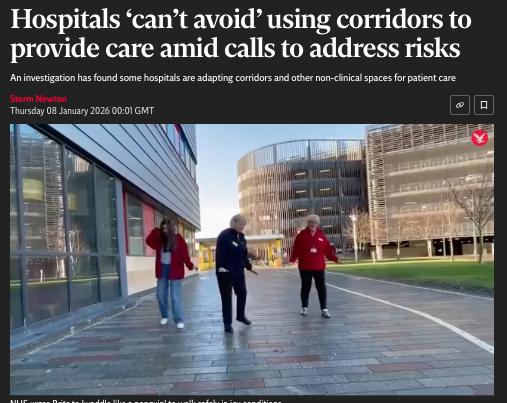
We hold them personally responsible for the consequences, so they produce fantasy spreadsheets, ignore the implications of cuts yet privately know the system for the most vulnerable, parked in corridors, is unsafe… which leads to the exit, or…
- Toxic accountability
- System-induced failure
- Complexity collapse...
... and we are left waiting for the next Mid-Staffs.
Research into what's called, High Reliability Organisations like the NHS, tells us; when leaders no longer believe the system is coherent, they leave.
Is it possible to work through it? Yes, but don't think individual resilience is the answer. That’s a basic error. Instead;
People need a small number of credible priorities with clear definitions of success. Explicit permission to stop doing some things.
Senior leaders rarely have safe spaces. They need peer groups of equals. The space to reflect and coaching focused on judgement, not performance.
Silence is the accelerant of failure.
It's important to separate system failure from personal failure. Reframing an unacceptable outcome not as a personal ‘fault’, preserves agency without denial.
Shift from control to what Karl Weick talks about in his book; Sensemaking...
'... in complex systems, leadership is about interpreting weak signals. That means being present… unearthing uncomfortable truths.
Slowing decisions down rather than speeding them up.
Stop rewarding decisiveness over judgement…'
...which drives fear.
One of the most powerful interventions is when senior leaders are allowed to say, publicly; ‘This is not deliverable’, ‘This risk cannot be mitigated’, ‘This timeline is political, not operational.’
-
Waiting list won’t be repaired by the election,
-
finances are unlikely to be honestly balanced.
-
The workforce is in a mess and will take five years and more to restore.
-
The ten year plan is incoherent and undeliverable.
-
There's no organagramme for the shape of the future.
-
The uncertainty and fear of redundancy is doing untold damage.
-
Social care is major problem that has to be fixed.
Without that permission, exit becomes the only honest option.
The NHS has stumbled into combining;
- High personal exposure
- Low control
- Moving targets
- Moral stress
- Public blame
… and is why experienced, reflective leaders leave first… because they understand the risks, best.
Less experienced leaders often stay longer because they haven’t yet learned when the system has become incoherent and...
... that is when the damage is done.
|