Dan Herschlag Receives 2026 BMS Award in Enzyme Chemistry and Chemical Biology
Dear Colleagues and Friends:
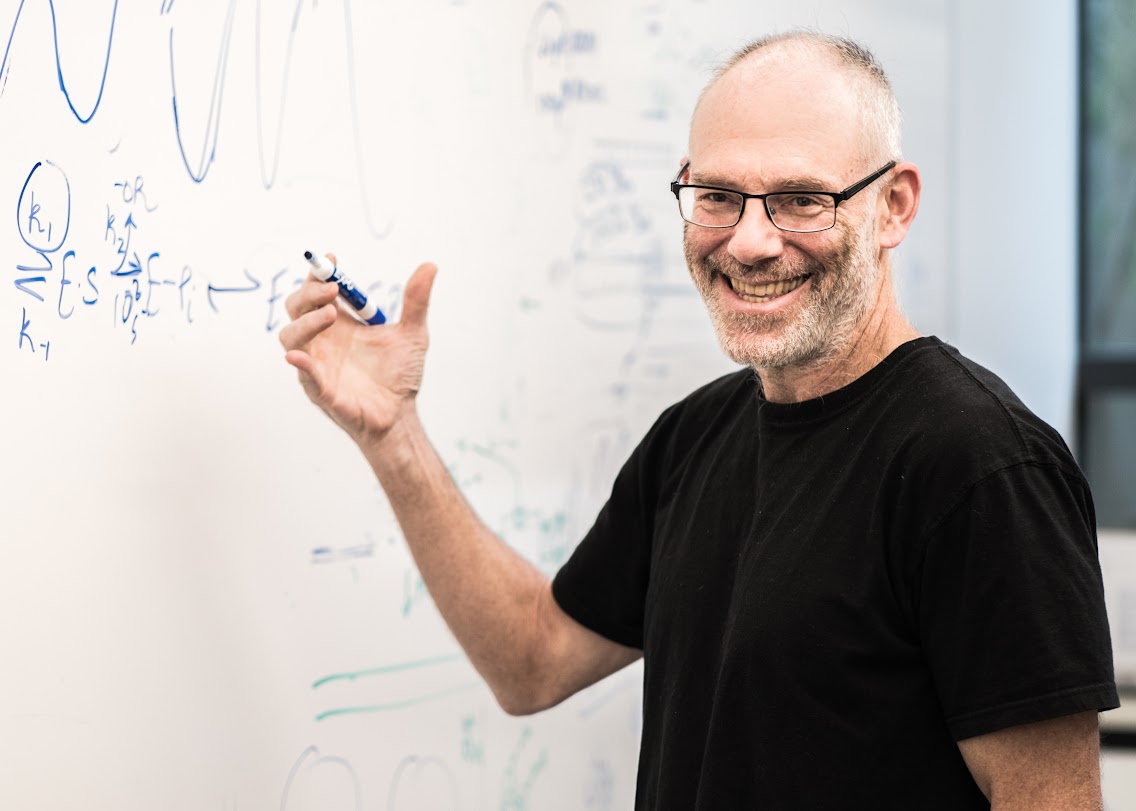
I am pleased to announce that Professor Daniel (Dan) Herschlag at Stanford University School of Medicine is the recipient of the 2026 Bristol Myers Squibb Award in Enzyme Chemistry and Chemical Biology from the ACS Division of Biochemistry and Chemical Biology. He is an outstanding scholar with feet in both the RNA and protein worlds. He was the first to bring quantitative thinking and analysis to RNA catalytic function while also having a transformative impact in the world of protein chemistry. His profound and ongoing contributions continue to redefine the frontiers of enzymology. The Division will host a symposium in his honor at the Spring 2027 ACS meeting. Stay tuned for more detail.
Many of Dan’s landmark contributions have been in ribozyme catalysis. Starting with work as a postdoc in Tom Cech’s and then continuing in his own lab at Stanford, Dan showed how approaches developed to probe protein enzyme reactions could be adapted to study RNA catalysis. He applied the concepts of physical organic chemistry and the methods of enzymology to the Tetrahymena ribozyme, the small “hammerhead” self-cleaving ribozyme, and “molecular chaperones” that enhance ribozyme catalysis and are involved in all aspects of RNA function. Although Dan’s work is highly quantitative, it also gives a qualitative understanding that is illuminating and memorable.
In the protein world, Dan introduced the groundbreaking concept of catalytic promiscuity, revealing that enzymes harbor latent activities toward alternative reactions and proposing its role in evolution and its potential for enzyme engineering. He also provided decisive evidence for long-hypothesized but poorly supported catalytic mechanisms, including ground state destabilization, the use of “intrinsic binding energy” from binding interactions and anion–π interactions to position catalytic groups without deactivating them and his in-depth analyses of hydrogen bonding have provided key insights into the physical and energetic properties of these ubiquitous interactions. Dan and his team pioneered an ensemble-function approach that systematically links conformational ensembles to free energy landscapes and catalytic efficiency. He recently built conformational models of serine protease catalysis based on more than 1000 structures of 17 serine protease to quantitate the catalytic contributions of specific active site features. This work provided the first quantitative, experimentally based model for the rate enhancements of enzymes.
Finally, Dan has had a profound impact as a mentor. One of the defining features of Dan’s laboratory is the amount of effort that he dedicates to the education of each of his graduate students and postdoctoral associates. He purposefully keeps his laboratory relatively small, making certain that nobody slips through the cracks and that each participant emerges as a potential leader in his or her chosen field.
Please join me in congratulating Professor Herschlag for receipt of this prestigious award.
Sincerely,
Pete Beal
Chair, Biochemistry and Chemical Biology, American Chemical Society
|