|
There are three things I like about France…
First, the wine. Particularly; Saint-Aubin 1er Cru ‘En Remilly’, 2018.
Second; President Macron’s sunglasses, and…
Third; the way they update their legislation. When French laws are changed, new law is integrated into the official ‘Code’.
Here, we create a layer cake, new stuff on top of the old. You have to search through years of old legislation to find-out what the current law means.
This complexity is important.
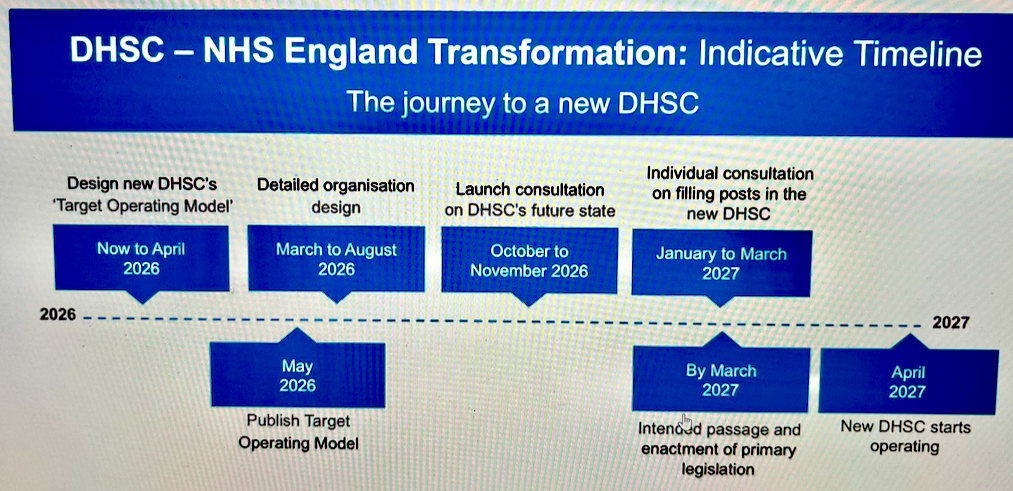
There’s a growing belief in Whitehall that the next NHS reorganisation can be legislated, scrutinised and implemented inside 300 (now 296) working days. (Timeline below)
Optimistic? No, implausible.
We’ve been here before.
The 1977 National Health Service Act; 280 pages, consolidated previous health service acts into a single framework.
The National Health Service and Community Care Act 1990. 106 pages, 67 sections across five parts and includes 10 detailed schedules.
The NHS Act 2006, was around 90 pages… essentially another consolidation.
The earthquake…
… The Health and Social Care Act 2012, Lansley’s-Lunacy. Nearly 400 pages of structural upheaval. Abolishing bodies, creating new ones, reallocating statutory duties and redrawing accountability lines…
… shockwaves through the system and the statute book.
The Health and Care Act 2022 added another layer on top. Fifteen months from White Paper to Royal Assent. It didn’t last.
Parliament subsequently had to amend the law again to accommodate the absorption of NHSDigital and Health Education England into NHSE.
Experience tells us something is important here.
Optimism is not a foundation for certainty and there is no certainty about any of this.
Reorganisation takes time and reorganisation of a previously reorganised system, takes more time.
Our legislative system is flexible. Unlike the codified systems in France, our existing laws are amended to accommodate change, but…
… Peers know from long experience that if awkward questions are not asked during the Bill stage, they return in the form of legal ambiguity, operational chaos and further legislation.
That’s why the Lords are forensic, patient and deeply sceptical of phrases such as ‘we’ll deal with this in guidance’.
For instance; dumping Healthwatch.
Milburn’s fingerprints are all over it. Twenty-odd years ago he dumped the Community Health Councils. This time, there’s no clear statutory replacement.
Optimistic? No, zealotry.
This is not a marginal change. It raises questions of accountability, access to a system that is paid for by the public, redress and independence from the Secretary of State.
I'm hearing, Ms Dash, et-al think complaints can be dealt with at provider level.
Optimism? No, idealism.
We know, Trusts get driven into cover-ups…
- Shrewsbury and Telford Hospital Maternity Scandal (2022)
- Mid Staffs
- Contaminated Blood
- Ombudsman reports of medical records altered or missing, to hide errors.
- Whistleblower Suppression
- Defensive Responses
- Prioritising reputation management
- Inadequate Investigations
Expect the smell of cordite from the trenches in the Lords.
We are working with a compost heap of the 1977 and 2006 Act, 2012 Act. The 2022 Act and hundreds of cross-references. The new, 2027 Act will have to unpick all that.
They might try using Henry VIII powers? A shortcut using secondary legislation (or Statutory Instruments) to alter, repeal, or amend existing law with less scrutiny. The device is becoming more common.
Optimism? No, cheating.
Parliamentary jiggery-pokery usually slows things down. Not speed them up. The Lords push-back against what they see as executive overreach.
Implementation? Passing legislation is not the same as making it work;
- Staff transfers; expect a battle when people realise civil service terms are nothing like NHSE terms.
- Budgets; plundered to pay VR this year, to come out of next year’s allocations.
- Accountability, Streeting’s desk in Whitehall will be overwhelmed, and …
… don’t forget the perennial problems of governance, complaints, performance oversight, with …
… everything up and running in 296 working days...
... whilst the Service is already operating at the limits of managerial and organisational capacity and half are leaving. We’re just not sure which half.
The HSJ reporting;
'Seven of the 16 posts on the joint NHSE/DHSC executive are now filled by interims, [and] Chief operating officer Tom Riordan, is due to leave the DHSC at the end of February.'
Optimism. No, it’s optimism-bias.
Well-documented in behavioural economics and project management research.
Daniel Kahneman’s book, Thinking Fast and Slow, is a must read. To paraphrase him;
‘The confidence that individuals have in their beliefs depends mostly on the quality of the story they can tell about what they’ve seen, even if they seen little.’
Leaders consistently…
… underestimate complexity, time and cost , and…
… overestimate their own ability to control outcomes, with predictable consequences.
Optimism wears heavy boots and is loud. When it kicks-around the pace of change and drowns the voice of the curious, it's dangerous.
|