Issue 656 - February 27, 2026

ARTICLES IN THIS EDITION


  • NEWS: Lawmakers Probe the Positive and Negative Impacts of Data Center Construction
  • NEWS: People Conceived with Donated Sperm, Eggs Would Have Access to Their Genetic Heritage Under New Proposal
  • NEWS: New Rules Potentially Impacting Homeowners and Businesses Remain Under Consideration
  • NEWS: Governor Issues Executive Order to Streamline Permitting
  • OPINION: The Road to Equity: Delaware's Property Reassessment Crisis

Lawmakers Probe the Positive and Negative Impacts of Data Center Construction


House and Senate energy committee members met in a joint session on Friday (2/27) afternoon to explore the effects of data center construction on jobs, the stability of the regional power grid, economic development, and the price of electricity for ratepayers in the First State.


The construction of data centers — structures that house large networks of servers, storage systems, and computing infrastructure — has risen dramatically in recent years with the rapid adoption of artificial intelligence (AI) technology. Such facilities are energy-intensive. There are at least five data centers that are under consideration in Delaware jurisdictions, the largest of which would consume 1.2 gigawatts of electricity, roughly about 25% more electricity than is used by all the homes in the state.


Dozens of additional data centers have been proposed in neighboring states.


The issue is not confined to Delaware or our region but is part of larger national and international trends. According to a 2024 U.S. Department of Energy report, the electricity consumption of U.S. data centers is currently growing...[at a] compound annual growth rate of approximately 7% from 2014 to 2018, increasing to 18% between 2018 and 2023, and then ranging from 13% to 27% between 2023 and 2028."


The report also cites other factors driving rising electricity demand, including the adoption of electric vehicles, increased domestic manufacturing, the move toward hydrogen production and utilization, and the electrification of industry and buildings.


Friday's joint hearing featured presentations by Reliability First, PJM Interconnection (the managers of the regional power grid), the General Assembly's Division of Legislative Services, the Delaware Division of the Public Advocate, and Glenn Davis (former director of the Virginia Department of Energy).


To access all of the material presented at the hearing, click here.


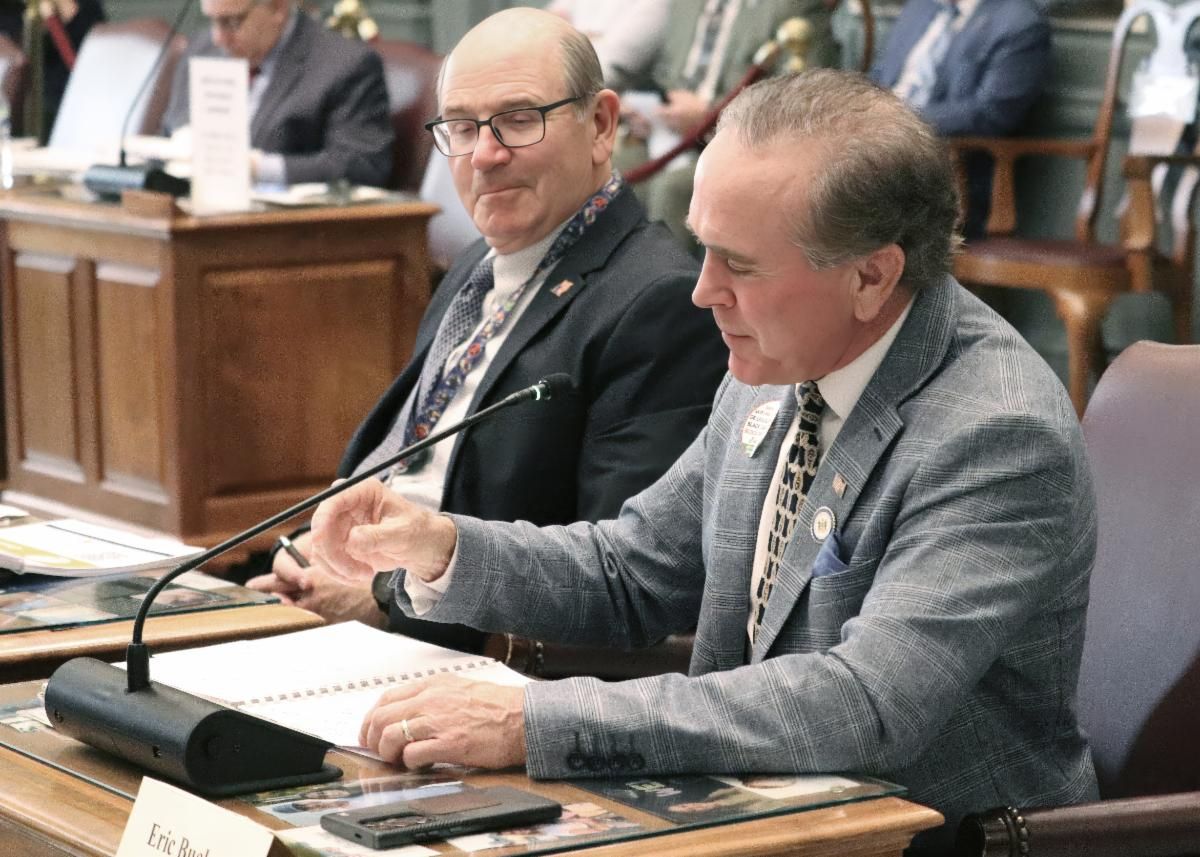
IN PHOTO, FROM LEFT: State Rep. Jeff Hilovsky and State Sen. Eric Buckson, both members of their chambers' energy committees, were active participants in Friday's hearing.

NEWS

People Conceived with Donated Sperm, Eggs Would Have Access to Their Genetic Heritage Under New Proposal


A new measure pending action in the State Senate seeks to reform Delaware’s parentage law by giving people conceived with donated sperm or eggs access to medical information and the identity of their donors.


Under Senate Bill 236, sponsored by State Sen. Dave Lawson (R--Marydel) and House Republican Leader Tim Dukes (R--Laurel), gamete banks and fertility clinics would be required to collect and maintain identifying information and nonidentifying medical history from gamete donors. Upon request, nonidentifying medical history must be made available to parents at any time. Additionally, upon turning 18, people conceived with donated genetic material would be able to access their medical histories and information identifying their donors.


Sen. Lawson said his bill reflects the growing use of assisted reproductive technology and the need for clarity in state law.


“As more families rely on assisted reproduction, it is critical that we provide a clear, consistent legal framework that respects both parents and children,” Sen. Lawson said. “This legislation makes clear that individuals conceived through these methods can obtain important medical history and, as adults, identifying information about their donor. That knowledge can be essential for medical, personal, and family reasons.”


The bill adopts portions of the 2017 updates to the Uniform Parentage Act, a model law developed to help states address evolving issues related to assisted reproduction in a consistent manner.


“This is a transparency issue at the most fundamental level,” Rep. Dukes said. “In an era where consumer testing like 23 and Me and AncestryDNA has become commonplace, we need to recognize that anonymous donations have already largely become a thing of the past. SB 236 is part of a growing ethical consensus that individuals conceived with donated genetic material have a right to know about the most personal information there is – the data encoded into every cell of their bodies.”


According to federal data, approximately 1.6% of babies born in the United States each year are conceived using assisted reproductive technology, a number that continues to grow.


The bill awaits the consideration of the Senate Health & Social Services Committee.

New Rules Potentially Impacting Homeowners and Businesses Remain Under Consideration


The Delaware Board of Electrical Examiners continues its consideration of new regulations on the installation of low-voltage wiring systems.


In a meeting notice issued at 5 PM on Friday, the board indicated its meeting on the morning of Wednesday, March 4, will include a "Low-Voltage Inspection Subcommittee Discussion."


Low-voltage wiring systems—typically under 50 volts—are used in nearly every structure in the state. They have a wide variety of applications, including telephone systems, sound systems, cable television, closed-circuit video, satellite dish antennas and receivers, HVAC thermostats, landscape lighting, data networks, fire alarms, and security systems.


Licensing requirements for low-voltage system technicians vary significantly across the nation. While some states have comprehensive statewide licensing, others leave regulation to local municipalities or exempt certain types of low-voltage work entirely. At present, Delaware does not require low-voltage technicians to be licensed.


The Delaware Board of Electrical Examiners first signaled its interest last year when a proposal to require all low-voltage installations to be performed by a licensed electrician appeared on its September meeting agenda. The meeting was canceled, and that proposal was ultimately dropped.


The owners of Delaware small businesses that install and maintain low-voltage systems question the need for new mandates, noting that imposing additional compliance costs will raise expenses and reduce the number of available workers. They also maintain that low-voltage, low-amperage systems typically pose little risk of shock or fire hazard and characterize any new industry regulations as a solution in search of a problem.


According to the National Fire Protection Association (NFPA), only 9% of home fires are caused by electrical issues, and the overwhelming share of these mishaps is attributable to the 110-volt and 220-volt AC services that supply power to nearly all residential appliances.


If you would like more information about Wednesday's Delaware Board of Electrical Examiners meeting, including the agenda and how to participate in person or online, please click here.

Governor Issues Executive Order to Streamline Permitting

Governor Matt Meyer signed an executive order on Thursday to streamline permitting regulations for certain targeted projects.


“For too long, Delawareans have watched essential projects get stuck in red tape that can stretch on for years, driving up costs and stifling progress,” Gov. Meyer said.


As stated in a news release issued by the governor's office, "Delaware’s permitting and regulatory review processes play a critical role in delivering housing, energy, transportation, broadband, and water infrastructure. In recent years, however, state permitting timelines have often stretched 18–24 months or longer, increasing project costs, discouraging private investment, constraining housing supply, and slowing delivery of essential infrastructure. These delays have placed Delaware at a competitive disadvantage relative to neighboring states with more predictable and coordinated review processes."


Executive Order 18 is intended to achieve the following goals:


  • Accelerate delivery of priority infrastructure—housing, energy, broadband, water/sewer, and mixed-use development—through coordinated and parallel permitting. 


  • Reduce uncertainty and delays by establishing clear timelines, agency points of contact, accountability mechanisms, and escalation procedures. 


  • Support smart growth by prioritizing infill, growth-area, and infrastructure-ready development rather than greenfield sprawl. 


  • Preserve statutory authority and protections, ensuring full compliance with Delaware law. 


  • Improve transparency and performance tracking through public dashboards, reporting requirements, and measurable metrics. 


State House Republican Whip Jeff Spiegelman (R-Townsend, Smyrna, Clayton--in photo), who works in the commercial real estate industry, said he was cautiously optimistic about the announcement.


“House and Senate Republicans, and the state’s business leaders, have consistently advocated for streamlining the permitting process and reducing the regulatory burdens on the business community, which have needlessly delayed projects and placed us at a considerable disadvantage when competing with other states," he said. "I’ve personally seen Delaware lose job-creation opportunities because of bureaucratic hurdles standing in the way of people willing to invest here.


"I see the governor’s action as a promising first step, but the proof of this initiative will not be in its good intentions but in its successful execution," Rep. Spiegelman continued. "That’s going to require more than an executive order. While the 14 members of the House Republican Caucus will do whatever we can to facilitate this effort, I urge any businessperson with a project potentially covered by the initiative to reach out to the governor's office with any concerns they may have."

OPINION

For the first time in over 40 years, Delaware underwent a comprehensive statewide property reassessment. This process has understandably caused "sticker shock" and frustration for many. It is essential to clarify that this was not a simple policy choice, but a court-mandated necessity, centered on equitable education funding. The Delaware General Assembly held five meetings at the end of 2025 exploring the recent property reassessment process. The question is, did reassessment achieve this goal?

In January 2018, the lawsuit Delawareans for Educational Opportunity (DEO) v. Carney was filed. The lawsuit argued that outdated property valuations violated the True Value Statute and the Uniformity Clause of the Delaware Constitution, effectively creating an unconstitutional funding system for our children. In May 2020, the Court of Chancery agreed, ruling that all three counties must conduct a statewide reassessment to reflect current market values. Before this lawsuit, reassessments were carried out in the 1970s and 1980s—Sussex County had not reassessed since 1974, New Castle since 1983, and Kent since 1987.


Following the court mandate, the counties initiated a competitive RFP (Request for Proposal) process. In June 2021, all three counties signed contracts with Tyler Technologies to perform the massive undertaking of reviewing hundreds of thousands of parcels. Field inspections began shortly after, with Kent County moving on an accelerated track. Kent County sent tax bills with the new property values in 2024, and New Castle and Sussex County followed in 2025.


For New Castle County, reassessment was met with public outcry and concerns from local jurisdictions. With New Castle County being the only County to elect the top official, County Executive, and the last stages of the reassessment process occurring during the election cycle, this contributed to the confusion the property owners experienced. The most noticeable concern was the decision to mail the tentative property valuations AFTER the November 2024 elections. The next concern was that the County did not have sufficient staff to handle the number of appeals filed by residents. As of October 2025, 3,900 of the 5,200 formal appeals filed were still pending. This left many property owners unclear on their tax obligations when bills were mailed at the end of November. (As of this week, NCC states that slightly over 2,500 appeals remain pending.)


There is a need to remove the potential for politics during the reassessment process and ensure that all key players are in communication throughout the process. This might be resolved by having the State negotiate the RFP and establish a standard contract with a consistent scope of work and timelines for all three Counties.


The Starting Line, Not the Finish: Confronting Delaware’s School Funding Crisis


This statewide reassessment, mandated by the 2020 court ruling that found our outdated 1970s and 80s data unconstitutional, was designed to restore fairness. However, the process has revealed deep-seated inequities in how we fund our schools—inequities that reassessment alone did not solve.

To understand the "sticker shock" many are experiencing, we must look at how Delaware funds education. Roughly 29% of our school revenue comes from a “local share” of property taxes. While state funding covers about 53% of the pie, the local share is where the disparity is most visible. In New Castle County, the local share is responsible for 81% of your county property tax bill.


The state allocates its share of funding through the unit count system. This historical model funds "Division 1" teacher positions based on enrollment units. While it provides a baseline, the system has faced criticism for inadvertently sending more resources to wealthier districts, as experienced teachers migrate to areas where local property wealth can support higher salaries. Approximately 15 years ago, the state began piloting needs-based funding to account for different student populations, but the underlying enrollment factors for the general tax pool have remained frozen since 2012 due to a lack of consensus on reform. Governor Meyer has included funding for an overhaul of public education funding in his FY 2027 proposed budget.


More troubling is the reality that even with updated property values, lower-income districts’ taxes are still increasing, and the gap with wealthier districts continues to expand. During the December reassessment meeting, Monet Smith, President of Delaware Association of School Business Officials, stated, "Reassessment only increased the wealth disparity between districts”. Taylor Hawk, Director of Legislative and Political Strategy for Delaware State Education Association, noted that the existing system "has forced poorer communities to over-tax themselves to provide something close to the same level of service as wealthier districts."


Reassessment alone has not solved the education equality issue. The State’s portion of education funding needs modernization, bringing it into the 21st Century.


Beyond Reassessment: Addressing Safety and Standards in Delaware Schools


While fixing our broken funding formula is a constitutional necessity, funding is just the tip of the iceberg regarding the challenges facing Delaware’s education system. We have established that property reassessment—mandated by the Delawareans for Educational Opportunity v. Carney lawsuit—was only the "starting line" for fiscal equity. However, the structural inequities revealed by this process, such as the fact that “reassessment only increased the wealth disparity between districts,” directly impact the quality of the classroom experience.


During an education town hall in February 2026, I was joined by Rep. Kim Williams, Delaware Department of Education Secretary Cynthia Marten, Red Clay Superintendent Dr. Dorrell Green, Red Clay School Board President Victor Leonard, and Matt Denn, Co-Chair of the Redding Consortium for Educational Equity. Our goal was to listen to Delaware residents and hear their direct concerns regarding the state of education today.


The attendees brought forward urgent concerns that go beyond tax rates and property values: school safety for both teachers and students, low performance standards, the need for better identification of learning disabilities, and an inadequate curriculum. While the General Assembly has taken steps to address some of these issues through recent legislation--such as HB 69 regarding reading screeners and SB 106 concerning cell phone use in schools--it is clear that more aggressive action is required.


One of the most pressing issues raised was school safety. DOE Secretary Marten summarized the crisis perfectly when she stated that Delaware does not have a “teacher leaving the profession issue” but a “teacher leaving the working conditions issue.” This sentiment echoes the testimony heard during the reassessment meetings, where experts noted that lower property wealth districts fall further behind because they lack the resources to maintain competitive and safe environments.


While work has progressed on student safety through the implementation of School Resource Officers (SROs) and Constables for willing schools, we must also protect our educators. In the coming month, I intend to release legislation addressing a Teacher Bill of Rights and a “We’ve Got Your Back Act.” The “We’ve Got Your Back Act” would make it a class C felony to recklessly or intentionally cause physical injury to an employee, contractor, or subcontractor of a district, charter, or private school while they are performing their duties. We can’t have discipline without accountability. Our students and teachers deserve high-quality learning environments.


As we work to modernize our 21st-century education funding and resolve the lingering confusion from the New Castle County reassessment appeals, we cannot lose sight of the people inside the buildings. I look forward to continuing my collaboration with colleagues to address the intersection of reassessment, equity in education, school funding, and safety. Our children are our future, and they deserve the best that Delaware can provide to ensure their success.