|
Deaconess Community,
Voting is the linchpin of our democracy. But as the nation nears its 250th birthday, it is appropriate to question not only the strength of the franchise, but whether we are now living in an illusion of democracy itself.
To assess democracy in this moment without the benefit of a spiritual gaze is to become discouraged.
Last month, the U.S. Supreme Court, in Louisiana v. Callais, struck down Louisiana’s former congressional map that provided two majority-Black districts which were necessary given Black population growth in the state. The ruling did not merely reshape one state’s congressional map. It sent a signal to legislatures across the country that racial vote dilution can once again hide beneath the language of partisan advantage. The decision further weakened Section 2 of the landmark Voting Rights Act (VRA) of 1965.
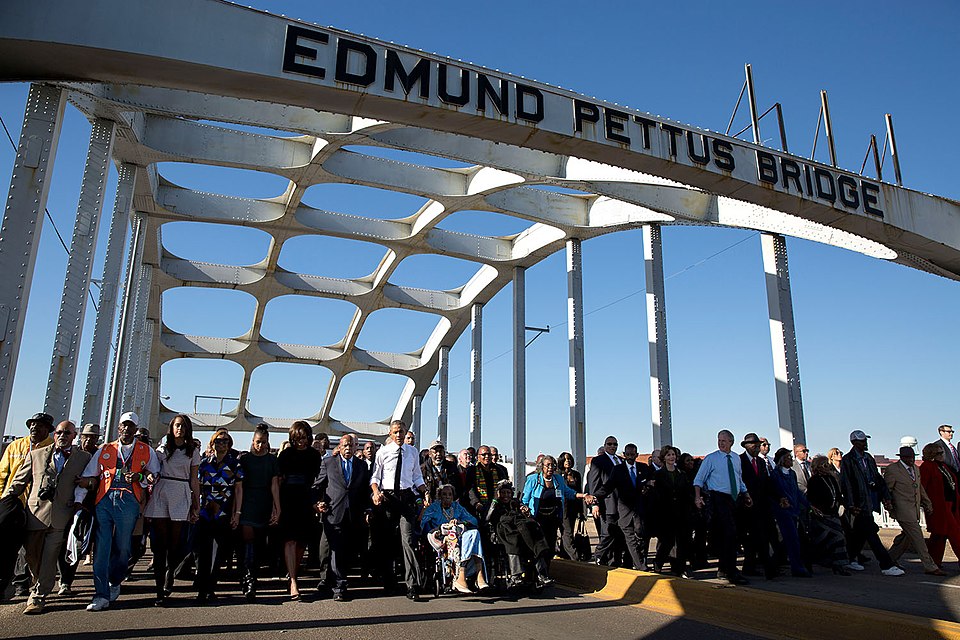
In pursuit of the right to vote, the Honorable John Lewis, Hosea Williams and others marched across the Edmund Pettus Bridge in Selma, Alabama in 1965. They faced brutal retaliation that included beatings, fire hoses, and vicious attacks from dogs. The nation watched in horror. Some finally understood the pain that stalked Black bodies in a nation that espoused freedom and liberty for all.
To understand Louisiana v. Callais, you must also understand Shelby v. Holder. The assault on voting rights did not begin this spring. It did not even begin with the Supreme Court’s 2013 decision gutting Sections 4 and 5 of the VRA, which required federal preclearance of voting changes in states with histories of discrimination. These decisions are part of a broader effort to dilute the political power of Black Americans and other communities whose growing influence threatens entrenched power structures.
Even before Shelby, voting rights were undermined through restrictive voter ID laws, intimidation at the polls, insufficient polling place resources, and other suppression schemes. From slavery to Reconstruction to Jim Crow to the Southern Strategy, one tactic after another was deployed to deny and abridge the right to vote.
All of this was motivated by racial animus. And here we are again. None of us are insulated from this moment.
Recently, the Missouri Supreme Court upheld the state’s gerrymandered congressional map, allowing it to likely take effect for the midterms. The map was intentionally designed to target the Kansas City-area seat held by Congressman Emanuel Cleaver, a longtime Democratic member of Congress and former chair of the Congressional Black Caucus. The newly drawn map is expected to shift Missouri’s congressional delegation from a 6-2 Republican advantage to a likely 7-1 advantage by fracturing Democratic voting strength in Kansas City.
At the same time, the court ruled against voting rights advocates who filed a referendum petition to suspend implementation and place the map before Missouri voters. A coalition gathered signatures in an effort to challenge the map through Missouri’s constitutional referendum process, arguing that voters not legislators should ultimately decide whether such aggressive gerrymandering should stand. But the Missouri Supreme Court determined that the filing of the referendum petition did not automatically suspend implementation of the map, therefore the newly drawn districts will likely be used in upcoming elections even while legal and administrative disputes continue.
Each of these events reveals a deeper democratic crisis unfolding not only in Louisiana and Missouri, but across the country. Legislators are engineering district lines to predetermine political outcomes, they are diluting Black political representation despite population growth, and maps are taking effect before voters have a meaningful opportunity to challenge them. It is all quickly becoming an illusion of democracy where elections still occur, but representation itself is increasingly manipulated and decided long before ballots are cast.
There is no question this moment is a bitter blow, but history also reminds us that there has never been a period in this nation where voting rights enjoyed broad, uncontested support. Black people have always had to organize, litigate, mobilize and sacrifice to protect the franchise.
I am not naïve. But I am also not without hope.
What lies before us cannot simply be a return to the pre-Shelby status quo. Even at its height, the Voting Rights Act did not fully protect Black political power from dilution and backlash. The future must be larger than restoration.
Congress has to restore and modernize the Voting Rights Act with protections responsive to contemporary suppression tactics. Federal legislation alone will not be enough. States have to fully lean into the power granted to states and adopt their own Voting Rights Acts, establish independent citizen-led redistricting commissions, expand early voting, implement automatic and same-day voter registration, restore voting rights for formerly incarcerated citizens and create enforceable standards for equitable ballot access.
The next era of voting rights work must be both defensive and imaginative. We must build a democracy robust enough to withstand demographic change, racial backlash and authoritarian impulses.
History reminds us that every major expansion of democracy in this nation was once dismissed as unrealistic. And yet people organized anyway.
The right to vote has never been secured because powerful institutions voluntarily surrendered power. It has been secured because ordinary people insisted that democracy become more honest than the nation was willing to be.
|