|
Dear Friends,
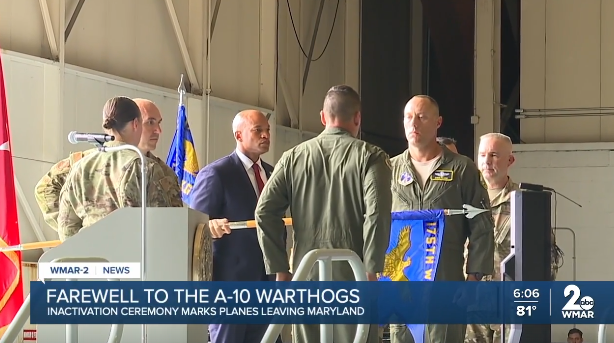
Tuesday, September 23rd, marks the end of an era in Maryland. The Maryland Air National Guard deactivated its last flying squadron and the supporting units that have safeguarded our state and nation for more than a century.
This legacy began in 1921, when the Maryland National Guard became the first Guard unit in the nation to receive airplanes after World War I. At that time, the 104th Observation Squadron was created, flying Curtis JN-4 “Jennies” bi-planes. Since then, a multitude of aircraft have taken off from its runways; such as the Curtiss “Jenny” biplane, the legendary P-51 Mustang, F-86 Sabre, SA-16 Albatross Seaplane, the C-130 Hercules, C-27 Spartan and, most recently, the A-10 Thunderbolt or as we call it, the “Warthog”. Each aircraft carried with its own piece of history, but it was never just about the planes.
What has always made the Maryland Air National Guard truly extraordinary are the men and women who raised their right hand, swore an oath, and wore the uniform with honor to protect and defend. Balancing civilian lives with military service, they stood watch over their communities, their state, and their country with skill and sacrifice. Both the Operational and Maintenance Squadrons have ensured these aircraft remain airworthy, mission-ready, and prepared to deploy whenever called upon. Many members followed in the footsteps of parents and grandparents, continuing a tradition of service that runs deep in Maryland families—just as I once served in the 135th Airlift Squadron, just like my father did before me.
Their story is written not only in Maryland’s history books, but in the very fabric of our communities, like Reckord Road here in Harford County, named after Maryland Guard’s Major General Milton Reckord. Their reach extended far beyond state lines, answering the call in nearly every major conflict and disaster for more than 100 years. Whether delivering lifesaving supplies after Hurricane Katrina or providing close-air support in Iraq and Afghanistan to our allied ground forces, they were always there, ready to protect, ready to serve.
When the last two A-10s of the 104th Fighter Squadron take off from Martin State’s runway for the final time, they will close a chapter that began, poetically, 104 years after it started. With their departure, Maryland will join the short list of states without a flying mission. Sadly, this also brings us one step closer to the final chapter of the A-10, a story that began right here in Maryland, where it was built in the Hagerstown factory. For countless troops on the battlefield, there was no more reassuring sight in the sky than the A-10, delivering the close air support they depended on for protection that no other aircraft could provide.
For many of us, this moment brings back memories of 13 years ago, when Maryland National Guard's other flying squadron, the 135th Airlift Squadron was deactivated. At that time, I shared a quote from Dr. Seuss that feels just as fitting today: “Don’t cry because it’s over, smile because it happened.”
Let us honor the missions completed, the bonds formed, and the protection provided by these Airmen. Memories and legacies that will endure long after the hangers grow silent.
To every Airman, past and present: thank you. Thank you for your courage, your commitment, and your service. Your watch in the skies overhead may be ending, but your legacy of protection will never be forgotten.
| | |
Maryland Air National Guard's 175th Deactivation Ceremony:
A Commemoration of Service of Maryland's A-10s
| | |
Developmental Disabilities Advocacy:
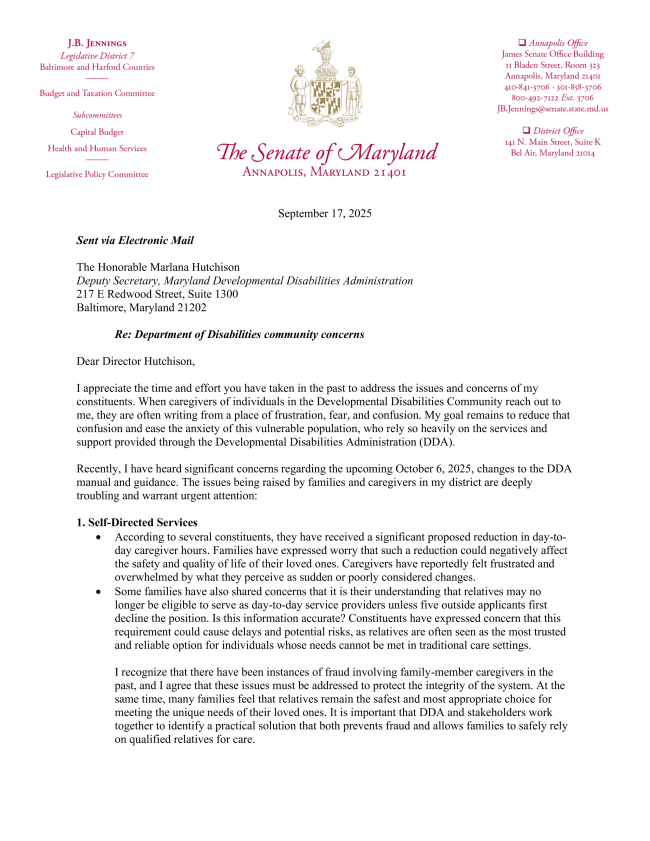
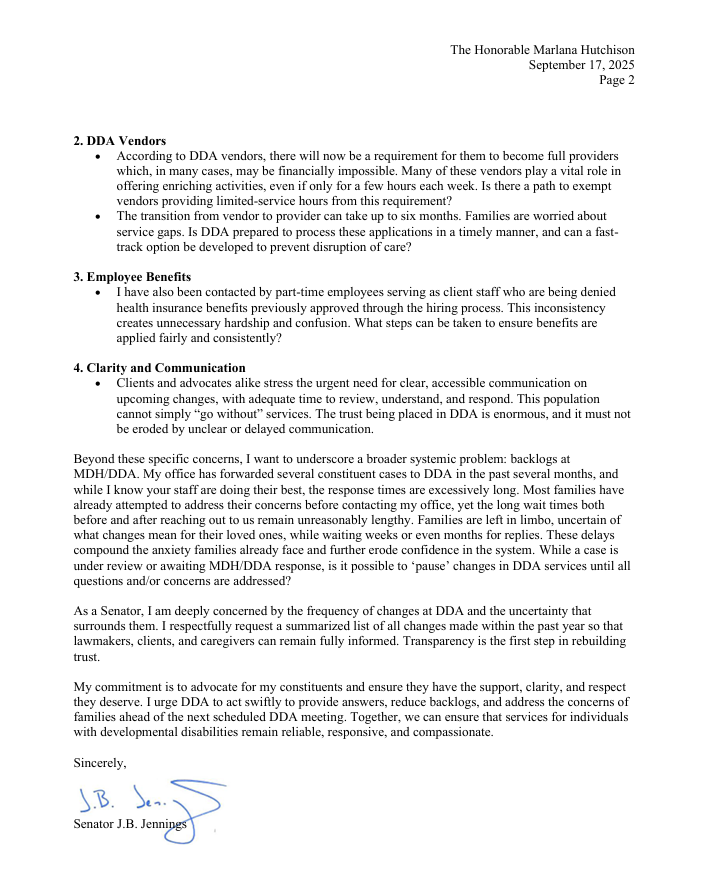
There is an upcoming manual change scheduled for October 6, 2025, for the Developmental Disabilities Administration (DDA) guidance. Recently, an advocacy group reached out to share concerns, prompting me, along with my colleagues Senator Guy Guzzone, Senator Craig Zucker, and Senator Shelly Hettleman, to engage on this issue.
On September 17th, I sent a letter to the Deputy Secretary for the Developmental Disabilities Administration outlining the concerns raised during that call. While I received confirmation that my letter was received, I have not yet received a response. Encouragingly, a local advocate informed me that, following our outreach, some health care reimbursement concerns were resolved this week.
I rely on community input to hold our state partners accountable and to ensure programs and services deliver on their promises. Your feedback is essential in helping me identify when systems fall short and need attention.
Below is the letter I sent to Director Hutchinson of the DDA:
| | |
Maryland Small Business:
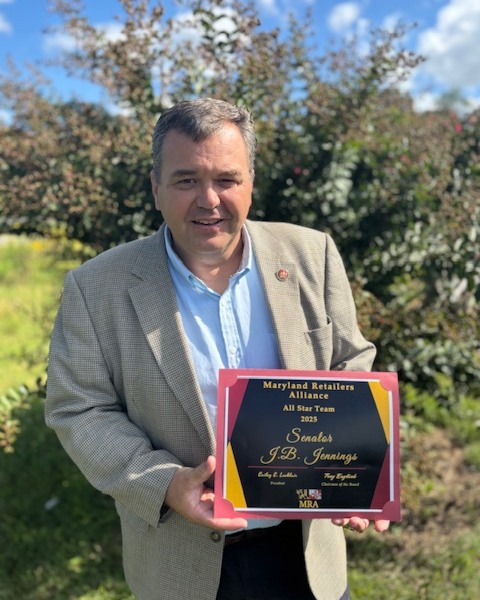
This month, I was humbled to be named to the Maryland Retailers Alliance All Star Team, an unexpected honor for which I’m truly grateful.
Small businesses showcase the strength, generosity, and talent of Marylanders, while creating opportunity and growth in our communities. As a small business owner myself, I’ve seen firsthand how keeping business local builds stronger neighborhoods and a healthier economy.
I grew up in my grandfather’s transmission shop, where I learned both the value of community and the sacrifices that come with running a family business. From meeting people broken down on the side of the road to weathering the difficult early years, those experiences shaped my respect for the resilience of small business owners.
That’s why I’ll keep fighting for Maryland’s economy, supporting commerce and growth without raising taxes on families who are already struggling. Over the last three years, many have voiced real concerns about the burdens being placed on small businesses, and I hear them loud and clear.
For those looking to start or grow a business, resources like Maryland One Stop, as well as programs in Harford and Baltimore Counties, provide valuable tools and support to help businesses thrive.
| | |
Governor Moore hosted a press release this week, updating constituents on the roughly $40 in savings per month on energy. The savings applies to all households and is dependent on usage from the February 2024-March 2025.
As a member of the Maryland Senate Republican Caucus, our message is clear: Marylanders deserve better. We need structural reforms that secure reliable in-state energy generation and a comprehensive approach to managing utility rates, not piecemeal policies that leave households struggling.
Senate Minority Leader, Senator Steve Hershey, said "Governor Moore isn’t giving out relief — he’s just recycling ratepayer money Maryland families already paid on their utility bills. Instead of fixing the failed policies that caused rates to skyrocket in the first place, Democrats are raiding the Strategic Energy Investment Fund as a short-term political gimmick. Every dollar in that fund came from ratepayers, and it should be returned to all of them, not just handed out in a one-off program so the Governor can score headlines."
We need long-term solutions to address the ongoing rise in energy costs, not short-term fixes like small rebates. Marylanders are already burdened by record-high PJM costs, multi-year rate hikes, and EmPOWER fees that add up to hundreds of dollars each year. These rising expenses have placed a heavy strain on families. At the same time, Maryland’s restrictive policies on coal and overly rigid green mandates have only added to the problem.
| | Solar Farms and Senate Bill 931 - Renewable Energy Certainty Act | |
|
Representatives from Baltimore County and Harford County are raising concerns about the impact of state policies on rural communities and long-standing local land use plans. Many are speaking out against Senate Bill 931/House Bill 1036, the “Renewable Energy Certainty Act,” which I opposed. This law removes counties’ ability to control the location of large-scale solar projects.
As a result, Harford County was forced to allow 5,500 acres of prime farmland to be converted into solar farms without meaningful local input. County Executive Cassilly warned this “pits food security against green energy.” Critics have also questioned the long-term viability of these projects, including the environmental impact of decommissioning solar panels at the end of their life cycle.
Farming is a way of life in Baltimore and Harford Counties, and across Maryland’s rural communities. As a former 4-H member, I learned early the importance of working the land, caring for animals, and supporting local agricultural hubs through farmers markets, education programs, and other community services. With nearly 40% of farmland no longer owner-occupied, high-dollar solar leases are accelerating the loss of active farms. Our farmland is finite, and it is our responsibility to protect these rural communities.
I will continue to support opportunities to undo the damage from Senate Bill 931. Restoring local land use authority, safeguarding farmland, and directing solar development to redevelopment areas or less-viable soils is essential to protecting our communities while responsibly advancing renewable energy.
During the 447th Legislative Session, I read dozens of emails from constituents who raised valid concerns about Senate Bill 931, and responded in March, that "I’m opposed to SB 931 because it does not take into account the members of the local community, or long-term planning involved. I feel that at this time, we are not in a dire situation where we need this to survive, and Marylanders are being forced to sacrifice enough at the moment."
Prior to the hearing for Senate Bill 931 in Education, Energy and Environment, I stated my concerns, indicating that should this legislation pass, "a hearing can be conducted within the county where generation stations, overhead transmission lines, or qualified generator lead line is proposed to be located, but does not require the State to yield to the needs and desires of the community and enables the State to abandon well-developed plans, thus disrupting the local economy, creating tension within local and state relationships and disregarding plans that zoning and regulatory committees have worked tirelessly to create for the community." I further spoke to the topic in my End of Session Newsletter, the final weekly update from Annapolis, when I stated:
I opposed Senate Bill 931 - Public Utilities - Generating Stations - Generation and Siting (Renewable Energy Certainty Act), which gives the PSC sweeping authority to approve large-scale solar projects. While the bill includes new standards for solar siting, certification, and workforce licensing, it comes at the cost of local input and threatens farmland and long-established land use plans. Marylanders deserve energy policies that respect their wallets and their communities, not one-size-fits-all mandates from Annapolis.
One bill I supported was Senate Bill 189 - Eminent Domain – Agricultural and Conservation Easements – Prohibited Taking, which would have given local authorities more input without interfering with existing plans. Unfortunately, the bill did not pass out of the Senate Education, Energy, and the Environment Committee (I do not serve on this Committee). Looking ahead, Maryland Senate Republicans plan to introduce legislation in the upcoming session to address our concerns regarding energy.
| | | | |
More Information on Days Cove Rubble Landfill:
Last week, I joined a packed crowd at the Perry Hall Library where community members gathered to discuss the permit proposed by Days Cove Rubble Landfill. I spoke firmly against this permit, citing concerns about responsibility, environmental risks, and public health impacts. I was proud to stand alongside my colleagues, Delegates Szeliga and Nawrocki, and Baltimore County Councilman Marks, as well as many constituents who share these concerns.
The landfill, located in White Marsh next to the Eastern Sanitary Landfill, is one of the three landfills already concentrated in Eastern Baltimore County along our waterways. Alarmingly, the permit request has now doubled, from 12,500 gallons of leachate to 25,000. This leachate would discharge into a swale leading to the Gunpowder River via Gunpowder Falls (Use II). Additionally, with the looming closure of the Wheelabrator incinerator, I am deeply concerned that our community could become a future dumping ground for Baltimore City.
In my letter to the Maryland Department of the Environment (MDE), I made my opposition clear, citing the company’s troubling history of violations. I also outlined three critical requests that reflect the concerns of our community:
- A comprehensive, independent environmental review that fully examines risks and evaluates alternatives.
- Genuine consideration of non-discharge solutions, such as off-site hauling or advanced treatment systems.
- A transparent, detailed plan from MDE explaining how nearby well users and the surrounding watershed will be safeguarded.
I am especially grateful to the Gunpowder Riverkeepers, Gunpowder Valley Conservancy, and the many community leaders across Harford and Baltimore Counties who continue to lead grassroots efforts and advocate on behalf of our residents and natural resources.
During the hearing, MDE extended the public comment period until October 22nd. I strongly encourage you to share your testimony, whether it’s a detailed letter, a short paragraph, or even a single sentence, by emailing paul.hlavinka@maryland.gov.
Together, we must stand firm to protect our community and the Chesapeake Bay from this harmful proposal.
| | | | |
Perry Hall is Celebrating 250 Years!
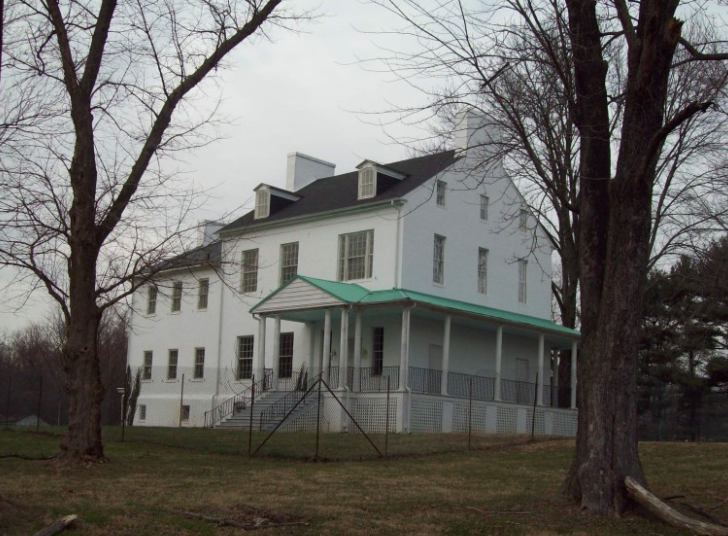
I was proud to take part in Perry Hall’s 250th Anniversary celebration by providing a letter to be placed into the community time capsule. What began in the 1700s as a 1,000-acre estate has grown into a thriving community of more than 11,000 acres. In my letter, I reflected on the many moments I’ve shared while walking alongside neighbors and experiencing the spirit of Perry Hall firsthand.
In the letter to our future Perry Hall residents, I wrote: "Perry Hall's growth over the past 250 years stands as a testament to the strength, resilience, and vision of its people. From the beginning, it has been the spirit of neighbors supporting one another, families putting down roots, and generations preserving the values that define this community that have allowed Perry Hall to flourish."
| | |
Congratulations Klein's on 100 Years
The Klein Family has been a huge part of our community in Harford County for over 100 years now. With nine locations, and it's first in Fallston, Maryland, we are so grateful to have you as partners in the community.
Klein's employs more than 900 associates, a huge accomplishment in Maryland's market. Marshall Klein, President of Klein's Family Markets, says, "there's always tomorrow," in reflecting on the ability to learn from experiences daily and continuously improve the stores. He's always quickly able to list off the Klein's Family Markets core values: "One family, executing excellence, and serving tenaciously."
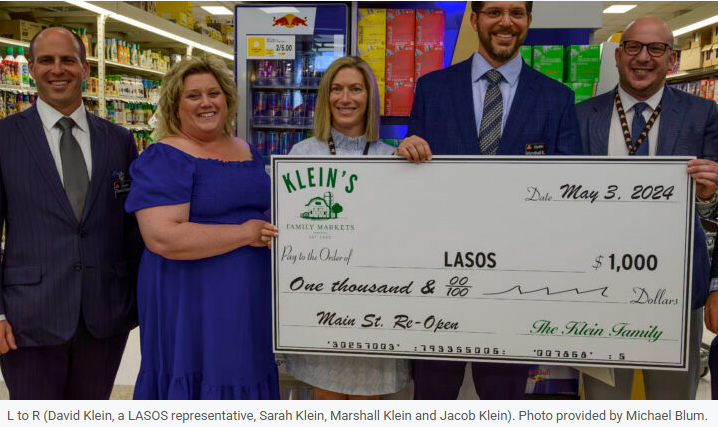
This week, Klein's had the Grand Reopening Celebration and Grocery Sweep Contest. The Klein family also offered $1,000 donations to SARC, The Mann House, LASOS, Pathfinders for Autism, and Bel Air Volunteer Fire Company.
| | |
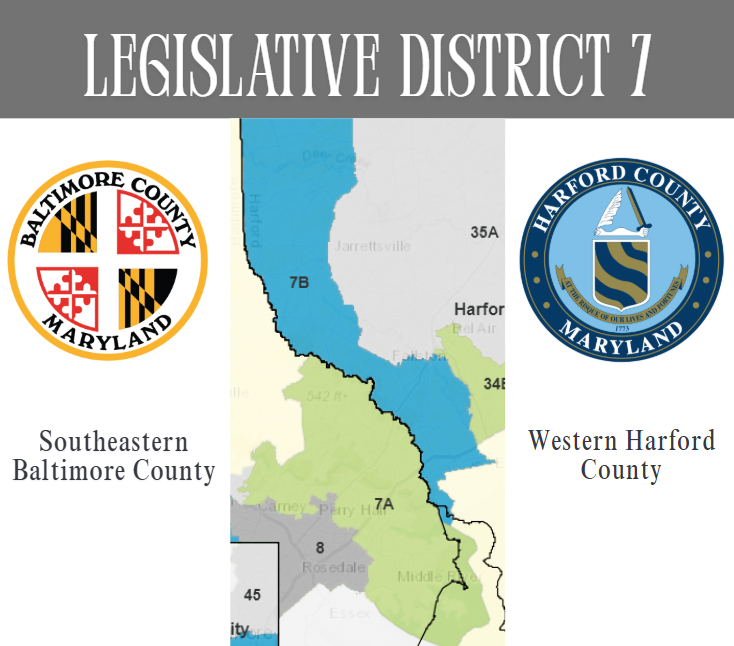
I hope you're having a productive week. My office remains ready to serve my constituents, should a need arise. Not sure if you reside in Legislative District 7? Check it out here: Members - Find My Representatives. Navigate to Look Up, and type in your address to see who represents your district and their legislation. Feel free to email me at jb.jennings@senate.maryland.gov. Follow me on Facebook, Instagram, or X.
Best regards,
| | |
Our Company | Contact Us | FAQs | Privacy Policy |
| | | |