|
|
WVPCA Weekly Outlook Newsletter
A Newsletter on Community Centered Healthcare
|
|
We offer this publication as a member service of the West Virginia Primary Care Association (WVPCA).
If you have questions regarding our organization, WVPCA membership, or if you have content to suggest for this newsletter, please contact
Pam Moore, Member Relations Coordinator, by email or by phone at (304) 346-0032.
Sincerely,
West Virginia Primary Care Association
1700 MacCorkle Avenue
Charleston, WV 25314-1518
304-346-0032
1-877-WVA-HLTH
|
Quick Links: In This Issue.....
|
| 12 Ways to Have a Healthy Holiday Season |
|
Brighten the holidays by making your health and safety a priority. Take steps to keep you and your loved ones safe and healthy-and ready to enjoy the holidays.
- Wash hands often to help prevent the spread of germs. It's flu season.
- Bundle up to stay dry and warm. Wear appropriate outdoor clothing: light, warm layers, gloves, hats, scarves, and waterproof boots.
- Manage stress. Give yourself a break if you feel stressed out, overwhelmed, and out of control.
- Don't drink and drive or let others drink and drive.
- Be smoke-free. Avoid smoking and secondhand smoke. Smokers have greater health risks because of their tobacco use, but nonsmokers also are at risk when exposed to tobacco smoke.
- Fasten seat belts while driving or riding in a motor vehicle. Buckle up every time, no matter how short the trip and encourage passengers to do the same.
- Get exams and screenings. Ask your health care provider what exams you need and when to get them.
- Get your vaccinations. Vaccinations help prevent diseases and save lives. Everyone 6 months and older should get a flu vaccine each year.
- Monitor children. Keep potentially dangerous toys, food, drinks, household items, and other objects out of children's reach.
- Practice fire safety. Most residential fires occur during the winter months, so don't leave fireplaces, space heaters, food cooking on stoves, or candles unattended.
- Prepare food safely. Remember these simple steps: Wash hands and surfaces often, avoid cross-contamination, cook foods to proper temperatures and refrigerate foods promptly.
- Eat healthy, stay active!
|
 |
|
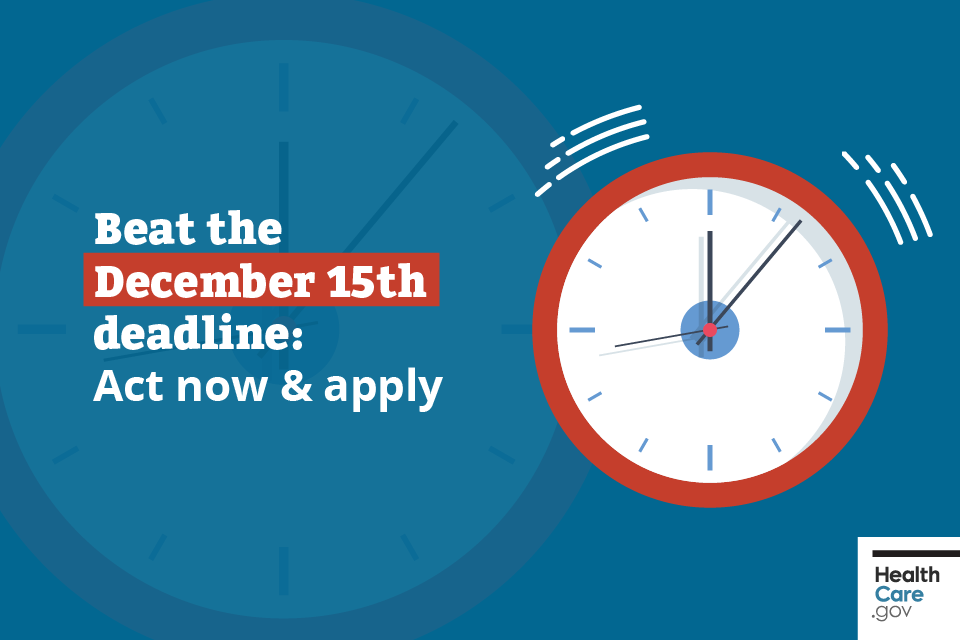
Counting Down the Days of 2019 Open Enrollment!
|
Emergency Preparedness
|
|
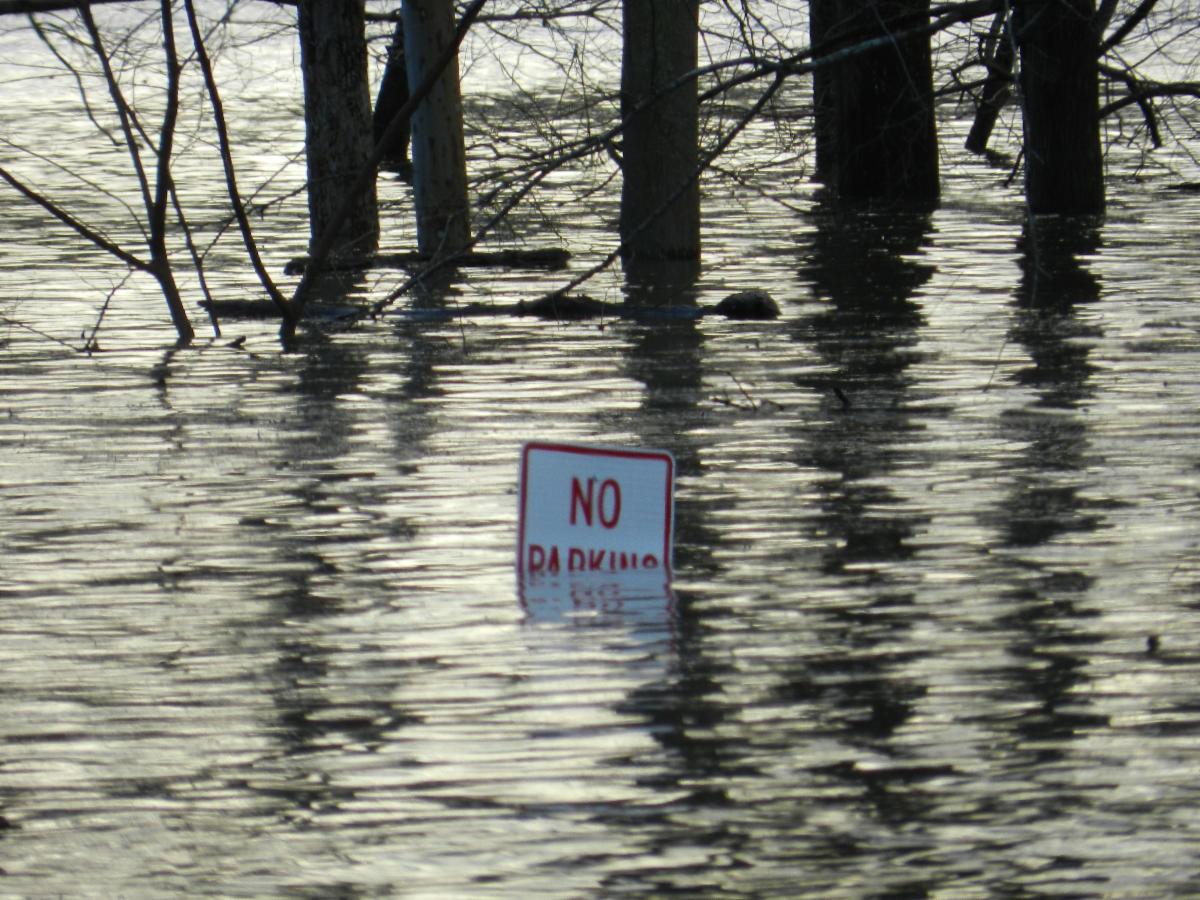
Natural Disasters are Getting Worse & Health Centers are Joining the Response
|
As natural disasters like fires, floods, and hurricanes become an increasingly prominent - and catastrophic - part of their patients' lives, community health centers are rapidly adapting.
They're installing solar power and backup generators among other precautions, so they can stay open, protect medications, and access medical records. They are now wading through flood waters to distribute supplies and driving dangerous roads to get medicines and equipment to immobile patients.
In short, health centers are seeing themselves as a fundamental part of a community's disaster response.
Beginning in the 1960s, community health centers were designed to provide primary and preventative care to vulnerable populations. Although they've adapted to serve the changing, complex needs of their patients, they fundamentally focus on providing ongoing primary care - not crisis response.
However, responding to the needs of their communities - whether ongoing or acute - is a fundamental part of health centers' role.
This has been the case in our own backyard in recent years, including the heat and power outages of the of the 2012 derecho, the floods of 2016. While West Virginia continues to see it's own natural disasters and weather related challenges, much like the rest of the country, it's only natural that Community Health Center prepare, plan, and remain ready to do their part.
Read the full Direct Relief Article covering this topic, click
here.
|
|
|
|
Five Ways to Protect Your Well-Being as a Health Care Professional
|
Everyday, millions of people seek advice, support, and help from healthcare professionals. And often those professionals give time, emotion, and energy well beyond their duties to those in need. But while their patients receive such care, healthcare professionals themselves often don't take the time to care for themselves.
The Greater Good Institute is helping those in healthcare to learn about their own needs and how to ensure they focus on self care and their own relationships just as they do for their patients.
Recently, Great Good Magazine took a closer look a closer look at this topic. To read the full article and learn a bit about how to care for yourself as a healthcare professional, click here.
Interested in attending the Greater Good Institute yourself? The application period is open for the 2020 class now. To learn more and register, click here. |
State News
|
|
The Health Plan Clarifies that Its Marriage with WVU Medicine is Off
CHARLESTON, W.Va. - The Health Plan says its proposed long-term partnership with WVU Medicine is off.
The Health Plan, a managed care organization based in Wheeling, put out a statement on Wednesday titled, "The Health Plan and West Virginia University Health System agree to terminate transactional agreement."
The bottom line, according to The Health Plan, is the two will no longer become a single entity.
The
statement confirmed that the managed care organization on Nov. 27 notified the state Insurance Commission that a deal proposed months ago has been terminated.
"While this effective transaction is no longer moving forward, The Health Plan remains committed to building a statewide integrated healthcare finance and delivery network that will include all major health systems," the Health Plan stated.
The full article is available
here.
|
|
|
WV Health Alert: Update on Vaping-Associated Lung Injuries
|
|
On behalf of our State Health Officer please see an update on vaping-associated lung injuries, including reporting requirements and guidance for healthcare providers on evaluating patients with suspected e-cigarette, or vaping product use associated lung injuries. Please distribute widely to public health partners.
To read the full WV HAN 163, click here, and find the related clinical evaluation resource here.
|
Upcoming Training Opportunities
|
|
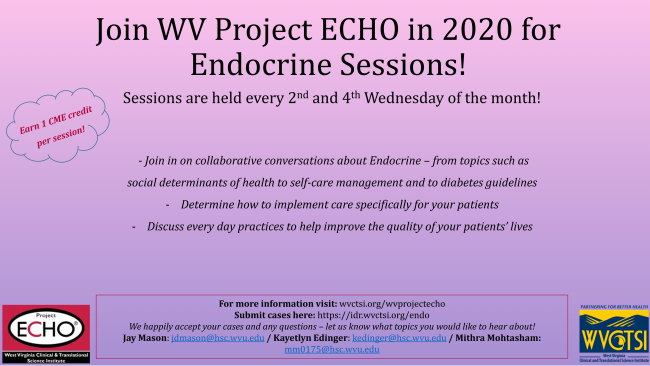
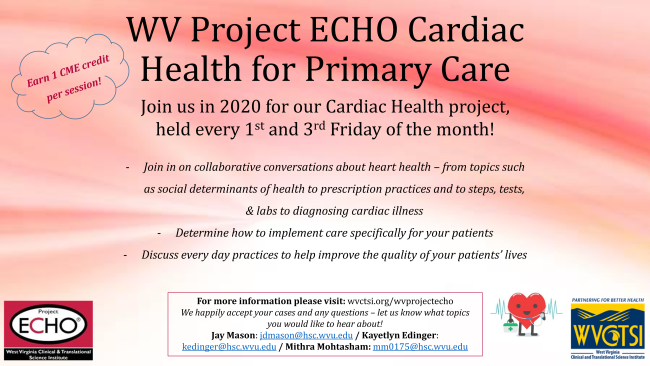
WV Project ECHO Announces Two Upcoming Training Events
|
For more information on both events, visit wvctsi.org/ wvprojectecho and to submit cases, go to https://idr.wvctsi.org/endo. All case submissions and questions welcome, so please let us know what topics you'd like to hear about during this session.
For more information contact Jay Mason, Kayetlyn Edinger, or Mithra Mohtasham.
|
National News
|
|
Childhood Obesity Report Delivers Mixed Results
|
Despite still commanding a hefty price tag -- $14 billion a year, to be precise -- some evidence suggests the worst of the childhood obesity crisis may have already passed.
The report shows that although childhood obesity rates remain alarmingly high, they actually have begun to stabilize in recent years and have even decreased slightly in some populations. The report also provides a raft of recommendations for family physicians, policymakers and others with an interest in ensuring that obesity rates continue to decline.
Read the full article by AAFP here. |
|
HHS Launches National HIV Program
|
HHS is announcing Ready, Set, PrEP, a national program that will provide HIV pre-exposure prophylaxis (PrEP) medications to thousands of Americans. Truvada for PrEP
®
and Descovy
®
are safe and effective medications that keep people from getting HIV and this program will bring the nation one step closer to ending the HIV epidemic in the United States.
More than one million Americans could benefit from taking PrEP medications but only a small percentage are using this effective HIV prevention tool. The Ready, Set, PrEP program provides access to PrEP medications at no cost for people who qualify. Over the next ten years, Ready, Set, PrEP will increase access and ensure these life-changing drugs are available to people at high risk.
To qualify for Ready, Set, PrEP, individuals must test negative for HIV, have a valid prescription, and not have prescription drug coverage. All prescriptions are fully covered for qualifying participants, however, the costs of necessary clinic visits and lab tests may vary depending on income. Individuals can find out if they qualify by visiting GetYourPrep.com or calling 855-447-8410.
For more information about Ready, Set, PrEP, visit HIV.gov. There, you will also find information cards, posters, consumer flyers, and other available resources for easy downloading and printing to help promote the program to potential participants in your community.
Ready, Set, PrEP
is a key component of the Ending the HIV Epidemic: A Plan for America (EHE) initiative. EHE aims to reduce the number of new HIV infections in the United States by 75 percent in five years and by 90 percent in 10 years. By increasing awareness and access to PrEP, the Ready, Set, PrEP program will provide thousands of people a safe, effective way to prevent HIV and bring our nation one step closer to ending the HIV epidemic.
Recognizing the importance of expanded access to HIV PrEP medications, CVS Health, Walgreens, and Rite Aid have donated their dispensing services to HHS. Beginning no later than March 30, 2020, as part of these donations, qualified patients can obtain the PrEP medications at the more than 21,000 combined CVS Health, Walgreens, and Rite Aid locations throughout 50 states, the District of Columbia, Puerto Rico, and the U.S. Virgin Islands or through mail order-all at no cost to patients. These pharmacies represent about a third of all the pharmacies in the United States. CVS Health, Walgreens, and Rite Aid will also provide patient counseling and take steps to promote patient adherence to the regimen. Between now and March 30, 2020 patients will be able to access PrEP medications through this program at thousands of participating pharmacies.
Thank you in advance for your support in increasing the uptake of PrEP medications among those who can benefit most from PrEP. The time is now to end the HIV epidemic in the United States. Working together, I know we can achieve this goal.
|
Funding Opportunities
|
|
The American Academy of Pediatric Dentistry (AAPD) offers matching grants to support community-based initiatives that provide dental homes to children who are under-served and/or have limited access to oral healthcare.
Funding may be used for:
- Child oral healthcare
- Clinic supplies, instruments, and equipment
- Salary
- Education and/or outreach to recruit dentist participation in program activities
- Special healthcare needs
Geographic coverage: Nationwide and U.S. Territories
Application Deadline: Dec 20, 2019
Sponsor: American Academy of Pediatric Dentistry
For eligibility information and to apply click here. |
Community Health Center Resources
|
Jackson Kelly attorneys provide limited consultation to all members of the WVPCA at no charge, as part of the WVPCA contract. There is no limit to the number of calls which any member may make. All inquiries within the scope of professional competence of firm attorneys will be addressed. Inquiries which require expertise not available through the firm will be promptly identified and, when requested, Jackson Kelly will assist in referring the matter to accounting firms, insurance agents, or others as circumstances warrant.
All inquiries, responses and consultation services provided by the firm lawyers will be provided without additional charge beyond the retainer amount, except for matters which require formal opinions, representation of record in litigation, transactional work, e.g. the purchase or sale of real property, or matters which require continued representation, research or consultation beyond a single inquiry or document review.
Justin M. Harrison is a labor & employment lawyer with Jackson Kelly PLLC. He is available for consultation through a special retainer relationship with the WVPCA.
Justin can be reached at 304.340.1358 and via email at justin.harrison@jacksonkelly.com.
|
Risk Management Manual for Health Centers Now Available!
The
Risk Management Manual for Health Centers is now available on the ECRI Institute Clinical Risk Management Program website! Designed to support a proactive approach to risk management at health centers and free clinics, the Manual provides background, tips, and how-tos in a manageable format.
Specific areas that are covered include:
|
Risk Management Programs & Plans
|
Claims and Lawsuits
|
|
Role of the Risk Manager
|
Patient Grievances and Complaints
|
|
Communication with Patients
|
Credentialing and Privileging
|
|
Communication among Providers, Staff, and Community Partners
|
Tracking Systems for Diagnostic Tests, Referrals, and Hospitalizations
|
|
ECRI Institute
The
ECRI Institute
offers numerous policy templates that can be used as guidance consistent with the needs of community health centers. To take a look at their library of policy templates, click
here
.
If you are not an ECRI member, creating a free account before accessing these materials is required. ECRI Institute resources are provided for free on behalf of HRSA.
To Access Policies:
- From the main page, click on the clinical risk management link on the left hand side of the page
- Click sample policies and tools listed under tool-kits on left side of page
Click on the + sign to access individual templates.
|
|
WVPCA Staff
Debra Boyd | Chief Financial/Chief Operations Officer
|
|
To sign up to receive the WVPCA Weekly Newsletter, click
HERE
|
|
|
West Virginia Primary Care Association
1700 MacCorkle Ave. Charleston, WV 25314| (304) 346-0032 |
WWW.WVPCA.ORG
|
|
|
|
|