 |
Iron & Steel Preservation
|
|

.
|

Watching and listening to craftsmen talk about their work experience, whether it's a local barista describing her work with an espresso machine, a blacksmith forging hot steel with a hammer, or a twenty-first century CNC machine operator, I've discovered it is often their skill with tools that defines their work. Two pieces in this newsletter focus on tools, on those who use them and those who make them.
You will also find more information about the next Iron & Steel Conference/Workshop. It is hosted by Lansing Community College, scheduled for October 2019, and will feature iron and steel rehabilitation projects, demonstration of the tools craftsmen use in this work, and applications in new construction.
Vern Mesler
Iron & Steel Preservation Coordinator
Lansing Community College
|
******** Save the Date ********
2019 Iron & Steel Preservation Conference/Workshop
October 18th and 19th
|
Lansing Community College Iron & Steel Preservation (ISP) Conference/Workshops have provided one of the leading experiences for hands-on participation, demonstrations and technical papers in the preservation of metal structures. A major topic for the 2019 conference/workshop is the
Cut River Bridge rehabilitation as an example worthy of attention at a national level, with a focus on the shop-riveted bridge members, the on-site riveting of connections with the field rivet hammer, and the removal of pack rust.
New in ISP 2019:
In addition to the preservation of historic metal structures, demonstrations for new riveted structures will be presented. New construction
can be enhanced by incorporating new riveted elements in renovated or re-purposed buildings: riveted exterior structures that complement a park shelter or the entrance to a building; a pavilion fabricated with riveted trusses, etc.
Friday, October 18, 2019
Presentations on the rehabilitation work recently completed on Michigan's Cut River Bridge on U.S. Highway 2 in the Upper Peninsula by Michigan Department of Transportation personnel who were directly involved in the rehabilitation work. (
Lloyd Baldwin, cultural and historic resource coordinator for MDOT, will lead these sessions from the initial planning stages to the completion of the rehabilitation work.)
Presentations on issues related to riveted and bolted connections and on the damaging effects of pack rust on metal structures. Presentations on the role of riveting in new construction and design.
Saturday, October 19, 2019
The experienced staff of craftsmen at Lansing Community College will demonstrate electric arc welding processes, braze welding, and an introduction to the industrial rivet process (both field riveting and shop hydraulic riveting). Workshop participants will experience the use of these and other industrial processes during hands-on sessions and learn how these processes are used in the preservation of historic metals and new construction.
Registration details will be available in May 2019. Look for them in the ISP Newsletter.
|
Lansing Community College Foundation
|
|
A fund has been established at Lansing Community College Foundation to support projects, research and conferences related to the rehabilitation of historic iron and steel. From this fund scholarships have been awarded to students in engineering, preservation, and industrial arts to attend previous Iron and Steel Preservation Conferences. Please consider donating to support ISP scholarships for the 2019 Iron & Steel Preservation Conference/Workshop.
The Lansing Community College Foundation is a nonprofit 501(c)(3) corporation. Your contributions make a big difference.
Thanks,
Vern Mesler
|
 |
|
Lansing Community College Craftsmen
|
|
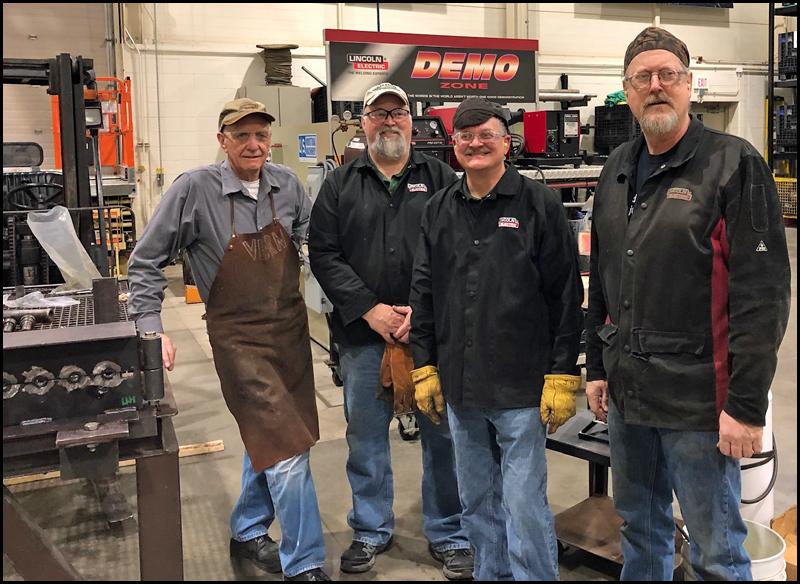
Left to right: Vern Mesler, Roger Morrison, Jeff Haynes, Jeff Seelye
With a set of handcrafted blacksmith steel tongs Jeff Haynes pulls a hot rivet from a gas forge and slips it into an open hole in the
Rivet Training Fixture. Jeff Seeley secures the rivet holder-on over the manufactured head of the hot rivet to prepare for driving the rivet. Roger Morrison picks up a #60 Boyer field rivet hammer, placing his index finger between the trigger and the handle (a trick ironworkers use to prevent pulling the trigger prematurely). He places the snap of the rivet hammer over the hot rivet shank and hammers the rivet into a button-head shape. It's the beginning of another rivet demonstration for Haynes's advanced Structural Fabrication class at Lansing Community College, part of a class lecture on various kinds of connections.
Students are witnessing three skilled craftsmen handling industrial tools that require not only skill with tools but also an understanding of the silent communication within a work group, a skill developed from years of experience working with others. These craftsmen are now teachers passing on their knowledge and experience to another generation of men and women about the value of craftsmanship and professionalism. All three retired after thirty years employed at General Motors: Morrison as Quality Control Gage Repairman, Haynes as Journeyman Welder/ Maintenance and Construction, and Seelye as Facilities Engineering Welder and AWS Certified Welding Inspector. They began their teaching careers at LCC in 2008.
Hands-on sessions at the October 2019 ISP Workshop will take place at LCC's state-of-the-art industrial facility under the leadership of these experienced instructors trained in the restoration of wrought iron, cast iron, and steel, and in the adaptation of modern techniques to the preservation of historic metals.
To read about another kind of craftsman, see this article from the March 2015 Newsletter:
|
Michigan Pneumatic Tool, Inc.
|
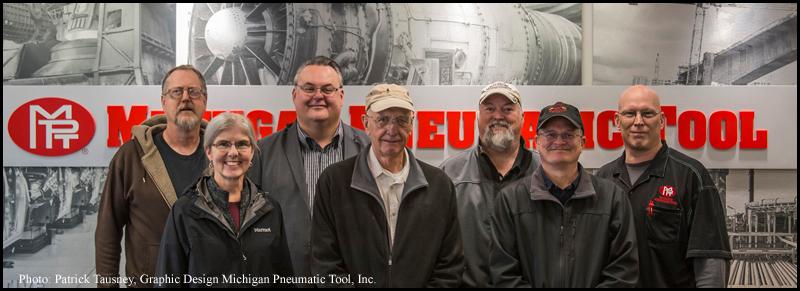
From left to right: Jeff Seelye, Nan Jackson, Robert Arthur, Vern Mesler, Roger Morrison, Jeff Haynes, Jeff Dever
|
Michigan Pneumatic Tools (MPT), a leading manufacturer of pneumatic tools, has moved from a 1950's Detroit industrial warehouse to a newly renovated building in Romulus, Michigan. Spacious throughout, it accommodates MPT's huge inventory of new and renovated pneumatic tools, work stations where MPT's skilled technicians build and repair pneumatic equipment for customers across the United States. The company also has engineers on staff to design custom tools for specialized applications.
Lansing Community College welding instructors had an opportunity to tour MPT's twenty-first century industrial facilities. Robert Arthur, Vice President of MPT, and Jeff Dever, MPT's Surplus Purchasing Manager, were our tour guides. Arthur was an in-charge virtuoso of tools as he led us through doors, walkways, and between heavy gauge gray metal shelving that ascended high above our heads. Rows of brightly painted tools: red, blue, green, gray. Blue tags hang from the handles of the red pneumatic tools, bright red, Michigan Pneumatic's recognized tool color. We were awed, entertained, and educated. We appreciate the time Arthur and Dever spent with us and the extensive knowledge they shared.
|
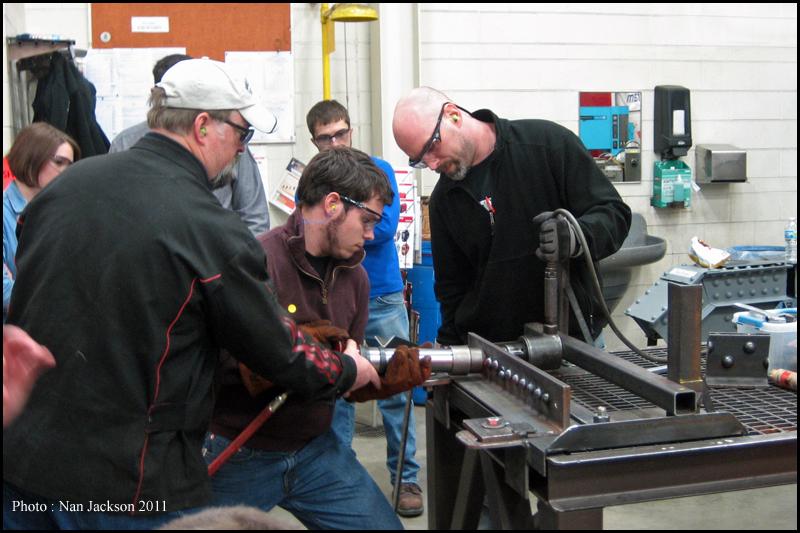
Jeff Dever (right) and Roger Morrison (left) assist a participant in riveting at the 2011 ISP Workshop.
|
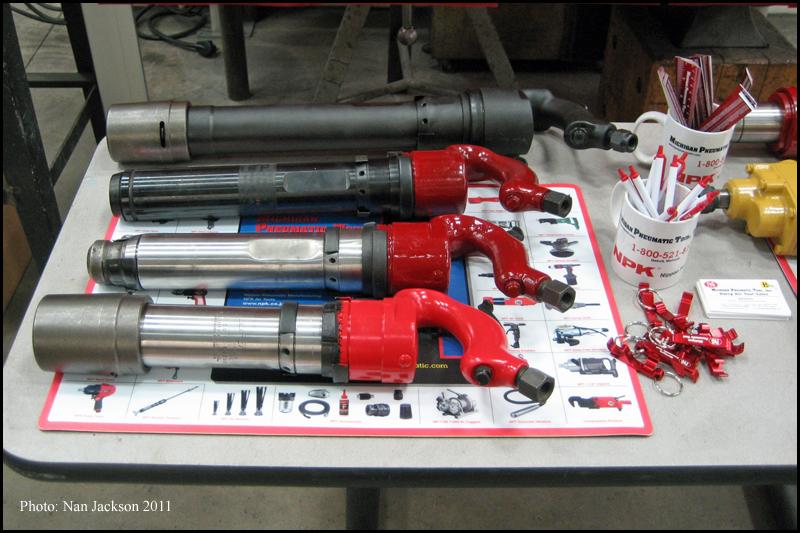
A display of Michigan Pneumatic rivet hammers and rivet buster at the 2011 ISP Workshop.
|
|
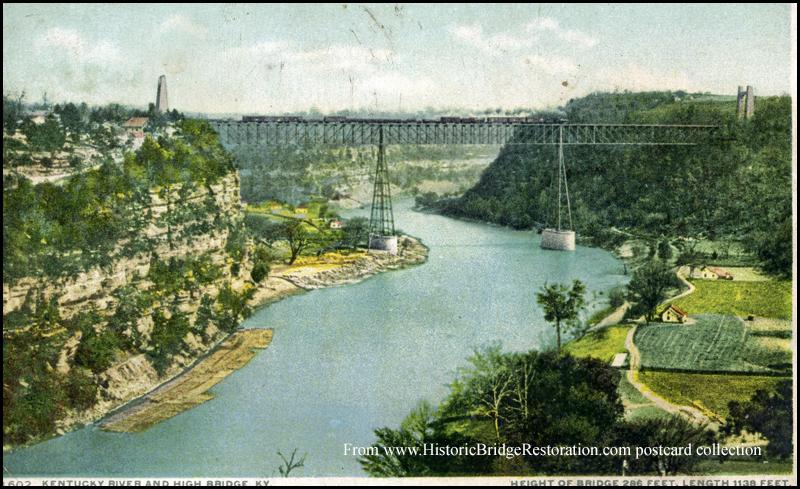
Between Michigan and Florida: High Bridge across the Kentucky River
(by guest writer Nan Jackson)
|
|
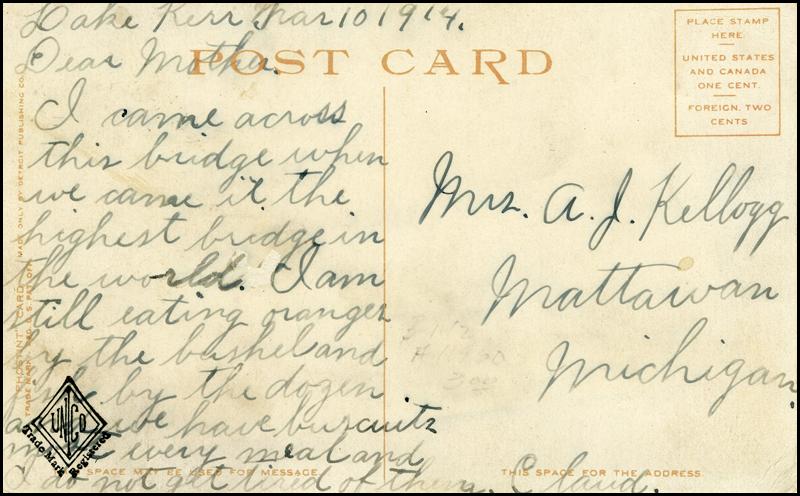
Every once in a while, a postcard makes an appearance in this newsletter. Usually the images on the chosen postcards have some connection to a historic bridge that links them to the theme of iron and steel preservation. Equally (and sometimes even more) interesting and thought-provoking is the text written on the other side of the card, along with details about the writer and the intended recipient. Claud wrote this message to his mother, Mrs. A. J. Kellogg, in Mattawan, Michigan:
Lake Kerr, Mar 10, 1914
Dear Mother,
I came across this bridge when we came it the highest bridge in the world. I am still eating oranges by the bushel and fish by the dozen and we have biscuits most every meal and I do not get tired of them. Claud
Lake Kerr was the name of the post office near Kerr City, Florida, a town on the northwest shore of the lake in an area known for its production of oranges in the late 1800s. Kerr City is now a ghost town, residents having deserted it after the severe freezes of 1894-95 [en.wikipedia.org/wiki/Kerr_City,_Florida]. I wonder what Claud was doing there in 1914; his message suggests he was living in the area, maybe working there. Or might he have been enjoying an extended stay for his health? The post office was kept open until 1942.
Now, what about the Kentucky Bridge, "the highest bridge in the world" -- is there a connection here between Lake Kerr and Mattawan? Google maps show this important railroad bridge to be more or less on a direct route traveling by car from Mattawan MI to Kerr City FL, about one third of the way along. In 2018, if I were to text a photo with the message "I came across this bridge ...," I'd probably mean that I was driving and caught a glimpse of the bridge from the highway, like "coming across" a forgotten glove under the passenger seat. In 1914, Claud undoubtedly meant it literally: traveling by train, he actually crossed this bridge. I assume that for some readers of this newsletter, their interest in iron and steel is born of an interest in railroad history. They may know that the founding of Mattawan MI was closely linked with the railroads and that a station was built there early on (I can imagine Mrs. A. J. Kellogg waving goodbye to her son from the platform ...). Feel free to contact Vern (
meslerv@gmail.com) if you know anything about the Kentucky bridge you'd like to share or about a possible pieced-together train route Claud might have taken between Michigan and Florida. What do you make of the trademark stamp in the lower left corner and the lack of postage stamp and postmark? For those of you short story writers, perhaps you'd like to try your hand using this as a writing prompt:
"I am still eating oranges by the bushel and fish by the dozen and we have biscuits most every meal and I do not get tired of them."
For another postcard piece (from ISP newsletter January 2016):
|
|
Attention: Architects and Engineers
|
Exposed historic brick walls, riveted columns, trusses, early twentieth century warehouses, factories, and historic structures: today many are being re-purposed, some renovated for businesses that allow the public to enjoy historic spaces not found in the blight of sameness that urban sprawl has to offer.
Many of these historic structures, valued for their industrial look, could be enhanced by incorporating new riveted elements in these renovated or re-purposed buildings: additional riveted columns and trusses in a craft beer brewery; riveted bar features in a hotel located in a restored historic building; riveted exterior structures that complement a park shelter or the entrance to a building; a new pavilion fabricated with riveted trusses. The only limitation for designing new riveted structures is the designer's imagination.
Riveting will never return to its historic prominence or compete with the bolted or welded connections used on bridges and buildings today, but riveted members can complement new construction or enhance a re-purposed/renovated building. There are steel fabricators and blacksmiths today proficient in the hot riveting process who are able to do this work, fabrication of metal structures with rivets.
Re-educating the industrial community to do riveting as part of new construction can have the additional benefit of providing those responsible for making the decision for saving a historic riveted structure (bridge or building) with the knowledge that the industrial community has the expertise to perform both the engineering and fabrication service required for riveting.
For those engineers and architects who would like to explore design ideas for new riveted structures, I'm available to meet to review technical and fabrication questions.
|
|
Program Fund
Please consider contributing to the Iron and Steel Preservation Program Fund. This fund was established to support projects, research, conferences and scholarships related to the repair, rehabilitation, and restoration of metals. The Lansing Community College Foundation is a nonprofit 501(c)(3) corporation.
Donate Here
|
|
|
|
Past Iron & Steel Preservation Newsletters
|
|
|
|
Sponsor
|
Want to become a sponsor?
|
|
Lansing Community College
5708 Cornerstone Drive
PO Box 40010
, MC 4100W
Lansing, MI 48917
|
|
|
|
|
Copyright © 2018. All Rights Reserved.
|
|
|
|