 |
Seasons Greetings from PCAP!
To end the year,
we were pleased to have
Alexandra Froese
presenting
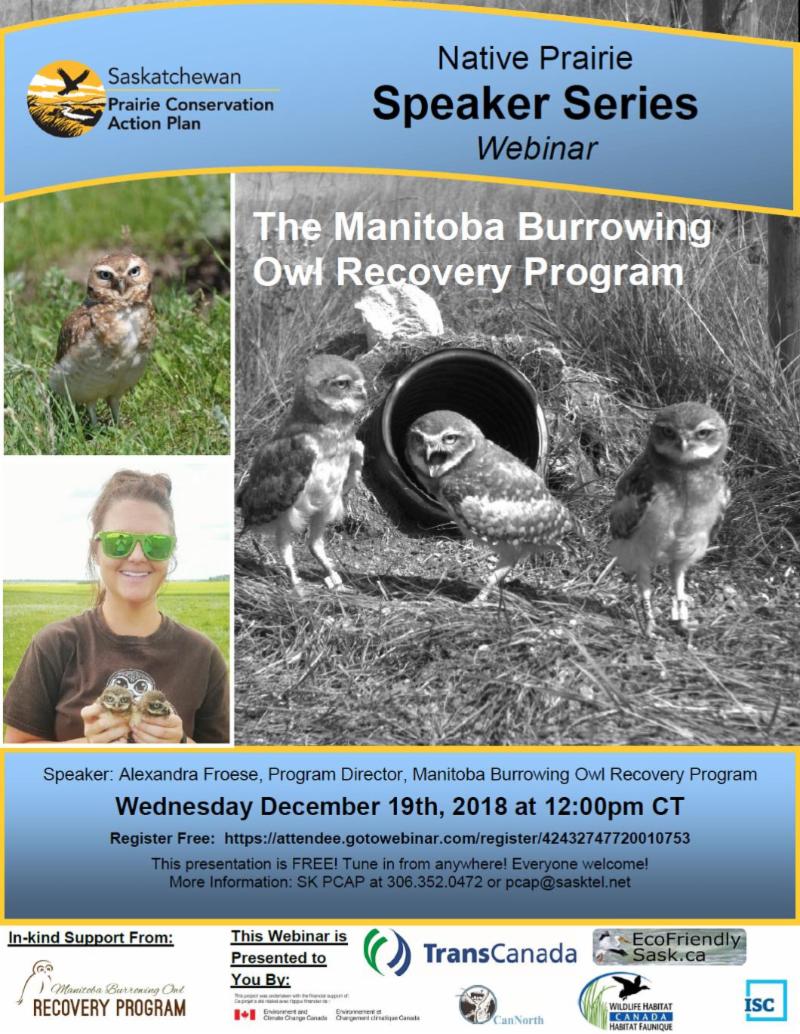
a webinar seminar about "The Manitoba Burrowing Owl Recovery Program" on December 19th. You can register for free here.
In addition, please "save the date" for our first
webinar presentation planned for 2019, with Amy Chabot presenting about Loggerhead Shrikes on January 8th (free registration here)
If you missed some our last month four presentations on Migratory Bats, Grater Sage-Grouse, Sharp-tailed Grouse, and on programs for SAR in Grassland National Park, you can now watch them at our PCAP YouTube channel!
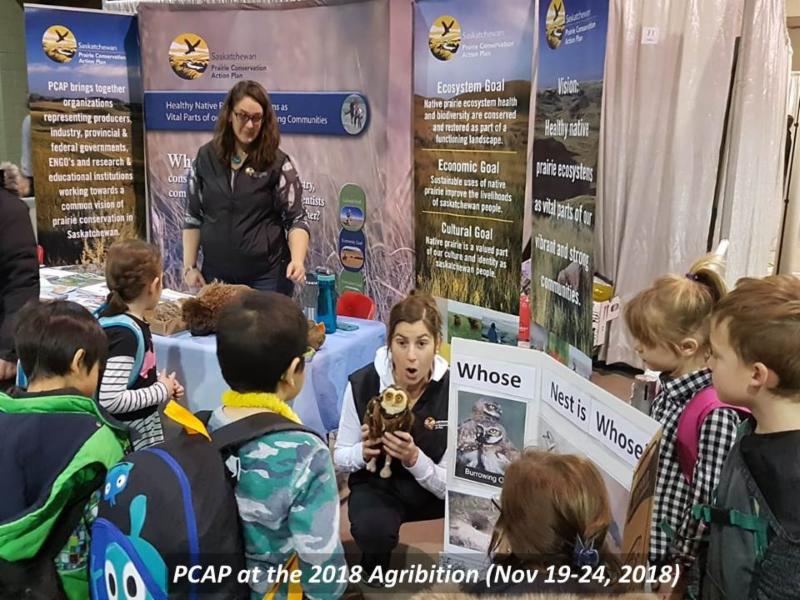
PCAP was also present at the Canadian Western Agribition last month in Regina. We had a booth in the Family Ag Pavilion where we talked with producers, landowners, ecologists, students and teachers about species at risk, the importance of native prairie, as well as some of our upcoming events. The overall Agribition attendance was 126,900 during all week, and there was an estimated 9,500 students that came through the pavilion! PCAP Stewardship Coordinator, Caitlin Mroz, and PCAP Education Coordinator, Julie-Anne Howe, also coordinated our Pitch for Pipits & Plovers Gameshow all week, where 23 classes participated and learned about how they can help Sprague's Pipit and Piping Plover recovery. This could not have been a success without the help of people who volunteered their time, so big thanks to Melanie, Lacey, Beatriz, kaitlyn, Larry, Mackenzie, John, Emily and Becky for your efforts and contribution!
Please feel free to contact me at any time; I'm pleased to receive your questions, comments or ideas.
Diego Steinaker
SK PCAP Manager
306 352 0472
pcap@sasktel.net
|
PCAP WEBINAR Presentations
"The Manitoba Burrowing Owl Recovery Program"
|
P
rairie Conservation and Endangered Species Conference - PCESC 2019
February 19-21, 2019. Winnipeg, MB
Early bird, until January 15, 2019
For details on the Conference Program please click here
|
|
Does your organization have a research or business challenge that requires outside expertise? Are you seeking ways to leverage your R&D budget? Work together with other organizations to pool resources for research?
You can get matching funding from Mitacs (not-competitive) to work with a university graduate student or postdoc, or a SaskPoly or college undergrad in any discipline, such as biology, engineering, computer science, marketing, policy, etc. You can also work with students from outside of SK.
Through
Mitacs Accelerate,companies and eligible NFP organization engage top graduate students and postdoctoral fellows to address a research challenge, benefiting from their skills and insight and the expertise of their faculty supervisor. Matching funds from Mitacs ensure that Accelerate collaborations are cost-effective and low-risk for companies and NFPs of all sizes. The Mitacs team provides personalized support throughout the application process. This support can range from identifying suitable academic collaborators to helping design a customized research plan for your organization's needs.
Please visit our
website or contact Mitacs Director Zsuzsa Papp (
zpapp@mitacs.ca)
tel: 306-491-2769 for further information.
|
Temperate grasslands are being lost worldwide and North American grasslands are no exception. The leading cause of this loss is the conversion of grasslands to cropland.
The conversion of intact grasslands represents a significant ecological loss that cannot easily be recovered.
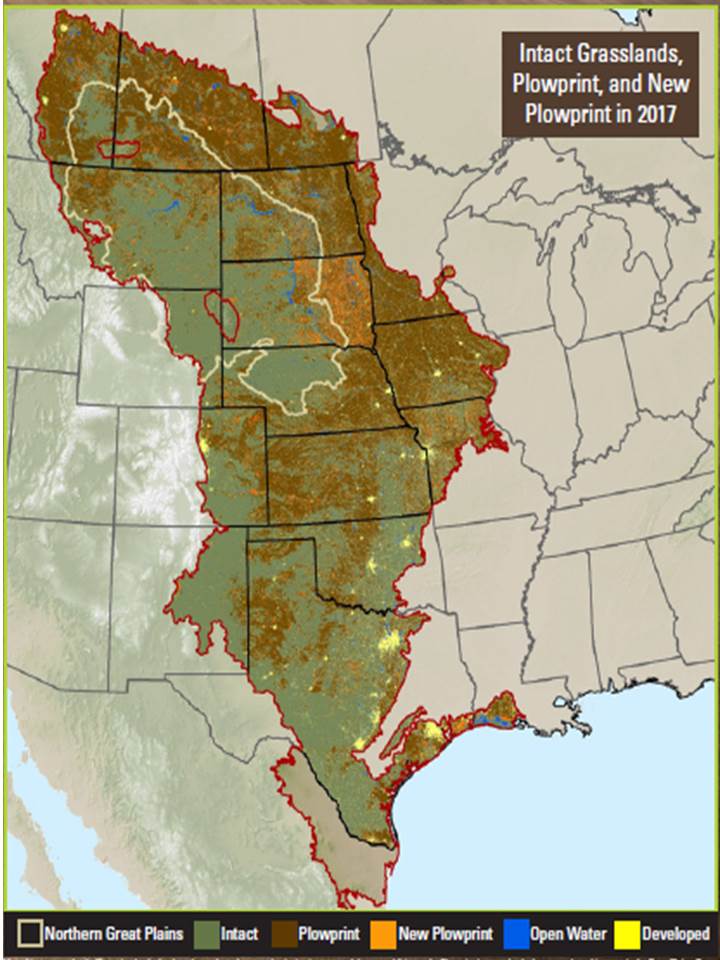
The purpose of the Plowprint analysis made every year by the World Wildlife Fund (WWF) is to identify remaining intact habitat across the Great Plains.
The Good News
: plow-up decreased
across the Great Plains in 2017. On average, over 800,000 fewer acres were converted to cropland across the Great Plains in 2017.
The Bad News: 1.7 million acres of grassland were lost across the entire Great Plains (
as compared to over 2.5 million acres in 2016).
Overall, approximately 53% of the Great Plains is still intact.
To track grassland loss, WWF used the USDA National Agricultural Statistics Service Cropland Data Layer in the U.S. and the Agriculture and Agri-Food Canada Annual Crop Inventory in Canada.
For this analysis, Grasslands refer to grasslands, shrubland, and wetland cover, and Cropland is defined as any annually planted agricultural commodity or fallow agricultural land.
Perennial Grass Cover: Gain & Loss
In 2017, perennial grass cover increased in the NGP portion of Saskatchewan, Alberta, Montana, Wyoming, North Dakota, and Nebraska, but decreased by 9,000 acres in South Dakota. Conversion of grassland to cropland, although damaging to native ecosystems, is not necessarily permanent, and cropland can rotate back into perennial grass cover through restoration or abandonment. Restoration and rotations into perennial cover, while important, are not always enough to conserve biological diversity.
In the Northern Great Plain, about 71% of the lands that have been plowed are on high quality soils. This means that almost 30% of NGP plow-up, or 15 million acres, is on low and marginal-quality soils.
Grassland Conversion Effect on Drinking Water
In Intact grasslands are important for protecting source water areas for downstream communities. Recent studies indicate that communities are spending hundreds of thousands, if not millions, of dollars to counteract the impact of increased sediment and nutrient loading.
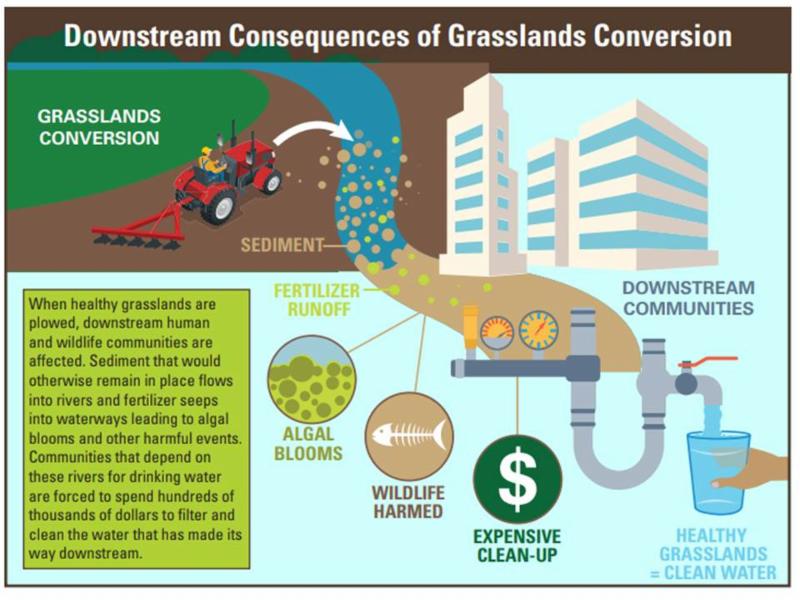
One study (1) found that farm fertilizer was the biggest contributor to nitrogen loading in water bodies, representing more than half of the total nitrogen loading. This study also suggested that small communities bear an unfair burden in dealing with the costs of removing nitrogen pollution from their drinking water
The second study in US (2) showed that communities located downstream from areas converted to cropland are spending significant amounts of money to combat the problem.
Keeping grasslands intact rather than plowing up marginal lands for farming is one obvious way to stop this trend.
(1) Vedachalam, S., Mandelia, A.J., and Heath, E.A. 2018. Source Water Quality and the Cost of Nitrate Treatment in the Mississippi River Basin, Northeast-Midwest Institute Report, 44 pp., http://www.nemw.org/
(2) LimnoTech. 2018. Assessing the Impacts of Land Conversion on Drinking Water in the Northern Great Plains, 34 pp.
|
|
|
|
PCAP Native Prairie Speaker Series
|
PCAP Webinar Presentation
"Loggerhead Shrikes"
by Amy Chabot, of ShrikeWatch Canada.
Tuesday January 8th, 2019 at 12:00pm CST.
|
|
Upcoming Events!
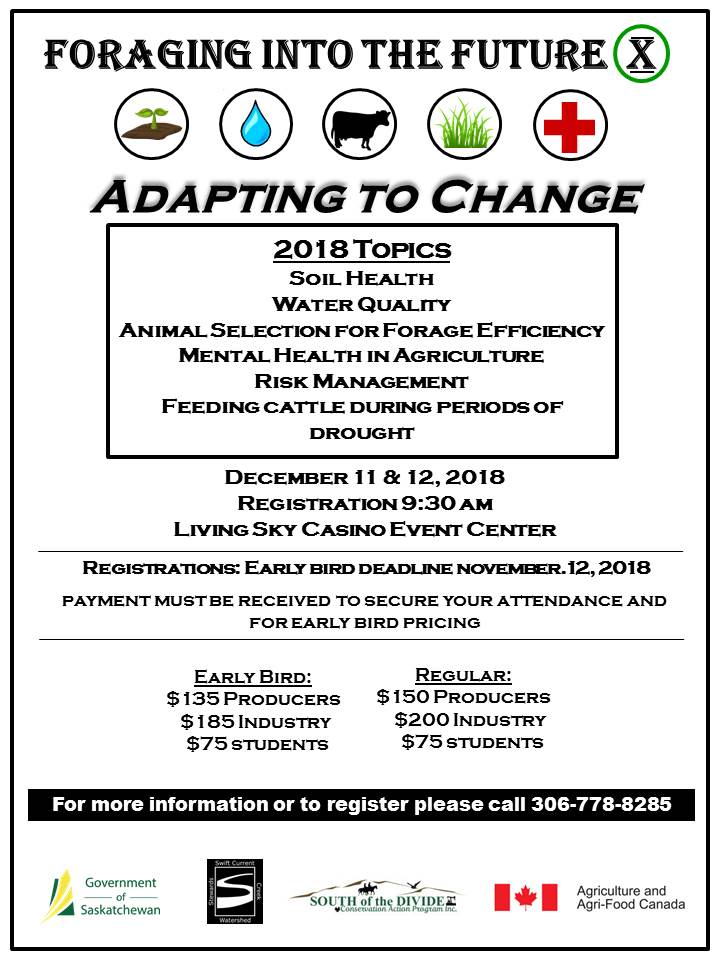
Foraging Into The Future X
December 11-12, 2018
Swift
Current, SK
February 19-21, 2019
Winnipeg, MB
|
Foraging Into The Future X
11-12 December, 2018
Swift Current, SK
|
Native Plants in the Classroom
Help the NPSS to reach the goal of raising $1000 for their Native Plants in the Classroom
campaign.
Native Plants in the Classroom is a project designed to connect youth with nature through classroom and outdoor exercises, teacher resources, and educational materials. Native plant teaching gardens are also being established in school yards, especially in areas where youth have little or no access to nature. These gardens also contain native plants used in traditional medicine as a way to reconnect indigenous youth to their culture. For more information on the program please visit:
Your
donation will ensure that students receive access to our award-winning educational programming.
|
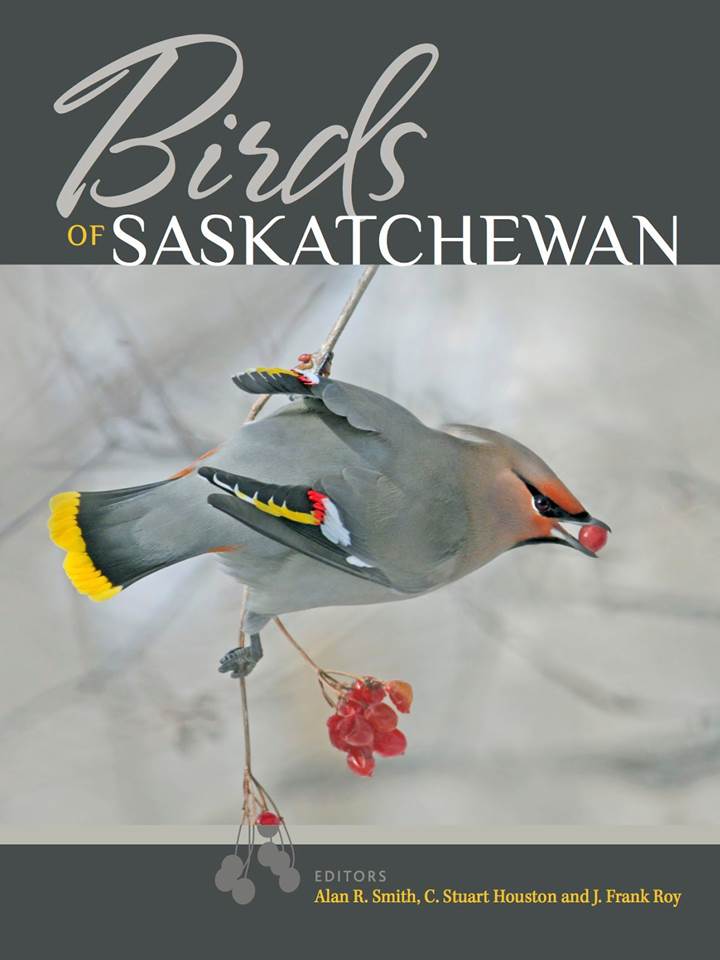
Birds of Saskatchewan
from Nature Saskatchewan
Nature Saskatchewan is excited to announce a long anticipated publication: "Birds of Saskatchewan
".
This is a full-colour, comprehensive look at all of the birds that call Saskatchewan home. 437 species of birds are documented in this 800 page compendium, a result of over ten years of work and several lifetimes of observation, research, and writing.
This fantastic book is now available for pre-orders until December 15, at a price of $64.95 + shipping. After December 15 the purchase price will be $79.95 + shipping. Orders will be accepted via online,
or via telephone at 306-780-9273 or 1-800-667-4668.
|
Nature Conservancy of Canada
Nature Conservancy of Canada (NCC)
| |