December 2020 | Volume 12 Issue 12 |
|
Happy December! Can you believe 2020 is almost over? I know starting the year 2021 isn't going to magically change anything that's currently going on, but I think we can all hope for a better year ahead.
For our November webinar, we had Dr. Nicola Koper from the University of Manitoba talking about oil development and noise on grassland songbirds. The recording of the presentation is available on our YouTube Channel!
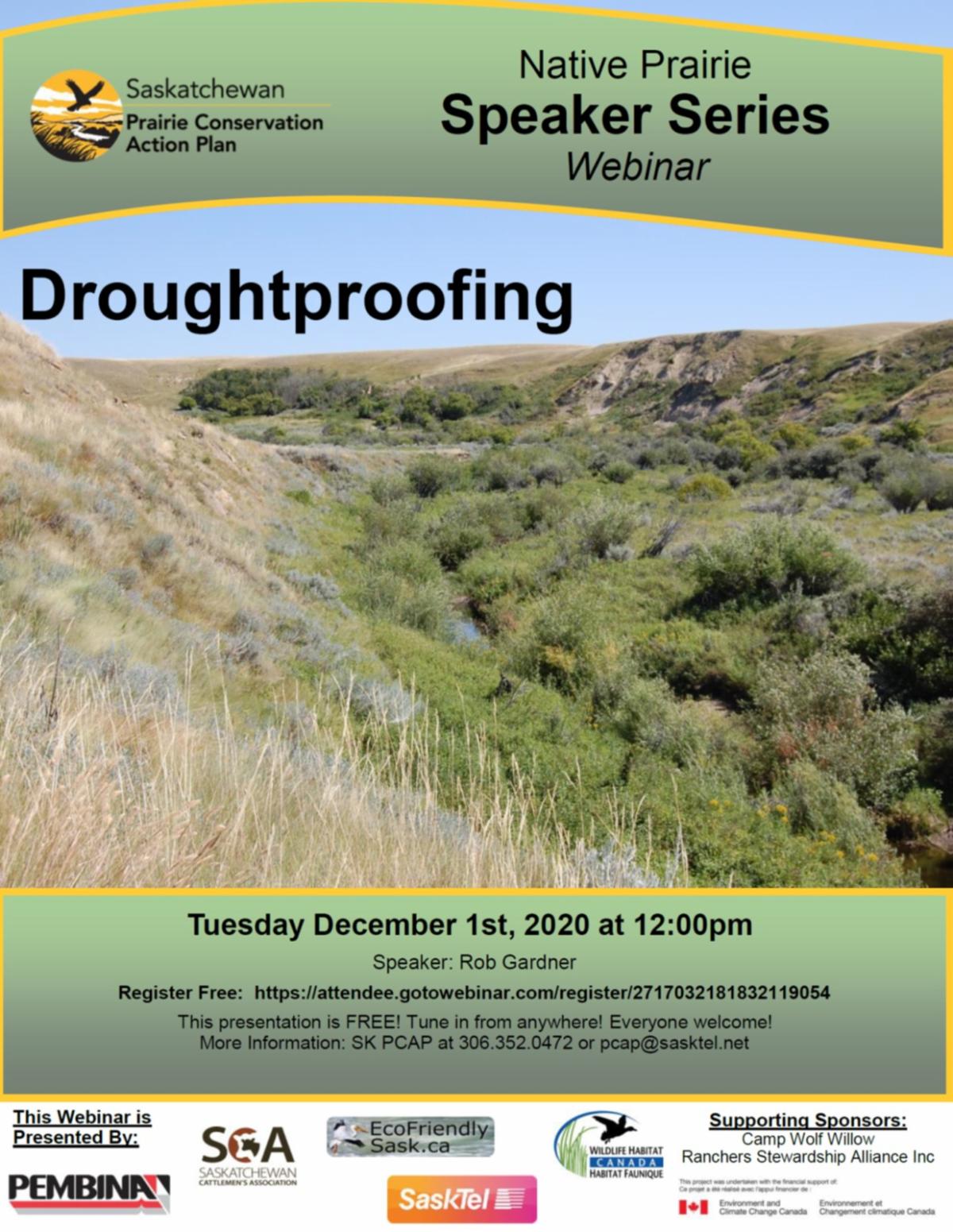
Our December NPSS presentation is today at noon! Rob Gardner is talking about Droughtproofing! You can register for free here. We also have the registrations open for the January and February webinars, on the NPSS webpage here.
Registration for the 8th Native Prairie Restoration/Reclamation Workshop is also open! Sponsorship and tradeshow information are also available! The Call for Posters is open and the deadline is December 4th! Please see more information about the virtual workshop below!
And finally, we would like to thank our sponsors for their generous support : Camp Wolf Willow, EcoFriendly Sask, K+S Potash, Pembina Pipelines, Ranchers Stewardship Alliance Inc, Saskatchewan Cattlemen's Association, SaskPower, SaskTel, Wildlife Habitat Canada and Environment and Climate Change Canada, as well as the continuous support of all the PCAP Partners.
Please note the PCAP office will be closed from December 23rd, 2020 - January 3rd, 2021.
Stay safe and take care! Happy December! I hope you all have a wonderful holiday season!
Carolyn Gaudet, SK PCAP Manager
Ph. 306 352 0472
|
The 8th Native Prairie Restoration/Reclamation Workshop will be on the PheedLoop virtual platform. Registration provides access to live presentations, tradeshow booths, poster session and a panel discussion. All presentations will be recorded and available to view on the virtual platform at your convenience after the workshop. You can also view this attendee training video to get an idea of how the workshop will function on a virtual platform.
There will presentations on:
planning, invasive species, how to read a seed certificate, soil, climate change, urban landscaping, orphan wells, and many more!
You can find the schedule here.
Early-bird (before January 15th) : $150+GST
Regular (after January 15th) : $200+GST
Student (no deadline) : $100+GST
Tradeshow:
Virtual Trade Show Booths will be in the "Exhibit Hall." Exhibitors will have their own profile to manage which includes company information and description, as well as links, videos, etc. Exhibitors will be able to engage in private or public chats with workshop participants. An upgrade is available for organizations who wish to have video chats with workshop participants as well as retrieve leads. You can also view a exhibitor training video to get an idea of how tradeshow booths will look and function using the virtual platform.
Corporate Tradeshow Booth: $275+GST
Non-profit Tradeshow Booth: $250+GST
Upgrade (video chat and lead retrieval): $100
You can find the Tradeshow application here.
Poster session:
New this year, poster presenters will have their own profile in the "Show Case" tab of the virtual platform. There will be designated poster session times during the week and we encourage poster presenters to be available during those times. The Call for Posters can be found here. The submission deadline is December 4th, 2020. If you are unsure of how a virtual poster session will go, check out the Exhibitor Training video above!
Networking:
Designated virtual networking sessions will be taking place throughout the week. Sessions will have specific topics and be scheduled in the event program. Workshop participants will have a choice of discussion groups and topics and they will communicate through the virtual platform.
If you have any suggestions for discussion topics or case studies, please send them our way!
For any questions, please contact Carolyn Gaudet, SK PCAP at pcap@sasktel.net.
|
PCAP Partner Spotlight...
Grasslands National Park
Submitted by Heather Facette, Parks Canada, Grasslands National Park
Grasslands National Park: Protecting and presenting mixed-grass prairie through the Canadian national park system.
Since the Saskatchewan Prairie Conservation Action Plan was implemented in 1998, Grasslands National Park has been an active partner supporting a shared interest in protecting native prairie. Parks Canada’s mandate: On behalf of the people of Canada, we protect and present nationally significant examples of Canada's natural and cultural heritage, and foster public understanding, appreciation and enjoyment in ways that ensure the ecological and commemorative integrity of these places for present and future generations. Of the 48 National Parks in Canada, Grasslands is the only one entirely dedicated to the preservation of mixed-grass prairie. Located in Southwestern Saskatchewan and bordering Montana, the Park consists of two blocks of prairie totalling 907 km2 (350 sections). The two campgrounds, day use areas, and scenic driving routes at the park accommodate between 15,000-20,000 visitors annually.
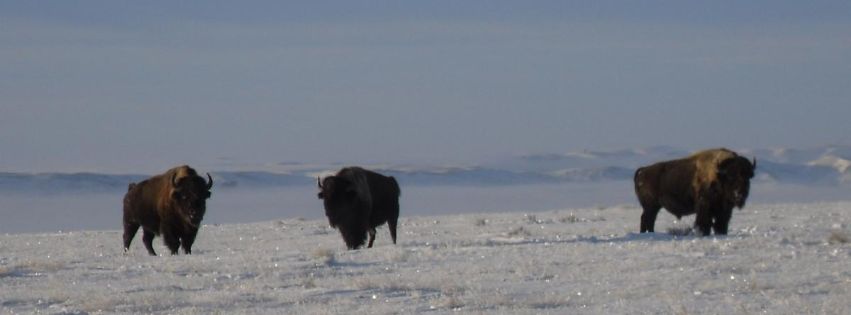
In addition to presenting this beautiful landscape to fellow Canadians and visitors, the park manages grazing within its boundaries, recognizing that this activity is an essential component to maintaining the health and production of prairie plant species. To complement the grazing strategies common elsewhere in the region, and working to restore historical use of the land, plains bison were re-introduced to a portion of Grasslands National Park in 2006 and have been thriving. Other lands managed by the park were grazed using a permit system, the first of its kind in the Parks Canada agency, allowing domestic cattle to graze areas outside of the Bison pasture. Through partnerships and licenses, local grazing expertise is now applied within park boundaries. Responsible grazing and prescribed fires, both key ecological processes in maintaining a healthy grassland, have been restored, creating a mosaic of quality habitat for many species of wildlife.
Since 1997, Grasslands National Park has developed an extensive vegetation restoration program and has reseeded 1133 hectares of previously cultivated land back to native prairie species. All this experience has shown that successful restoration requires high quality native seed, ongoing management and monitoring, and patience. Good planning and site preparation sets the foundation for success, after which the necessary climatic conditions to properly influence native plant establishment are needed. In addition to large scale restoration, the Invasive Alien Plant Program has expanded to control problematic species capable of displacing native prairie, such as lesser burdock, leafy spurge, annual bromes, and field bindweed. These programs will be necessary in the future to ensure native prairie remains intact.
Many unique prairie plant and wildlife species are monitored to varying degrees to analyze population trends and to determine if intervention by park staff can implement meaningful change in their recovery. We work with partners and stakeholders who have a common interest to increase the awareness of the threats to native prairie.
Any adventurer who enjoys learning or searching for archeological features, discovering the ancient footsteps of local dinosaurs, or who can appreciate the subtle and cryptic nature of prairie species, should visit Grasslands National Park. Our intact and largely unaltered native prairie is only a small fraction of what originally covered the Great Plains expanding from Mexico to Canada. A few tracts of native prairie are under legal protection, however; a lack of broad protection nationally and internationally means that it is constantly at risk (e.g., agricultural conversion, urban sprawl, energy development, road building, etc.). Education and ongoing collaboration is needed for the long term persistence of many prairie species facing declines.
|
Native Prairie in the News
You've probably read about NCC acquiring a new property in the SW Saskatchewan already, but incase you haven't...
|
|
SK PCAP Native Prairie Speaker Series
Plan to attend our December Native Prairie Speaker Series webinar today!
|
Save the date!
January NPSS Webinar
Topic: Prussian Carp
Presenter: Shayna Hamilton, MSc Candidate at the University of Regina
February NPSS Webinar
Topic: Greater Sage-grouse in Montana
Presenter: Lorelle Berkeley, Research Wildlife Biologist, Montana Fish, Wildlife and Parks
|
December 3, 2020
December 4, 2020 @ 3:30 CST
December 7-11, 2020 and January 11-15, 2021
February 24-25, 2021
|
2020 Speaker Series
Supporting Sponsors
Camp Wolf Willow
Ranchers Stewardship Alliance Inc.
|
2020 Education Programs:
Presenting Sponsors:
|
2020 Education Programs
Supporting Sponsors:
|
|
Carolyn Gaudet, Editor, Saskatchewan Prairie Conservation Action Plan Newsletter |
|
SK PCAP gratefully acknowledges financial support in 2020-2021 from:
Camp Wolf Willow, Ducks Unlimited Canada, EcoFriendlySask.ca, K+S Potash, Parks Canada - Grasslands National Park of Canada, Pembina Pipelines, Ranchers Stewardship Alliance Inc., Saskatchewan Cattlemen's Association, Saskatchewan Ministry of Agriculture, Saskatchewan Ministry of Environment - Fish and Wildlife Development Fund, SaskPower, SaskTel, University of Saskatchewan - College of Agriculture and Bioresources, Water Security Agency and Wildlife Habitat Canada.
SK PCAP gratefully acknowledges in-kind support for 2020-21 from:
Agriculture and Agri-Food Canada - Science and Technology Branch, Canadian Parks and Wilderness Association, Canadian Western Agribition, Environment Canada - Canadian Wildlife Service, Friends of the Royal Saskatchewan Museum, Friends of Wascana Marsh, Meewasin Valley Authority, Native Plant Society of Saskatchewan, Nature Conservancy Canada, Nature Saskatchewan, Parks Canada - Grasslands National Park, Prairie Wind & Silver Sage, Ranchers Stewardship Alliance Inc., Redberry Lake Biosphere Reserve, Saskatchewan Association of Rural Municipalities, Saskatchewan Association of Watersheds, Saskatchewan Bison Association, Saskatchewan Burrowing Owl Interpretive Centre, Saskatchewan Cattlemen's Association, Saskatchewan Environmental Society, Saskatchewan Forage Council, Saskatchewan Forage Industry Network, Saskatchewan Ministry of Agriculture, Saskatchewan Ministry of Environment, Saskatchewan Ministry of Energy and Resources, Saskatchewan Science Centre, Saskatchewan Stock Growers Association, Saskatchewan Wildlife Federation, Saskatoon Nature Society, SaskEnergy, SaskOutdoors, SaskPower, Society for Range Management - Prairie Parkland Chapter, South of the Divide Conservation Action Program Inc., University of Regina, University of Saskatchewan - College of Agriculture and Bioresources.
|
|
|
|
|
|
|