|
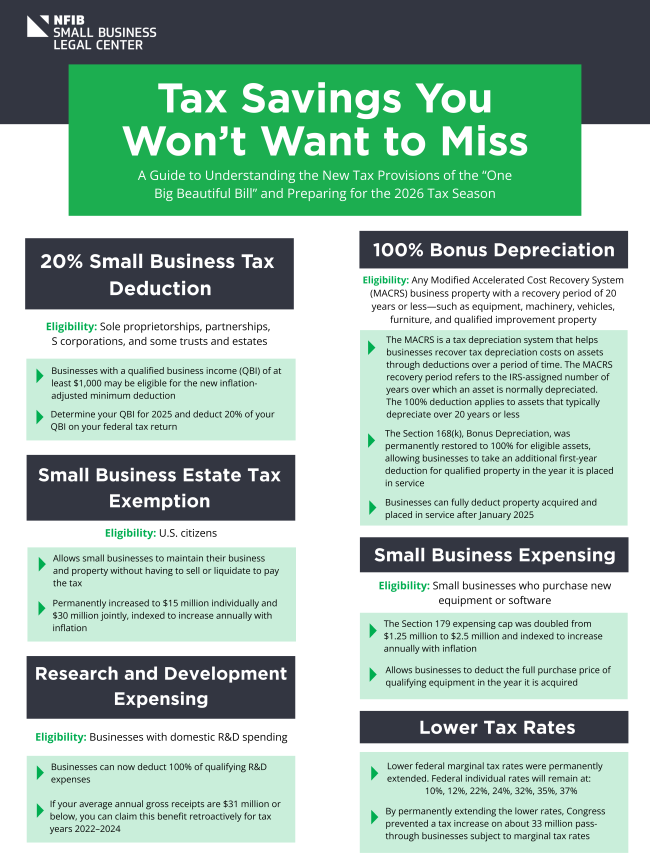
Small business owners should be aware of several federal tax provisions now in place that may significantly reduce tax liability during the 2026 tax filing season (for income earned in 2025), according to guidance from the National Federation of Independent Business (NFIB).
Key provisions include:
· 20% Small Business Tax Deduction: Eligible pass-through businesses may deduct up to 20% of qualified business income (QBI). An inflation-adjusted minimum deduction is available for businesses earning at least $1,000 in QBI.
· 100% Bonus Depreciation Restored: Businesses may fully deduct the cost of qualifying equipment, machinery, vehicles, furniture, and certain improvements in the year the asset is placed in service, beginning January 2025.
· Expanded Section 179 Expensing: The Section 179 expensing cap has doubled to $2.5 million, allowing small businesses to immediately deduct the full purchase price of qualifying equipment and software.
· Full R&D Expensing: Businesses with domestic research and development expenses may deduct 100% of qualifying R&D costs. Smaller businesses meeting gross receipt thresholds may claim this benefit retroactively for tax years 2022–2024.
· Higher Small Business Estate Tax Exemption: The estate tax exemption was permanently increased to $15 million for individuals and $30 million for couples, helping family-owned businesses transfer assets without forced liquidation.
· Lower Federal Tax Rates Made Permanent: Lower individual marginal tax rates—ranging from 10% to 37%—were permanently extended, preventing automatic tax increases on millions of pass-through businesses.
Important Timing Note: The 2026 tax filing season refers to returns filed in early 2026 for income earned during calendar year 2025.
Read the full NFIB tax tip sheet for eligibility details and planning considerations
|