Dear Explorers,
December air is crisp and cool, and the landscapes around us look drastically different than they did last season. Without leaves on the trees, we can see longer distances and easily spot soaring birds. With an understanding of how to layer for winter, you can step outside safely and comfortably all season long.
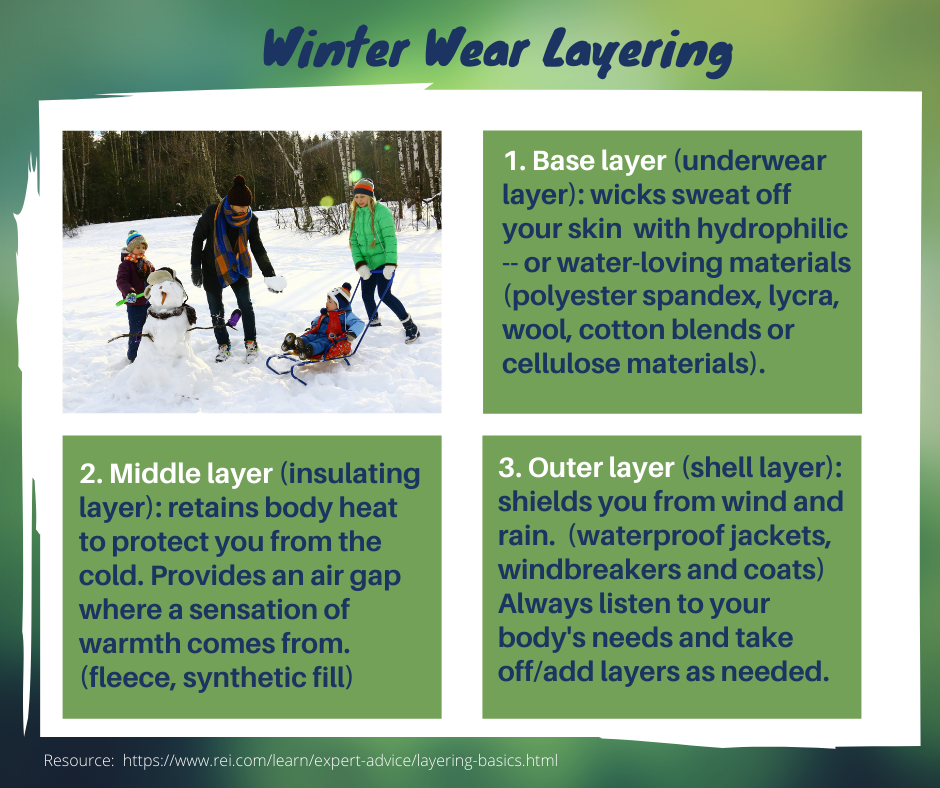
Layers are key to any adventurous activity in colder weather. The best clothing layering systems involve different materials, each one serving its own function during varying activity levels in the rapidly changing weather that is common this time of year.
Before deciding on clothing, remember that everyone runs differently in different temperatures Therefore, knowing how your body reacts to cold weather is key for comfort. Those with colder hands and feet might opt for thicker gloves or mittens and insulated footwear, while others might be fine in thinner gear. The main reason layering works so well is that it is adaptable and allows us to add and remove layers, allowing us to maintain our own personal microclimate close to our skin while we're out and about.
Inner layer: Water is the enemy when it comes to the cold. Water requires over 200 times more energy to heat than air, then evaporate after being warmed (taking even more thermal energy with it). This is great for the middle of August, but not in December. During vigorous activity we can excrete up to a liter of water an hour through our skin, so giving H2O a place to go away from our skin is the main role of the inner-most layer of your clothing.
Base layers are made out of hydrophilic—or water-loving—material that pulls the liquid water off of your skin where it can evaporate on the surface of the layer cooling the fabric, but leaving you warm and dry. This first layer is usually made out of a synthetic material (polyester, spandex, lycra) or natural fibers (wool, cellulose, and some cotton blends). Like most t-shirts, cotton holds onto too much water and doesn’t allow it to evaporate efficiently, leaving you feeling clammy after just mild exertion.
Middle layer(s): Our first layer is often light and airy and don’t retain any air near our bodies. That air gap is what gives us our sensation of warmth even in blustery conditions. The next layer(s) maintains that dead air space. A good rule of thumb is an inch of insulation for 30 degrees. If you're comfortable in a t-shirt at 60 degrees, you'll be comfortable in a 1-inch thick jacket in close to freezing temperatures. However, if you need a sweater at 60 degrees, then you would want to add more layers to get comfortable at those temperatures. The type of insulation affects the efficiency of that layer, but ultimately not how warm it is. An inch is an inch is an inch, whether it’s fleece, down, synthetic fill, or ugly Christmas sweaters. Heavier materials will make you work harder, and produce more heat, but a properly layered system will allow you take off pieces to keep that microclimate the correct temperature.
Outer layer: Now that our warm air is bound to our bodies, the third and outer-most layer is the final protective coating - like the chocolate on a Cadbury Cream Egg! Without this layer, all of our hard work heating up the air and keeping ourselves dry is undone. This shell can vary depending on the expected weather, from hardened jackets made to withstand torrents of rain and wind, to light wind-breakers meant to keep away the odd breeze. This layer must directly face the elements, and is often the most technical piece of gear for adventurers. That said, a good outer-layer doesn’t have to be very costly. Packing a lighter, non-waterproof jacket that can be swapped for a heavier waterproof one also works, and can even outperform the expensive do-it-all jackets.
From all of us at ClearWater Conservancy, thanks for exploring with us this year, and Happy Holidays!
Deb & Dan
Executive Director and Adventure Coordinator, ClearWater Conservancy