Court Hears Compelling Evidence of Underfunding and Inequity |
|
A superintendent explained how he is forced to make impossible choices that he knows are not in the best interest of children, like cutting courses or letting positions go unfilled positions after teachers retire; he came close to eliminating the district’s arts and sports programs.
A teacher described working with worn-out textbooks from 1997 that reference Bill Clinton as the most recent president.
A constitutional law professor explained that the drafters of the Pennsylvania Constitution were focused on writing language to ensure high-quality education across the state in part because democracy depends on an educated population.
A school finance expert characterized the state’s school funding system as “irrational,” “anachronistic,” “disconnected from need,” and “insufficient to meet the standards the state has set for its students.”
A former Pennsylvania education official testified that lack of resources is a “fundamental root cause” of racial and socio-economic disparities in academic performance between student groups and that “it’s very, very unlikely that Pennsylvania will be able to close the achievement gaps we’ve seen for decades without additional funding, particularly for schools with high percentages of students in poverty.”
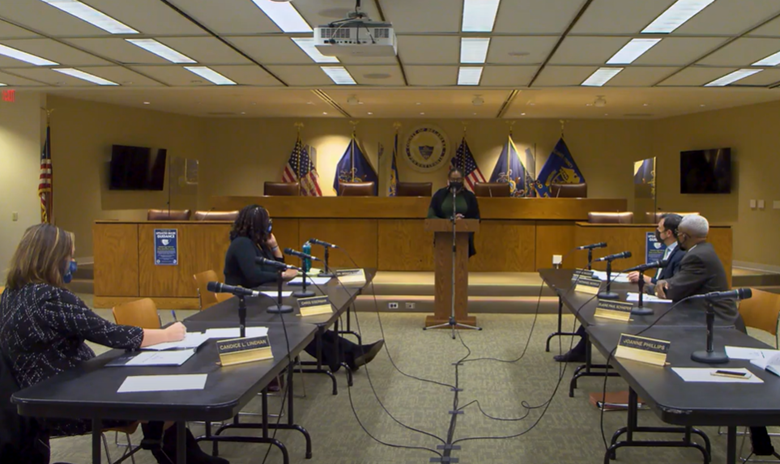
These were some moments from witness testimony in the trial challenging the constitutionality of the Pennsylvania school funding system, which moves into its eighth day in Commonwealth Court on Dec. 1. You can find daily highlights here. News outlets including the Philadelphia Inquirer, WHYY, Chalkbeat, and other local newspapers are following proceedings closely.
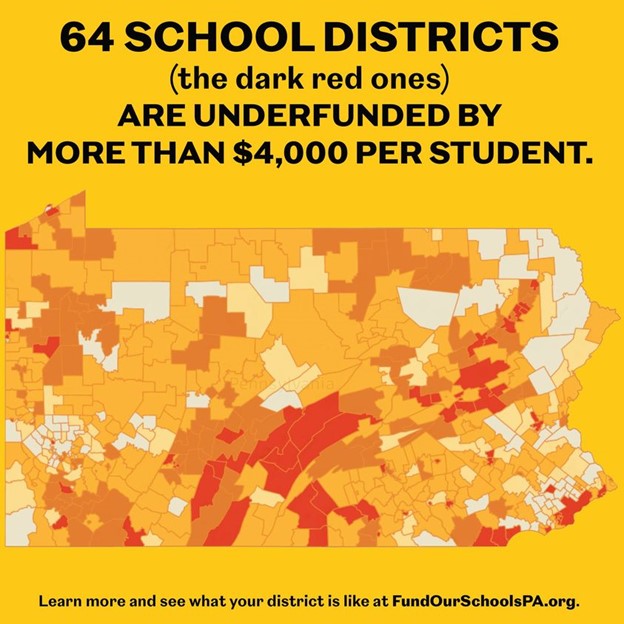
The trial is expected to continue for eight to ten weeks. Our witnesses are describing rural, urban, and suburban communities that cannot raise enough funds locally to ensure their children can graduate college- and career-ready. Our case also shows how inadequate state support to low-wealth school districts disproportionately impacts Black and Brown children across Pennsylvania.
We encourage you to watch the court’s livestream of the trial, share what you’re hearing via social media or letters to the editor, and contact your Pennsylvania legislators to urge them to finally start making the kinds of substantial investments in education that our children need and deserve.
|
|
Parent Webinar on Fair Funding |
|
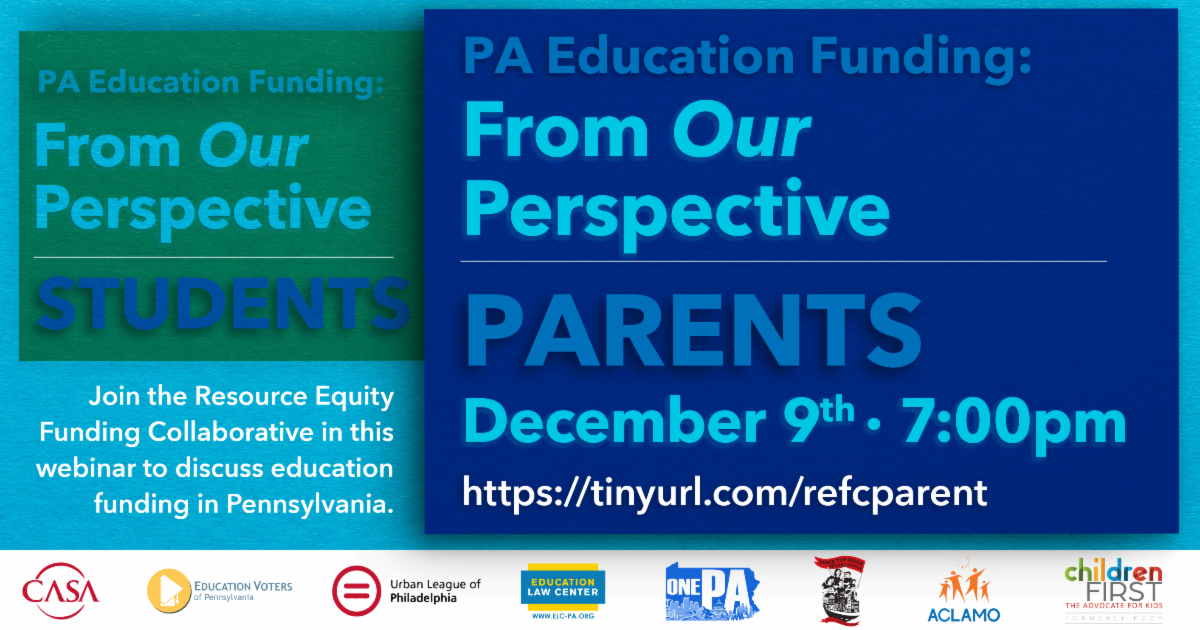
On December 9, ELC and our partners in the Resource Equity Collaborative will host the last in a recent series of school funding events for parents, students, and community members with parents from Bethlehem, Allentown, and Wilson School Districts. Parents will share how students and districts would benefit from adequate and equitable state funding. You can register here.
|
|
Credit Transfer Legislation Moves Forward |
|
Senate Bill 324, "Fostering A Smooth Transition for Graduation,” passed out of the Pennsylvania House Education Committee on Nov. 15 and is now headed to a vote on the House floor. The bill unanimously passed the Senate in June.
The bill ensures additional supports and access to timely graduation for students who experience “education instability” – students who have one or more school changes in a year due to homelessness, foster care, residential placement, etc. Without such targeted support, these students are at high risk of not graduating from high school at all.
Senate Bill 324 helps youth experiencing education instability achieve school success through graduation planning, transfer of records, and a point of contact in school. Please contact your state representative and urge them to support Senate Bill 324!
|
|
Pittsburgh School Board Votes Not to
Reinstate Exclusionary Discipline Policy
|
|
Last spring, ELC worked with partners to reduce the use of exclusionary discipline for non-violent offenses in Pittsburgh Public Schools’ code of conduct. This was an important reform to address the overuse of exclusionary discipline, which disproportionately impacts students of color and students with disabilities. Earlier this month, the School Board was asked to reinstate this harmful policy. ELC joined families and advocates to voice our opposition.
Our Equal Justice Fellow, Essence Kimes, testified for ELC and reminded the board that “reinstating this policy will lead students down a pathway that pushes them out of school and into carceral systems without addressing the underlying issues that give rise to the student’s behavior.” WESA highlighted our advocacy in their coverage of the issue. Ultimately, the board did not reinstate this harmful policy!
|
|
Advocating for Youth in Detention Facilities |
|
Attorney Ashli Giles-Perkins testifies to the Delaware County Board of Managers of Juvenile Detention |
|
ELC’s Independence Foundation Public Interest Law Fellow Ashli Giles-Perkins provided public comments on Nov. 16 to the Delaware County Board of Managers of Juvenile Detention about the educational deprivations and barriers that impact youth who are system-involved.
Our testimony emphasizes how educational barriers persist for these students, even after their release. (To watch the testimony, click here; ELC’s testimony begins at 1:04:14.) For youth with disabilities who are in detention, special education is commonly non-existent.
The Board of Managers was newly established in June, following the closure of the county’s Lima Juvenile Detention Center by a Common Pleas Court judge in March in response to allegations of abuse. ELC’s testimony highlighted how Delaware County has the opportunity to keep our young people in the community, ensure school stability whenever possible, and deliver necessary services that lead to greater success.
|
|
PA Supreme Court Finds Expulsion of Student Wrongful, Articulates ‘Real Threat’ Standard |
|
The Pennsylvania Supreme Court ruled in J.S. v. Manheim Township School District that school district administrators overreached when they permanently expelled a 17-year-old high school student for off-campus speech that did not constitute a threat or cause a substantial disruption.
The case involved a student who had sent Snapchat messages after school hours, referring to another student as a potential school shooter based on his appearance. J.S. told school officials he was joking and intended the online conversation to remain private but was nonetheless expelled. ELC, along with ACLU Pennsylvania, filed an amicus brief in the case in support of the student. Our appellate brief emphasized the importance of limitations to a school district’s authority to restrict free speech and highlighted the need to maintain critical due process protections in school discipline proceedings; the lack of such safeguards disproportionately impacts Black girls, students with disabilities, and LGBTQ students.
Affirming the Commonwealth Court’s decision, the Supreme Court concluded that where, as here, communications are “plainly not intended to threaten” other students, such communications do not constitute a “true threat.” J.S. had also argued that he was denied due process because he was not able to confront a student during the hearing. The majority ruling concluded that the matter should be resolved on the First Amendment question alone, leaving open the authority of school districts to compel a student’s attendance at an expulsion hearing.
|
|
Join Our Team:
We're Hiring a Development Specialist
and Attorneys in Philadelphia and Pittsburgh!
|
|
ELC seeks an experienced professional for a full-time development position in our Philadelphia office. The candidate should have at least 5 years of experience in development for a nonprofit, particularly working with individual donors, events and sponsorships, and foundations. The ideal candidate will also have a demonstrated commitment to civil rights, racial justice, and advancing the rights of underserved populations.
|
|
Thanks, Giving Tuesday Donors! |
|
Thank you to everyone who supported our #GivingTuesday fundraiser! It’s not too late to support our work.
|
|
Education Law Center | 215-238-6970 (Philadelphia)| 412-258-2120 (Pittsburgh)| |
|
A copy of the official registration and financial information of the Education Law Center may be obtained from the Department of State by calling toll-free, within Pennsylvania, 1-880-732-0999. Registration does not imply endorsement. |
|
|
|
|
|
|