When clients look to hire a law firm, there are many things that should be considered. Among one of the first things that come to mind is an inquiry as to whether the attorneys of the firm have the experience, aptitude, skills, and expertise required to accomplish the goals of the client on the matter at issue and matters of the company moving forward.
There are many ways to question and investigate firms regarding their capabilities for demonstrating requisite adroitness to achieve client goals, but inquiring into how the law firm trains its personnel and systematizes its workflows for maximum efficiency is almost never part of any consultation conversations. That always perplexes me, for if I were hiring a law firm to form a long term relationship with a work group of lawyers, I’d ask them to tell me how they source talent and train that talent to be industry and practice areas specialists focusing on preventing, diagnosing and treating any legal issues that would arise in a business like mine. If they couldn’t answer that question definitively, my search for a trade partner would likely continue.
Having a workforce with matchless hard and soft skills is important for a law firm, and for your business, for a variety of reasons. No matter what sector you work in, the tasks your employees perform every day rely on different tools and processes. It’s essential to ensure your employees have the technical skills and personality attributes they need to perform their jobs successfully for the benefit of your customer base. Giving employees the skills they need leads to happier employees, more productive employees, improved efficiencies, increased productivity and performance, uniformity of work processes, less skill gaps, reduced corporate waste, enhanced employee empowerment, and reduced turnover. This all results in your business having a competitive edge over others, and customer satisfaction.
Well-trained employees make customers feel appreciated, respected, and cherished because they are able to have their needs and concerns predicted and addressed in a proactive manner. When employees are confident and competent, they can focus squarely on the tasks at hand, which for a law firm like ours is delivering a partnership with a successful, solutions-orientated firm that strives to deliver measurable results and added value in transactional, litigation, regulatory or operational legal matters. A well-trained legal team will have a “problem spotted, problem solved” mentality that gives clients the peace of mind they need to manage risk and run a profitable business. So what does Jimerson Birr do to train its workforce?
Through tailored programming and coaching, JB’s training program focuses on key skill sets for all professionals and creating timely curriculum around current topics and trends. We place a heavy emphasis on practice skill development, understanding the business of our firm and our clientele, performance standards, business development and client service — all critical to success in today’s commercial environment.
To ensure that our professionals acquire the essential skills they need to practice law effectively, the firm has established a formal training program, administered by dedicated training specialists, job-specific subject matter experts, direct supervisors of personnel, and a Professional Development Committee comprised of representatives from each department and/or job classification within the firm. These professionals are charged with ensuring that our workforce satiates their thirst for the law and learns how to translate that knowledge to effective client services. Through the firm’s training programs, we offer comprehensive training and career development programs for our professionals that include valuable work experience, a wide variety of educational programs, practice resources, area of law specific training, guidelines for achieving core competencies, and individualized professional development through evaluations, feedback, mentoring, and career planning.
There are five (5) basic tenets to JB’s training program. Each tenet is described at a high level as set forth below:
1. Orientation and Onboarding - JB’s orientation and onboarding process is how the firm integrates new hires and gets them up to speed. During the onboarding process, employees learn more about the scope of their role, their colleagues, and the values of the larger organization. Through the process of onboarding, incoming employees have the opportunity to get access to and training for the tools they’ll need to be using. They will also be able to ask important questions and acclimate to the company climate. Orientation and onboarding transpires through a series of curated and often department-related training sessions that occur over two-week period time. This process is specifically designed to quickly enable employees to understand their role, how their performance impacts the firm at large, and what firm resources are available for utilization. It typically starts immediately after employees are hired and continues until they begin their focus on job-specific training and independent work after the first two weeks at the firm.
2. Job-Specific Training (Introductory, Intermediate) - JB takes a practical approach to on-the-job training by designing a program focused on each new employee acquiring introductory, intermediate, and advanced competencies and skills needed to become a key contributor in our working environment. Rather than showing employees academic presentations or giving them worksheets, JB personnel learn about the job by process immersion, task shadowing and task performance. JB trains by doing the job. This training happens at the workplace, with guidance primarily obtained from resources set forth within the firm’s learning management system content and augmented with personal instruction from a subject matter expert, supervisor, manager, department head, or another knowledgeable employee. Our job-specific training allows employees to gain experience working in situations similar to those they’ll encounter on a daily basis. Within the first six months on the job, JB employees can expect to learn workplace expectations, equipment operation, resource availability, workplaces systems and processes, and any other skill they need to complete their job successfully. For this part, JB largely relies on a crowdsourced LMS training program consisting of standard operating procedures and work instructions, and managed by subject matter experts, which provide detailed step-by-step instructions that allow processes to be completed accurately and consistently. These training materials keep procedures big and small running smoothly, securely, and at the highest quality. This approach to teaching is excellent for employees with tight schedules or a desire for more flexible learning opportunities. The hands-on approach makes it great for letting employees train and test themselves in real-world scenarios they may encounter on the job. Given the operational demands of practicing law and time budgeting, getting new employees up to speed on JB’s workflow, procedures, and service features can be a daunting task in a short time frame. However, JB’s self-paced LMS learning emphasis is one of the best ways to maximize knowledge retention while providing operational lodestars. Our LMS training content easily provides employees with the majority of any necessary training our employees need, while providing them with effective support that eases their pain points.
Beyond bundled coursework set forth in our learning management platform, JB provides an informal shadowing and mentoring program that enables employees with the opportunity to learn best practices from career professionals in a typical workday. Each supervisor and supervisee are implement a system of on-the-job learning that allows employees to closely follow, observe, and at times perform tasks of their supervisors and mentors performing within the role. Supervisors provide access to subordinate employees to observe professional decision-making processes, service deployment, colleague engagement, and professional goal construction and pursuit. JB’s informal shadowing and mentoring program has two primary goals: 1) to create connections between experienced and more junior professionals to facilitate information sharing; and 2) to ensure that professionals have access to a more experienced professional’s advice and guidance as they chart a path to success at the firm. No matter where we all are in our legal careers, we can always learn from our colleagues – particularly those with more experience.
3. Job-Specific Advanced Training - While most of the firm’s training programs are geared towards acquiring pressing job specific skills, integrating into the firm smoothly, and developing relationships that will set new employees up for success, the firm does not give up on the development process of an employee after they have assimilated into the firm and embraced the JB culture. In fact, just the opposite occurs. Through JB’s job-specific annual training program and Professional Development Committee lead external continuing educational initiatives, employees are able to continue developing in a manner that helps them gradually improve skills, acquire new knowledge, and progress in their careers.
Job-specific Advanced Training is provided to supplement introductory and intermediate training provided in the beginning of an employee’s career at the firm. Advanced training is focused on primary responsibility tasks from each employee’s job description and is conducted at least annually by the subject matter expert for the task. As each subject matter expert routinely refines LMS training materials and acquires new expertise, they are required to present those changes to all affected personally within each job category at least once per year. This advanced training, while provided by the subject matter expert, is curated by the departmental or job classification member of the Professional Development Committee that supervises the subject matter expert. On occasion, the firm will also impart new curriculum designed to introduce new skills or aptitude to a group of personnel within the same or similar job positions. These trainings often occur on Training Tuesdays on a scheduled created annually by the firm’s Professional Development Committee. Nearly all advanced training is provided by subject matter experts and is frequently accompanied by a meal or social engagement during or following the training. Another key component of job-specific annual training is employee participation in self-originated learning or continuing education.
Within each work group and industry team, leaders encourage all employees to use their rights to advanced learning by promoting external or self-motivated professional development, which may include such things as
- Legal or industry conferences and conventions
- Professional or trade association involvement
- Webinars or online learning courses
- Technical literature or treatises
- Practice or industry related blogs, newsletters, podcasts or online tutorials
- Work group focused lunch and learns or workshops
- Vendor produced training content
There are endless amounts of internet resources available to stay abreast of trends, current topics of interest and practical tools to help our personnel advance their legal career at their preferred pace, and JB endeavors to curate those resources for ease of access to curious minds.
4. Soft Skills Training - As part of the firm’s standardized training process, it offers coursework, consulting instruction and firm-led training in soft skills development. Soft skills are non-technical skills that can define how we interact with others and build relationships. Through honing our soft skills, our employees are able to acquire personality traits that enable one another to communicate and work cooperatively with co-workers and clients. These skills are useful for both new and tenured employees, and they play a vital role in building a respectful, collaborative, and efficient culture within our law firm. Examples of topics covered in soft skills training programs include:
- Communication;
- Decision making and problem-solving;
- Teamwork;
- Presentations and public speaking;
- Leadership and management;
- The Mentor-Mentee relationship;
- Time management and work ethics;
- Conflict resolution;
- Client service;
- Attention to detail
- Personal accountability and goal setting;
- Networking;
- Organizational skills;
- Delivering and receiving constructive criticism;
- Working under pressure, adaptability, and resilience; and
- Creativity and innovation in the workplace.
5. Firm Wide Annual Training - Firm administered annual training and development is essential in responding to the rapid business changes that occur due to continual economic fluctuations, evolution of law or professional service providing maxims, enhanced technology, and cultural and demographic factors. To respond to the need for employees to stay apprised of developments that require training from our entire workforce, JB provides training and development of employees to aid them in improving their ability to succeed at their current position, and to prepare them for career advancement. Examples of this types of training are:
- Advanced tailored training for technical process or applications provided by Subject Matter Experts, training teams on firm wide issues or implementation (e.g. new systems or policy changes);
- Firm policy or procedure refresher courses;
- Firm best practices refresher courses;
- Focused skills training;
- Technology training;
- Teambuilding training;
- Quality control training;
- Project management training;
- Sales training;
- Conducting meetings training;
- Special project kickoffs or progress reporting meetings;
- Goal and KPI review meetings;
- Guest speakers or external curriculum programs; and
- Workshops to collaborate and brainstorm on firm strategic goals.
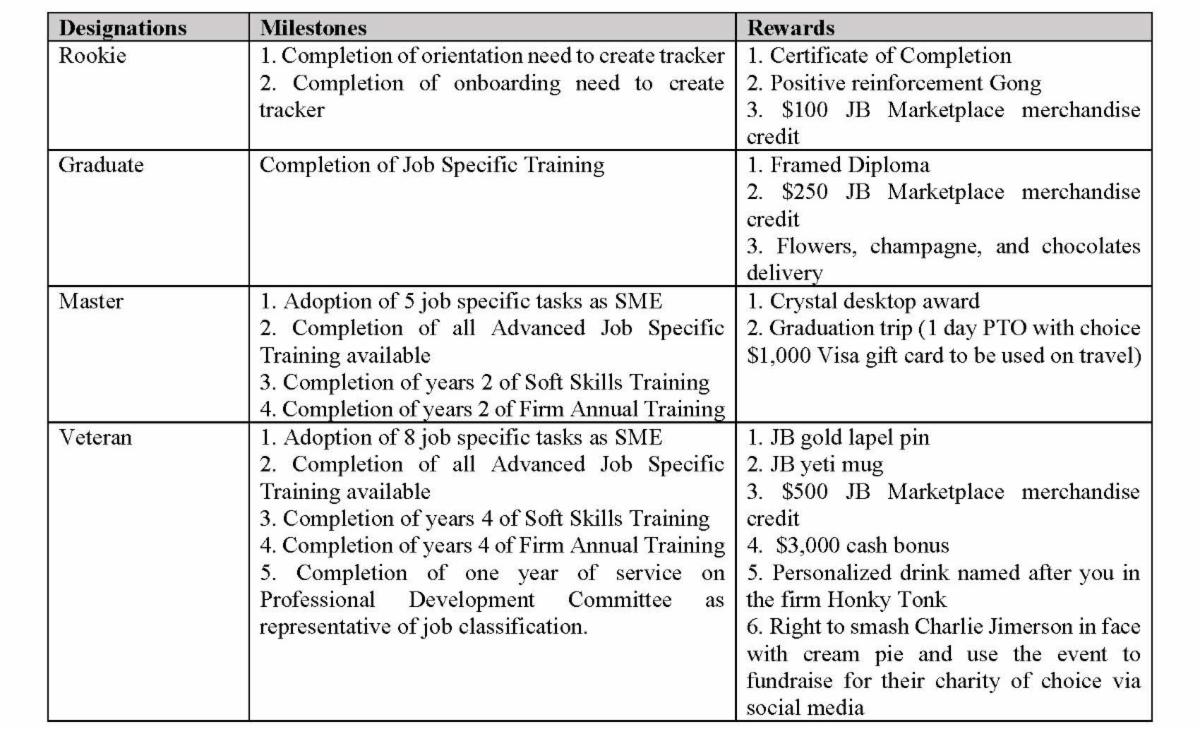
All of this culminates in achieving milestones within our programming path comprising JB University. JB University helps us progress and think bigger. JB University is an internal educational accrediting program designed to be a source of company pride and unity, as well as organizational growth. Navigating each year of prescribed training associated with JB University means stepping into a shared space of learning and discovery, committing to growth as a leader, and making new connections. A workshop or a private experience, a serendipitous brainstorming meeting, or just a simple advanced training conversation promoted by a JB University track can create a spark, generating innovative ideas and new possibilities for collaboration for our employees on a mission to deliver results for our clients.
This makes JB University more than a pipeline: it drives the evolution of our law firm. There’s a sense of the future through the curriculum and people participating in JB University. It’s a process where our small organization can act big, experiment, and try new things. Teams of professionals, subject matter experts, and external thought leaders come here to navigate their way from now to next.
What does JB’s University look like in action? This chart sets forth our course.