|
Greetings!
Here is your monthly update for those participating in the Time to Restore project in New Mexico, Oklahoma, Texas, and Louisiana. If you know others who may be interested in this newsletter, please send it their way! If you were forwarded this message, you can sign up to get on our list here.
| | | Upcoming virtual trainings | | |
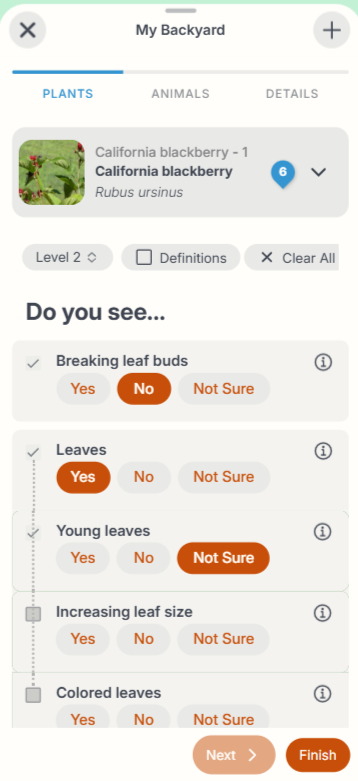
Join us for a virtual training Wednesday, December 3 at 5:30pm MT / 6:30pm CT. This December training will include a preview of the new Nature's Notebook app (pictured at right) that will be released next spring, so don't miss out!
We will also provide a brief overview of the project and a chance for Q&A about the project. This is a great opportunity to meet other observers collecting data on the Time to Restore project!
We've also added training dates through May. Our training calls in February and April will provide a full 1.5 hour training on how to participate in the project. The December, January, March, and May calls will be one hour and will include a brief overview on how to participate in Time to Restore, an update on the data collected so far, and tips on how to improve the quality of the data you collect as an observer.
| | Plant of the Month: Firewheel, Gaillardia pulchella | | |
Photo: Ray Matthews via Ladybird Johnson Wildflower Center
Each month, we feature one of the plants on the Time to Restore list. Firewheel (Gaillardia pulchella), also known as blanket flower, is one of our Texas priority species.
This species has a wide distribution across much of the central United States. The plants grow 1-2 feet tall and are heat and drought tolerant. This species has flowers clustered in inflorescences 1-2 inches across that consist of brownish-red disc flowers surrounded by bright, showy red and yellow ray petals. To know if the disc flowers are open, look for the reproductive structures, particularly the bright yellow pollen on the stamens. Disc flowers start opening on the outer edge of the disc, next to the ray petals, then progress in toward the center of the disc.
You may want to observe this species as a patch of plants. You can do this on your Observation Deck on the Add or Edit Plant page. If you have more than one plant or patch, consider monitoring 2-3 individuals at the same site to capture the variation between plants.
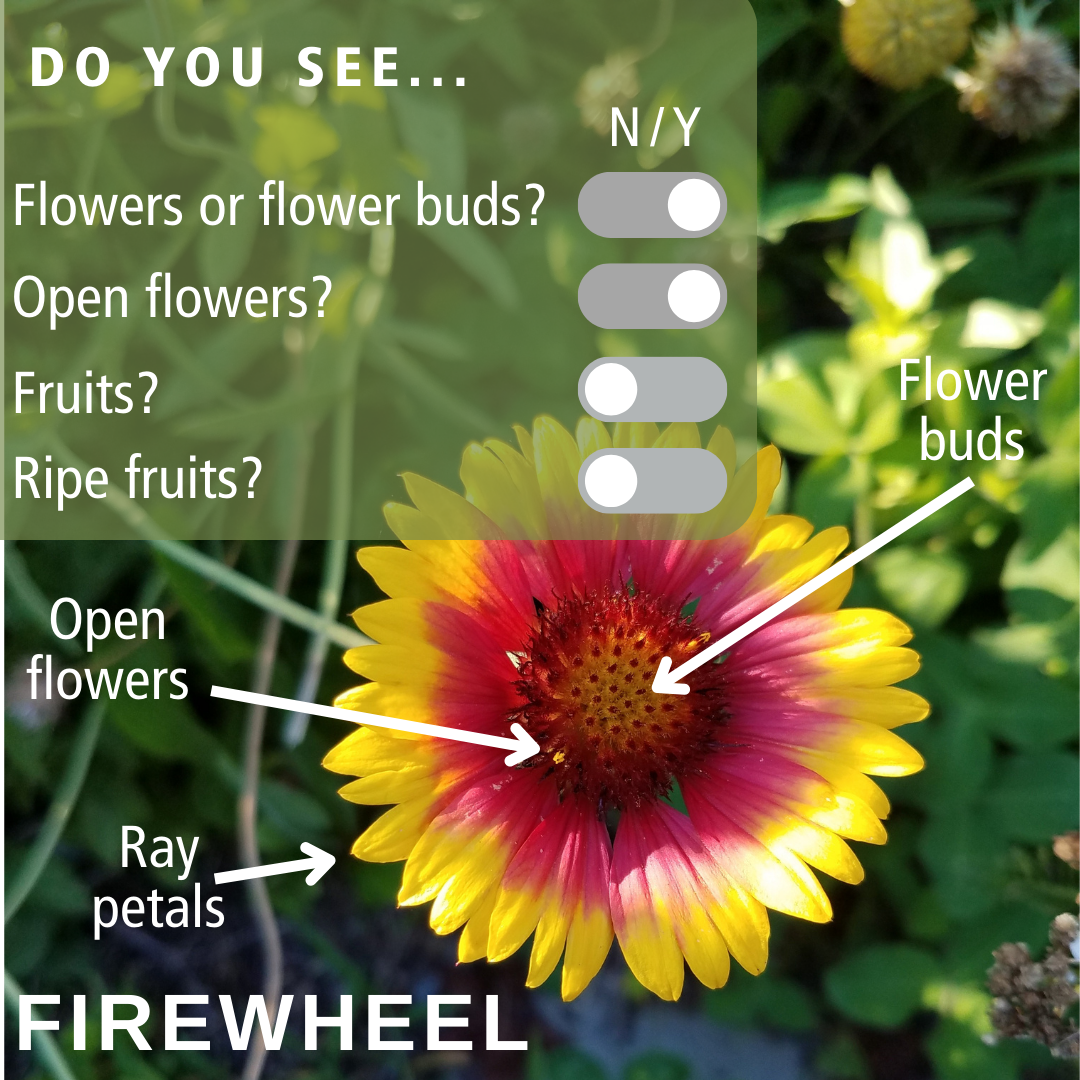
For the plant pictured below, you would report:
Flowers or flower buds - yes
Open flowers - yes
Fruits - no
Ripe fruits - no
| | |
Photo above: B Steiner via USA-NPN SmugMug
Remember that flowers for this species are not open until you can see the reproductive structures, particularly the bright yellow pollen on the stamens as pictured in the graphic above.
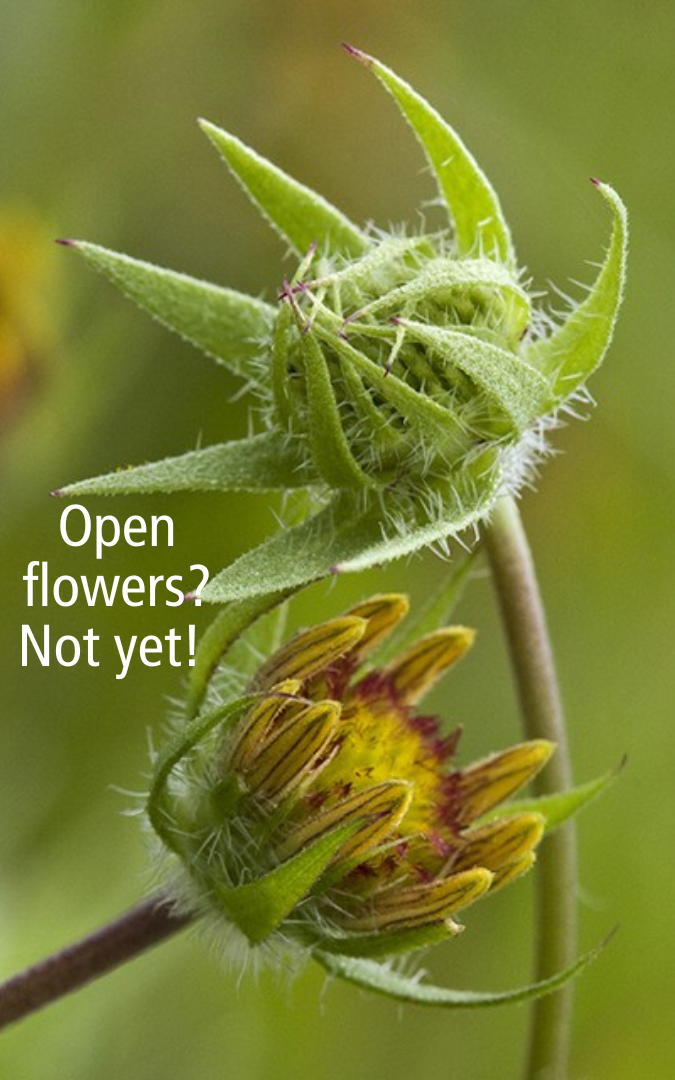
Disc flowers start opening on the outer edge of the disc, next to the ray petals, then progress in toward the center of the disc.
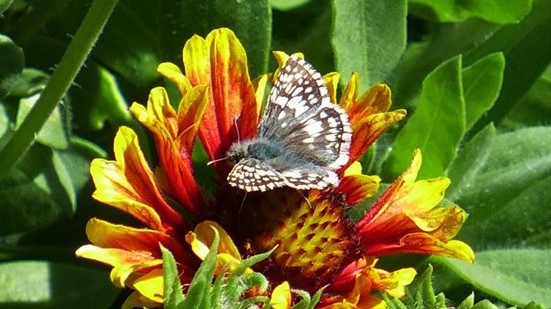
For the photo at right, you would report "yes" for flowers or flower buds but "no" for open flowers.
Photo at right: Steven Schwartzman, Ladybird Johnson Wildflower Center
| | | |
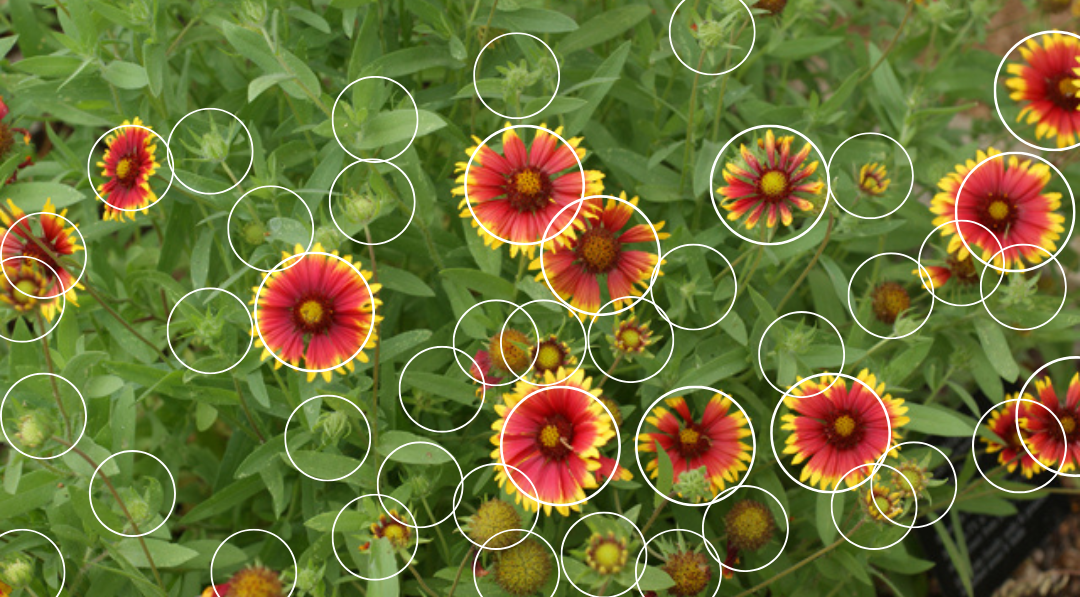
As for the optional intensity questions, you are answering the question "How many flowers or flower buds are present?" Remember that for this species, you should count the number of inflorescences on the plant, or patch of plants.
In the patch below there are approximately 45 inflorescences (each circled in white). The number may be slightly higher or lower than this estimate, but since we only need to select a bin, we would report 11-100 flowers or flower buds. Optionally, you could put the actual number of flowers you counted in the comments for your observation.
| | Photo: Ray Matthews via Ladybird Johnson Wildflower Center | | |
Nature's Notebook Nest
Stay connected with fellow observers and Local Phenology Leaders at the Nature's Notebook Nest! These standing monthly meetings on the first Monday of the month at 12pm PT / 3pm ET are a great chance to ask your questions and get advice from fellow observers. Mark your calendars, next Nest is December 1! If you sign up for reminders we'll send you an email a few days before and then the morning of the call.
| | | Training options in your state | | |
Participants in all states are invited to join us for monthly training series on the first Wednesday of the month. The next training will be Wednesday, December 3, 2025 @ 6:30 p.m. CT. Register here.
Louisiana
Interested in organizing a training for your group in Louisiana? Reach out to Gina Lloyd to schedule.
New Mexico
Interested in organizing a training for your group in New Mexico? Reach out to Kim Eichhorst to schedule.
Oklahoma
Interested in organizing a training for your group in Oklahoma? Reach out to Jane Breckinridge to schedule.
Texas
Interested in organizing a training for your group in Texas? While we have scaled back on trainings at this point in the project, we are still providing virtual trainings for larger groups of 40 of more. Reach out to David Gwin to schedule.
The table below shows the Texas counties that are represented by Master Naturalist and NPSOT chapters that have already approved the project. We are now up to 74 counties! Let us know if you are already planning on participating in the project but your county is not represented below!
| | | North Texas Counties | Dallas, Denton, Collin, Cooke, Fannin, Hunt, Kaufman, Montague, Parker, Rockwall, Tarrant, Parker, Wise | | Central Texas Counties | Bell, Caldwell, Bastrop, Blanco, Burnet, Comanche, Erath, Hamilton, Hays, Lampasas, Llano, Milam, Palo Pinto, Travis | | East Texas Counties | Polk, San Jacinto, Trinity, Tyler | | Southeast Texas Counties | Austin, Brazoria, Brazos, Burleson, Colorado, Fayette, Fort Bend, Galveston, Grimes, Harris, Lee, Leon, Madison, Montgomery, Nueces, Robertson, Walker, Waller, Washington, Wharton | | Southwest Texas Counties | Bexar, Comal, Guadalupe, Kinney, Medina, Uvalde | | West Texas Counties | Bailey, Borden, Cochran, Cottle, Crosby, Dawson, Dickens, Floyd, Garza, Hale, Hockley, Kent, King, Lamb, Lubbock, Lynn, Motley, Scurry, Stonewall, Terry, Yoakum | | | | | |
Gina Lloyd
Time to Restore Louisiana Coordinator
ginalloyd113@gmail.com
| | | | |
Kim Eichhorst
Co-Director of the Bosque Ecosystem Monitoring Program (BEMP)
New Mexico contact for Time to Restore
kimde@unm.edu
| |
Jane Breckinridge
Director of the Euchee Butterfly Farm and Tribal Alliance for Pollinators
Oklahoma contact for Time to Restore
jane@nativebutterflies.org
| | | | |