The Rule Is a Historic Step Forward
The Conservation and Landscape Health Rule represents a historic policy shift that elevates conservation to equal standing with energy development and recreation. It institutionalizes the integration of Indigenous Knowledge in federal land management and empowers Tribes to nominate and co-manage Areas of Critical Environmental Concern (ACECs). For the first time, the rule recognized Tribal Governments not merely as stakeholders, but as sovereign partners in stewarding ancestral landscapes.
Free, Prior, and Informed Consent
The DOI’s rescission of the rule without prior notice or formal consultation contradicts decades of federal Indian policy and undermines binding treaty obligations and trust responsibilities. It also violates commitments under the United Nations Declaration on the Rights of Indigenous Peoples (UNDRIP), including the principle of Free, Prior, and Informed Consent (FPIC).
“Any move to rescind the Public Lands Rule threatens to roll back progress achieved through years of advocacy,” said Chairman Mark Macarro, President of the National Congress of American Indians (NCAI). “Tribal Nations expect and demand that any subsequent policy preserves and expands our right to co-manage public lands, integrates Indigenous Knowledge meaningfully, and fulfills the federal government’s treaty obligations. Our voices will remain unified and strong in defense of our rights and ancestral lands.”
Tribal Nations Call for Immediate Action
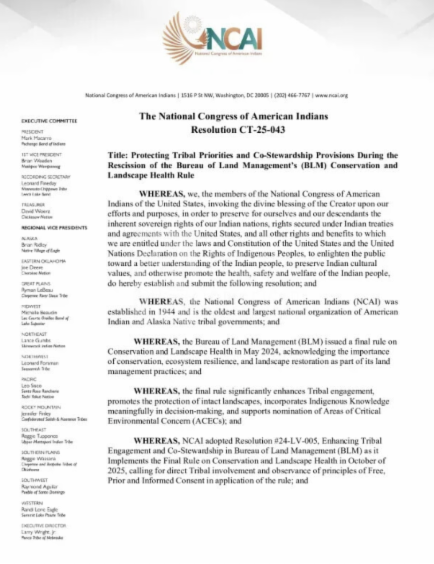
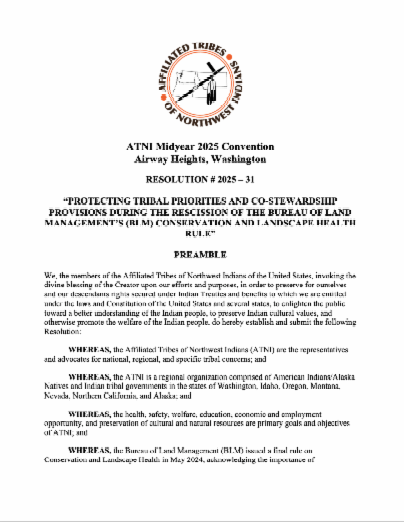
Resolutions from the Bering Sea Interior Tribal Commission, National Congress of American Indians, and Affiliated Tribes of Northwest Indians call for the following actions:
- Immediate halt to rescission of the Conservation and Landscape Health Rule.
- Full Tribal consultation before any revisions to public land management policies.
- Institutionalization of Indigenous Knowledge in land use practices with enforceable protections under FPIC.
- Binding data sovereignty safeguards, including FOIA exemptions and intellectual property protections.
- Continued Tribal participation in ACEC nominations, leasing decisions, and co-management of restoration and mitigation lands.
A Critical Moment for Climate and Cultural Survival
“This is not just about land—it is about our way of life, climate resilience, food security systems, medicines, languages, and sacred knowledge tied to these landscapes,” said Frank Katchatag, Chairman of the Bering Sea Interior Tribal Commission. “To remove Tribes from this process is to erase generations of science, culture, and stewardship.”
As environmental changes continue across landscapes, Tribal co-stewardship offers a proven, effective approach to safeguarding biodiversity and ecological integrity. A rescission would undercut efforts to adapt landscapes to climate extremes, further endangering ecosystems and cultural lifeways..
Standing Firm for Future Generations
The message from Tribes across the nation is unequivocal: uphold the Tribal provisions and priorities within the rule and keep the promise of co-stewardship and keep the promise of adopting Indigenous Knowledge with western science management practices. The Tribal Governments urge the United States government to hear the voices of Tribes across the Nation.
|