Campaigning for Democracy And Socialism |
|
Democracy Is Challenged by Fascism in a Conflicted Culture |
|
Biden tells us 'this is not who we are' when dealing with one or another version of this cartoon,
He's only partly right. Perhaps 30% of the electorate has been turned into zombies of the new confederacy. As cultural warriors in our dreams, Zombies are not known to regain their humanity. But there's still time to unite the many to defeat the few. Seize the moment!
|
|
 |
WE ARE INVITING FEEDBACK! Please send us your letters, comments, queries, complaints, new ideas. Just keep them short and civil. Longer commentaries and be submitted as articles.
DIFFICULTY READING US?
|
Graphic: Said Aniff Hossanee (Mauritius), The Thinker, 2020.
From Vijay Prashad
Make Noise about the Silent Crisis of Global Illiteracy: The Fifth Newsletter (2022)
Dear friends,
In October 2021, the United Nations Economic Commission for Latin America and the Caribbean (ECLAC) held a seminar on the pandemic and education systems.
Strikingly, 99% of the students in the region spent an entire academic year with total or partial interruption of face-to-face classes, while more than 600,000 children struggled with the loss of their caregivers due to the pandemic.
It is further estimated that the crisis could force 3.1 million children and youth to drop out of school and force over 300,000 to go to work. At the seminar, Alicia Bárcena, the executive secretary of ECLAC, said that the combination of the pandemic, economic turbulence in the region, and the setbacks in education have caused ‘a silent crisis’.
The situation around the world is equally dire, with the phrase ‘silent crisis’ perhaps in need of a more global application.
The United Nations notes that ‘more than 1.5 billion students and youth across the planet are or have been affected by school and university closures due to the COVID-19 pandemic’; at least 1 billion school children are at risk of falling behind in their studies.
‘[T]hose in poorer households’, the UN said, ‘do not have internet access, personal computers, TVs or even radios at home, amplifying the effects of existing learning inequalities. Close to one third of all children – at least 463 million – do not have any access to technologies for remote education; three out of four of these children come from rural areas, most of them from the very poorest households.
Because of the school closures during the lockdowns and the lack of infrastructure for online learning, many children ‘face the risk of never returning to school, undoing years of progress made in education around the world’.
|
|
|
|
Don't Surrender February! Defend Black History Month. We All Need It. |
From the Zinn Education Project
In his 1935 book, Black Reconstruction in America, W. E. B. Du Bois wrote, “One cannot study Reconstruction without first frankly facing the facts of universal lying.” He denounced the Dunning School, the dominant approach to Reconstruction at the time, which denied Black achievements and celebrated white supremacy.
Current scholarship is no longer dominated by the lies that Du Bois exposed in 1935, but those lies still loom large in popular understandings of Reconstruction. In writing a national report on the teaching of Reconstruction, Zinn Education Project researchers found the influence of the Dunning School in more than a dozen states’ standards and curricula.
The Dunning School’s distorted scholarship framed Reconstruction as an illegitimate enterprise that failed to sustain multiracial democracy. For much of the 20th century, this bogus history was used to justify denying Black people full citizenship. Its proponents used the pretense of scholarly objectivity to erase from the historical record Reconstruction’s monumental Black-led advances for racial justice.
Many K–12 standards seem to have followed suit. They emphasize the “failures” of Reconstruction, overshadowing its transformative nature and obscuring how white supremacists dismantled it precisely because of its successes. The “lies agreed upon” that Du Bois critiqued in Black Reconstruction are still alive and well. Learn more about the state of Reconstruction education and find recommendations for improvement in the upcoming report.
This report represents a comprehensive effort by the Zinn Education Project to understand Reconstruction’s place in state social studies standards across the United States, examine the nature and extent of the barriers to teaching effective Reconstruction history, and make focused recommendations for improvement.
Using our own Reconstruction standards as a guide, we examined course requirements, frameworks, and support for teachers. We also include stories about creative efforts by districts and/or individual teachers in each state to teach outside the textbook about Reconstruction.
Zinn Education Project Reconstruction Standards
The Zinn Education Project created and rooted our assessment of the state of Reconstruction education in the set of learning and teaching standards below.
These standards were developed in collaboration with scholars and teachers.
The foundational premise of any set of teaching and learning standards for the Reconstruction era should be Black people’s agency, highlighting both what Black people did (to end slavery, engage in politics, build institutions, etc.) and what goals, beliefs, and motivations undergirded those actions. Descriptions of the violent backlash to Reconstruction should emphasize how white supremacist ideology drove the effort to overturn multiracial democracy in the South and shaped the political and economic development of the entire nation after the Civil War. Read in full here.
|
|
|
|
Indiana House Passes Bill Targeting 'Critical Race Theory'
The Lafayette Independent
Feb 3, 2022 - The Indiana House of Representatives on Wednesday passed a controversial bill barring schools from teaching about Critical Race Theory, which examines history, culture, and the law through the lens of race and identity.
The bill would also require districts to post curriculum materials online and establish a curriculum advisory committee.
Rep. Tony Cook, R-Cicero, one of the bill's sponsors, said parents should be able to weigh in on what their kids are learning.
"The overriding intent of this bill is to provide curricular transparency," Cook asserted. "As well as to empower parents by returning them the opportunity to participate in the curriculum process."
Indiana's bills are part of a national push by Republican lawmakers to restrict the teaching of Critical Race Theory in classrooms. Education Week reports more than a dozen states have enacted such policies. Democrats and social justice organizations say the measures are an attempt to sweep portions of America's history under the proverbial rug.
Rep. Tonya Pfaff, D-Terre Haute, a teacher with nearly three decades of classroom experience, said she received more than 900 emails urging her to vote against the bill.
"Students are not fragile," Pfaff argued. "They want to learn, and they want their teacher to be honest about the uncomfortable truths of the past and the present."
Rep. Vernon Smith, D-Gary, argued discomfort is necessary to promote change.
"The only way you can get people to change is through two ways: either dissatisfaction, and that's discomfort, or through agitation, and that's discomfort," Smith contended.
The bill now goes on to the Senate for further consideration, where The Associated Press reported it faces an uncertain future. A similar bill in the senate died after one of its authors drew national attention for arguing teachers should be impartial when teaching about Nazism.
References:
|
|
As White Nationalists And Jan. 6 Extremists Embrace
Christian Nationalism, Even Darker Forces Revive
|
|
Photo: PROUD BOYS marching in front of the US Supreme Court along First Street between Maryland Avenue and East Capitol Street, NE, Washington DC on Wednesday morning, 6 January 2021 by Elvert Barnes Photograph
Proud Boys leader accuses Trump of leaving group 'on the battlefield bloody and alone'
By David Neiwert
Daily Kos via Alternet
Jan 28, 2022 - Most of the far-right extremist movements that arose online and then in real life over the past decade—the alt-right, white nationalists, and other authoritarian proto-fascists—have been generally ecumenical and areligious in their rhetorical appeals and organizing, other than their frequent expressions of antisemitism. But that’s beginning to change, as Jack Jenkins explored this week at the Washington Post.
With “Groyper” leader Nick Fuentes leading the way, it’s becoming much more common to hear them embracing Christian nationalism—an ideology long embraced by the larger radical right, particularly the so-called “Patriot” movement. Moreover, a number of these white nationalists appear to be pushing even farther into a particularly ugly—and previously stagnant—brand of religious nationalism: Christian Identity, the bigoted theological movement claiming that white people are the true “Children of Israel,” that Jews are the literal descendants of Satan, and that all nonwhite people are soulless “mud people.”
As Jenkins reports, since the Jan. 6, 2021, Capitol insurrection, Fuentes’ white-nationalist “America First” organization has increasingly employed Christian nationalist rhetoric: Chanting “Christ is King” at the antiabortion “March for Life” last week and at anti-vaccine protests, using crucifixes as protest symbols, and similar rhetorical appeals. In a speech at the America First conference in Orlando in March at which he declared America “a Christian nation,” Fuentes warned his audience that America will cease to be America “if it loses its White demographic core and if it loses its faith in Jesus Christ.”
“Christian nationalism—and even the idea of separatism, with a subtext of White, Christian and conservative-leaning [influences]—took a more dominant role in the way that extremist groups talk to each other and try to propagandize in public,” Jared Holt of the Atlantic Council’s Digital Forensic Research Lab told Jenkins.
Christian nationalism has long been a feature of the nation’s extremist right, dating back to the original Ku Klux Klan of the 1860s and its later version in the 1920s. Fuentes’s rhetoric “could have come word-for-word from a Klan speech in 1922,” historian Kelly J. Baker told Jenkins. “The Klan’s goal here was patriotism and nationalism, but it was combined with their focus on White Christianity.”
This worldview was a powerful animating force at the Jan. 6 insurrection, embodied by the moment when the self-described “Patriots” entered the vacated Senate chambers, took over the dais, and proceeded to share a prayer led by Jacob “QAnon Shaman” Chansley.
A video captured by The New Yorker shows the moment: One insurrectionist shouts, “Jesus Christ, we invoke your name!” The men bellow “Amen!” Then Chansley begins to lead them in prayer, saying: “Thank you heavenly father for gracing us with this opportunity to stand up for our God-given inalienable rights.” He also thanks God for allowing them to “exercise our rights, to allow us to send a message to all the tyrants, the communists and the globalists that this is our nation, not theirs.”
He concluded: “Thank you for allowing the United States of America to be reborn. Thank you for allowing us to get rid of the communists, the globalists, and the traitors within our government.”
As historian Katherine Stewart explained in the New York Times:
A final precondition for the coup attempt was the belief, among the target population, that the legitimacy of the United States government derives from its commitment to a particular religious and cultural heritage, and not from its democratic form. It is astonishing to many that the leaders of the Jan. 6 attack on the constitutional electoral process styled themselves as “patriots.” But it makes a glimmer of sense once you understand that their allegiance is to a belief in blood, earth and religion, rather than to the mere idea of a government “of the people, by the people, for the people.”
A number of the groups, notably the Proud Boys and Oath Keepers, who led the insurrection similarly voiced their affinity for Christian nationalism. The morning of Jan. 6, as Jenkins reports, a group of Proud Boys led by Ethan Nordean—the primary leader of the men who later spearheaded the siege of the Capitol, were seen praying together.
Nordean had spoken about “sacrificing ourselves for our country” while speaking at an impromptu Proud Boys rally near the Washington Monument, according to footage provided to Religion News Service (RNS) by independent journalist Dakota Santiago.
Nordean—a notorious street brawler nicknamed “Rufio Panman”—described an epiphany he had during a protest about Jesus Christ’s sacrifice on the cross:
I had a moment of realization where I was like, “You know what, I’m going to be diehard about everything in my life. I’m gonna be real.” Because everything that we have sacrificed—because you know how hard it is in this environment that we live in—it is time that you rise to the occasion. Be real.
Now you may not believe in that, but it’s important in the very least for my case for me, because this man did this thing. Just as we sacrifice ourselves for our country. A man provides and protects even when he’s not loved. That is what we do. We are hated but we do it in anyway, we keep showing up every day and we protect these people from these tyrannical dictators.
The same religious fervor has intensified in the aftermath of the insurrection, particularly as “Patriot” movement believers and their mainstream Republican enablers have doubled down with a gaslighting narrative insisting that what happened Jan. 6 wasn’t an insurrection, it was a righteous protest by Real Americans.
That narrative has been ardently adopted by Christian nationalists like the Trump supporters interviewed earlier this month by NPR:
Outside on the walkway, Murray Clemetson stands with an armful of hand-made signs he brought to church, such as, "Set the DC Patriots Free" and "We Are Americans, Not Terrorists." The law-school student and father of three —all home-schooled— was at the "Stop The Steal" rally in Washington, D.C., last year.
"The only insurrection that happened on Jan. 6 was by the agent provocateurs, paid actors, and corrupt police and FBI," he says, disputing all the evidence made public in the more than 700 criminal cases that the rioters were Trump fanatics.
The church the interviewers reported from is Ken Peters’ Patriot Church in Tennessee, one of the nation’s most prominent Christian nationalist congregations. Peters is a rabidly pro-Trump pastor who has appeared onstage in recent months with Mike Lindell, the “My Pillow” conspiracy theorist who claims Donald Trump was the victim of election fraud. Peters also spoke to the crowd gathered in Washington, D.C., on Jan. 5 at a pre-rally for the next day’s “Stop the Steal” protest that devolved into the Capitol insurrection. ...Read More
|
|
Digging Deeper into the Current Conjuncture: |
|
|
Photo: A protester holds up a sign that reads "We Never Left Jim Crow" during a protest. SCOTT OLSON/GETTY IMAGES
Voter Fraud Propagandists Are Recycling Jim Crow Rhetoric
The conservative plot to suppress the Black vote has relied on racist caricatures,
then and now.
By Nick Tabor
The New Republic
Feb 4, 2022 - It’s safe to say that in living memory, public trust in American elections has never been lower. A year into Joe Biden’s presidency, the statistics have become familiar: Roughly two-thirds of Republicans, and more than 40 percent of the general electorate, do not believe Biden’s 2020 victory was legitimate.
While Republican leaders pushing claims about the 2020 election being fraudulently decided ought to—and likely do—know better, the incentives are not hard to grasp. Pushing back against Donald Trump’s insistence that he won the election is politically dangerous within the GOP. But there’s a longer-standing tradition, as well:
Hysteria about election fraud has served the GOP’s legislative aims reliably. Last year, under the banner of “election integrity,” at least 19 states imposed new restrictions on voting access, and additional restrictions are in the works. These run a wide gamut, from familiar methods (such as tightening voter ID requirements) to novel ones (like making it a crime to pass out bottled water at polling places).
If this moment represents a rare and novel crisis, it also reflects an old pattern. The use of election fraud claims to justify voter suppression has a deep history in the United States, and nowhere was it used more aggressively than in the post-Confederate South.
During Reconstruction and the so-called “Redeemer” era, reports that Black voters intended to commit fraud served as grist for massive campaigns of voter suppression and intimidation. Ultimately, at the dawn of the Jim Crow era, this all culminated in a series of new state constitutions that systematically stripped Black men—and in many cases, poor whites as well—of their voting rights.
In speeches last month, Biden compared the January 6 insurrectionists to Confederate soldiers and likened the newest voting restrictions to Jim Crow policies. These comparisons were essentially apt—even if the laws in question are not nearly as extreme as those of the Jim Crow South. But the decades immediately following the Civil War, which are often overlooked in national memory, and which produced the Jim Crow order, may be the most instructive period for the present moment.
Southern fears about phantasmic voter fraud became widespread in the late 1860s, as ballot access was being extended to Black men on a state-by-state basis—and, not coincidentally, as the Ku Klux Klan was also expanding its reach. These voting rights were solidified in 1870, with the passage of the Fifteenth Amendment, which said no man could be turned away from the polls because of his “race, color, or previous condition of servitude.”
It’s hard to imagine the psychological effect this must have had on white Southerners. Hundreds of thousands of freedmen were now eligible to participate in elections, with each of their ballots carrying the same weight as the vote of a white aristocrat. The region’s electoral composition was swiftly and radically transformed.
It’s important to acknowledge that in the late nineteenth century, many elections were extraordinarily corrupt. This was the era of Tammany Hall, in which patronage, bribery, and fraud were the order of the day. Tammany officials routinely filled registration lists with the names of people who were dead, in prison, or nonexistent.
But at the same time, accusations of fraud—regardless of the facts in any given election—were de rigueur. It’s almost impossible to get a handle on the amount of fraud that was actually occurring; but scholarship from recent decades has suggested that overall, reports from the period may have been overblown. “The evidence,” as the scholars Howard W. Allen and Kay Warren Allen wrote in 1981, “is unsystematic, impressionistic, and by and large inconclusive.”
It was a common trope, going back many decades, to describe African Americans as shifty and dishonest. As soon as ballot access was broadened, reports of voter fraud started being overlaid on top of these claims.
From reading the old newspaper coverage, however, one clear takeaway is that for the Democratic Party—which was aligned with the South’s former slave-owning class—and its allies, voter fraud claims took on a racist hue in the postwar context. Democrats had long been claiming that African Americans were unfit to vote, given their low rates of literacy and civic education (even though the white ruling class itself was responsible for this deficiency). It was also a common trope, going back many decades, to describe African Americans as shifty and dishonest.
As soon as ballot access was broadened, reports of voter fraud started being overlaid on top of these claims. The narrative developed in Democratic newspapers that white Republican leaders were stealing elections and that African Americans were being enlisted as their pawns.
A useful case study is the election of 1872, the first presidential contest after the Fifteenth Amendment was enacted. . ..Read More
|
|
|
|
From The Classroom To City Hall: Meet Rita Joseph, NYC’s New Ed Committee Chair
By Christina Veiga
Chalkbeat
Feb 2, 2022 - As a teacher for 23 years, Rita Joseph has tried to make a difference for her students at P.S. 6 in Brooklyn. Now she hopes to affect the lives of many more students, as a newly elected member of the City Council and head of its education committee.
Joseph, who emigrated from Haiti as a child, taught students who are learning English as a new language. She stayed in the classroom throughout her campaign. Her last day was Dec. 23, giving her a front-row seat to the challenges of the pandemic, including teaching through the initial shut down, and now, the omicron wave. She has also experienced it as a parent worried about the ways COVID has interrupted her own son’s middle school education.
Joseph was elected to represent Brooklyn’s 40th District, which spans Flatbush, Prospect Lefferts Gardens, Kensington, Ditmas Park, and the southern edge of Crown Heights. She spent her first days in office calling every school in the district and has already met with Chancellor David Banks and American Federation of Teachers President Randi Weingarten.
Chalkbeat asked her about her time as a teacher, her priorities for the education committee, and what vulnerable students need to succeed in the face of so much interrupted learning.
Here are her answers, edited for length and clarity.
Tell me about your teaching career. What drew you to the classroom and how would you describe your teaching philosophy?
I wanted to be a diplomat. I studied international relations, studied abroad, and came back and started working for the UN. And once I was in there, I wasn’t happy because I wasn’t seeing the changes that I would like to see, because the UN is such a huge institution. And my cousin called and said, ‘Hey the DOE [Department of Education] is hiring bilingual educators.’
And I was like, ‘Oh, my Creole is not that great.’ So I started collecting Haitian Creole newspapers to teach myself how to write Creole, and then to read it fluently.
Then I was placed at P.S. 6 on Oct. 29, 1999. And I’ve never looked back. I tried to quit a couple of times, though. Mind you, education wasn’t my thing. My principal’s like, ‘Go back upstairs, Ms. Joseph.’ And she became my mentor.
Unfortunately, in 2005, she passed away. She said she saw some magic so we had to mold that. She molded me into the educator I became.
I went in, and I started fighting for the very basic things that my kids needed. From technology to arts, dance programs, making sure they were taken care of as a whole — educating the whole child. So that was the motto, educating the whole child.
It sounds like you really loved your job. So why did you decide to transition into politics?
I’ve been on the inside a lot, doing the change in just one school. With this opportunity, I can do so much more — a bigger platform. I may not be able to give them everything, but I’m going to darn try my best to deliver resources to all of these schools and help these students.
I want them to trust our public schools. I want them to know that when they come, they’re safe. They will get the resources and the support that they deserve, along with the parents. I want to hear parents’ voices. I want them engaged in every step of the way.
I’m a public school parent as well. I speak up. I talk. I want to find out what my kid doesn’t have, and how can we get it to their school?
Pivoting to your current role, the City Council doesn’t have direct policy making power over the education department. But one of your biggest levers of influence is holding oversight hearings and making top officials answer questions publicly. What will your first oversight hearing prioritize and why?
One of the biggest things I would love to focus on is: class size. Why isn’t it a priority? Why are we still having crowded classrooms, especially during this time?
Fighting for students who were historically left behind. I was an ESL (English as a second language) coordinator. I’ve seen our students. Students who live in alternative housing. I need their voice at the table as well.
And just families that are struggling, I want to fight for them. I want to bring (officials) in, put them in the hot seat if I have to, to find out, to deliver services to the children.
When it comes to COVID safety protocols in schools right now, what do you think is working well? What do you think needs to change? What can the City Council, and the education committee, do to address those concerns?
I was at two schools this morning. I noticed they do the temperature check. They do the screening. Students are sitting at their three feet. They have their mask on — no one had a mask below their nose, on top of their head. I didn’t get to see lunch. One of these days I’m going to pop in to see how the lunch protocol works.for them. ...Read More
|
|
|
|
In One Year, $1.78 Trillion Was Stolen From the Working Class
|
|
The wealth workers should have received, had wages kept up with productivity, was instead given to shareholders.
By Colleen Boyle and Eric Dirnbach
In These Times via Common Dreams
Feb 3, 2022 - The fate of the Build Back Better Act is currently unknown. The bill would be the largest social spending achievement in decades and provide needed services and support to millions of families—with more than half of the proposed $1.75 trillion in spending going to child care, preschool, affordable housing, higher education and healthcare.
But this proposed spending, over 10 years, is barely noticeable compared with the wages workers have lost over the past 40 years. In terms of productivity, wages should be significantly higher than they are, and the average worker continues to be shortchanged thousands of dollars annually. And much of the money workers should be getting is instead being pumped up to the top 0.3% of income earners.
How Much Money Have Workers Lost?
The chart above from the Economic Policy Institute (EPI), an independent think tank, shows the growing gap between productivity and worker pay since 1979, during which productivity grew 3.5 times as much as pay.
A number of factors have contributed to this productivity-wage gap. According to EPI, starting in the late 1970s, more unemployment has been tolerated to reduce inflation, the federal minimum wage has been raised less often, the deregulation of a number of industries has kept wages lower, corporate globalization has increased, wage theft has grown, and labor laws have failed to stop growing employer hostility toward unions. As unions declined, they had less power in their industries and therefore less ability to negotiate better wages to capture productivity gains.
In the chart, the line tracking productivity soars while the line tracking wages stagnates. As the two diverge, income inequality increases.
Less explored than the causes of the productive-wage gap is how much this gap is actually costing workers in real dollars—and where that lost income is going instead. As EPI's Lawrence Mishel and Josh Bivens calculate, if wages had kept pace with productivity, then the median hourly wage (adjusted for inflation) in 2017 would have been $33.10. The actual median hourly wage in 2017 was $23.15, a gap of $9.95 per hour.
We calculated what that gap has cost the average worker. According to the Current Employment Statistics (Establishment Survey), produced by the Bureau of Labor Statistics, the average weekly hours of production and nonsupervisory employees for private sector employers in 2017 was 33.6 hours.
33.6 hours per week x 52 weeks = 1,747.2 annual hours worked
1,747.2 annual hours x $9.95 per hour in lost wages = $17,385 in lost annual pay
In 2017 alone, then, the average worker lost $17,385—because wages have not kept up with productivity.
In July 2017, the Bureau of Labor Statistics reported the total number of production and nonsupervisory employees to be 102.5 million workers.
$17,385 x 102,500,000 workers = $1,781,962,500,000 in lost income for workers
Which means—in 2017 alone—the total amount of income lost to all production and nonsupervisory workers was $1.78 trillion.
Where did that money go?
Basically, corporate profits have been soaring. In the chart below, based on data from the Bureau of Economic Analysis, this tremendous rise in corporate profits becomes apparent.
So companies have been paying employees an increasingly smaller share of the value their labor produces, which is another way of seeing what the productivity-wage gap already showed us. But there are many things corporations can do with profits, and they usually don't hoard the money in corporate bank accounts.
What did they do with the extra wealth they were extracting from their workers? Partly, they increased dividend payments to shareholders.
In 2017 alone, dividends paid by U.S. businesses totaled $1.5 trillion. Between 1979 and 2020, domestic corporations paid shareholders $27 trillion.
Here's the productivity and worker-pay chart from EPI again, but with annual corporate dividends added:
The wealth workers should have received has, arguably, instead been given to shareholders through dividends—a mechanism which functions like an upward distribution of wealth.
Of the $1.8 trillion not paid to workers in 2017, $1.5 trillion went to shareholders instead.
But aren't a lot of workers also shareholders? In a sense, aren't they just getting their money another way? Not really, according to the data.
For the 2017 tax year, aggregate data from the IRS shows that 83% of dividends went to filers with an adjusted gross income of more than $100,000—roughly the top 18% of filers.
What's more, 37% of all dividend income went to the top 0.3% of filers—those who took home more than $1 million. ...Read More
|
|
Francis Collins On Covid-19 Politics:
'The Culture War Is Literally Killing People’
|
Photo: Francis Collins, former National Institutes of Health director and the founder and senior fellow of BioLogos. Photo courtesy of BioLogos
Many white evangelicals, said the former head of the National Institutes of Health, have been ‘victimized by the misinformation and lies and conspiracies that are floating around, particularly on social media and some of it in cable news.’
By Adelle M. Banks
Religion News Service
Feb 3, 2022 (RNS) — Former National Institutes of Health director Francis Collins said he is “heartbroken” that more of his fellow white evangelicals have not received the COVID-19 vaccines.
“I am just basically heartbroken in a circumstance where, as an answer to prayer, vaccines have been developed that turned out to be much better than we dared to hope for,” he said in an interview with Religion News Service on Wednesday (Feb. 2).
“And yet they are still not seen as something that a lot of white evangelicals are interested in taking part in and, as a result, people are dying. I just didn’t see that happening and certainly not at this scale.”
Collins is the founder and senior fellow of BioLogos, an organization that seeks to foster the integration of “rigorous science” with Christian faith. He and BioLogos President Deborah Haarsma, an astronomer, spoke to journalists at a Faith Angle Forum/BioLogos webinar on Wednesday titled “Faith and Science in an Age of Tribalism.”
Haarsma said on the webinar that the country’s divisions have reshaped views of science.
“The world has become so aggressively polarized that it seems like every issue has to land in a red camp or a blue camp, and when you view the world that way, somehow Christian faith gets assigned to red and science gets assigned to blue,” she said. “And for scientists who are Christians, like myself and Francis Collins, this just doesn’t make any sense to us.”
Collins stepped down in December after 12 years as the NIH director and still runs a government research lab so spoke as a private citizen.
He tied “this red-blue situation” — including social media, political messages and words heard in churches — directly to the COVID-19 pandemic. He said it includes white evangelicals who are resistant to or disinterested in pursuing vaccines — some 30% to 40%, according to PRRI and Pew Research Center.
“The culture war is literally killing people,” added Collins, citing estimates that more than 100,000 people have died unnecessarily due to vaccine resistance and hesitancy even as “hundreds of thousands of lives” were saved.
Francis Collins, from top, Deborah Haarsma and Peter Wehner participate in a Faith Angle Forum/BioLogos webinar titled “Faith and Science in an Age of Tribalism," Wednesday, Feb. 2, 2022. Video screengrab
Collins said in an interview after the webinar that many white evangelicals have been “victimized by the misinformation and lies and conspiracies that are floating around, particularly on social media and some of it in cable news.”
But he also wondered about his success in conveying the lessons from the science he has watched develop over the last two years.
“l Iook at myself and say, ‘Have I failed in my role as a public communicator?’” he said.
Haarsma said she understands that some resistance to vaccines and boosters has nothing to do with evangelicalism.
“There’s some people who were vaccinated once and had a bad reaction, so they didn’t want their second shot or didn’t want the booster,” she said in the joint interview with Collins. “And I’d like to explain to them that, hey, getting another shot could really help you and you might not have a bad reaction again.” ...Read More
|
|
From the CCDS Socialist Education Project... |
|
|
A China Reader
Edited by Duncan McFarland
A project of the CCDS Socialist Education Project and Online University of the Left
244 pages, $20 (discounts available for quantity orders from carld717@gmail.com), or order at :
The book is a selection of essays offering keen insight into the nature of China and its social system, its internal debates, and its history. It includes several articles on the US and China and the growing efforts of friendship between the Chinese and American peoples.
|
|
|
|
Taking Down
White Supremacy
Edited by the CCDS
Socialist Education Project
This collection of 20 essays brings together a variety of articles-theoretical, historical, and experiential-that address multi-racial, multi-national unity. The book provides examples theoretically and historically, of efforts to build multi-racial unity in the twentieth century.
166 pages, $12.50 (discounts available for quantity), order at :
|
|
|
|
NOT TO BE MISSED: Short Links To Longer Reads... |
|
Photo: Everybody, back to the office. Bettman Archives / Getty Images
Does Hybrid Work Reduce Carbon Footprint? It's Complicated
Compared to either fully office-based or remote, could it be the worst of both worlds?
By Lloyd Alter
Treehugger
Feb 3, 2022 - Many companies are pushing to get their employees back to the office, calling it critical for maintaining the corporate culture.
This Treehugger has often written that the third industrial revolution would be the end of the office and that in the future it would be a coffee shop: "The major purpose of an office now is to interact, to get around a table and talk, to schmooze. Just what you do in a coffee shop."
The main reason I was so enthusiastic about the end of the office was the energy and carbon it would save. Not just the gas in the cars or the building operations, but the massive embodied and upfront carbon from building office buildings and the highways, subways, and other infrastructure designed to meet the peak demand of the morning and afternoon commute.
Many employees do not want to go back to the office full-time, and many companies are settling into the concept of hybrid offices, where employees work from home a couple of days per week. But while totally closing offices and eliminating commutes could make a big difference in emissions, what is the impact of going hybrid? The Carbon Counter at The Financial Times had a look at this and came up with some interesting—and some questionable—conclusions. They conclude hybrid might be the worst of both worlds:
"A half-empty office needs much the same heating and air conditioning as a full one. Giving up the commute two days a week may not be enough to cancel out the extra heating and lighting needed at home. That is the case for a British worker who lives alone and — like 69 percent of his compatriots — drives to work."
They see a slightly different picture in the U.S. where "there are bigger savings from homeworking, largely down to a cut in the time spent driving gas-guzzling cars." They also worry that people are moving further from the city, being willing to have longer commutes for fewer days per week, and they are moving to bigger suburban houses, where they have twice the footprint of someone living in the city.
The Carbon Counter estimates that full-time home working has a footprint of about half of full-time office working in the U.S., but only a minor saving in carbon emissions with a switch to three days in the office, two at home, based on a 22-mile commute and a 40% increase in heating and electricity for those days working from home.
I suspect the savings are going to be greater. No company is going to keep 100% of their office space for two-thirds of the number of people and will eventually rationalize this, especially when the pandemic is over and they are no longer worrying about social distancing. Companies are going to do a lot more "hot-desking" where employees do not have permanent personal spots, which many find makes the office less attractive an option, encouraging more people to work from home as much as they can. ...Read More
|
|
New York Magazine’s
Union Scores Its First Contract in the Newsroom’s 54-Year History
By Daniel King
Mother Jones
Jan 13, 2022 - Yesterday, after two and a half years of negotiating with magazine management and just hours after Bernie Sanders announced his support for its members, New York magazine’s union announced it had “finally (finally!!!!!!) reached an agreement in principle with management” for the first time in the publication’s 54-year history.
“More to come soon, but for now we are so incredibly proud of and grateful for our incredible members,” the union tweeted, “(and Bernie).”
“I stand in solidarity with @NYMagUnion workers,” Sanders had said. “Management must come to the table and agree to a fair contract now.”
The union’s 130-plus editorial workers have actualized in an agreement the bargaining power accrued across the NewsGuild of New York—which also represents workers at the New York Times, the New Yorker, Daily Beast, BuzzFeed News, and the Nation.
It comes as corporate consolidation accelerates across digital publishing: Vox Media, which owns New York magazine, announced it’s buying Group Nine Media; the combined company is expected to make more than $700 million in revenue and $100 million in pretax profit this year, the Times reports.
That’s a massive empire whose workers are already seeking seats at the table.
And with consolidation’s rise—BuzzFeed gobbled up HuffPost, and Vice Media acquired Refinery29—unions stand to both gain and lose increasingly. Sanders’ support has become familiar fare in that story arc, and media shops continue to leverage his tweets and bring to bear the full force of his 15.5 million followers.
A classic in the Sanders canon was his 2019 tweet skewering media dingus Jim Spanfeller, the widely despised and journalistically illiterate CEO of G/O Media, which owns Gizmodo, Jezebel, The Root, The Onion, and other sites: “I stand with the former @Deadspin workers who decided not to bow to the greed of private equity vultures like @JimSpanfeller,” Sanders wrote, naming the executive most synonymous with sparking the exodus of highly regarded editors and reporters, the bruising of beloved media brands, and the shelling out of once-great platforms.
Under Spanfeller, The Root in particular has seen more than two-thirds of its phenomenally talented staff leave, and A.V. Club staff was stunned last week to see hiring notices posted online for their own jobs, a corporate tactic to force them to move offices across the country. “This is the kind of greed that is destroying journalism,” Sanders had said of Spanfeller.
But while Sanders boosts and bemoans plenty of media outfits, and has endorsed Starbucks unions, Amazon workers, and custodians’ unions, what unites these stories is not their loudest political supporter. It’s their shared recognition that a theory of labor is tenable: Workers unionize when they see that unions work. ...Read More
|
|
Photo: António Costa at a campaign rally before his re-election as Portugal’s prime minister.
Costa’s Win In Portugal Continues Comeback By Europe’S Center-Left
Analysis: Social democratic parties that have adapted to the political landscape are winning elections again
By Jon Henley
The Guardian
Feb 4, 2022 - The unexpected triumph of António Costa’s Socialist party in Portugal’s elections this week continues a cautious comeback by Europe’s centre-left – and, analysts say, may hold some lessons in what remains a mixed picture for the continent’s social democrats.
After wins last autumn by Germany’s SPD and Norway’s Labour party, the Portuguese prime minister’s unexpected victory – with 41.7% of the vote, five points up on 2019 – was further good news for a movement that five years ago looked in terminal decline.
In some countries, it still does. The French Socialist party was all but obliterated in the 2017 elections and polls predict its candidate in this year’s presidential race, Anne Hidalgo, the Paris mayor, will do well to capture more than 3% in the first round, a barely imaginable score for a party once led by François Mitterrand and which, only a decade ago, controlled the Élysée, senate, parliament and most of France’s regions.
The Dutch Labour party (PvdA) likewise collapsed to a record low in 2017, winning less than 6% of the vote and losing almost three-quarters of its MPs, and in parliamentary elections last year it failed dismally to improve on its score.
And while the context in central and eastern Europe is different, the Czech Social Democrats (CSSD), who had won four of the six polls held since the country’s formation in 1993 and come second twice, lost so heavily in October that they are no longer even in parliament.
Elsewhere, things are rosier: all five Nordic countries are led by centre-left governments; Italy’s Democratic party is a member of its ruling coalition; Pedro Sánchez’s PSOE heads a progressive alliance in Spain; and a social democrat chancellor, Olaf Scholz, leads a three-party left-liberal coalition in Germany.
Political scientists point to multiple reasons for the decline of Europe’s centre-left over the past decade, and explanations for its cautious recent revival appear just as varied. “We should be very careful about generalising too much,” said Gérard Grunberg, an emeritus professor of European politics at Sciences Po in Paris.
Social democratic parties with their roots in 19th-century labour movements could for decades count for their core vote on traditional, especially manual, workers – an electorate that has shrunk by as much as 50% in some countries. The 2008 financial crash and its economic fallout added anger over high unemployment and falling living standards to mounting alarm among many of those traditional voters at broader trends – globalisation, automation and immigration.
Far-right parties played on those fears while, at the other end of the political spectrum, anti-capitalist, anti-globalisation, anti-establishment far-left parties proved equally attractive to another part of the centre-left voter pool: middle-class, often public sector, teachers, healthcare workers. ...Read More
|
|
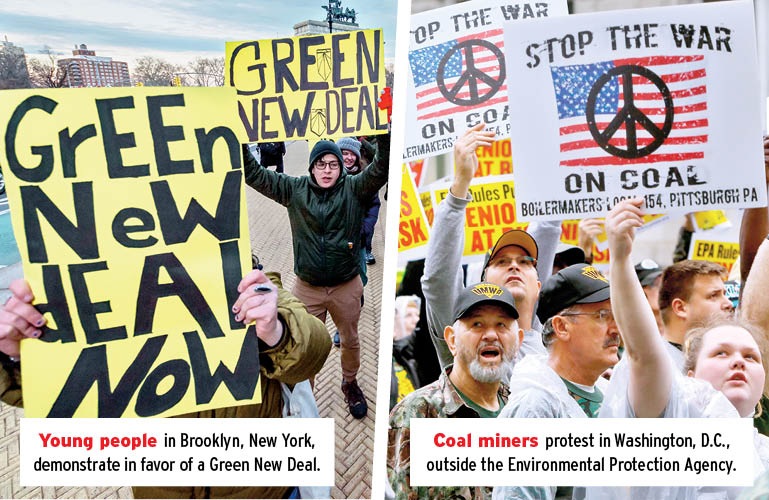
Organizers in Appalachia Are Building a Green New Deal Blueprint for Themselves
By C.J. Polychroniou
Truthout
Feb 2, 2022 - The Green New Deal proposal is one of the only effective, broadly recognized pathways to tackle the climate crisis and address its social and economic consequences. It is technologically possible and economically sustainable. Yet although the Green New Deal project is already under way in some shape or form in various states, it has yet to be scaled up to the national level. In fact, climate policy as a whole has been stalled in Congress, and the Biden administration has so far engaged more in symbolic gestures than in living policy processes.
With time quickly running out to prevent a greenhouse apocalypse, activists need to reorganize and unite efforts to build massive public support and political will for climate action. In this context, much is to be gained by looking at the work of ReImagine Appalachia, which is promoting a Green New Deal blueprint for the Ohio Valley region. This is the focus of the following exclusive interview for Truthout with Amanda Woodrum, senior researcher at Policy Matters Ohio and co-director of project ReImagine Appalachia.
Woodrum works at the intersection of energy, equity and the environment with the aim of finding common ground among environmental, labor, racial justice and community leaders to create a powerful grassroots movement with the capacity to assist in the transition toward an ecologically sustainable and equitable future.
C.J. Polychroniou: It has been three years since Rep. Alexandria Ocasio-Cortez (D-New York) and Sen. Edward Markey (D-Massachusetts) introduced a Green New Deal resolution. Progressive Democrats in Congress also introduced the THRIVE ?ct in April 2021, which is in line with the vision of the Green New Deal. Yet, very little progress has been made so far toward decarbonizing the economy and moving in the direction of a sustainable and equitable future. Is this an accurate assessment of where we are? If so, what are the main obstacles that need to be overcome so we can keep moving forward in the hope of avoiding a greenhouse apocalypse?
Amanda Woodrum: Let my answer be a big verbal hug to you and others who feel like you do. We have made progress, big progress, it just hasn’t fully materialized into actual infrastructure quite yet (at least not at the scale we need).
First, I think of [the bipartisan infrastructure package] as a down payment on our climate infrastructure needs. It contains hundreds of billions of dollars for modernizing our electric grid, electrifying our transportation system, including public transportation, upgrading the nation’s rail infrastructure, and starting to repair the damage from the last century of extraction industry practices — reclaiming abandoned mine lands, capping orphaned oil and gas wells that spew methane, and remediating brownfields at shuttered coal plants and former steel facilities. The Biden administration is currently working to develop federal policy guidance on these resources designed to ensure the jobs created from these investments are good union jobs and pathways into those union jobs are built for Black workers and other people of color, as well as women and the many other people currently working in low-wage jobs.
Second, we are at a tipping point. Much work needs to be done to make sure the resources from bipartisan infrastructure package are spent the right way. If we are successful in this, it will change the landscape, both physically and mentally.
Even in Appalachia, if these resources are spent wisely, we will see that national climate solutions, if done right, can be good for the economy and the working people it serves. More and more people already understand this, or we wouldn’t have gotten this far.
As you know, the Ohio River Valley of Appalachia, also known as coal country, has long been a political stumbling block to national climate and clean energy solutions. No longer. Appalachia is now at the table of the national conversation. We know what we want and need.
ReImagine Appalachia is advancing the vision of a 21st century economy for the Ohio Valley. Can you talk about the principles and aims guiding this vision?
ReImagine Appalachia is a collection of hundreds of stakeholder groups working across the Ohio River Valley states of Appalachia — Ohio, Pennsylvania, West Virginia and Kentucky. We came together to create a collective vision of what a 21st century sustainable Appalachia looks like, and to build out the roadmap for how we get from where we are to where we need to go.
It is important to understand that Appalachia is essentially an area of concentrated poverty. The region has been exploited for more than a century by absentee corporations in the extractive industries — exploiting our workers, damaging our lands, and leaving our workers and neighbors sick. With the abundance of natural resources in the lands of coal country, one would think we would be the richest region in the nation. But we are not. We are the poorest. Too many of the region’s counties rank in the bottom 10 percent nationally for their high level of unemployment and poverty, and low family incomes. The region is poor, and it isn’t going to lift itself up by its collective bootstrings.
National climate solutions, if Appalachia is at the table, can be an opportunity to secure much needed and deserved resources for the region. Appalachia literally powered the prosperity of the rest of the nation, while the region itself was left in poverty. We believe the region is owed its due share of climate infrastructure resources.
The people of Appalachia want everything everyone else wants — a modern electric grid in Appalachia that doesn’t lose power every time it rains hard; universal, quality broadband affordable to everyone so the kids can use computers without going to the library and parents can work remotely; to grow clean and efficient manufacturing in the region with equivalent jobs to those found in the coal industry; and, to build out a sustainable transportation network that includes an Appalachian rail corridor. Perhaps more importantly, we want the good union jobs that can come with these investments. These infrastructure investments can put the region’s residents to work building the future they want to live in while also laying the foundation for a much more prosperous economy over the long haul.
We must also invest to repair the damage from the last century of extractive industry practices — reclaiming abandoned mine lands; remediating brownfields, including coal ash ponds and coal slurries; reforesting the region; restoring the wetlands; and supporting sustainable agricultural practices among local farmers rather than Big Ag. This is why the coalition to ReImagine Appalachia is calling to revive the Civilian Conservation Corps, as a carbon farming strategy that involves absorbing excess carbon with natural greenery. One can easily see how many people we could put to work just planting trees. We also think a revived Civilian Conservation Corps, as a public jobs program paying living wages, could be used to create second-chance opportunities for our many residents that were caught up in the “war on drugs” and opioid[crisis], something that hit Appalachia hard.
We call it a new deal that works for us.
Who are ReImagine Appalachia’s partners, and what is being done to reduce greenhouse gas emissions in the Ohio Valley?
ReImagine Appalachia is a diverse group of stakeholders — organized labor, racial justice leaders, faith groups, local government officials and environmental organizations, among many others. Folks based in the region working to find common ground and to re-find our common humanity. The last decade or so has been incredibly divisive. Absentee corporations in the extractive industries have helped foment that divide. But the reality is that there is a win-win solution for the 99 percent of us. To find it we must stop to listen to each other. All sides must do this. Environmental leaders must realize that no one will replace their job for an idea. People must be able to put food on the table for their families. And they shouldn’t have to choose between a job and the environment.
But if we work together, we can make sure the climate-friendly jobs of the future are good for workers, communities and the environment. That means making sure most of the jobs we create are good union jobs, we are prioritizing coal industry workers for new opportunities; we are including on-the-job training opportunities on publicly funded infrastructure projects for union apprentice; and we are targeting Black workers, women, other people of color and low-wage workers for these apprenticeships. We can learn a lot about how to do this from best practices in the national movement to ensure community benefits from big development projects. Essentially, public infrastructure resources should come with community and labor standards, or “strings attached.”
What strategies have you discovered that work best for securing broad consensus around ReImagine Appalachia’s policy blueprint for a sustainable future?
ReImagine Appalachia’s success is in part due to the creation of an inspiring, collective vision in the context of the very real possibility of securing federal resources that can actually turn that vision into reality. That vision is a collective vision created by people with deep roots in the states of the Ohio River Valley of Appalachia. Many people in the region have been waiting a long time for something like this to come along.
Nothing we do is done in a vacuum. Every year, we start the year off with a strategy summit that hundreds of stakeholders participate in to help develop our vision and our workplan. Our initial vision and blueprint was written after culling through 50 pages of notes from a virtual convening of stakeholders. Even then, the draft document was shared widely for even broader input and additional listening sessions were held to secure reactions to the draft.
We continue to dig deeper into every piece of our vision, collectively, with listening sessions and input into various drafts. When many people with different backgrounds, experiences and areas of expertise help to craft a vision, those diverse stakeholders not only help make it better, they learn from each other and ultimately become more dedicated to helping make that vision a reality. To promote wide dialogue, across stakeholder groups, we hold many public events (virtually), and share almost all of them live on Facebook. So, even if you cannot attend the actual event, you can see and learn what happened later and weigh in.
We also have several teams that get together regularly to discuss issues — a labor team, a racial and community justice team (that helped launch the Black Appalachian Coalition, or BLAC), and a research team. Our 2022 strategy summit led us to believe we need to create a faith table, one dedicated to promoting community dialogue at the local level and visioning sessions, and a manufacturing team.
We are particularly excited about the idea of redeveloping shuttered coal plants and former steel facilities into environmentally friendly industrial parks, or eco-industrial parks. The basic idea of an eco-industrial park is that one company’s waste is another company’s useful input. Shuttered coal plants have incredible electric grid and transportation infrastructure that can be harnessed to make the sustainable products of the future. For various reasons, we believe Appalachia could become a hub for battery technology, alternatives to single-use plastics, steel bars for rail, and electric buses and vehicles.
We have so much work to do and so little time! But rest assured, the proverbial train has left the station and we are chugging forward into the new energy economy. We just need to keep hammering away at it, beating the same drum, and singing from the same hymnal. All the metaphors will be needed to keep this train on track.
C.J. Polychroniou is a political scientist/political economist, author, and journalist who has taught and worked in numerous universities and research centers in Europe and the United States. Currently, his main research interests are in U.S. politics and the political economy of the United States, European economic integration, globalization, climate change and environmental economics, and the deconstruction of neoliberalism’s politico-economic project. ...Read More
|
|
The Day the Vice President Accused 'Several Million' Americans of Being Fascists
By John Stoehr
The Editor Board via Alternet
Feb 3, 2022 - It’s fair to say the Editorial Board uses “fascism” too broadly. This week, one of our readers wrote in to admonish the subject of an interview on Monday for branding everything she doesn’t like with the word.
It’s also fair to say we use “fascism” too narrowly. By doing so, we leave out a lot of our history, which, you know, is kinda sorta fascist. If you’re someone who believes the US is the land of the free, the beacon of hope around the world, the shining city on the hill, well, using fascist to describe America’s past is probably going to cause discomfort.
Henry Wallace wasn’t squeamish about calling a spade a spade. He was one of Franklin Roosevelt’s vice president (the 1940 election). He was also the leader of what used to be called the Progressive Party. In 1944, the Times asked him to define what fascism means. The result was a document that could have been written yesterday. Wallace wrote:
“If we define an American fascist as one who in case of conflict puts money and power ahead of human beings, then there are undoubtedly several million fascists in the United States. There are probably several hundred thousand if we narrow the definition to include only those who in their search for money and power are ruthless and deceitful.”
That sounds like a lot of people we know: the J6 insurgents, Donald Trump’s family and cronies, the Republicans and the very obscenely rich people who continue to fund their party and its efforts to, first, starve the republic, over a period of decades, before sabotaging it.
Wallace, moreover, wasn’t squeamish about saying something else that needed saying. There are “several million fascists in the United States” who are happy to collude with the enemy if that’s what it takes to rule.
As it happens, these millions are the most bigoted people imaginable. Hatred on the nation’s inside is sympatico with hatred of the nation outside. The implication? These “super-patriots” can be traitors.
I think we should see them as such. Yet we don’t.
We gotta face facts. The excerpt below might make facing them easier. Wallace was writing as America was at with Nazi Germany. Fascism wasn’t as abstract as it is today. After reading the below, I hope it becomes concrete. We like to think of all of our fellow Americans as believing in freedom, democracy and the American way. It’s not so.
A fascist is one whose lust for money or power is combined with such an intensity of intolerance toward those of other races, parties, classes, religions, cultures, regions or nations as to make him ruthless in his use of deceit or violence to attain his ends. The supreme god of a fascist, to which his ends are directed, may be money or power; may be a race or a class; may be a military, clique or an economic group; or may be a culture, religion, or a political party.
The perfect type of fascist throughout recent centuries has been the Prussian Junker, who developed such hatred for other races and such allegiance to a military clique as to make him willing at all times to engage in any degree of deceit and violence necessary to place his culture and race astride the world. In every big nation of the world are at least a few people who have the fascist temperament. Every Jew-baiter, every Catholic hater, is a fascist at heart. The hoodlums who have been desecrating churches, cathedrals and synagogues in some of our larger cities are ripe material for fascist leadership.
… . The dangerous American fascist is the man who wants to do in the United States in an American way what Hitler did in Germany in a Prussian way. The American fascist would prefer not to use violence. His method is to poison the channels of public information. With a fascist the problem is never how best to present the truth to the public but how best to use the news to deceive the public into giving the fascist and his group more money or more power.
If we define an American fascist as one who in case of conflict puts money and power ahead of human beings, then there are undoubtedly several million fascists in the United States. There are probably several hundred thousand if we narrow the definition to include only those who in their search for money and power are ruthless and deceitful. Most American fascists are enthusiastically supporting the war effort. They are doing this even in those cases where they hope to have profitable connections with German chemical firms after the war ends. They are patriotic in time of war because it is to their interest to be so, but in time of peace they follow power and the dollar wherever they may lead.
American fascism will not be really dangerous until there is a purposeful coalition among the cartelists, the deliberate poisoners of public information, and those who stand for the K.K.K. type of demagoguery.
Still another danger is represented by those who, paying lip service to democracy and the common welfare, in their insatiable greed for money and the power which money gives, do not hesitate surreptitiously to evade the laws designed to safeguard the public from monopolistic extortion. …
The symptoms of fascist thinking are colored by environment and adapted to immediate circumstances. But always and everywhere they can be identified by their appeal to prejudice and by the desire to play upon the fears and vanities of different groups in order to gain power. It is no coincidence that the growth of modern tyrants has in every case been heralded by the growth of prejudice. It may be shocking to some people in this country to realize that, without meaning to do so, they hold views in common with Hitler when they preach discrimination against other religious, racial or economic groups. …
The American fascists are most easily recognized by their deliberate perversion of truth and fact. Their newspapers and propaganda carefully cultivate every fissure of disunity, every crack in the common front against fascism. They use every opportunity to impugn democracy. … They claim to be superpatriots, but they would destroy every liberty guaranteed by the Constitution. They demand free enterprise, but are the spokesmen for monopoly and vested interest. Their final objective toward which all their deceit is directed is to capture political power so that, using the power of the state and the power of the market simultaneously, they may keep the common man in eternal subjugation. …
Monopolists who fear competition and who distrust democracy because it stands for equal opportunity would like to secure their position against small and energetic enterprise. In an effort to eliminate the possibility of any rival growing up, some monopolists would sacrifice democracy itself.
It has been claimed at times that our modern age of technology facilitates dictatorship. What we must understand is that the industries, processes, and inventions created by modern science can be used either to subjugate or liberate. The choice is up to us. The myth of fascist efficiency has deluded many people. It was Mussolini's vaunted claim that he "made the trains run on time." In the end, however, he brought to the Italian people impoverishment and defeat. It was Hitler's claim that he eliminated all unemployment in Germany. Neither is there unemployment in a prison camp.
Democracy to crush fascism internally must demonstrate its capacity to "make the trains run on time." It must develop the ability to keep people fully employed and at the same time balance the budget. It must put human beings first and dollars second. It must appeal to reason and decency and not to violence and deceit. We must not tolerate oppressive government or industrial oligarchy in the form of monopolies and cartels. As long as scientific research and inventive ingenuity outran our ability to devise social mechanisms to raise the living standards of the people, we may expect the liberal potential of the United States to increase. If this liberal potential is properly channeled, we may expect the area of freedom of the United States to increase. The problem is to spend up our rate of social invention in the service of the welfare of all the people.
The worldwide, agelong struggle between fascism and democracy will not stop when the fighting ends in Germany and Japan. Democracy can win the peace only if it does two things:
Speeds up the rate of political and economic inventions so that both production and, especially, distribution can match in their power and practical effect on the daily life of the common man the immense and growing volume of scientific research, mechanical invention and management technique. Vivifies with the greatest intensity the spiritual processes which are both the foundation and the very essence of democracy.
The moral and spiritual aspects of both personal and international relationships have a practical bearing which so-called practical men deny. This dullness of vision regarding the importance of the general welfare to the individual is the measure of the failure of our schools and churches to teach the spiritual significance of genuine democracy. Until democracy in effective enthusiastic action fills the vacuum created by the power of modern inventions, we may expect the fascists to increase in power after the war both in the United States and in the world. ...Read More
|
|
CHANGEMAKER PUBLICATIONS: Recent works on new paths to socialism and the solidarity economy
Remember Us for Gift Giving and Study Groups
We are a small publisher of books with big ideas. We specialize in works that show us how a better world is possible and needed. Click Gramsci below for our list.
|
|
This Week's History Lesson:
Governor Glenn Youngkin’s 'No-Guilt History '
of Virginia for Fragile White People
This could be posted in today's 'The Onion,' but it's true. Check it out.
|
|
Photo: The Sharswood Plantation was built in the 1800s in Gretna, Va. (Heather Rousseau/For The Washington Post)
By Dana Milbank
Washington Post
Feb 1, 2022 - History has come alive for Trumpist Republicans. They’re rewriting it every day.
This week, Rep. Thomas Massie (R-Ky.), in a tweet deriding Anthony Fauci, claimed to quote the 18th-century French philosopher Voltaire. The quote was actually uttered by a neo-Nazi pedophile.
But Massie’s, er, Enlightenment is a footnote compared with the historical revisionism Republican governors are attempting. Florida’s Ron DeSantis proposes a law (variations of which have been enacted in 10 states) to prohibit public schools from making (White) children “feel discomfort, guilt, anguish, or any other form of psychological distress on account of his or her race.” Virginia’s Glenn Youngkin opened a tip line so parents can report teachers mentioning anything “divisive.” The clear intent and likely effect of such actions: excise any reference to America’s racist past. Just in time for Black History Month!
So how would history sound denuded of anything potentially distressing for White kids? We don’t have to guess, because we’ve already been there. I have an actual 7th-grade textbook used in Virginia’s public schools from the 1950s through the 1970s — when Virginia began moving toward the current version of history: the truth.
I therefore present these verbatim excerpts from the textbook (“Virginia: History, Government, Geography” by Francis Butler Simkins and others), shared with me by Hamilton College historian Ty Seidule, author of “Robert E. Lee and Me: A Southerner’s Reckoning with the Myth of the Lost Cause.” Let’s call it “Glenn Youngkin’s No-Guilt History of Virginia for Fragile White People.”
“A feeling of strong affection existed between masters and slaves in a majority of Virginia homes. … It was to [the master’s] own interest to keep his slaves contented and in good health. If he treated them well, he could win their loyalty and cooperation. … The intelligent master found it profitable to discover and develop the talents and abilities of each slave. … The more progressive planters tried to promote loyalty and love of work by gifts and awards.”
Dana Milbank: Glenn Youngkin didn’t mind if some kids got an anti-racist education: His own
“Many Negroes were taught to read and write. Many of them were allowed to meet in groups for preaching, for funerals, and for singing and dancing. They went visiting at night and sometimes owned guns. … Most of them were treated with kindness.”
“The tasks of each [house slave] were light. … They learned much about the finer things of life. The house servants took a great deal of pride in their comfortable positions. …The field hands … were given a rest period at noon, usually from one to three hours. Those who were too old or too sick to work in the fields were not forced to do so. … The ‘task system’ … gave them free hours after they finished their daily tasks. … The planter often kept a close eye upon [the overseer] to see that the slaves were not overworked or badly treated.”
“Each slave was given a weekly ration consisting of three or four pounds of pork and plenty of corn meal and molasses. To this food were added the vegetables, fruits, hogs and chickens which the slaves were allowed to raise for themselves. … When a slave was sick, tempting food was often carried to him from the master’s table. … At [Christmas,] extra rations and presents were given the slaves.”
“Male field hands received each year two summer suits, two winter suits, a straw hat, a wool hat, and two pairs of shoes. … Often the members of the master’s family would hand down to their favorite slaves clothing which they no longer needed. … [The slaves] loved finery.”
“Every effort was made to protect the health of the slaves. … It was the duty of all mistresses to give sick slaves the same care they gave their own children.”
Glenn Youngkin: Virginia’s parents can decide what’s best for their children
“The house servants became almost as much a part of the planter’s family circle as its white members. … A strong tie existed between slave and master because each was dependent on the other. … The regard that master and slaves had for each other made plantation life happy and prosperous.”
"[The slaves] liked Virginia food, Virginia climate, and Virginia ways of living. Those Negroes who went to Liberia … were homesick. Many longed to get back to the plantations. … It must be remembered that Virginia was a home as much beloved by most of its Negroes as by its white people. Negroes did not wish to leave their old masters.”
“Life among the Negroes of Virginia in slavery times was generally happy. The Negroes went about in a cheerful manner making a living for themselves and for those for whom they worked. … They were not worried by the furious arguments going on between Northerners and Southerners over what should be done with them. … The negroes remained loyal to their white mistresses even after President Lincoln promised in his Emancipation Proclamation that the slaves would be freed.”
There you have it. Historically wrong and morally bankrupt — but for tender White minds, discomfort-free. ...Read More
|
|
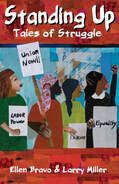
These titles will be released in 2022, but you can order them from Hard Ball Press just in time for the holidays!
Powerful stories, wonderful gifts.
As they stand up, slow down, form unions, leave an abusive relationship or just stir up good trouble, the characters in this multi-generation novel entertain and enlighten, make us laugh and rage, and encourage us to love deeply, that we may continue the fight for justice.
"So much fiction is about escape and fantasy, but these powerful Tales of Struggle will enrich our real and daily lives." ─ Gloria Steinem
“What a wonderful story of class, class struggle and regular people. The story is about struggle and change, but also about joy and humor. Great work! ─ Bill Fletcher, Jr., author of Solidarity Divided
Price: $15.00
|
|
Amazing Worldwide
Internet Radio:
Put your speakers on, rotate, zoom in, pick a station, anywhere in the world, any time, live, native languages and many English stations as well, thousands of them
Copy this link: http://radio.garden/visit/santa-cruz-da-graciosa/MDu6eLeE
|
|
Some Zapatista Wisdom — from the World of Snails
WEEKLY BULLETIN OF THE MEXICO SOLIDARITY PROJECT
|
|
This week's issue/ Meizhu Lui, for the editorial team
The world of snails — caracoles — exists right under our feet, but we hardly ever even notice their humble existence so close to the ground.
Taking an hour to travel from flower to leaf, sipping a drop of water along the way, touching horns — such a lovely way to spend time. Just as we ignore the snail, they ignore us. We co-exist in parallel realities.
So with the Zapatistas in México. They produce food in harmony with the earth, take time to play, and live the truth that evolution and revolution usually develop at a snail’s pace. Year by year, the Zapatistas expand their protective shell, the accumulated and accumulating wisdom of generations. Making a world that most do not see, they ignore the “civilizing” and “modernizing” projects of globalization.
We humans who inhabit the giant-size capitalist world that towers commandingly above the Zapatista caracoles also experience life as a spiral. But our world has spiraled out of control, threatening our future survival at an accelerating pace. Our disruptive — no, suicidal — global order has reached its limits.
Slow down. Look and listen. Be humble and generous. Build on what your ancestors learned. In these troubled times, the Zapatista message we explore in this week’s issue inspires with its simplicity.
In this week’s issue, we’re also pleased to introduce a new monthly column, Anti-Imperialista, by José Luis Granados Ceja, a freelance writer and photojournalist based in Mexico City whose work focuses on contemporary political issues and grassroots social movements.
|
|
|
Our Amazing Resource for Radical Education |
There are hundreds of video courses here, along with study guides, downloadable books and links to hundreds of other resources for study groups or individuals.
Nearly 10,000 people have signed on to the OUL for daily update, and more than 150,000 have visited us at least once.
Karl Marx's ideas are a common touchstone for many people working for change. His historical materialism, his many contributions to political economy and class analysis, all continue to serve his core values--the self-emancipation of the working class and a vision of a classless society. There are naturally many trends in Marxism that have developed over the years, and new ones are on the rise today. All of them and others who want to see this project succeed are welcome here.
|
|
|
|
Talkin' Socialism
Every Saturday, 10 am Eastern
Twenty Twenty Two Tactics
Robert Putnam's book, the Upswing, opens the discussion, which I expect to be robust in our usual fashion, for any who have read or scanned the book,
However -- I accept the challenge. And will prepare an alternate historical and economic argument for humanity's escape from the tyranny of commodity relations.
Putting Plague Year II behind us -- what could be worse than putting that behind us????
On Panel: John Case, Carl Davidson, Lou Martin, JB Christensen, James Boyd, Randy Shannon, Tina Shannon, Scott Marshall, Mike Diesel, Doc Aldis. Get a live link from John Case on Facebook. YouTube appears a few hours later.
Also: Carl Davidson discussed Manufacturing and the Green New Deal on KPFA
|
|
Video: Why is Ukraine the West's Fault? Featuring John Mearsheimer...70 min
|
|
Harry Targ's 'Diary of a Heartland Radical' |
This week's topic:
Click the picture to access the blog.
|
|
Dharma Talk of the Week: The Four Noble Truths | Thich Nhat Hanh ...18 minutes
|
|
Film Review: Lesbian Nun Drama Benedetta Is Both Profane And Sublime—No Wonder Some Catholics Hate It
|
Paul Verhoeven's controversial new film is as lurid but more spiritual than you've heard
By Katie Rife
AV Club
All of this must be terribly amusing to director Paul Verhoeven, whose last film, 2016’s Elle, was the kind of challenging arthouse fare that would seem to point toward a more cerebral phase of his career. Benedetta is both that Verhoeven and the Verhoeven who made Basic Instinct and Showgirls. Verhoeven co-wrote the script with Elle’s David Birke, using the book Immodest Acts: The Life Of A Lesbian Nun In Renaissance Italy as the jumping-off point for their own impish interpretation of the life of Benedetta Carlini, the abbess of a convent in 17th-century Italy who was prosecuted and imprisoned for an affair with one of her fellow brides of Christ.
But frottage—a.k.a. scissoring, which the historical record mentions specifically, and Verhoeven re-creates faithfully—was not Benedetta’s only affront to Renaissance decency. The film rides a provocative line by never quite clarifying whether Benedetta’s lifelong conviction that she’s been chosen by Jesus and the Virgin Mary is a real anointment by God, a fanatical delusion, or a cynical power play. For her part, Belgian movie star Virginie Efira plays the title character with complete conviction, whether she’s kneeling in awe before the Virgin Mary or being pleasured with a dildo carved out of a statue of the Blessed Mother.
A comedic prologue sets the tone with a sharp-tongued child and a conveniently timed splatter of bird shit, but the story really begins when a new initiate, Bartolomea (Daphne Patakia), arrives at the walled convent where Benedetta lives. A victim of abuse and incest, Bartolomea has no frame of reference for how to thank someone for being kind to her except to offer that person sexual gratification. And so, when Benedetta defends her and takes her under her wing, Bartolomea responds the only way she knows how.
But the sparks between the two women don’t test Benedetta’s faith. If anything, the relationship enhances her powers as a mystic, inspiring vivid dreams containing profound messages from God. The appearance of the stigmata on her hands and feet convince the majority of the nuns that this young sister is the real deal, and soon Benedetta has replaced the convent’s longtime abbess, Sister Felicita (Charlotte Rampling), as its leader.
Ecstatic visions, erotically charged regimes of punishment and penitence, and backroom Catholic politics ensue. There are those at the Theatine Convent of the Mother of God who think Benedetta is a sham. And given her confidence and charisma, it doesn’t take much for church officials like the corrupt Nuncio of Florence (Lambert Wilson) to sign on to this theory. So, who speaks for God? Benedetta? Sister Felicita? Nuncio, and the sadistic smile that creeps across his face when he puts poor Bartolomea to the rack?
The obvious touchstone for Benedetta is The Devils, Ken Russell’s still semi-blacklisted 1971 movie. These films tread similar ground in terms of themes and content: Both use historical events as inspiration for a furious condemnation of institutional hypocrisy, and both delight in the blasphemous commingling of religious and carnal ecstasy. (Both also have a scene of a nun kissing a bloodied, emaciated Christ on the cross—enough, on its own, to send legions of decency types into hysterics.) But Benedetta is a more earnest film in the sense that, at times, it plays like a glowing, pious Catholic drama about the lives of the saints—but with scenes from a ’70s nunsploitation movie cut in.
Verhoeven embraces the coarse earthiness of Renaissance peasant culture in Benedetta. Shortly after the bird-shit gag, a carriage taking young Benedetta to her new home at the convent passes a stage show where actors in skeleton costumes light their farts for a cheering crowd. Plague lingers in the background, a memento mori that brings a sense of urgency to the passions that drive the story. As in his WWII drama Black Book, Verhoeven applying his pulpier tendencies to historical drama in Benedetta plays like a defiant assertion of life—lusty, messy, wanton, animal life—in the face of overwhelming death and oppression.
This affirmation stirs the blood, to be sure. But it’s also the key to why those protestors are so upset. Mortification of the flesh is a key tenet of Christianity, declaring that one must deny one’s earthly needs and desires as much as possible in order to be worthy of God. Benedetta, a story about a nun who has both a close relationship with Jesus Christ and an active sex life, obviously contradicts this. More importantly, in the Catholic Church specifically, priests are necessary middle men who stand between the faithful and the divine. Benedetta doesn’t need men to talk to God for her, which, along with her brazen ambition, makes her an existential threat.
If Benedetta is a true saint—and this movie leaves that question open to interpretation—then queer sex is holy, and church hierarchy is parasitic and unnecessary. This, even more so than the Virgin Mary dildo, is what makes Benedetta dangerous. Although the Virgin Mary dildo doesn’t hurt. ...Read More
|
|
Book Review: A New Functional Paradigm of Human Rights |
By Johannes Van Aggelen
CounterPunch
Jan 31, 2022 - Alfred de Zayas’s Building a Just World Order (Clarity) is fascinating and erudite book that encompasses in fourteen sections the spectrum of human rights issues dealt with by the Office of the UN High Commissioner for Human Rights, where the author worked as a senior lawyer for over two decades, and which he also served as a consultant and UN Independent Expert on the Promotion of a Democratic and Equitable International Order (2012-18).
In his 14 reports submitted to the UN Human Rights Council and General Assembly, Professor de Zayas proves that UN rapporteurs can be more than bureaucrats, paper-pushers, ideologues, politicians or narrative managers. Each report has added value, and this book, which builds on those reports, is not a mere compilation of information available on the internet but provides a coherent analysis of the challenges faced by the UN Secretary General, High Commissioner, Human Rights Council, and civil society in identifying problems and devising pragmatic and implementable solutions. Books like this give us hope that the sometimes cumbersome and sclerotic human rights protection system may yet deliver on human rights and inspire legislators to go beyond lip service to human rights and adopt the necessary laws and enforcement mechanisms. The author’s vision is that with perseverance and good faith, human rights can be made juridical, justiciable and enforceable.
What strikes the reader confronted with 480 pages of dense text and thousands of footnotes is the logical arrangement of distinct but interrelated issues, which the author tackles methodically, taking the reader by the hand onto the human rights arena, walking him about, elucidating the Realpolitik of conflict-prevention, peacebuilding, sustainable development goals, achieving economic and trade justice, and concluding with a new functional paradigm of human rights.
The book describes the tasks and possibilities of UN rapporteurs, addresses the mechanisms for the democratic pursuit of human rights, proposes concrete reforms to the Security Council and UN Secretariat, declares peace to be a human right, denounces extravagant military expenditures, pleads for disarmament for human security, states that the realization of the right of self-determination of peoples is a crucial conflict-prevention mechanism, demands that the “rule of law” evolve into the rule of justice, declares the right to information together with the right to truth to be a conditio sine qua non for a functioning democracy, proposes a charter of rights of whisteleblowers, who should be recognized as human rights defenders, reaffirms the international law prohibition of the use of force and of interference in the internal affairs of other States, considers the relationship between business and human rights, discusses the pros and cons of public-private partnerships, proposes an international tax authority, a financial transactions tax and the criminalization of tax havens, demands that investor-state-dispute settlement arbitrations be abolished as contrary to article 53 of the Vienna Convention on the Law of Treaties as contra bonos mores, recommends reforming the Bretton Woods Institutions and ensuring that the World Bank and IMF work in tandem and not against human rights and development.
Two chapters of this multifaceted book stand out by their conciseness, lucidity and uncompromising ethics – chapter 2, which formulates 25 Principles of International Order, and chapter 12, devoted to the author’s ground-breaking mission to Venezuela, the first by a UN rapporteur in 21 years.
The Zayas principles of international order (pp. 46-60) were described by the President of the UN General Assembly 2018-19, Maria Fernanda Espinosa, as a “modern Magna Carta”. Indeed, if the international community agreed to implement them, going beyond the thrust of General Assembly Resolutions 2625 and 3314, peace with justice could be ensured in the 21st century. Zayas also relies on the important work of Virginia Dandan, who as UN Independent Expert on International Solidarity drafted a pertinent declaration that still awaits adoption by the UN General Assembly.
Professor Carlos Correa, Executive Director of South Centre, praises the book for proposing a new functional paradigm of human rights, abandoning the artificial division of rights into those of the so-called first, second, and third generation. What the world needs is recognition that there are enabling rights such as the right to peace, food, water, shelter, healthcare, education, that necessarily take priority over certain civil and political rights. Ultimately the whole edifice of human rights protection is there to ensure that all of us have a level playing field in which we can develop our personalities and achieve our potential, free of racial, religious or linguistic discrimination, without having to endure artificial pressures of governmental or private-sector censorship and “political correctness”. On page 447 Zayas defines the concept as follows: “Universal human rights constitute a holistic system of interdependent entitlements and freedoms. Yet, ‘universal’ does not mean homologated or insensitive to cultural specificities… human dignity, the source of all human rights, necessarily dictates priorities – a hierarchy based on common sense and mutual respect …codification has not been concluded, since continuing standard-setting remains necessary to better protect the practical expression and exercise of human dignity.”
The chapter on the Zayas mission to Venezuela reveals that the illegal unilateral coercive measures imposed by the US on Venezuela constitute the principal cause of the suffering in that country. The second UN rapporteur to visit Venezuela, Professor Alena Douhan, confirmed in her report, submitted to the UN Human Rights Council in September 2021, the findings and conclusions of the 2018 Zayas report, which resulted in the liberation of hundreds of political detainees, the strengthening of Venezuelan cooperation with UN agencies, including FAO, UNDP, UNHCR and WHO, and the opening of a Caracas Office of the High Commissioner for Human Rights. The non-confrontational approach employed by Zayas succeeded in building confidence and enabled the liberation of a German journalist detained in El Helicoide, Billy Six, in March 2019 (p. 438)
Zayas believes in the principle “audiatur et altera pars” (listen to all sides) – throughout this book and in all of his 14 reports Zayas proactively gets at the facts from all parties, and evaluates the arguments pro and con. Some consider Zayas to be an emblematic, even Quixotic rapporteur, not afraid to dissent from the mainstream narrative and prepared to endure serious mobbing from governments and non-governmental organizations (p. 429) and even from OHCHR (p. 188) because of his boldness in breaking taboos. This may also explain why he has been ignored by what he calls the “human rights industry” (p.447), which would just as well defend the status quo.
Bottom line: This book should appeal to many readers, not only to the “experts”. It belongs in every law school and political science department. User-friendly in approach and content, it readily lends itself as a human rights textbook, illustrating the maxim “si vis pacem cole justitiam” — if you want peace, cultivate social justice. As Professor Carlos Villán Duran, President of the Spanish Society for International Human Rights Law wrote: “This lucid, hands-on, independent, pragmatic study is a mode d’emploi for achieving a rules-based international order under the UN Charter.” We can endorse this assessment. ...Read More
|
|
522 Valencia St.
San Francisco, CA 94110
415 863-6637
|
|
|
|
|
|
|
|




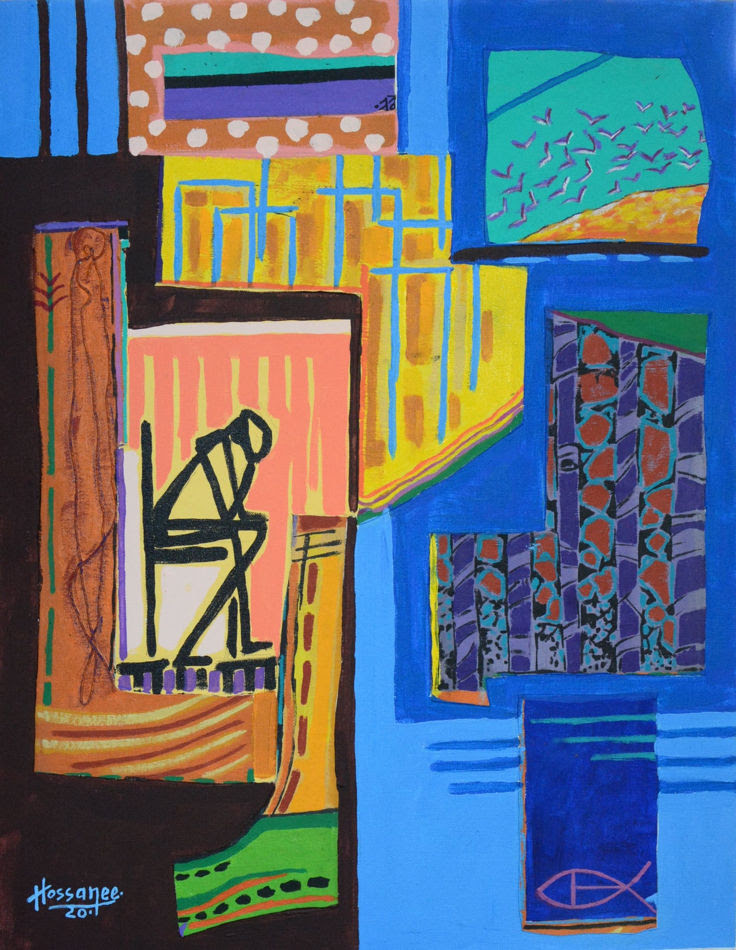



:format(webp):no_upscale()/cdn.vox-cdn.com/uploads/chorus_asset/file/23213762/joseph.JPG)


:max_bytes(150000):strip_icc():format(webp)/GettyImages-515298774-72bf3934d7bd4f939089a5158cdc7a06.jpg)