Friday's Labor Folklore
Con Carbon, the Minstrel of the Mine Patch
Deportee
The plane crash at Los Gatos Canyon
California, 1948
 
The skyplane caught fire over Los Gatos Canyon
A fireball of lightning, and shook all our hills 
Who are these friends, all scattered like dry leaves?
The radio says, "they are just deportees.
-- Woody Guthrie
The Song    
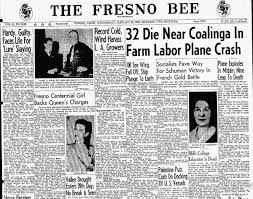
Deportee (Plane Wreck at Los Gatos) is a ballad and a protest song whose lyrics were written by Woody Guthrie following the crash of an airplane on January 28, 1948 near Los Gatos Canyon, located 20 miles west of Coalinga, California. The crash - one of the worst in California history - killed all 32 people onboard, including 28 undocumented Mexican farm laborers.
 
The workers were being repatriated to Mexico as part of the Bracero Program created by Congress in 1942. The program allowed Mexican farm laborers (braceros) to work in the United States due to the severe labor shortages caused by World War 2.
 
The crash had no survivors. Four Americans and 28 Mexican laborers, including 3 women, lost their lives. The crash was reported on radio and in newspapers, including the New York Times. The Times report included the names of the flight crew and security guard but ignored the names of the victims, referring to them only as "deportees."  
 
Woody Guthrie, who was living in New York City, was outraged at the Times article. He was inspired to write a poem assigning symbolic names to the dead. He wrote, "goodbye to my Juan, goodbye Rosalita; adios, mis amigos, Jesús y Maria."
 
Woody wrote Deportee in 1948; a decade later his poem was put to music by Martin Hoffman, a schoolteacher. Pete Seeger began performing the song at his concerts and, since then, Deportee has been recorded by Arlo Guthrie, Joan Baez, Willie Nelson, Dolly Parton, Sweet Honey and the Rock, Bruce Springsteen and others.  
Deportee  
(a.k.a. "Plane Wreck at Los Gatos") 
Words by Woody Guthrie
Music by Martin Hoffman
 
The crops are all in and the peaches are rotting,
The oranges piled in their creosote dumps;
They're flying 'em back to the Mexican border
To pay all their money to wade back again.
 
Goodbye to my Juan, goodbye, Rosalita,
Adios mis amigos, Jesús y Maria;
You won't have your names when you ride
  the big airplane,
All they will call you will be "deportees." [Chorus]
 
My father's own father, he waded that river,
They took all the money he made in his life;
My brothers and sisters come working the fruit trees,
And they rode the truck till they took down and died.
 
Some of us are illegal, and some are not wanted,
Our work contract's out and we have to move on;
Six hundred miles to that Mexican border,
They chase us like outlaws, like rustlers, like thieves.
 
We died in your hills, we died in your deserts,
We died in your valleys and died on your plains.
We died 'neath your trees and we died in your bushes,
Both sides of the river, we died just the same.
 
The sky plane caught fire over Los Gatos Canyon,
A fireball of lightning, and shook all our hills,
Who are all these friends, all scattered like dry leaves? 
The radio says, "they are just deportees."
 
Is this the best way we can grow our big orchards? 
Is this the best way we can grow our good fruit? 
To fall like dry leaves to rot on my topsoil
And be called by no name except "deportees?"
 
© 1961 by Woody Guthrie Publications, Inc. & TRO-Ludlow Music, Inc. (BMI)
See this video of the story and the song ...

Deportee  
by
The Last Internationale  

The Memorial 
On Jan. 27, 2017 Fresno State University sponsored a book talk by Tim Z. Hernandez, a poet, novelist and professor of creative writing at the University of Texas at El Paso.  Hernandez - who grew up in a farm town in California's Central Valley - was launching his new book about the 1948 plane crash, All They Will Call You.
 
At the book talk Hernandez told the story of how he always wondered "who were the people on that plane?" and "did anyone ever tell their loved ones why they didn't come home?"
 
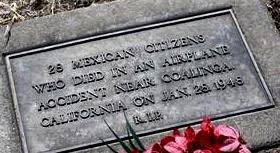
As part of his research into the plane crash he visited the Roman Catholic Diocese of Fresno where he met Carlos Rascon, the newly-appointed Director of Cemeteries. Rascon led the author to the old Holy Cross Cemetery in West Fresno where he pointed out a bronze marker that read, "28 Mexican citizens who died in an airplane accident near Coalinga, California on January 28, 1948, R.I.P." 
Rascon recounted a story he had heard from the cemetery workers. Each November, around the time of El Dia de los Muertos - a Mexican holiday which honors the dead - someone had been leaving flowers at the gravesite.

That person, they would discover, was Jaime Ramirez who grew up in central Mexico. When they met Jaime he told them about a story his mother told him when he was nine. Jaime's grandfather and his great-uncle were immigrant farmworkers who died in a plane crash in the United States in 1948, but she did not know where he was buried.
 
Jaime Ramirez came to the U.S. in 1974 and landed a job as a dishwasher in Pasadena, California. He often wondered about where his grandfather's grave was, but he didn't know where to start. He continued working in the food service industry and, eleven years later, he become a kitchen manager and moved to Salinas. He started searching for his grandfather's name in the county Hall of Records and, in 1989, someone suggested he visit the old cemetery in Fresno where he discovered the bronze marker. He called his mother in Mexico who cried over the telephone.  
 
Ramirez's story was brought to life by author Tim Hernandez in his book All They Will Call You. When the two men met they celebrated each other's efforts to bring forth the identities of the workers who lost their lives in the 1948 crash.    
 
And so began a campaign, with the help of the Catholic Diocese and others, to establish a memorial in Holy Cross Cemetery. Hernandez - after a year and a half of research - was able to identify the names of all of the victims. With community support - including the assistance of musicians Lance Canales, John McCutcheon and others - over $10,000 was raised to place a granite memorial which was dedicated in 2013. Nora Guthrie - the daughter of Woody and Marjorie Guthrie - along with the Guthrie Foundation assisted in the fundraising effort.  
 
The names of the victims of the plane wreck at Los Gatos - including the names of Jaime Ramirez' grandfather and great-uncle - are now inscribed on a memorial in the cemetery in Fresno, California. Jaime now owns a restaurant located a few miles from that cemetery. And each November, he still brings flowers.     
 
The 28 Mexican laborers have finally received the recognition they deserve.  
 
Woody Guthrie's song has come full circle. 
  
-- Saul Schniderman, editor.
 
[Sources used, with extensive quotes: WQED News report and interview by Sasha Khokha, 7/14/17; Wikipedia; Names emerge from shadows of 1948 crash by Diana Marcum in Los Angeles Times, 7/9/13;  All they will call you: a writer gives Woody Guthrie's "deportees" their names back by Felix Contreras in alt.latino; press release in Fresno State News, 1/27/17; The People behind Guthrie's "Deportee" Verses in NPR's Tell Me More, 3/28/13]; Photo of mass grave: Michael Robinson Chavez , LA Times-Getty Images 

(forward to a friend)