|
When they practiced together earlier in the day it looked effortless. But as the experienced handlers watched Deputy Luis Guiral get ready for his official certification as a K-9 handler they didn’t know if that would change as soon as testing started. “Our nerves run down the lead,” said Canine Unit Sergeant Amanda Eddinger. “The dogs can pick up our emotions, so they can do this perfectly 1,000 times but now that it’s a test their nerves are through the roof and the dog can feel it.”
Deputy Guiral has been waiting for this moment for a long time. He excelled in the notoriously grueling K-9 tryouts and started K-9 school with a new dog in May of 2025. But only three weeks into the 16-week school he got a serious knee injury while training and was out so long that the dog he was working with had to go to a different deputy. Now fully healed, he has completed K-9 school with a dog he named Guapo. Before the team can be officially on patrol, handler and dog have to pass the state certification.
Two evaluators watch Deputy Guiral and Guapo demonstrate the deep level of understanding between a dog and their handler. One is from Largo’s Canine Unit, the other is Corporal Paul Martin, a Pinellas County Sheriff’s Office K-9 handler on his very last day in uniform before retirement. He’s already turned in most of his gear but kept his uniform just a little longer to see one of his own start his new adventure in the unit.
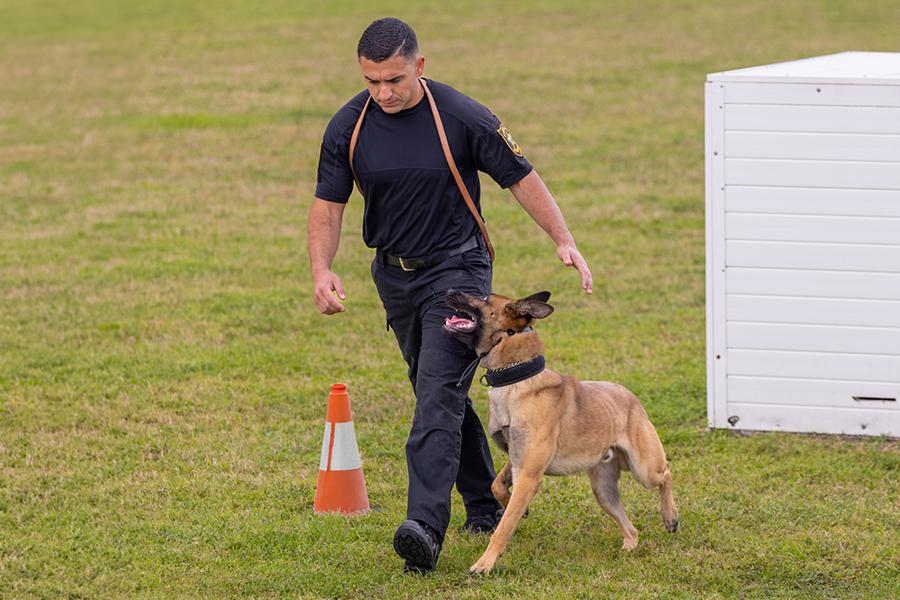
As the evaluation begins, Deputy Guiral calls Guapo to a heel position, and the dog moves close to his side, pressed against his left leg and looking up with adoration and expectation. This is all a game to him, a game with an exciting prize at the end (his favorite tug toy and enthusiastic praise) and he wants more than anything to do exactly what his handler tells him to do. It’s on the handler to learn how to speak the dog’s language.
“Training the dog is the easy part,” said Deputy Tony LoRusso, who is currently working his third dog and has trained countless others. “It’s the handlers who have so much to learn. For the dogs, you manipulate their drives, you make the exercise rewarding, and that’s what the dog wants to do. The handler has to interpret body language, learn how to think like a dog. If the dog isn’t doing something we have to dissect why.”
Guapo knows exactly what to do, sticking to Deputy Guiral’s side as he walks in a long horseshoe shape. The evaluators call out commands: slow pace, fast pace, regular pace, left turn. Even when the roar of a plane overhead means that Deputy Guiral mishears a command, Guapo sticks by his side, which is exactly what the evaluators hope to see.
In the next exercise, he puts Guapo into a sit and walks 50 feet away. Guapo’s eyes never leave him, but he stays exactly where he was told to, alert for the next command. Deputy Guiral puts him into a down, and then the two-minute timer begins, showing that Guapo can stay focused on his task even when far from his handler. When he’s finally called he eagerly rushes to his favorite spot by Deputy Guiral’s leg. The evaluators walk close by him for the social exposure test, making sure he doesn’t react. Then Deputy Guiral fires one blank from a training gun. Guapo gives a tiny flinch, that’s all.
“The dog can be startled, it might catch him off guard, but as long as he doesn’t run away or become aggressive it’s a pass,” said Deputy LoRusso. “The goal for gunfire is for the dog to be neutral, it should be just another noise in the world. It shouldn’t distract them from whatever the handler needs them to do, whether that’s remain in a heel, or attack, or search a building.”
From there, the dog does an area search, working off lead in a field with multiple big boxes, simulating sheds or storage containers where a suspect could hide. Guapo checks each one with a quick sniff before zeroing in on the one with a person hiding inside, barking and pawing until the suspect emerges.
Next comes the apprehension evaluation, and what Deputy Guiral described as the most nerve-wracking part of the evaluation. While another deputy wearing a bite sleeve serves as the decoy and runs down a field, Deputy Guiral sends Guapo sprinting after him. Though he’s extremely gentle in all other situations, when his handler gives the command Guapo is ready to bite, rushing to take down a criminal who may hit him or even shoot him, holding on with 200 pounds of pressure per square inch.
Then, when he’s almost there, his handler calls him back.
“With these high prey drive dogs, once they see the decoy that’s all they want,” Deputy Guiral said. “You tell them go get him, and then a few seconds later you say nah, just kidding, come back to me.” Guapo does exactly what he’s supposed to. He puts his intense attack on hold, wheels around, and runs back to his handler’s side. It’s a sign of Deputy Guiral’s connection with his dog, and the trust Guapo has in him. Whatever he asks of Guapo, the dog will do without hesitation.
The team does two more apprehension exercises. In one Guapo pursues and apprehends a fleeing decoy, and releases him at Deputy Guiral’s command. Guapo needs to let go immediately if a fighting felon suddenly gives up. In the last apprehension, the decoy fires a blank during the bite. Just as he was trained, Guapo ignores it and stays firmly attached to the bite sleeve.
The final test for man and dog is a building search. If a suspect is hiding in a house or there is an open door at a warehouse with a burglar possibly inside, a dog can search the building much faster than a deputy. Deputy Guiral stands near the open door, loudly announcing who he is, what the suspect should do (come out), and what will happen if they didn’t. When the decoy doesn’t respond, he sends Guapo in. The dog searches every room until he finds fresh human scent, then alerts.
And with that, both Deputy Guiral and K-9 Guapo are certified, and ready to hit the road two days later for their first shift together.
This is something Deputy Guiral wanted since he first became a deputy nine years ago. All new recruits get to work with the Canine Unit as part of their in-house training so they know how to support them on a track. “I remember doing the K-9 portion of the in-house and going on an actual track. Seeing what the dogs do amazed me, and from that day there were two things I wanted to do here: SWAT, which I was able to be on for four years, and K-9.”
Just because he’s certified doesn’t mean he gets to kick back now. “For the Canine Unit, training never stops,” Deputy Guiral said. “If you slack it will show in your dog.” They have one 10-hour training day every week, and whenever they’re not on a call they’re working with their dog on tracks, article searches, and obedience.
Guapo seems ready for his first shift. Deputy Guiral describes his partner as a very friendly dog but one who doesn’t want to just hang around being patted. “He gets a couple of pats and then he wants to work. He’s game on the whole time.”
|