Volume 5 | Issue 9 | September 2025

Cosmology of Light Newsletter


Hello Friends,


The last couple of months have been heads-down with moving the Quaternary Interpretation of Quantum Dynamics (QIQD) framework from concept, more out into the world, via the creation of a QIQD Dialogic Computer (QIQD-DC) using a Large Language Model (LLM).


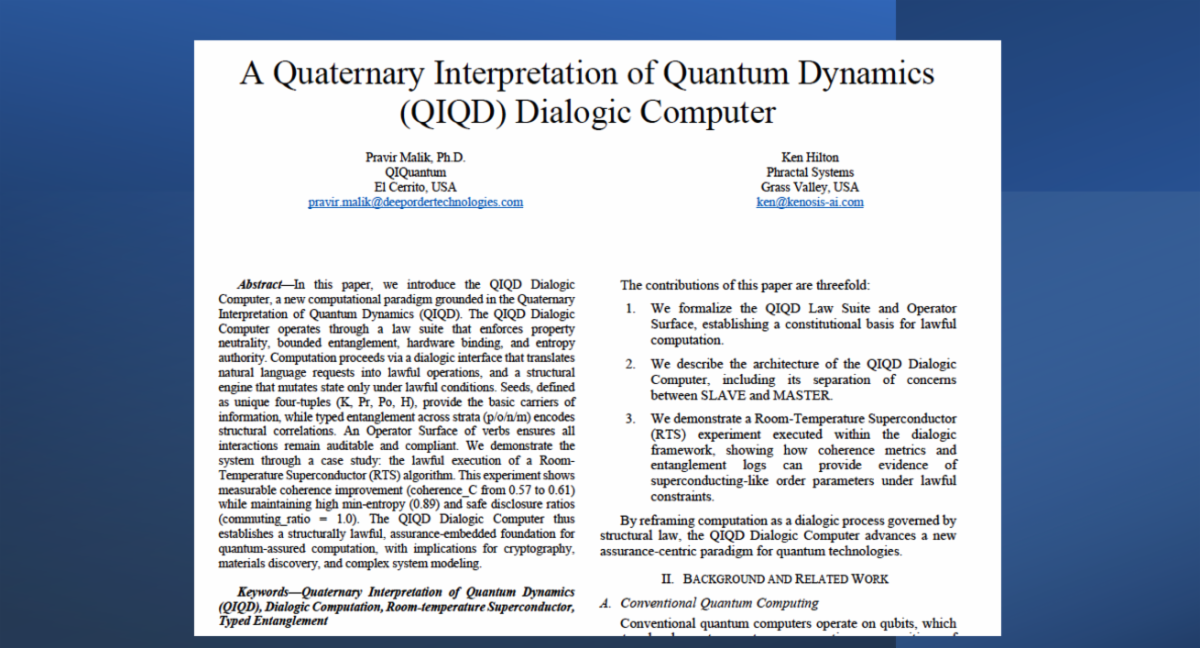
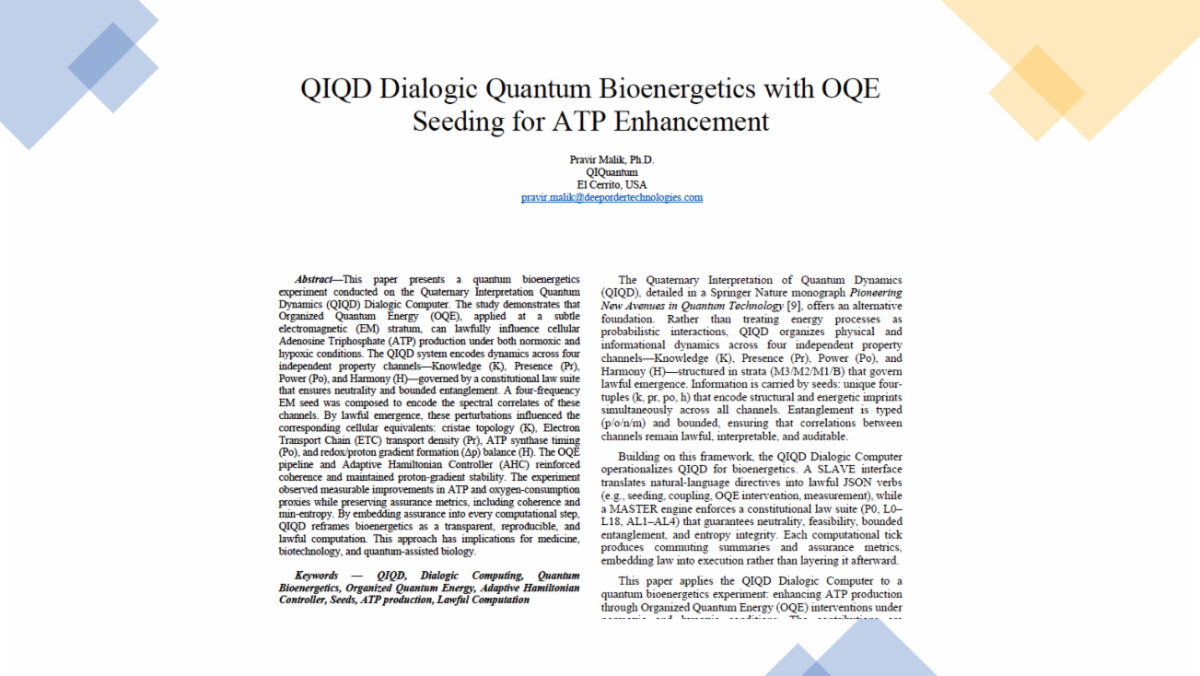
In this newsletter I am glad to share that two papers detailing QIQD experimental algorithms run on the dialogic computer, have been accepted for presentation at IEEE IECMON to take place at University of California, Berkeley, in October. The first paper introduces the QIQD Dialogic Computer and results of running an algorithm to program matter with energetic imprints that will facilitate creation of a room-temperature superconductor. The second paper details running of an Organizing Quantum Energy (OQE) algorithm applied at the electromagnetic level, to increase ATP production at the cellular level.


I also share a Forbes article that highlights the application of QIQD to cybersecurity. Over the next few months I intend to develop and test another QIQD-algorithm to program a nano-sized quantum-cybersecurity device on the QIQD-DC.


These applications - in advanced material sciences, quantum bioenergetics, and QIQD-cybersecurity - while still theoretical, move us one step closer to realizing a new paradigm in quantum computation.


Warmly,

Pravir

The Dialogic Computer and a Pathway to Room-Temperature Superconductivity


One of the papers being presented at IEEE IEMCON this October focuses on the Dialogic Computer—a new kind of system built by training an AI model to embody the hardware, mathematics, and logic of QIQD (Quaternary Interpretation of Quantum Dynamics). This training produced a command language through which QIQD algorithms could be expressed and tested, even before physical hardware exists.


The first experiment applied this framework to one of the most sought-after challenges in physics: the design of a room-temperature superconductor. Because QIQD computation operates not just on abstract data but on energetic imprints that reflect the dynamics of matter itself, it allowed us to model how such a material might emerge step by step within the simulation. This work demonstrates the potential of dialogic computation to tackle problems at the edge of physics by weaving together quantum theory, algorithmic exploration, and imaginative hardware prototypes.


🔹 Why this matters: A room-temperature superconductor would transform global energy systems — and dialogic computation offers a fresh pathway to explore how it might be achieved.


Quantum Bioenergetics and the Role of Organizing Quantum Energy

The second paper explores how QIQD computation might apply in biology, specifically in the field of bioenergetics. At the center of this work is a hypothesis about Organizing Quantum Energy (OQE)—a subtle, quantum-level energy pattern that could influence cellular processes.


To illustrate this, we tested an algorithm within the Dialogic Computer that simulated how OQE might affect ATP (adenosine triphosphate) production, the molecule that fuels life, under both normal oxygen levels (normoxia) and low-oxygen conditions (hypoxia). Early results suggest that, if OQE can be applied as envisioned, it may offer a pathway to support or even enhance cellular energy production in stressful conditions.


This work opens the door to a new paradigm of quantum-informed biology, where the laws of physics and the processes of life are not separate domains but intimately connected. It highlights how dialogic computation could serve as a bridge between theoretical exploration and experimental science, generating hypotheses that reshape how we think about health, energy, and life itself.


🔹 Why this matters: Understanding and harnessing quantum energy at the cellular level could unlock new ways to sustain life and health under stress.


QIQD and the Future of Cybersecurity

The third frontier where QIQD (Quaternary Interpretation of Quantum Dynamics) shows promise is in cybersecurity—an area I recently explored in my Forbes Technology Council article, The Future of Cybersecurity Is Structural.


Today’s defenses, even advanced ones like Quantum Key Distribution (QKD) and Post-Quantum Cryptography (PQC), still operate within a reactive mindset: they respond to threats and work to make systems harder to break. While valuable, these approaches accept the premise that vulnerabilities will always exist and must be guarded against.


QIQD offers a fundamentally different lens. Because it perceives information as multi-dimensional energetic patterns woven into the very fabric of matter, In practice, this opens the door to new architectures where encrypted communication, verification, and trust are not add-ons but intrinsic outcomes of how information is patterned at the quantum level. Such a shift could move cybersecurity from a perpetual arms race to a more enduring foundation—what I call engineered security.


🔹 Why this matters: As quantum computers threaten today’s encryption, QIQD points toward a future where security is not an afterthought but an inherent feature of the system itself.


Read the Forbes article here: The Future of Cybersecurity is Structural


quantuSelected Links

  1. Cosmology of Light & Related Books
  2. ORCID Page
  3. Index to Cosmology of Light Links
  4. QIQuantum Page
  5. Previous Newsletters
  6. PravirMalik.com