No. 7, October 2025

Diamond Sutra Translation

Prefer to view as a webpage? Please click here.


Greetings!,


On Sunday, Sept. 14, we held a Passage to Light ceremony for Art Gardner. Well over 100 people downloaded the ceremony, and about 70 people joined with me on Zoom to do the ceremony together. I gave a short eulogy for my friend of many years, noting his kindness and warmth and all that he had contributed to Unfettered Mind. A number of friends and acquaintances also offered their own memories and feelings. Among the people participating was Art's cousin who expressed his gratitude for the gathering. He had recently reconnected with Art and was grateful to learn that Art was part of a whole community who turned out to honor him through this ceremony. My thanks to Molly White hosting the ceremony.


Diamond Sutra

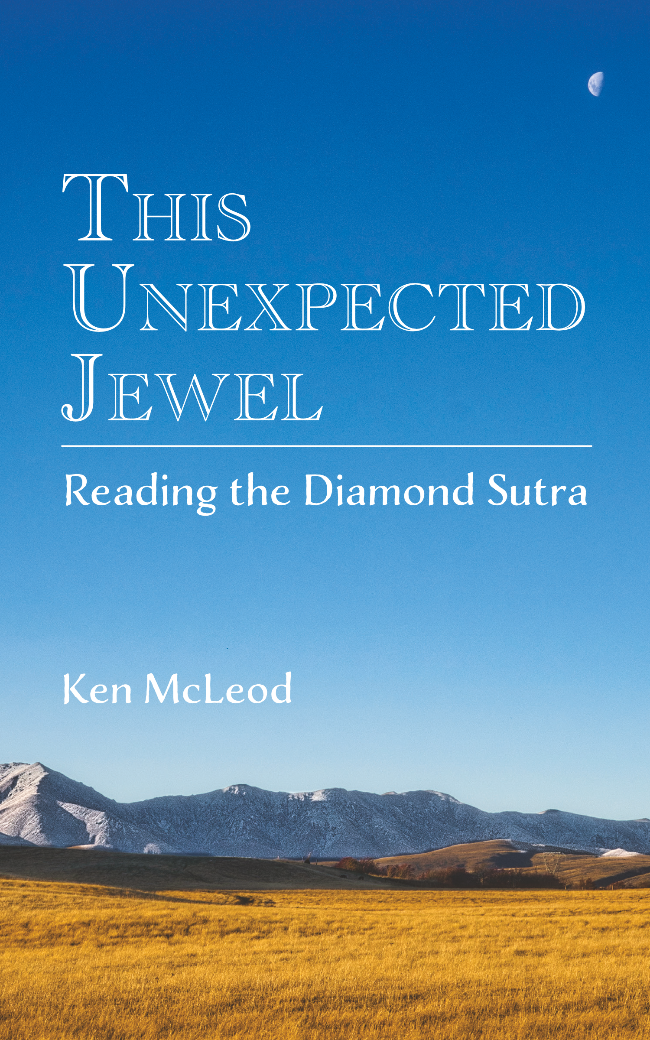
The next bit of news is that my translation of the Diamond Sutra is now available in both paperback and ebook format through Amazon, Barnes & Noble, Bookshop.org and various other outlets. The title is This Unexpected Jewel: Reading the Diamond Sutra.


I named this translation This Unexpected Jewel because the Diamond Sutra has become a jewel for me in a way that I was not expecting at all. The cover photo reflects that theme with its open landscape, deep blue sky, and the moon peeking into the picture in the top right corner.


I first encountered the sutra through Red Pine’s translation and commentary in 2009. The third chapter struck a chord in me that continues to resonate and unfold in me to this day. In 2011 I started to read the sutra chapter by chapter with a student in Los Angeles. It soon became clear to me that I would have to translate it some day for myself. Other translations, most of which take a scholastic approach, fail to convey the power and immediacy of the pointing out instructions that are given implicitly and explicitly throughout the sutra. 


As often happens in life, other forces took over. I ended up writing three other books first: the practice trilogy of Reflections on Silver River, The Magic of Vajrayana, and A Trackless Path. When the last of these books was published in 2023, I turned attention to the Diamond Sutra.


In 2024 outside forces again took over. This time, they unexpectedly presented me with the opportunity to teach a course on the Diamond Sutra at The Alembic in Berkeley. The timing was such that I could not complete my translation before the course began. Nevertheless, the response to the course clearly indicated that many people were interested in a translation that reflected a practice perspective. 


Inspired by a good friend who has been practicing sutra reading for several years, I started reading the sutra aloud while standing as I worked on the translation. It made such a difference to how I heard and understood the text that I made reading the sutra aloud while standing an integral part of the course at The Alembic. Now I consistently encourage people to read a sutra or some other text aloud as part of their practice. Reading aloud while standing brings about a physical and emotional connection with a text that enriches understanding in unexpected ways. Those who have taken up this practice consistently report that it has had a profound effect on how they understand and relate to the text.


A slim volume of less than 70 pages, This Unexpected Jewel is reasonably priced: $14.95 for the paperback and $9.99 for the ebook. This book is a translation of the sutra itself. I plan to write and publish a commentary sometime next year.


So what are you waiting for? Buy a copy, read it aloud everyday for a month (about 40 minutes a day), and then tell me (ken@unfetteredmind.org) what happened, or post a review online and tell the world!


Logo competition

A short report on the logo competition. We received ten entries, with one person submitting three different designs. Some of the entries were playful, some were well thought out, and two held promise. Even so, the Board of Directors decided to go in a different direction.


The artists who created the two designs with promise will each receive a complementary copy of There Is No Enemy, the four-volume set of practice notes, which we hope to publish next year. 


My sincere thanks and appreciation to everyone who submitted a design. 


How to Lose Your Mind

Finally, in this newsletter I begin a series of commentaries on the mahamudra text that I published in the April newsletter. So dense is that text that each practice tip will be a short practice-oriented commentary on a sentence or two of the text.


Best,


Ken

Practice Tip: How to Lose Your Mind, part 1


My translation of Gampopa's text is now up on the website. You can find it here. It is probably a good idea to bookmark this page as we go through the text line by line.


The text has three sections: how mahamudra is, how mahamudra comes to be, and how to hone thatness. My commentaries are about the aspects of practice that Gampopa is pointing to in each section. In many of the commentaries, I will comment on the translation challenges in that section and explain why my translation may differ from more conventional usage.


First, what is mahamudra? Mahamudra is a word that points to a way of experiencing life in which awareness and experience are not separate. Keep this in mind as you read these notes.


Let’s turn to the first section: how mahamudra is. 


Mahamudra is not a thing. It is not an object of knowing. In particular, it is not something that can be known or understood by the conceptual mind. To drive this point home, to nail it down, Gampopa writes:


Mahamudra has no genesis,

Mahamudra has no conditions,

Mahamudra has no method,

Mahamudra has no path, and

Mahamudra has no result.


The aim of these absolute negations is to reduce distractions and difficulties. Mahamudra practice largely consists of doing nothing. We rest in awareness. When something comes up, we let it be. We don't resist it or pursue it. We don't even observe or note it. We let it come and go on its own. Nor do we look to have a particular experience. We rest in whatever we do experience, not doing anything with it to change it. This not doing may be simple, but it is not easy. 


These five negations are useful. How do we use them?


Today, let’s look at the first one: mahamudra has no genesis.


This sentence is usually translated as “Mahamudra has no cause.” This translation is both misleading and a misuse of English. Is an acorn the cause of an oak tree? No! An acorn does not cause an oak tree. An acorn becomes an oak tree. An acorn grows into an oak tree. Only a philosopher might say that an acorn causes an oak tree: a gardener, never.


In the context of mahamudra, then, Gampopa is saying, “There is nothing that becomes mahamudra.” In other words, there is no mahamudra acorn that you can plant and let it grow into the mahamudra oak tree. No such luck. 


Let’s consider this from a practice perspective. Let mind and body settle, and then quietly say to yourself, “Mahamudra has no genesis. There is nothing that becomes mahamudra.” 


What happens?


There is usually a shift. It’s subtle, but with a little practice you can usually feel it in both mind and body. At first you may not even notice it. When you do, it may last only a moment. No matter. That's why we practice.


Again, let mind and body settle for several minutes. Rest with the breath, or say your favorite prayer. Rest in the sensations of your body, the sensations of breathing. Don’t try to do anything. Just rest. After a while, again say to yourself, “There is nothing that becomes mahamudra.” Then rest. Do this periodically, allowing a good bit of time (5-10 minutes) before trying again each time. Sooner or later, you sense a shift.


For me, in that shift a stillness is present. It's a bit deeper and clearer than the stillness of not thinking. Also, the sense of time drops away. Then the shift fades or I start thinking about something.


Once you start to sense that shift, you will be tempted to try to hold onto it, to deepen it, to explore it, or to regenerate it as soon as it fades away. Too bad. You are no longer practicing mahamudra. You are doing something. You are working at something. Don't! Stop working. Stop trying to make something happen. Stop trying to control what you experience. Stop falling into distraction.


Rest in the shift. When it fades away or you fall into confusion, continue to do nothing. Just rest. The shift opens a door to another possibility. In a half-hour period of meditation, ask the question that elicits the shift four or five times at the most.


Remember, mahamudra has no genesis. A shift takes place whether you sense it or not. By just sitting and doing nothing, you create the conditions for mind and body to assimilate the shift. This is not something you can do intentionally, so don't try. All you can do is pose the question from time to time and then rest with mind and body clear, open, and undistracted, thus allowing the assimilation to take place.


That’s enough for today’s newsletter. We’ll continue in the next one. I’ll try to write these weekly, but if I miss one or two here and there, DON'T PANIC. Come to think of it, maybe you should keep a towel handy, too.


Please go to our donation page to see all the ways you can help or support Unfettered Mind. https://unfetteredmind.org/donate/

Unfettered Mind
Phone:
(310) 243-6802
Connect With Us:
Twitter