|
This long-term research project was recently published in the journal Agriculture.
Abstract:
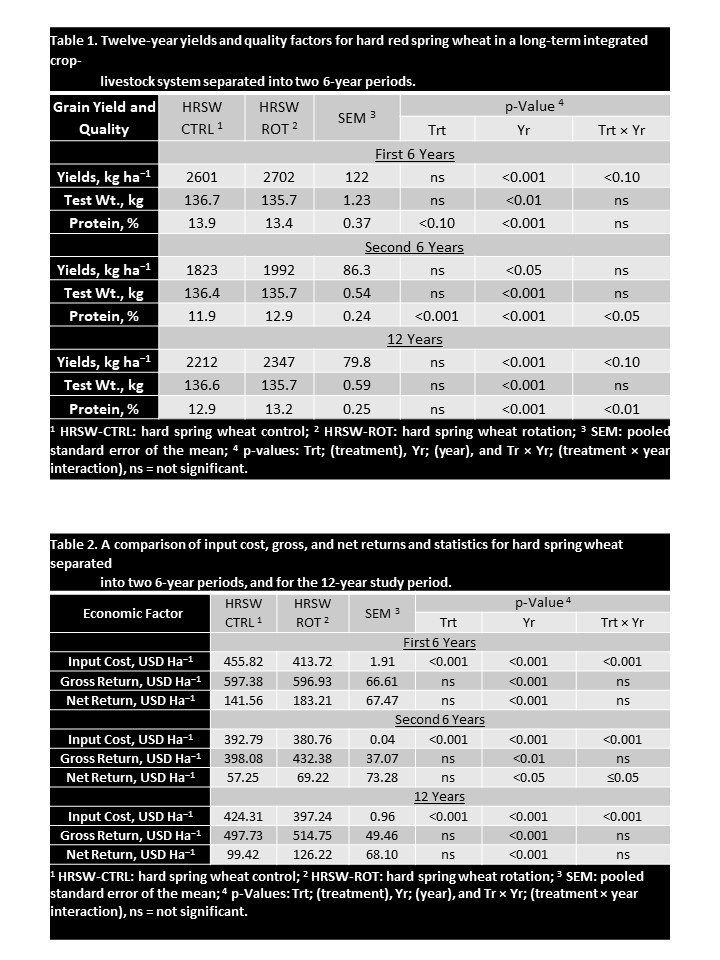
Integrated crop grazing systems can improve farm profitability due to enterprise complementarity. Utilizing the supply of N from legumes, livestock manure, and plant residues will result in improving grain yield and quality. A long-term 12-year integrated systems study evaluated continuous spring wheat (HRSW-CTRL) with spring wheat (HRSW-ROT) grown in a five-crop rotation: (1) spring wheat, (2) seven-species cover crop, (3) forage corn, (4) field pea/forage barley mix, and (5) sunflower. Yearling beef cattle steers grazed the field pea/forage barley mix, unharvested corn, and a seven-species cover crop. Spring wheat was marketed as a cash crop. Contrary to expectations, HRSW-ROT did not significantly increase grain yield or improve quality over HRSW-CTRL. Improved soil fertility was observed in the HRSW-ROT plots throughout the study relative to SOM, N, P, and K. Crop yield, test weight, and protein percent are shown in Table 1 and crop economics is shown in Table 2. Although largely non-significant, the rotation with grazing management significantly reduced input costs but resulted in negligible gross and net returns over the 12-year period. Year-to-year weather variability was the cause of the differences between the two production management methods. The two spring wheat production management methods were similar, but the integration of beef cattle grazing and forage production added value to the rotation system.
Recently, cropping systems in this semi-arid region have been including canola (Brassica napus L.), soybean (Glycine max (L.) Merr.), corn (Zea maize L.) and in some instances, millet (Setaria italica L.) in a five-crop rotation with HRSW. Including cash crops such as this and evaluating them in place of HRSW would provide farmers with additional flexibility and value-added within their enterprises. This would allow them to utilize the nitrogen made available from legumes in integrated crop grazing systems and enhance the profitability of their operations. Farmers who want to establish a diverse crop rotation with grazing need to create a crop grazing plan with special consideration focused on crop complementarity and chemical carryover in the crop rotation. When integrating a cropping system with grazing, consideration must be given to establishing infrastructure for livestock water and fencing. Virtual fencing is a viable fencing alternative provided a perimeter fence exists.
Reference:
Songul Senturklu, Douglas Landblom, Larry Cihacek. Effect of a Long-Term Integrated Multi-Crop Rotation and Cattle Grazing on No-Till Hard Red Spring Wheat (Triticum aestivum L.) Production, Soil Health, and Economics. Agriculture 2026, 16 (1), 73.
|