|
Profitability drivers in the beef cattle industry can be partitioned into several categories some of which include breeding/crossbreeding, feed resources, calving date/weaning date, and the impact modifying the breeding season length can have on potential profit. Good breeding management defines a specific date to begin breeding heifers and cows and a specific date to end the breeding period. Common breeding season lengths range from 45- to 60-days. Removing herd sires from breeding groups on a predetermined date results in late cycling cows being identified as “open” or not pregnant.
Ultrasound is powerful technology available for pregnancy determination by the local veterinarian. Because ultrasound technology is readily available, there is no reason to remove bulls at a predetermined time. Leaving herd sires with cows for an extended period of time followed by ultrasound pregnancy determination allows the producer to identify late calving cows that are pregnant instead of being identified as “open”. Although late calving cows in a given ranch are outside of a predetermined calving window, those same cows may fit perfectly at another ranch that has a different calving window.
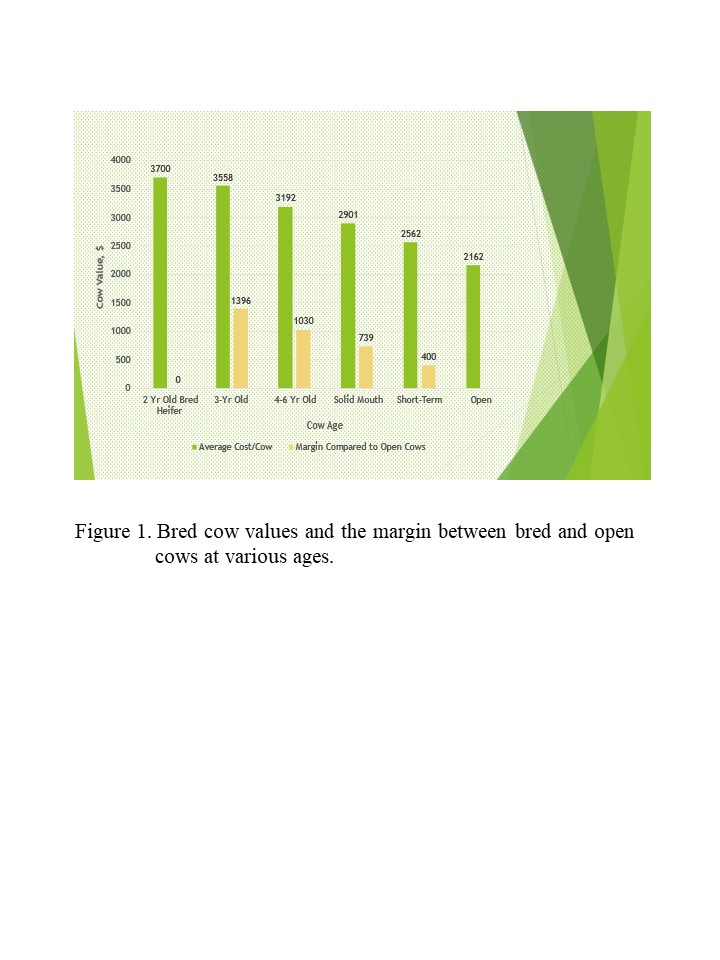
The difference in cow value between “open” and “bred” can be significantly large and is related to cow age. As cows age, their productive life shortens, which is reflected in the amount cow buyers are willing to pay. Figure 1, shows the average cow value for various cow ages from a bred heifer to short-term broken mouth cows and the margin or difference between the bred cow value and an open cow. Young 3-year-old cows have the greatest margin of $1,396 compared to an open cow and there is a stepwise margin decline as cows age settling at an average margin of $400 between a short-term bred cow compared to an open cow. These bred cow values illustrate that there is a financial advantage for not removing bulls according to a predetermined breeding period, but rather sorting cows into the predetermined breeding period using ultrasound during the fall pregnancy check. Allowing bulls to remain with breeding groups also reduces labor and resources needed to gather cattle, sort, and haul bulls to a set aside pasture.
|