|
Winter feed cost makes up a large portion of the production cost for producing weaned calves in North Dakota and is a major variable influencing profitability in the cow-calf sector. The large round bale is the most common method for preserving hay. Small square bales, which were the most common hay preservation method before the advent of the large round bale, are made to have some baled hay in the barn during calving or for horses, sheep and goats that are fed in small spaces where large round bales are less convenient.
The most common method for feeding large round bales is to roll them out on the ground. However, there are other methods for feeding hay to various classes of livestock. In addition to rolling bales out on the ground, there are PTO driven bale processors and several styles of round bale feeders constructed from steel tubing and polyethylene pipe. Bale processing machines are not mixers, but have become popular as an alternative to tub grinding, because the shredded forage can be delivered to bunks or fed on the ground. A three-year study was conducted using 360 crossbred cows to evaluate cow wintering performance, hay consumption needed to maintain cow body condition, labor input, wintering cost, and hay waste, when large round bales were fed using a bale processor, rolled out on the ground, or fed in a tapered-cone bale feeder. For economic analysis, operating budgets were prepared for 100- and 300-head reference herds. The first two years of the study an alfalfa-grass mixed hay (alfalfa, crested wheatgrass, bromegrass) was fed and the third year of the study oat hay was fed.
Results from the study indicated that the amount of hay required to maintain body condition was greatest for cows fed using the bale processor, intermediate for cows fed when rolling hay out on the ground, and the least when bales were fed using a tapered-cone bale feeder. Comparing the tapered-cone bale feeder to the other methods, rolling bales out on the ground required 5.0% more hay and feeding with the bale processor required 15.3% more hay. The largest reduction in wintering cost was obtained using the tapered-cone bale feeder. Economically, wintering cost using the tapered-cone feeder was reduced 21.0% for the 100-head reference herd and 17.6% for the 300-head reference herd compared to feeding with the bale processor. The full report of this feeding methods research can be found in the Dickinson Research Extension Center’s annual report:
https://www.ndsu.edu/agriculture/sites/default/files/2022-10/Effect_of_Hay_Feeding_Methods_on_Cow_Perf_Hay_Waste_Wintering_Cost.pdf
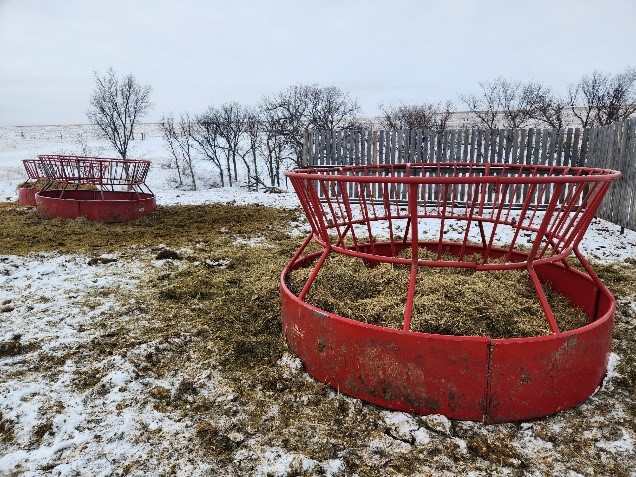
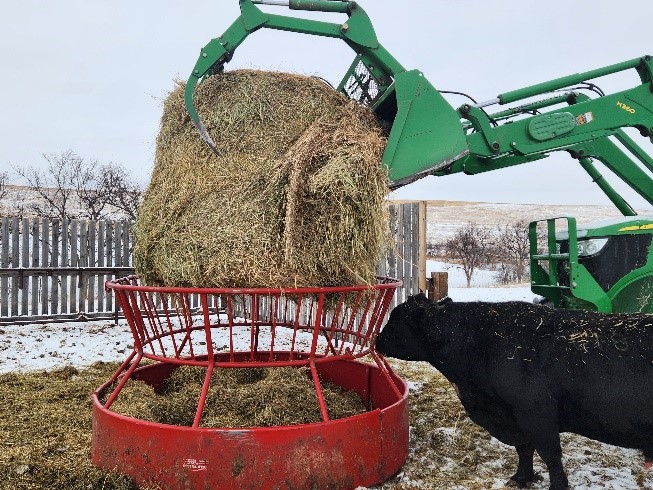
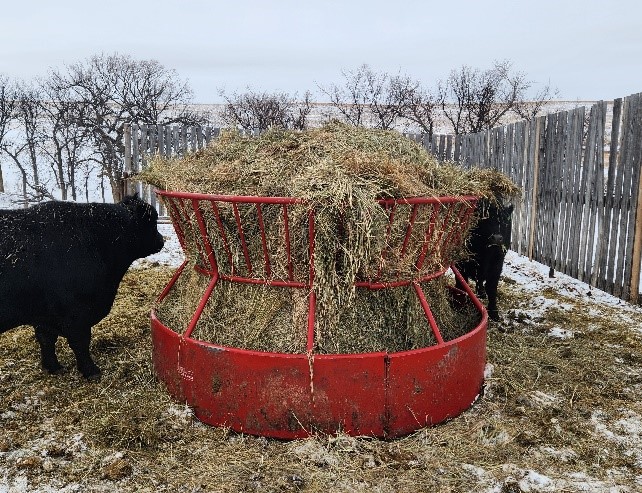
Research conducted at Kansas State University evaluated different styles of round bale feeders and was reported by Emma Briggs. Round bale feeders constructed of steel tubing or polyethylene pipe without 18” of sheeting around the bottom of the feeder resulted in a similar amount of waste ranging from 19.7% to 21.2%. Feeders constructed using steel tubing and at least 18” of metal sheeting around the bottom of the feeder were reported to have the least amount of waste. However, while straight sided feeders with 18” of bottom sheeting reduced waste, waste was still measured to be 12.4%. In the Kansas State University study, the most efficient feeder was the sheeted bottom basket feeder that reduced waste to 5.5%. The basket style feeder design holds the bale in the center and a larger outer ring allows animals access to hay similar to eating from a manger. This feeder design with a center basket keeps hay near the central area of the feeder restricting hay from falling or being pulled out of the feeder. Basket or tapered-cone feeders are the most efficient designs. Basket round bale feeders are shown in figures 1-3 and figure 4 shows bale processor waste after feeding.
|