|
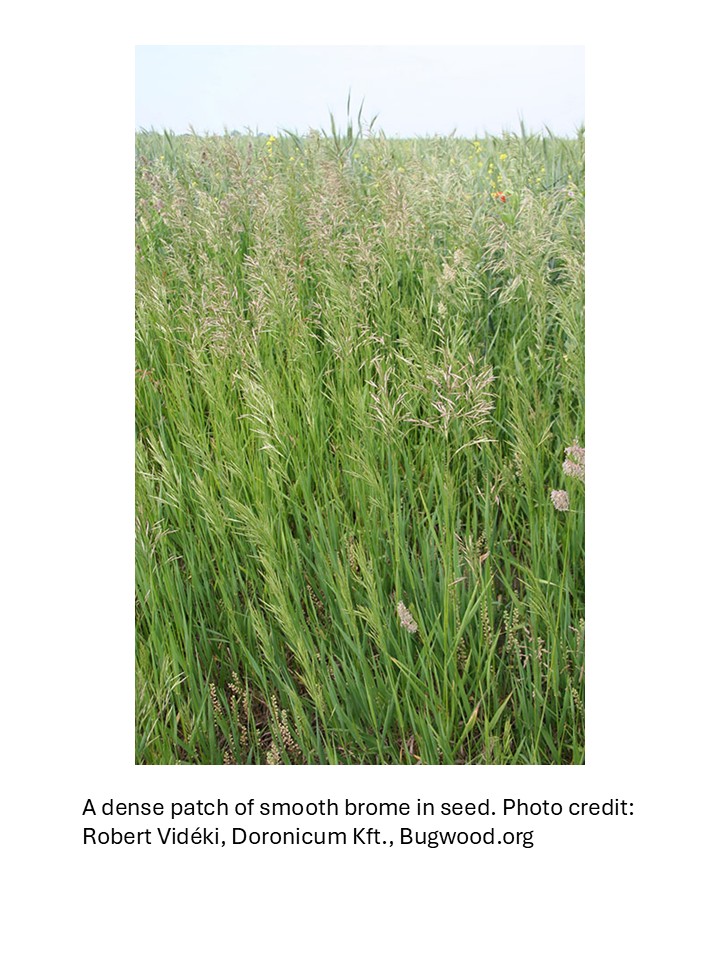
Smooth bromegrass, Bromus inermis, is a introduced, naturalized, long-lived perennial, monocot, cool-season, tallgrass, that is cold hardy, moderately tolerant of drought, fairly resistant to saline and slightly acidic soils, grows best with 18 inches or more rain per year, and can invade poorly managed grasslands.
Two strains are recognized and separated by the origination of the source material. The Northern Type germ plasm originated from the Russian Steppe and Northern Germany. The Southern Type germ plasm originated from the Hungarian Plains and France.
The Northern Type has mainly stem leaves, weakly rhizomatous producing mostly crown tillers forming tussocks (bunches), it has short glumes, develops more seeds, and grows slower but more evenly through the growing season producing lower point in time peak aboveground herbage biomass. It readily forms symbiotic associations with soil microorganisms.
The Southern Type has both basal leaves and stem leaves, strongly rhizomatous producing mostly rhizomes tillers resulting in sod forming, it has long glumes, develops less seeds, and grows rapidly early in the growing season for a short period producing a greater point in time peak aboveground herbage biomass. It does not form symbiotic associations with soil microorganisms. The current years dead roots are labile with nutrient contents easily reabsorb by the plant. It is by far the most common type grown in North America.
The Southern Type smooth bromegrass has rapid early growth. New leaf and stem growth develop from crown and rhizome tiller buds during early April. The extensive fibrous root system growth is activated early. Tillers produce three and a half new leaves by early May. Grazing can start on 1 May. Vegetative leaves contain above 18% crude protein during early to mid May. Early boot stage starts in mid May with crude protein at 17%. Flower stalks emerge in early June with crude protein at 15%. Most lead tillers flower during June when they contain 14.4% crude protein and at that time the forage has the greatest weight of crude protein per acre. If the smooth brome field is for hay production, this would be the time to cut it. If it is not cut for hay, seed development soon follows with crude protein at 11.4%. As the seeds mature, the crude protein remains above 9.6% until late June. Then the fiber content increases and crude protein, water, and digestibility decrease and by early July crude protein is below 9.5% and by early August below 8.0%. Phosphorous levels drop below 0.18% during early July.
Dr. W.C. Whitman had included at least two Northern Types of smooth bromegrass in each of the grass variety trials during 1954 to 1965 because the Northern Types have good steady growth of forage during the entire growing season. Northern types also have fast recovery growth after grazing or haying, has high seedling vigor, produces viable seed in quantity, and it does not escape, it stays where it is planted.
https://www.ndsu.edu/agriculture/ag-hub/publications/dickinson-rec-2018-annual-report
|