|
Lacey Quail
Livestock Management Extension Specialist
North Central Research Extension Center
Heifer development is a necessary expense that can often take years to repay itself, and many systems exist to develop heifers into productive members of the cow herd. Ideally, the heifer development system should prepare heifers to conceive early and calve early during their first calving season, as early-calving heifers produce more pounds of beef and have greater longevity. In many cow-calf operations, heifers are routinely exposed to fixed-time artificial insemination for an opportunity to conceive on the first day of the breeding season. Additionally, value is often added to heifers that fail to conceive before being marketed. Research at NDSU’s Dickinson Research Extension Center has investigated methods of heifer development to compare reproductive and feedlot performance as well as carcass return value.
Heifers were developed using one of the following systems:
A) Heifers were developed, synchronized, and timed inseminated (14-day CIDR-PG) in a drylot environment before being turned out to graze native range and exposed to clean-up bulls (CONTROL)
B) Heifers grazed NATIVE RANGE prior to, during, and after a synchronized timed insemination (14-day CIDR-PG) without exposure to clean-up bulls. Non-pregnant heifers were finished and harvested
C) Heifers grazed a combination of native range and ANNUAL FORAGE crops (field pea-forage barley mix, unharvested corn, multi-specie cover crop) prior to, during, and after a synchronized timed insemination (14-day CIDR-PG) without exposure to clean-up bulls. Non-pregnant heifers were finished and harvested
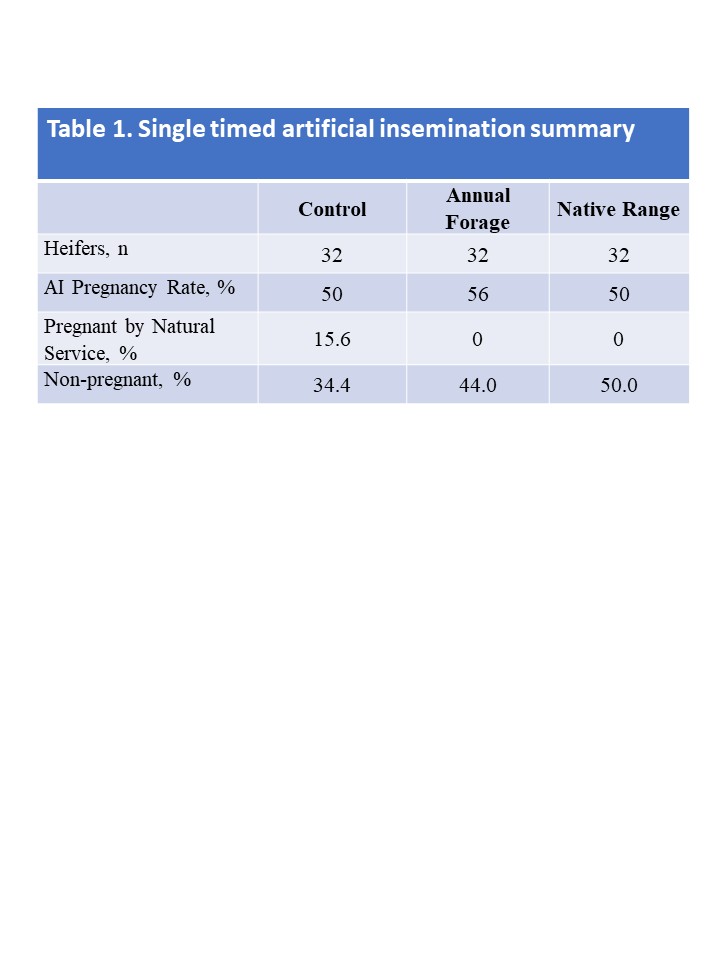
Pregnancy rates to artificial insemination were similar between heifers in different treatment systems. Heifers that failed to become pregnant to artificial insemination were finished in a feedlot prior to grid marketing. Heifers in all treatment systems had similar feedlot end weights (Control = 1,432 pounds, Annual Forage = 1,423 pounds, Native Range = 1,476 pounds, P = 0.58), feedlot average daily gain (Control = 4.52 pounds, Annual Forage = 3.58 pounds, Native Range = 4.41 pounds, P = 0.11), and feed cost per pound of gain (Control = $0.91, Annual Forage = $0.96, Native Range = $0.83, P = 0.38). Carcass characteristics were also similar, including gross carcass value (Control = $2,462.86, Annual Forage = $2,412.75, Native Range = $2,500.63, P = 0.60). Overall, system net return per heifer considering both pregnant and grid-marketed heifers was $1,313.26, $990.91, and $1,041.64 for Control, Annual Forage, and Native Range heifers, respectively. These data summarize that heifer development strategies utilizing different grazing opportunities are competitive compared to more traditional drylot development systems considering reproductive performance, carcass value, and net return.
|