|
With the growing season coming to an end for some crops, like winter wheat and field peas, and harvest dates approaching for others, farmers might be wondering how profitable their crops are going to be. A good way to predict gains is to accurately estimate grain yield prior to harvest. An early and precise estimation of grain yield is a critical skill for farmers. Reliable yield forecasts are useful for various purposes, including:
· Crop insurance
· Delivery planning
· Harvest and storage management
· Budgeting for cash flow
Now, keep in mind that this is just an estimate and variations in field conditions can impact final yields.
For small grains:
1. Walk into the field and select a spot that is representative of the area.
Avoid drowned-out spots and field edges.
2. Count the number of spikes in 3 ft of row
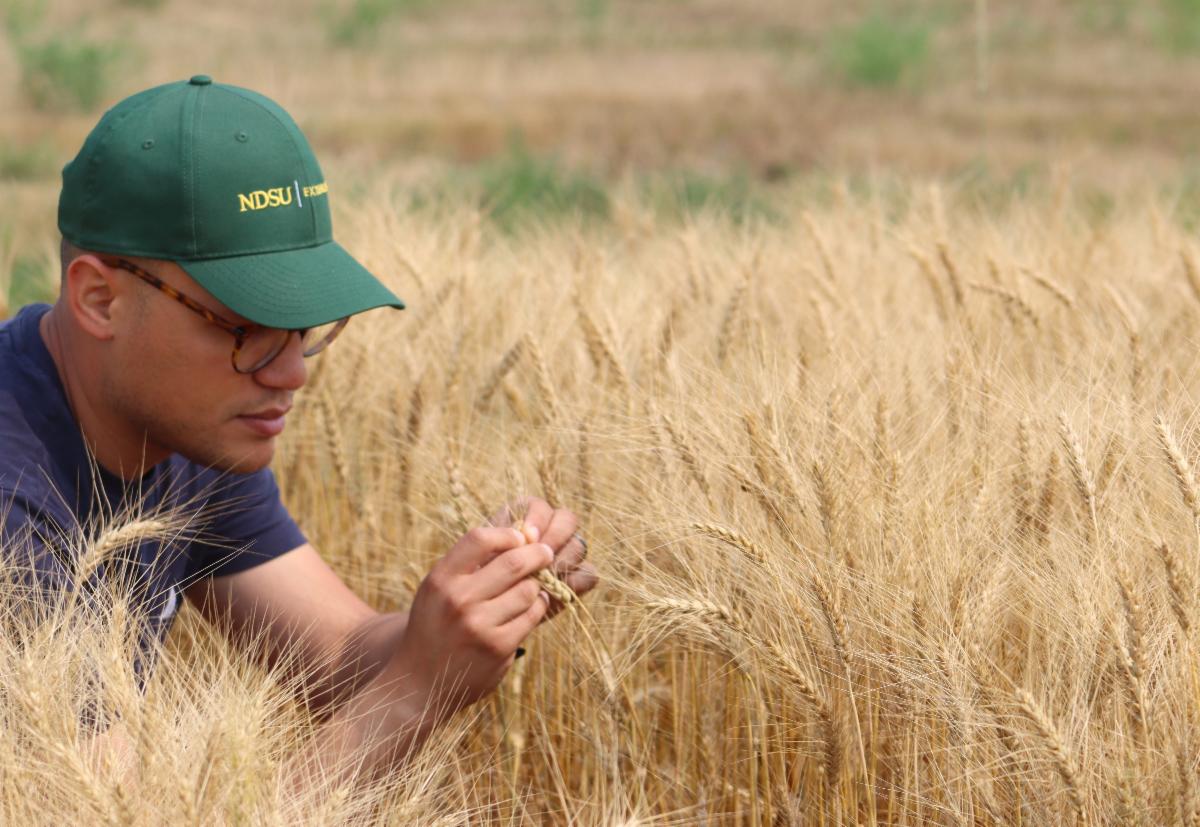
3. Count the number of kernels in 5-10 spikes and average that number. In
your counts, include both small and large spikes to avoid overestimation.
4. With the number of spikes per 3 ft of row and the average number of
kernels per spike in hand, use one of the following formulae.
For 7” row spacing:
· Wheat: Grain yield (bu/acre) = (kernels per spike x spikes per 3 ft of row)
x 0.0319
· Barley: Grain yield (bu/acre) = (kernels per spike x spikes per 3 ft of row)
x 0.0389
· Oats: Grain yield (bu/acre) = (kernels per spike x spikes per 3 ft of row) x
0.0504
To adjust to other row spacings:
· 6-inch row width = multiply grain yield estimate by 1.17
· 7.5-inch row width = multiply grain yield estimate by 0.93
· 10-inch row width = multiply grain yield estimate by 0.70
· 12-inch row width = multiply grain yield estimate by 0.58
For field peas, you can roughly estimate it by:
1. Counting the number of peas in five plants and averaging the results
2. Counting the number of plants per square foot
3. Use the formula:
Yield = (Peas per plant x plants per sq ft) / 6.35
References
The Small Grains Field Guide A-290, J.J. Wiersma and J.K. Ransom, 2005. Reviewed May 2017.
|